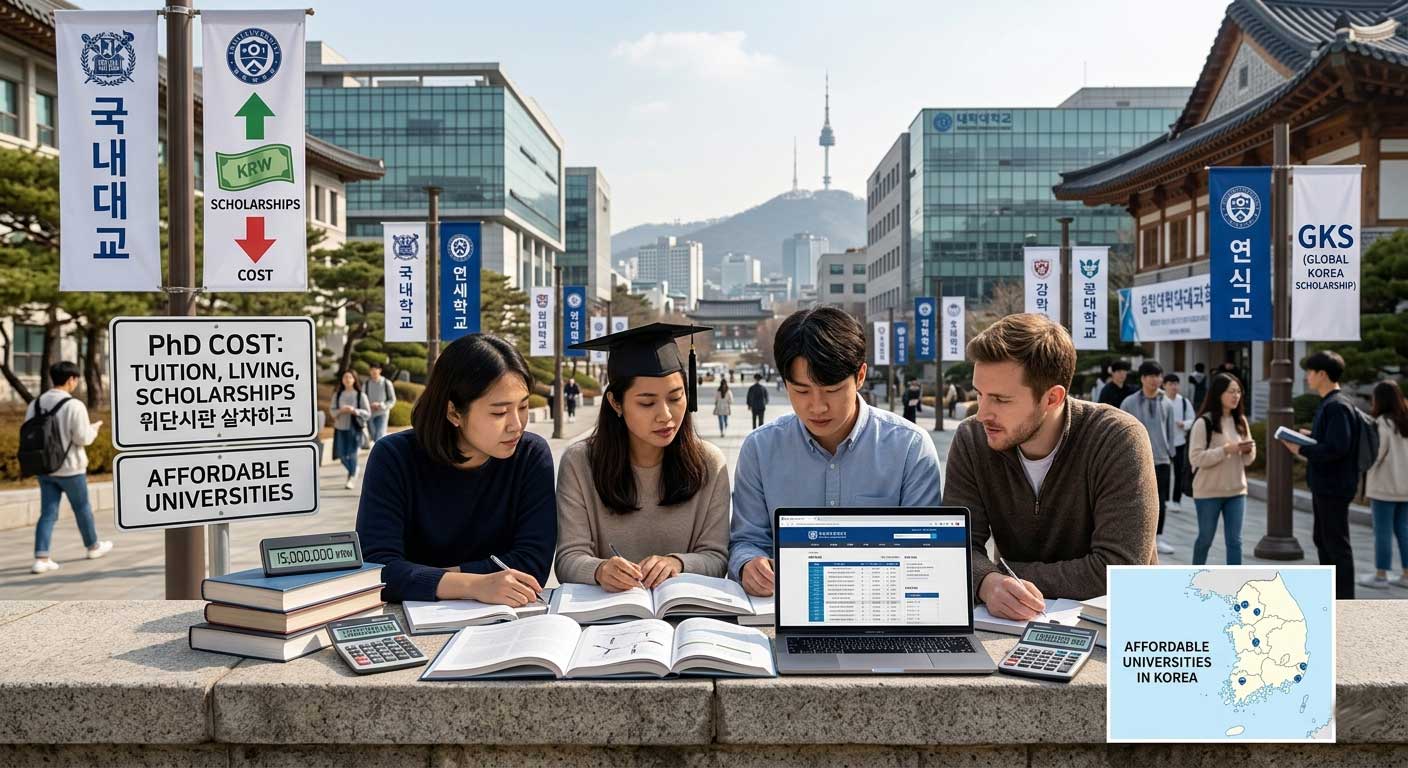

South Korea has become one of the most attractive destinations for international PhD students in Asia. The country combines world-class research universities, advanced technology infrastructure, strong government investment in R&D, and a relatively affordable cost of education compared with many Western countries. Universities such as Seoul National University, KAIST, POSTECH, Yonsei University, and Korea University consistently attract international doctoral applicants.
Many students choose Korea because they can access high-quality research, modern laboratories, and strong industry collaboration while paying lower tuition than in countries such as the United States or Canada. In addition, generous scholarship programs, research assistantships, and government-funded initiatives make fully funded PhD study a realistic possibility.
This guide explains the full cost of a PhD in South Korea, including tuition fees, living expenses, scholarships, and affordable universities. You’ll also learn how funding works, how Korea compares with other countries, and the practical steps required to apply.
Overview of PhD Costs in South Korea
The total cost of a PhD in Korea depends on the university, city, and your funding package. Most international students should budget for tuition, accommodation, food, health insurance, transportation, and personal expenses.
Estimated Annual Cost Breakdown
| Expense Category | Estimated Annual Cost (USD) |
|---|---|
| Tuition (public university) | $3,000–$8,000 |
| Tuition (private university) | $5,000–$15,000 |
| University dormitory | $1,200–$3,600 |
| Off-campus housing | $3,000–$9,000+ |
| Food | $2,400–$4,800 |
| Transportation | $300–$900 |
| Health insurance | $200–$600 |
| Miscellaneous | $1,000–$2,500 |
| Total (without scholarship) | $10,000–$30,000+ per year |
Students in Seoul generally face higher living costs than those in cities such as Daejeon, Pohang, or Gwangju. A fully funded PhD can reduce out-of-pocket costs dramatically and may even provide a monthly stipend.
Tuition Fees for PhD in South Korea
PhD tuition varies by university type and academic field. Public universities are usually cheaper than private institutions, while laboratory-intensive STEM programs often cost more than humanities programs.
Typical Annual PhD Tuition by University Type
| University Type | Typical Annual Tuition (USD) |
|---|---|
| Public / national universities | $3,000–$8,000 |
| Private universities | $5,000–$15,000 |
Examples of tuition patterns:
- National universities (e.g., SNU, regional national universities)Generally lower tuition, especially for domestic students, but international PhD fees remain competitive by global standards.
- Private universities (e.g., Yonsei, Korea University)Higher tuition but often accompanied by substantial scholarships for strong applicants.
- Research-focused institutions (e.g., KAIST, POSTECH)Tuition may be partially or fully waived for many doctoral students because these universities emphasize funded research.
Public vs Private Universities
| Feature | Public Universities | Private Universities |
|---|---|---|
| Tuition | Lower | Higher |
| Government funding | Strong | Moderate |
| Research opportunities | Excellent | Excellent |
| Scholarship availability | Good | Often extensive for international students |
| Campus facilities | Generally strong | Often very modern |
Public universities tend to be the most budget-friendly option. Private universities may charge more, but they frequently offer tuition discounts, graduate assistantships, and international student scholarships that narrow the gap.
STEM vs Humanities Programs
STEM doctoral programs usually have higher tuition because they require laboratories, specialized equipment, consumable materials, and research infrastructure. Humanities and social science programs generally have lower direct research costs and therefore lower tuition.
Typical Annual Tuition by Field
| Field | Typical Annual Tuition (USD) |
|---|---|
| Engineering / Computer Science | $6,000–$15,000 |
| Natural Sciences | $5,000–$12,000 |
| Business / Economics | $5,000–$10,000 |
| Humanities / Social Sciences | $3,000–$8,000 |
In practice, funded STEM students may pay less out of pocket than humanities students because professors often support doctoral researchers through grants and laboratory budgets.
Affordable Universities for Doctoral Studies in Korea
If cost is your main concern, these universities are often considered relatively affordable or financially attractive for PhD study.
Affordable and Funding-Friendly Options
| University | Why It’s Affordable |
|---|---|
| Seoul National University | Competitive tuition for a top-ranked institution; strong scholarship opportunities. |
| KAIST | Many PhD students receive tuition waivers and stipends. |
| POSTECH | Research-focused funding model with generous graduate support. |
| Chungnam National University | Lower tuition and living costs in Daejeon. |
| Pusan National University | Affordable tuition outside Seoul; strong research programs. |
| Gyeongsang National University | Lower regional living expenses and competitive tuition. |
Universities located outside Seoul often provide the best value because housing and daily expenses are significantly lower.
Cost of Living for PhD Students in South Korea
Living expenses vary dramatically by city.

7
Monthly Living Costs by City
| Expense | Seoul | Daejeon | Pohang |
|---|---|---|---|
| Dormitory | $150–$400 | $120–$300 | $100–$250 |
| Off-campus room | $400–$1,000+ | $250–$600 | $200–$500 |
| Food | $250–$400 | $200–$350 | $200–$300 |
| Transportation | $40–$80 | $30–$60 | $20–$50 |
| Total | $900–$2,000+ | $600–$1,200 | $500–$1,000 |
Understanding Key Money (Jeonse / Deposit System)
A major housing consideration in Korea is the deposit system, often called “key money” (jeonse or large rental deposit). Landlords may require a significant refundable deposit in addition to monthly rent. University dormitories usually avoid this issue and are often the easiest option for first-year international students.
Choosing a city outside Seoul can save thousands of dollars per year without necessarily sacrificing research quality.
Funding and Scholarships for PhD Students in Korea
Funding is one of Korea’s strongest advantages for doctoral study. Many international PhD students receive partial or full financial support.
Global Korea Scholarship (GKS)
The Global Korea Scholarship is the flagship Korean government scholarship. Benefits typically include:
- Full tuition coverage.
- Monthly living stipend.
- Airfare.
- Settlement allowance.
- Health insurance.
Competition is high, but it is one of the most comprehensive funding packages available.
University Scholarships
Most Korean universities offer graduate scholarships based on academic performance, research potential, or departmental recommendations. These may provide:
- 50–100% tuition reduction.
- Monthly research stipends.
- Teaching assistant opportunities.
BK21 FOUR
BK21 FOUR is a major government research funding initiative that supports graduate students in participating laboratories. Benefits can include monthly research funding, conference support, and enhanced research opportunities.
For STEM students, securing a position in a BK21-funded lab can significantly improve financial support.
How to Study PhD in South Korea for Free
Studying almost entirely free is achievable if you combine multiple funding sources.
A common fully funded pathway
- Receive a university tuition waiver.
- Join a funded research laboratory.
- Obtain a professor-funded research assistantship.
- Supplement with BK21 or departmental funding.
Practical strategy
Improve your chances of full funding
- Contact potential supervisors before applying.
- Highlight research publications, projects, and technical skills.
- Target laboratories with active grants.
- Apply early for both university admission and scholarships.
- Consider universities outside Seoul where funding competition may be less intense.
Many successful international PhD students in Korea pay little or no tuition and receive enough stipend support to cover basic living expenses.
Comparison with Other Countries
Typical Cost Comparison
| Country | Typical PhD Tuition | Living Cost | Funding Availability |
|---|---|---|---|
| South Korea | Low–Moderate | Moderate | Good–Excellent |
| United States | High | High | Excellent at top programs |
| Canada | Moderate–High | High | Good |
| Germany | Very Low | Moderate | Good |
Compared with the United States and Canada, Korea often offers lower tuition and living costs. Germany may be cheaper in terms of tuition, but Korea can provide stronger industry links in fields such as semiconductors, electronics, AI, and engineering.
For students seeking a balance of affordability, research quality, and funding opportunities, Korea is increasingly competitive.
Step-by-Step Application Guide for PhD in Korea
- Choose your field and universityIdentify programs that match your research interests.
- Find a potential supervisorRead faculty publications and contact professors whose work aligns with your goals.
- Prepare documentsTypical requirements include transcripts, degree certificates, CV, statement of purpose, recommendation letters, and English proficiency scores (IELTS/TOEFL) if required.
- Apply for scholarshipsSubmit separate scholarship applications when necessary (GKS, university scholarships, departmental funding).
- Submit the university applicationFollow the university’s graduate admission timeline carefully.
- Interview (if required)Some departments or professors conduct online interviews.
- Receive admission and funding offerReview tuition waivers, stipends, and research assistantship details.
- Apply for a student visa (D-2)Use the university’s admission documents and financial proof.
- Arrange housingUniversity dormitories are often the simplest and cheapest option for new international students.
Conclusion and Next Steps
The cost of a PhD in South Korea can range from about $10,000 to $30,000+ per year without funding, but many international students reduce that amount dramatically through scholarships, tuition waivers, and research assistantships. Public universities are generally cheaper than private universities, and living outside Seoul can significantly lower expenses.
For budget-conscious applicants, universities such as KAIST, POSTECH, Chungnam National University, and Pusan National University offer attractive combinations of research quality, funding, and affordability. Programs like the Global Korea Scholarship and BK21 FOUR can make fully funded study possible.
The next step is to shortlist universities, identify potential supervisors, and begin preparing your application documents well before the admission deadline. Early preparation greatly improves your chances of both admission and funding.

ScholarLink AI
Your Ultimate Admission Co-Pilot
- 🎓 Professors Database: World’s largest supervisor directory
- 📡 Live Positions: Real-time faculty openings & vacancies
- 👥 Students Database: Connect with successful applicants
- 🎯 Smart Matching: AI-driven professor recommendation
- 💰 Funding Analysis: Real-time lab & research funding data
- 📝 Apply Management: Track applications & cold emails