
Every year, hundreds of thousands of international students turn their dream of global education into reality by choosing Canada as their top study destination. Renowned for its world-class universities, welcoming multicultural environment, and high standard of living, Canada offers far more than just an academic degree. To begin this life-changing journey, securing a Canadian Student Visa, which is officially known as a study permit, is your essential first step.
Why Do International Students Choose Canada?
Canada consistently ranks among the best places in the world to study. Beyond receiving top-tier education, international students enjoy unmatched advantages. Canadian institutions are globally recognized for rigorous academic standards, cutting-edge research facilities, and diverse program options. Furthermore, students can work off-campus during their studies, and upon graduation, many qualify for a Post-Graduation Work Permit (PGWP) to gain valuable Canadian work experience. Ultimately, this local experience significantly boosts eligibility for permanent migration through Express Entry or Provincial Nominee Programs (PNP).
What You Will Learn in This Guide
Navigating visa procedures can feel overwhelming, but with the right guidance, the process becomes straightforward. In this complete guide, we break down everything you need to know about how to apply for a Canadian student visa step-by-step. You will discover the updated requirements for obtaining a study permit in Canada, including admissions, proof of funds, and required documentation. We also provide key insights into processing times and fees for Canadian student visas so you can plan your timeline effectively, alongside proven tips for a successful Canadian student visa application to maximize your chances of approval.
What is a Canadian Student Visa and Study Permit?
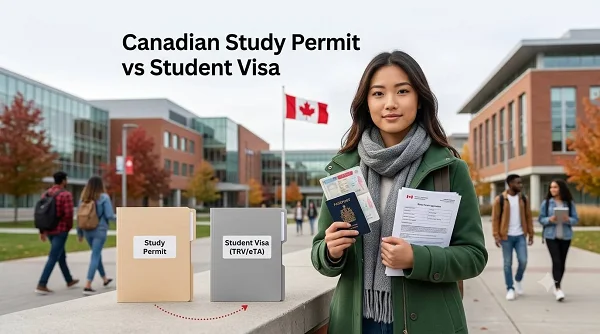
Many applicants confuse a study permit with a student visa, but they serve two distinct legal purposes under Canadian immigration law. A study permit is an official document issued by Immigration, Refugees and Citizenship Canada (IRCC) that authorizes a foreign national to study at a Designated Learning Institution (DLI) in Canada while outlining conditions such as study levels and work hours. On the other hand, a student visa, issued as a Temporary Resident Visa (TRV) or Electronic Travel Authorization (eTA), is the official travel document required to enter the country physically.
How They Work Together
You do not need to apply for a TRV or eTA separately. When your study permit application is approved by IRCC, your entry visa or eTA is automatically issued alongside it. Once you arrive at the Canadian port of entry, such as an airport or border crossing, a border service officer will review your approval letter and physically print your official study permit.
How to Apply for a Canadian Student Visa Step by Step
Learning how to apply for a Canadian student visa requires a methodical approach to ensure you maintain full control over your application timeline. The process begins by applying to and receiving a formal Letter of Acceptance (LOA) from a recognized Canadian educational institution. Following acceptance, most undergraduate and college-level applicants must obtain a Provincial Attestation Letter (PAL) or Territorial Attestation Letter (TAL) from the host province before submitting their official paperwork.
Next, you will create a secure account on the official IRCC portal (GCKey), gather your document checklist, and accurately complete all required application forms. After paying the necessary processing and biometrics fees electronically, you will schedule an appointment at a local Visa Application Centre (VAC) to submit your fingerprints and photo, followed by completing a medical exam if required for your region.
Choosing the Right Program and Institution
Your choice of program plays a critical role in your visa approval chances because IRCC officers evaluate whether your chosen course logically aligns with your academic background and career trajectory. It is vital to ensure your target school is a Designated Learning Institution (DLI) with an active DLI number. Additionally, if your long-term goal involves working in Canada after graduation, you must confirm that your specific program qualifies for a Post-Graduation Work Permit (PGWP) prior to enrolling.
Preparing and Submitting Your Application Online
Submitting your file online via the IRCC portal is the fastest and most efficient route. Once your profile is configured, you will upload clear, high-resolution PDFs of all supporting documents and double-check information consistency across every form. After reviewing your details, you complete the digital signature, process total fees using a valid credit card, and safely store your official submission receipt containing your unique Application Number for ongoing tracking.
Requirements for Obtaining a Study Permit in Canada
Fulfilling all requirements for obtaining a study permit in Canada is non-negotiable, as missing even a single document can cause severe processing delays or outright rejection. Applicants must hold a passport that remains valid for their entire intended duration of study, accompanied by an official Letter of Acceptance (LOA) from a DLI detailing program length and tuition costs. Depending on your level of study, you may also need a valid Provincial Attestation Letter (PAL).
Beyond basic identity papers, you must submit comprehensive proof of financial support proving you can handle tuition, living expenses, and return travel. A strong Statement of Purpose or Letter of Explanation (LOE) is required to clarify your study goals and confirm your intention to depart Canada upon permit expiry. Lastly, applications require official language proficiency test results such as IELTS or PTE, along with police clearance certificates and a passed medical examination where applicable.
Financial Proof and Supporting Documents
Financial insufficiency remains one of the leading reasons for study permit refusals, making solid documentation essential. You must demonstrate sufficient, liquid funds to cover your first year of tuition alongside guaranteed living costs. Applicants in certain expedited streams typically submit a Guaranteed Investment Certificate (GIC) proving locked funds in a Canadian bank. Otherwise, you can supply bank statements from the past four to six months showing stable cash flow, receipts of prepaid tuition and housing, or a legal sponsorship affidavit supported by official tax returns and employment contracts.
Processing Times and Fees for Canadian Student Visas
Planning your study timeline requires understanding the processing times and fees for Canadian student visas so you can submit your application well in advance. Government fees currently consist of a $150 CAD study permit processing fee and an $85 CAD biometrics fee, bringing the total base cost to $235 CAD, excluding third-party expenses like medical exams or document translations.
Processing times vary significantly depending on your country of residence, overall application volume, and whether you submit under standard or specialized processing streams. Common factors that trigger processing delays include incomplete files, unverified or inconsistent financial records, submitting during peak application seasons between May and August, and late completion of biometrics or medical appointments.
Tips for a Successful Canadian Student Visa Application
To maximize your chances of approval, implement practical tips for a successful Canadian student visa application right from the start. Draft a compelling Letter of Explanation (LOE) that speaks directly to the visa officer, explaining your educational background, addressing any past study gaps, and articulating how this specific degree advances your career upon returning home.
Furthermore, you must demonstrate robust economic, familial, or professional ties to your home country to satisfy the temporary residence requirement. Maintain complete financial transparency by providing documented proof, such as property sale receipts or official loan documents, for any large or recent deposits into your bank account.
Common Mistakes to Avoid in Student Visa Applications
Avoiding frequent errors can mean the difference between approval and rejection. Many applicants fail by applying too late, often submitting files less than three months before their intake start date. Another major error is choosing a degree or diploma that lacks logical alignment with past academic studies or employment experience. Finally, submitting unexplained bank activity or omitting official English translations for foreign language documents routinely leads to refusal.
Conclusion: Start Your Canadian Study Journey with Confidence
Securing a Canadian study permit is an empowering step toward achieving world-class education, valuable career growth, and global opportunities. By carefully selecting a recognized DLI, preparing an honest financial portfolio, and writing a persuasive Statement of Purpose, you set yourself up for a smooth approval process. Keep your timeline organized, review every document against IRCC guidelines, and submit your application with complete confidence to begin your journey in Canada today.

ScholarLink AI
Your Ultimate Admission Co-Pilot
- 🎓 Professors Database: World’s largest supervisor directory
- 📡 Live Positions: Real-time faculty openings & vacancies
- 👥 Students Database: Connect with successful applicants
- 🎯 Smart Matching: AI-driven professor recommendation
- 💰 Funding Analysis: Real-time lab & research funding data
- 📝 Apply Management: Track applications & cold emails