
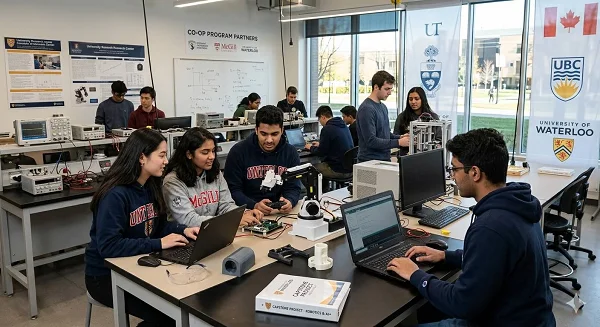
Picture an international student staring at two acceptance letters—one in Business, the other in Computer Science—knowing that the choice could shape not only a career but also the chance to build a life in Canada. Want the most powerful and straightforward route to getting a job, a Post-Graduation Work Permit, and future opportunities? STEM streams reliably deliver the best opportunities, due to strong demand from employers and skills gaps.
This guide will walk you through which STEM programs in Canada best lead to a lucrative career and how you can pick the one best suited to you.
What Counts as a STEM Field in Canada?
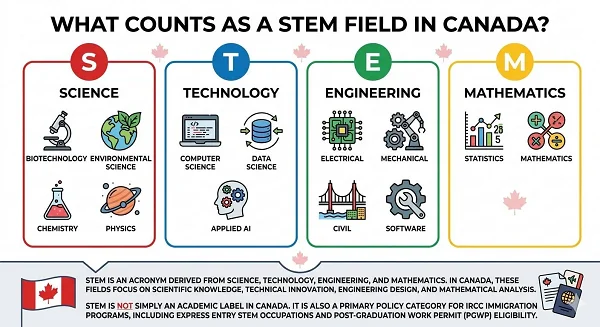
STEM is an acronym derived from the first letters of Science, Technology, Engineering and Mathematics. It is an extensive term covering scientific knowledge, technical innovation, engineering design and mathematical analysis.
In Canada, institutions generally group fields such as computer science, data science, software, electrical, mechanical, and civil engineering, biotechnology, environmental science, mathematics, statistics, and applied AI under the STEM umbrella.
However, STEM is not simply an academic label in Canada. It is also a primary policy category for IRCC immigration programs, including Express Entry STEM occupations and Post-Graduation Work Permit (PGWP) field-of-study lists. Because eligibility for some immigration streams relies on program and occupation classification as STEM, knowing this designation is far more significant in Canada than in other nations.
Why International Students Choose STEM in Canada
International students elect to study STEM in Canada as it offers a blend of internationally lauded education with hands-on experience, as well as extensive research environments.
Globally ranked university institutions: Canada attracts students from all over due to universities like the University of Toronto, University of British Columbia (UBC), University of Waterloo, and McGill University that produce research that stands internationally.
Their Canadian programs consistently score well in global rankings for mathematics, engineering, computer science, and other STEM topics.
Links to industry and employers: Co-op programs, applied research in partnerships with organizations and the government, in-depth final year capstone projects, and internships will provide the international student a wealth of practical skills obtained from working closely with potential employers, as well as government and other researchers, on the ground.
Research facilities: Many Canadian universities invest substantial funding and resources into STEM programs and research, which opens doors to innovative research centers, faculty member research projects, and cross-disciplinary approaches to complex problems.
Interest in technical skills: The Canadian job market continually sees great interest in engineering, computer science and other tech skills, as technology, data, and green initiatives continue to be integrated with innovation investment.
While the demand for certain skills can ebb and flow, international student candidates will enjoy broad career choices.
It’s important to note that strong job demand does not automatically translate into immigration eligibility, which is determined by the requirements of specific immigration programs.
Top In-Demand STEM Subfields and Career Outlook
Because of the high demand for STEM professionals around the world, a large number of students are interested in studying STEM degrees at undergraduate and postgraduate level.
Finding the best STEM fields in Canada for jobs depends on your interests, skills, and long-term career goals.
Here are high demand STEM Subfields and Career:
Computer Science & Artificial Intelligence (AI)
Computer Science and AI focus on developing software, intelligent systems, machine learning models, and advanced computing solutions. AI students can have jobs in AI Engineer, Machine Learning Engineer and Computer Scientist. demand outlook: Strong and growing.
Canada’s expanding AI ecosystem, digital transformation initiatives, and investment in research continue to create demand for professionals with advanced computing and AI skills.
Software & Data Engineering
This field combines software development, cloud computing, data infrastructure, and analytics to build reliable digital products and data-driven systems.
AI students can have jobs in Software Engineer, Data Engineer and Cloud Engineer demand outlook is Strong. organizations across nearly every industry rely on software and data professionals to modernize operations and support digital services.
Biotechnology & Health Sciences
Biotechnology applies biological science to healthcare, pharmaceuticals, agriculture, and medical research, while health sciences support innovation in diagnostics, therapeutics, and public health.
Example job opportunities are Biotechnologist, Clinical Research Associate and Biomedical Scientist. The demand outlook is growing. Continued investment in healthcare innovation, life sciences, and medical research supports long-term demand for qualified professionals.
Environmental Science & Sustainability
- Environmental science focuses on protecting natural resources, addressing climate challenges, and helping organizations meet sustainability goals.
- Different opportunities for Environmental science are Environmental Scientist, Sustainability Consultant and environmental analyst
- The demand outlook is growing. Canada’s focus on clean energy, environmental protection, and sustainable development continues to increase opportunities in this field.
Mathematics & Actuarial Science
These disciplines use mathematical modelling, statistics, and risk analysis to solve complex business, financial, and scientific problems.
Mathematics students can apply for Actuary, Statistician and Quantitative Analyst jobs.
Demand outlook is steady to strong. Employers in finance, insurance, government, healthcare, and technology continue to seek professionals with advanced analytical and quantitative skills.
While each of these fields offers promising career opportunities, the best choice is one that matches your strengths and interests. Graduates who combine technical expertise with practical experience—such as co-op placements, internships, or research projects—are often well positioned in Canada’s competitive job market.
| Subfield | Example Careers | Demand Outlook | Typical Program Length |
| Computer Science & Artificial Intelligence | AI Engineer, Machine Learning Engineer, Computer Scientist | Strong and growing due to continued investment in AI, automation, and digital technologies | Bachelor’s: 4 years Master’s: 1–2 years |
| Software & Data Engineering | Software Engineer, Data Engineer, Cloud Engineer | Strong across technology, finance, healthcare, and other industries undergoing digital transformation | Bachelor’s: 4 years Master’s: 1–2 years |
| Biotechnology & Health Sciences | Biotechnologist, Clinical Research Associate, Biomedical Scientist | Growing as Canada expands healthcare innovation and life sciences research | Bachelor’s: 4 years Master’s: 1–2 years |
| Environmental Science & Sustainability | Environmental Scientist, Sustainability Consultant, Environmental Analyst | Growing with increasing investment in clean energy, environmental protection, and sustainability | Bachelor’s: 4 years Master’s: 1–2 years |
| Mathematics & Actuarial Science | Actuary, Statistician, Quantitative Analyst | Steady to strong across finance, insurance, government, healthcare, and technology | Bachelor’s: 4 years Master’s: 1–2 years |
Tuition Fees for STEM Programs in Canada
The STEM tuition fees Canada international students pay vary by university, province, program, and degree level.
| Program | Typical Annual Tuition |
| Computer Science | CAD $35,000–$65,000 |
| Engineering (Mechanical, Civil, Electrical, Software, etc.) | CAD $40,000–$70,000 |
| Mathematics & Statistics | CAD $30,000–$55,000 |
| Environmental Science | CAD $30,000–$55,000 |
| Biotechnology & Life Sciences | CAD $35,000–$60,000 |
These ranges are based on published tuition schedules from major Canadian universities and national tuition data, including Statistics Canada, and should be verified directly with the institution before applying.
STEM Fields and the Post-Graduation Work Permit (PGWP)
For international students wishing to apply in Canada for post-graduate studies, there is a set of PGWP guidelines, an aspect to consider carefully, especially in relation to the choice of your program. Such regulations are ever-changing; especially for 2024, many PGWP guidelines were updated at least a handful of times. So ensure you get the latest guidelines from IRCC, and not past guidelines. As of November 2024, for college, career and other non-degree granting programs, your PGWP eligibility in some situations is determined based on the CIP code assigned to your program. If a field-of-study requirement is in effect for your program, the CIP code for your program must appear on an IRCC’s official list of qualifying fields of study, which should mean that a program should never just be assumed that it may qualify due to being branded as a “STEM” program.
In contrast, university Bachelor’s, Master’s, and PhD degree programs are generally exempt from this specific field-of-study restriction. While graduates must still satisfy all other PGWP eligibility requirements, they do not need their degree program to appear on the eligible CIP list.
IRCC has also confirmed that the eligible CIP list will remain unchanged throughout 2026, with no additions or removals during the year. This provides greater predictability for students who are planning their studies or applying to eligible college and non-degree programs.
Even so, you should always verify your specific program’s six-digit CIP code with your institution and check it against the official IRCC field-of-study page before accepting an offer of admission. Because IRCC has updated these rules multiple times since 2024—and may revise them again after 2026—you should never rely on a published list of “eligible STEM programs” without confirming the latest requirements directly from IRCC.
| Program Type | PGWP Field-of-Study Restriction Applies? |
| University Bachelor’s Degree | Generally exempt. The PGWP field-of-study requirement does not generally apply, although all other PGWP eligibility requirements must still be met. |
| University Master’s Degree | Generally exempt. Students are not generally required to have a program on the eligible CIP field-of-study list. |
| University PhD Degree | Generally exempt. The field-of-study restriction generally does not apply, subject to meeting other PGWP requirements. |
| College Diploma or Certificate | Yes. If the field-of-study requirement applies, you must verify that your program’s CIP code appears on IRCC’s current list of eligible fields of study before enrolling. |
| Other Non-Degree Programs | Yes. Eligibility depends on the applicable PGWP rules and whether the program’s CIP code is included on IRCC’s eligible field-of-study list, where required. |
Choosing the Right University for Your STEM Field
Finding the best universities for STEM in Canada is about more than choosing the highest-ranked institution. The right university depends on your academic interests, career goals, preferred learning environment, and budget. While universities such as the University of Toronto, the University of Waterloo, the University of British Columbia (UBC), McGill University, and the University of Alberta are widely recognized for their STEM strengths, the best choice is the one that aligns with your personal and professional objectives.
Research Opportunities and Lab Access
If you plan to pursue research, graduate studies, or a career in innovation, look for universities with well-funded laboratories, active research centers, and opportunities for undergraduate research. Large research-intensive institutions often provide access to cutting-edge facilities and faculty working in fields such as artificial intelligence, biotechnology, clean energy, and advanced engineering.
Co-op and Internship Opportunities
Practical experience is one of the biggest advantages of studying STEM in Canada. Many universities offer co-op education, internships, or industry-sponsored projects that allow students to apply classroom knowledge in real workplaces. If gaining work experience before graduation is a priority, compare each university’s co-op structure, employer network, and graduate employment outcomes.
Class Size and Hands-On Learning
Teaching style can vary significantly between institutions. Programs in engineering, biotechnology, and other laboratory-based disciplines often benefit from smaller lab sections, project-based learning, and close interaction with professors. Consider whether you prefer the resources of a large university or the more personalized learning environment of a smaller program.
Location and Cost of Living
Your study destination affects both your university experience and your budget. Cities such as Toronto and Vancouver offer extensive industry connections, research opportunities, and networking events, but they also have some of Canada’s highest living costs. More affordable cities, including Edmonton and Halifax, can provide excellent STEM education while reducing housing and everyday expenses.
Rather than focusing solely on rankings, compare universities based on the opportunities that matter most for your field. A university with strong research facilities, meaningful industry partnerships, and an affordable location may provide better long-term value than a higher-ranked institution that is less aligned with your goals.
| Factor | Why It Matters for STEM Students | Question to Ask Yourself |
| Research Funding & Lab Access | Provides opportunities to work with advanced equipment, research projects, and faculty experts. | Do I want research experience or plan to pursue graduate studies? |
| Co-op & Internship Opportunities | Helps you gain practical experience, build professional networks, and strengthen your résumé before graduation. | Does this university offer structured co-op or internship options in my field? |
| Class Size & Hands-On Learning | Smaller labs and project-based courses can provide more individualized support and practical training. | Do I learn better in smaller, interactive classes or large lecture-based programs? |
| Location & Cost of Living | Living expenses vary significantly across Canadian cities and can affect your overall study budget. | Can I comfortably afford to live in this city throughout my studies? |
| Program Strength in Your Field | Universities often have different areas of research and industry specialization. | Is this university particularly strong in the STEM discipline I want to study? |
Application Requirements for STEM Programs
If you don’t know how to apply for STEM programs in Canada you should carefully pay attention to the following criteria:
- Meet the academic prerequisites: STEM programs typically require strong grades in mathematics and science subjects such as calculus, physics, chemistry, or biology, depending on the discipline. Engineering and computer science programs often have higher admission requirements than many other fields.
- Demonstrate English language ability: International applicants usually need to submit the results of an approved English language test, such as IELTS Academic, TOEFL iBT, or PTE Academic, unless they qualify for an exemption under the university’s policy.
- Prepare academic documents: Most universities require official transcripts, proof of graduation and any additional documents specified by the program.
- Submit program-specific materials: master’s and PhD programs commonly require a Statement of Purpose (SOP) outlining your academic background, research interests, and career goals. Some programs may also request a CV, letters of recommendation, or evidence of previous research experience. Certain engineering or design-related programs may ask for a portfolio or other supplementary materials.
- Check application deadlines: Admission deadlines vary by university, so apply early to allow enough time for document verification, study permit processing, and scholarship applications.
Before submitting your application, always review the admission requirements on your preferred university’s official website, as prerequisites and required documents can differ by institution and program.
Frequently Asked Questions (FAQ)
What fields are considered STEM in Canada?
In Canada, STEM stands for Science, Technology, Engineering, and Mathematics. It generally includes fields such as computer science, software engineering, electrical, mechanical and civil engineering, data science, artificial intelligence (AI), biotechnology, environmental science, mathematics, statistics, and other science- and technology-based disciplines. For immigration purposes, IRCC uses Classification of Instructional Programs (CIP) codes—not just program titles—to determine whether certain programs fall within eligible STEM categories.
Which STEM field has the best job prospects in Canada?
Several consistently show strong or growing demand across Canada:
- Computer Science & Artificial Intelligence: AI Engineer, Machine Learning Engineer
- Software & Data Engineering: Software Engineer, Data Engineer, Cloud Engineer
- Cybersecurity: Security Analyst, Cybersecurity Consultant
- Environmental Science & Clean Energy: Environmental Scientist, Sustainability Consultant
- Biotechnology & Health Sciences: Biotechnologist, Clinical Research Associate
Demand varies by province, industry, and economic conditions, but technology, engineering, healthcare innovation, and clean energy remain among Canada’s strongest employment sectors.
Do all STEM degrees qualify for a post-graduation work permit (PGWP)?
No. A STEM program does not automatically qualify for a PGWP.
Since November 2024, many college and other non-degree programs must have a 6-digit CIP code that appears on IRCC’s eligible field-of-study list. However, university Bachelor’s, Master’s, and PhD programs are generally exempt from this specific field-of-study requirement, although they must still meet all other PGWP eligibility rules. IRCC has also confirmed that the eligible CIP list will remain unchanged throughout 2026, providing greater predictability for current students. Before enrolling, always verify your program’s CIP code on the official IRCC website, as the rules have changed multiple times since 2024 and could change again after 2026.
How much does it cost to study STEM in Canada as an international student?
Undergraduate STEM programs: approximately CAD $30,000–$70,000 per year
Course-based Master’s programs: approximately CAD $20,000–$45,000 per year
Research-based Master’s and PhD programs: approximately CAD $7,000–$30,000 per year, with many students receiving research or teaching assistantships that help offset costs.
Which Canadian universities are best for STEM programs?
Several Canadian universities are internationally well known for STEM education and research, including:
- University of Toronto
- University of Waterloo
- University of British Columbia
- McGill University
- University of Alberta
Can STEM graduates get permanent residency in Canada more easily?
Not automatically. Holding a STEM degree alone does not guarantee permanent residence.
A STEM qualification may strengthen your profile by helping you qualify for skilled employment, but eligibility for permanent residence depends on the specific immigration program, your work experience, language proficiency, education, and other selection criteria. Immigration policies also change over time, so applicants should review the current IRCC requirements before making decisions based on immigration goals.
Is computer science still in high demand in Canada?
Yes. Computer science remains one of Canada’s strongest STEM fields, with sustained demand for professionals in software development, artificial intelligence, cloud computing, cybersecurity, and data engineering.