

You’re comparing the most popular courses in the UK when you see a headline about the UK’s tighter student visa approval rates. You wonder what subjects are international students actually pursuing in the UK today, and does this choice have a real impact on things like visa approval or job opportunities? To some extent the answer is yes, STEM and healthcare programs continue to attract the largest share of international students, and while your subject of study won’t determine your visa approval, it can affect your university’s match profile, graduate employment prospects and your future career options.
Which Fields of Study Are Most Popular Among International Students
While examining the most popular areas of study for international students in the UK, it is important to consider international admission trends and not just statistical data on universities in the United Kingdom. Since the interests of domestic and international students may differ, the areas of study that have the greatest number of students in general do not necessarily attract many foreign students.
Nowadays, international demand is dominated by STEM fields, which still account for the largest number of international students due to the good prospects of employment for graduates and worldwide applicability. The area of health professions has been growing fast and includes such fields as nursing, biomedical science, public health, and other allied health professions. Business and Management, Computer Science, and Engineering are still very popular, and Economics remains one of the classic areas of choice of international students who value careers in finance, governmental organizations, and international businesses.
Top fields by international student demand in UK
| Field of study | International Demand | Why its popular |
| Engineering & Technology | Very High | Technology is one of the strongest sectors for international graduates in the UK, combining high salaries, strong sponsorship demand, and long-term growth. |
| Computer Science & AI | Very High | Strong global demand for tech talent, high graduate salaries, and opportunities in AI, software development, cybersecurity, and data science. |
| Business & Management | High | Offers career paths in finance, consulting, marketing, entrepreneurship at multinational companies across the world. |
| Healthcare & Nursing | Growing and high | Growing demand for healthcare professions, an ageing population, and ongoing workforce shortages make these degrees highly attractive. |
| Economics
|
High | It’s popular because it provides careers in finance, policy, banking, and international organizations. |
| Data Science & Analytics | High | Increase in employer demand for data-driven decision-making across industries. |
STEM and Health Sciences: The Fastest-Growing Demand
STEM (Science, Technology, Engineering, and Mathematics) and health sciences attract the most international student’s attention from all over the world to the UK. This attention and demand highlighted the UK’s long reputation for excellence research, strong graduate employment outcomes, and growing global demand for skilled professionals across science, technology, and healthcare.
Degrees from UK universities are very respected by employers and academic institutions around the world and this is why most students are eager to get a degree from UK institutions.
Employment status also plays a key role in this trend. Graduates in STEM can find a job faster across sectors including engineering, computing, data science, biotechnology, pharmaceuticals, and environmental sciences. Health-related qualifications also provide clear professional pathways.
STEM subjects and health-related programs are the most important subjects for international students and account for a high volume of searches from international students. But we should consider that growing demand also brings greater competition. Top Universities with popular STEM and health programs often receive more applications than other universities so, students should expect competitive entry requirements.
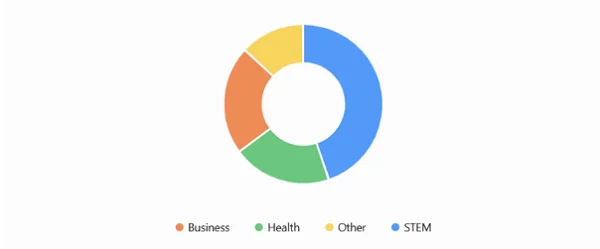
Business, Economics and Management: A Long-Standing Favorite
Business, Management, and Economics are the most popular fields for international students in the UK. These sciences have led to the global reputation of British business schools and the wide range of job opportunities offered in international markets.
Economics, in particular, continues to attract exceptionally high levels of interest and represents a substantial share of UCAS applications among several international students’ groups. Business and Management programs also remain consistently popular, especially at the postgraduate level, where many universities offer intensive one-year master’s degrees. These short programs appeal to international students who want to reduce both tuition costs and time while they are earning a global recognized degree.
Common specializations in these field:
- Finance: include banking, corporate finance, and financial analysis.
- International Business: focus on global markets, cross-border management, and international trade.
- Marketing: aim to check consumer behavior, digital marketing, branding, and market strategy.
Graduate Outcomes by Field: What the Data Actually Shows
Based on the UK government’s Graduate Outcomes Survey (HESA) and Longitudinal Education Outcomes (LEO) survey, graduates who majored in science courses, particularly Medicine, Dentistry, and Allied Health Professions, have always had the highest employment figures in jobs requiring high levels of skill. In addition, graduate salaries have been found to differ based on major and tend to rise with more years of experience.
salary levels vary significantly by subject and career stage. For instance, data provided by the Higher Education Statistics Agency (HESA) on their Graduate Outcomes 2025 indicates that graduates in Medicine and Dentistry had the highest mean salary approximately 15 months after graduating (average salary of £43,925), while the second and third highest salaries belonged to graduates of Electrical and Electronic Engineering (£36,115) and Mechanical Engineering (£33,000), respectively. On the other hand, graduates who specialized in creative fields like Fine Arts (£23,825) and Cinematics and Photography (£26,975) had lower average incomes within the same time frame.
| Subject | Approximate UK Graduate Outcomes |
| Medicine & Dentistry | £43,925 |
| Electrical & Electronic Engineering | £36,115 |
| Mechanical Engineering | £33,000 |
| IT | £30,515 |
| Fine Arts | £23,825 |
Above outcomes are approximate graduate outcomes based on the UK’s Graduate Outcomes Survey (HESA) and Longitudinal Education Outcomes (LEO). Employment outcomes and salary levels will be different by occupation, employer, region, and years since graduation. Verify these data with the latest HESA/LEO release because these statistics will be updated annually.
How Recent UK Visa Policy Changes Affect Field of Study Decisions
The latest reforms that have been made to the immigration policies in the UK have made international students ponder more carefully on which course and institution to join.
International student visa approvals are being increasingly linked to BCA thresholds set up in accordance with the UK Immigration White Paper 2025 that sets higher standards for institutions in terms of metrics such as visa refusal rate and course completion rate.
The institutions are putting more resources into courses that have high completion rate and graduation rate, particularly those related to STEM and health fields. This is one reason why more students are still interested in fields like engineering, computer science, nursing, biomedical sciences, and medicine. This does not mean that some subjects are better for getting a visa than others. Students studying other subjects can successfully obtain a UK Student visa if they follow the visa rules and provide requirements and have an offer from a university.
How to Choose the Right Field for You
Selecting the right field of study is one of the most important decisions you’ll make as an international student. If you want to know how to choose a field of study in the UK as an international student you should know that popularity should not be the only factor influencing your decision, focus on finding the right balance between personal motivation, academic readiness, and future opportunities. A subject that matches your abilities and career ambitions better can help you be successful.
| Factor | Question to Ask Yourself |
| Personal Interest | Do I enjoy this subject enough to study it for the next few years? |
| Academic Strengths | Am I good at the subjects and skills this course requires? |
| Entry Requirements | Are my grades and qualifications good enough for university’s entry requirements? |
| Career Goals | Will this degree help me get the career I want in the future? |
| graduate outcome data | What are the job opportunities and salary prospects for graduates in this subject? |
| Graduate Route Plans | Will this course help me make the most of the UK’s Graduate Route after I finish my studies? |
Frequently Asked Questions (FAQ)
What is the most popular field of study for international students in the UK?
STEM subjects such as Engineering, Computer Science, and Health Sciences, currently attract the highest number of international students in the UK. Business and Management also are the most popular choices because of their global recognition and broad career opportunities.
Which degree has the best job prospects in the UK?
According to the HESA and LEO data Medicine, Dentistry, and Subjects Allied to Medicine consistently have some of the strongest employment outcomes.
Are STEM subjects more popular than business among international students?
In recent years STEM subjects have attracted higher levels of international student interest than Business. Growing demand for technology and healthcare professionals together with strong graduate employment has increased students to Engineering, Computer Science, Data Science, and Health-related courses.
Does choice of subject affect UK student visa approval?
Your choice of subject does not directly affect your UK Student visa approval. Visa decisions are based on meeting the student visa requirements, including receiving an offer from a licensed sponsor, meeting financial requirements, and providing the necessary documentation.
What is the average graduate salary by subject in the UK?
Graduate salaries vary significantly by subject and career stage. According to HESA Graduate Outcomes data, graduates in Medicine and Dentistry reported average earnings of around £43,925 approximately 15 months after graduation, while graduates in Electrical and Electronic Engineering earned around £36,115.

ScholarLink AI
Your Ultimate Admission Co-Pilot
- 🎓 Professors Database: World’s largest supervisor directory
- 📡 Live Positions: Real-time faculty openings & vacancies
- 👥 Students Database: Connect with successful applicants
- 🎯 Smart Matching: AI-driven professor recommendation
- 💰 Funding Analysis: Real-time lab & research funding data
- 📝 Apply Management: Track applications & cold emails