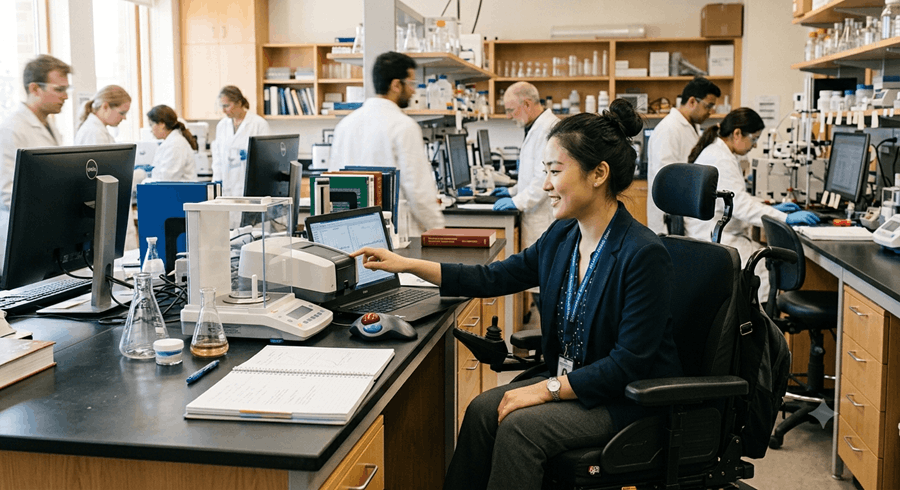

For many aspiring researchers, a PhD represents the highest level of academic exploration. But for students living with physical, sensory, neurological, or chronic health conditions, a question often arises early: is a doctoral path realistically accessible? The encouraging answer is yes. Across universities in the United States, the United Kingdom, Canada, Europe, and increasingly parts of Asia, institutions are expanding the policies and infrastructure that make PhD study with a disability not only possible but genuinely supported.
Doctoral education has historically been associated with intense independence: long research hours, conference travel, lab work, and complex collaboration with supervisors and research teams. Yet modern universities recognize that intellectual ability is not limited by disability. Many institutions now provide structured disability accommodations in graduate studies, ranging from accessible laboratories and adaptive technologies to flexible deadlines and specialized support services.
Consider a realistic scenario. A student with a visual impairment applies to a neuroscience PhD program in Canada. During the admissions stage, the university’s Accessibility Services Office works with the applicant, the graduate school, and the research supervisor to identify tools such as screen-reader–compatible data software, accessible lab documentation, and modified presentation formats. The result is not a lowered academic standard — it is a research environment where the student can perform at full intellectual capacity.
This reflects a broader transformation in doctoral education: support for disabled doctoral candidates is now understood as part of academic excellence, not a special exception. In practice, though, navigating these systems requires knowledge. This guide is built to clarify it.
In the sections ahead, we cover:
- What counts as a disability in a doctoral context, and your legal rights
- How disability accommodations function in doctoral programs worldwide
- The academic, financial, and research support available to PhD students with disabilities
- How to choose a genuinely accessible university before you apply
- How to talk to supervisors, universities, and funding agencies
- Practical tips for completing a PhD across every stage
- What to do when accommodations fail or discrimination occurs
Understanding these factors early can be the difference between a stressful academic journey and a sustainable, successful doctoral experience.
Can You Do a PhD With a Disability?
Yes — you can pursue and complete a PhD with a disability. Thousands of doctoral students around the world successfully conduct research while living with physical disabilities, sensory impairments, chronic illnesses, mental health conditions, and neurodivergent profiles. What ultimately matters in doctoral education is a student’s capacity to think critically, conduct rigorous research, and contribute new knowledge. These abilities are independent of whether someone uses a wheelchair, relies on assistive technology, manages chronic fatigue, or processes information differently.
According to UNESCO and the WHO, roughly 16% of the world’s population — over 1.3 billion people — live with some form of disability. That single statistic highlights an important reality: disability is not rare in academia. It has simply been historically under-supported.
What Counts as a Disability in a PhD Context?
In a doctoral setting, disability is broadly understood as a long-term physical, mental, sensory, intellectual, or neurological condition that substantially affects a person’s ability to carry out everyday activities. The definition extends well beyond visible disabilities. Universities typically design accommodations to support several broad categories:
- Physical disabilities — mobility impairments, spinal cord injuries, muscular dystrophy, or conditions requiring mobility aids.
- Sensory disabilities — visual impairment, blindness, hearing loss, or deafness requiring assistive technologies such as screen readers, captioning, or accessible lab tools.
- Chronic medical conditions — multiple sclerosis, diabetes, autoimmune diseases, Crohn’s disease, chronic pain, chronic fatigue syndrome, or epilepsy, which may require flexible schedules or healthcare coordination.
- Neurodivergent conditions — ADHD, autism spectrum conditions, dyslexia, dyspraxia, or other learning differences that influence how students process information and organize research tasks.
- Mental health conditions — anxiety disorders, depression, PTSD, or bipolar disorder that may require academic flexibility, counseling access, and supportive supervision.
It’s also worth distinguishing temporary from chronic conditions. Temporary situations — recovery from surgery, a broken limb — may qualify for short-term academic adjustments depending on university policy. Chronic or permanent disabilities typically require ongoing accommodations throughout the program. Most countries define disability through legislation focused on the long-term nature of a condition and its substantial impact on daily life, and universities generally follow those legal definitions when determining eligibility for support.
A Realistic Scenario
Imagine a student with severe arthritis applying to a political science PhD program in the United Kingdom. Fieldwork and long writing sessions could initially seem daunting. Once admitted, the university’s Graduate School Disability Office works with the student and supervisor to implement practical adjustments: ergonomic workstations, voice-to-text software for long research chapters, flexible deadlines during medical flare-ups, and remote seminar participation when needed. With these in place, the student completes field interviews, publishes papers, and progresses through the PhD timeline like any other doctoral researcher.
The lesson is simple but powerful: disability does not prevent academic achievement; a lack of support does.
Why Many Students Still Doubt It
Despite the progress, many applicants hesitate because they assume a PhD requires perfect health or unlimited stamina. In reality, doctoral research is already a highly flexible structure compared with undergraduate education. Much of the work is independent reading, writing, and data analysis — tasks that can often be adapted with the right technology and scheduling. Students routinely underestimate how adaptable research environments become once accommodations are properly arranged.
That leads to the next important question: what rights and support actually exist?
Your Legal Rights as a Disabled PhD Student
Most countries have legislation protecting students with disabilities from discrimination in higher education. These laws require universities to provide equal access to admissions, teaching, research opportunities, examinations, and graduation requirements. Crucially, universities cannot reject qualified applicants simply because they have a disability — admissions decisions must rest on academic merit, not assumptions about a medical condition or support needs.
The legal frameworks differ by country, but they point in the same direction:
- United States — disability rights in higher education are protected under Section 504 of the Rehabilitation Act and Title II of the Americans with Disabilities Act (ADA). Institutions must provide equal access and appropriate auxiliary aids and services.
- United Kingdom — the Equality Act 2010 requires universities to make reasonable adjustments so disabled students are not placed at a substantial disadvantage.
- Canada — federal and provincial human-rights legislation, alongside student-aid systems, requires accommodation to the point of undue hardship.
- Europe — universities increasingly combine accessibility offices with national anti-discrimination and higher-education frameworks.
The most important legal concept in practice is reasonable adjustments (or, in the US, reasonable accommodations): practical changes that remove unnecessary barriers without fundamentally altering the academic standards of the program. Typical examples include extended examination time, alternative assessment formats, flexible attendance, accessible learning materials, modified laboratory arrangements, and remote participation when appropriate.
A practical tip: become familiar with your university’s disability policies early, and keep documentation of communications, accommodation agreements, and medical evidence. If a problem arises later, that record makes it far easier to advocate for yourself. (See When Things Go Wrong, below.)
Support for PhD Students with Disabilities
Strong doctoral outcomes rarely depend on determination alone. Success usually comes from a combination of intellectual fit, supervisor support, realistic workload design, and the right accommodations. A useful way to think about support for PhD students with disabilities is in four layers: institutional support inside the university, external funding and grants, health and wellbeing services, and assistive tools that make research tasks accessible. Students who engage these systems early tend to manage doctoral study far more sustainably — the right support does not lower standards; it removes barriers that distort performance.
Institutional Support
Most universities provide a formal disability or accessibility office that coordinates disability accommodations in graduate studies. These offices review documentation, assess functional needs, and issue accommodation plans shared with instructors, graduate administrators, and, where relevant, supervisors. In doctoral settings this can include extended exam time, alternative formats for course materials, note-taking support, captioning, sign-language interpretation, adapted lab access, remote participation, and accessible housing or transport.
For PhD students, institutional support often reaches well beyond taught-course adjustments. A doctoral student may need an accessible workstation for long writing sessions, permission to attend supervisory meetings remotely, screen-reader-compatible software, or modified fieldwork planning. This is easy to overlook: doctoral accommodations are not only about classroom exams. They also apply to comprehensive exams, lab procedures, conference participation, archival research, teaching duties, and milestone reviews. Where universities do this well, the disability office, graduate school, and supervisor work together rather than leaving the student to negotiate everything alone.
Mental Health and Wellbeing Services
Many universities offer counseling, crisis support, wellbeing services, peer mentoring, and graduate-student wellness programs. For candidates managing depression, anxiety, burnout, trauma, or the mental strain of a long-term condition, these services can stabilize progress before research delays compound into attrition risk. In a doctoral context, mental health support is not separate from academic success — it is often part of it.
External Support and Funding
Outside the university, students may be eligible for grants, scholarships, charitable support, and nonprofit guidance:
- United Kingdom — eligible undergraduate and postgraduate students in England can receive Disabled Students’ Allowance (DSA), a non-repayable, non-means-tested grant of up to £27,783 for the 2026–2027 academic year (higher in Wales; separate arrangements in Scotland and Northern Ireland). DSA can fund needs assessments, specialist equipment, assistive technology, non-medical helpers, and disability-related travel.
- Canada — the Canada Student Grant for Students with Disabilities is available through provincial and territorial student-aid applications, with additional support for services and equipment such as tutors, note-takers, interpreters, and technical aids.
- United States — beyond institutional obligations under the ADA, students can look to vocational rehabilitation programs, disability-specific fellowships, and foundation grants.
For international students comparing systems, reliable starting points include GOV.UK (UK student finance), Canada.ca (federal disability grants), the European Commission’s study-abroad accessibility guidance, the U.S. Department of Education’s disability-rights pages, and Disability Rights UK for postgraduate-specific and charitable-trust information. Terminology and eligibility rules vary significantly between countries, so check the primary source for your destination.
Peer Networks, Mentoring, and Career Support
Support is not only administrative. Peer networks of doctoral students with similar experiences reduce isolation and offer practical advice. Faculty and researcher mentors help students navigate academic expectations alongside disability-related challenges. Inclusive career-development services assist with conference accessibility, networking, job applications, and the transition into academic or industry roles. Together these turn a lonely process into a supported one.
Assistive Tools and Practical Aids
Assistive support is where academic access becomes tangible: screen readers, speech-to-text and dictation tools, text-to-speech software, captioning services, ergonomic equipment, hearing-assist systems, accessible lab devices, scheduling tools, and modified transport. A student with a repetitive strain injury may finish a thesis through voice dictation and ergonomic hardware. A deaf candidate may rely on live captioning in seminars and supervision. A student with ADHD may benefit from structured coaching, a quiet testing space, and workflow tools that reduce cognitive overload. The technology itself is useful, but the real value is continuity: these tools protect time, energy, and concentration for research.
When these supports combine well, they do more than help a student cope — they create the conditions for strong, consistent doctoral work. That is why the smartest applicants ask not only, “Can this university admit me?” but also, “Can this environment support my research over three to five years?”
Disability Accommodations in Graduate Studies
Disability accommodations are practical adjustments that let a student meet the same academic standards as everyone else, through accessible methods. For doctoral students they often extend well beyond the classroom: research design, fieldwork, laboratory activity, comprehensive exams, teaching responsibilities, conference participation, and the final defense can all be adapted when necessary. The goal is never to simplify the intellectual expectations of a PhD — it is to remove structural barriers that prevent students from demonstrating their real research ability.
The most successful students treat accommodations as part of research planning, not as a last-minute request during a crisis.
How to Request Accommodations
Arranging accommodations can take several weeks — longer for specialist equipment or lab modifications — so start early. The typical process is:
- Contact the university’s disability or accessibility support office.
- Submit appropriate medical or psychological documentation.
- Meet with an accessibility advisor to discuss your circumstances.
- Agree an accommodation plan tailored to your research and coursework.
- Review and update the plan as your research progresses and needs change.
Deadline Flexibility and Time Adjustments
Doctoral timelines already run four to six years, but milestone deadlines still exist for coursework, comprehensive exams, dissertation chapters, and grant applications. A student with a chronic condition may face unpredictable fatigue or hospitalization, and universities can approve adjustments such as extended coursework deadlines, additional time for qualifying exams, adjusted dissertation-submission timelines, and temporary reductions in teaching-assistant duties. These are usually coordinated between the disability office, the graduate program director, and the supervisor — and, importantly, arranged before problems occur rather than after missed deadlines. That preparation often prevents small disruptions from becoming major delays.
Alternative Formats for Exams and Assessments
Milestone assessments — qualifying and candidacy exams, proposal defenses, research presentations — can often be adjusted in format without changing the intellectual standard. Common accommodations include extended exam time, quiet testing environments, oral examinations in place of written ones (or vice versa), captioning or sign-language interpretation during presentations, and accessible document formats.
Consider a doctoral student with severe dyslexia facing a written comprehensive exam. Rather than a standard timed format that disadvantages them, the university may allow additional time and provide digital materials compatible with text-to-speech software. The evaluation remains identical — the student must still demonstrate mastery of the field — but the process becomes accessible. Accommodations modify how evaluation happens, not what knowledge is required.
Accessible Laboratories and Research Equipment
In engineering, chemistry, the life sciences, and medicine, doctoral research often involves labs or specialized equipment. Research-related accommodations include adjustable-height benches, accessible microscopes and instruments, voice-controlled or screen-reader-compatible software, adapted fieldwork equipment, and research assistants for tasks requiring physical manipulation.
Imagine a doctoral researcher in environmental science who uses a wheelchair. If benches are fixed at standing height, the student may struggle to access equipment safely; with accessibility planning, the department can install adjustable workstations or relocate key instruments so the student conducts experiments independently. Because a PhD is defined by original research output rather than classroom performance, accessible research environments matter enormously.
Remote Participation and Online Thesis Defense
Digital communication has significantly expanded accessibility. Many universities now permit remote participation in seminars, supervisory meetings, and even dissertation defenses when necessary — video-conferenced seminars, recorded lectures, remote supervision, online research-group discussions, and virtual defenses with examiners joining remotely. A candidate undergoing medical treatment might temporarily relocate closer to healthcare and continue supervision and seminars online without pausing the research. This flexibility became common during the global shift to online learning and is now a permanent feature of many accessible doctoral programs.
Accessible Doctoral Programs: Choosing the Right University
Choosing a university matters for every applicant, but for someone planning PhD study with a disability the choice is even more strategic. A program can look prestigious on paper and still be exhausting in practice if the campus is hard to navigate, online systems are inaccessible, or the culture around accommodations is slow and defensive. An accessible doctoral program is not just a PhD with a disability office somewhere on the website — it is a research environment where access is built into daily academic life: buildings, labs, digital systems, supervision, fieldwork, and institutional attitudes.
So evaluate accessibility the way you evaluate supervisor fit, funding, and research quality. A strong match for one student may be a poor match for another. The most useful question is not “Does this university support disabled students?” — almost every institution will say yes. The better question is: how does this university make doctoral work realistically accessible over several years?
What Makes a Doctoral Program Accessible?
An accessible program usually performs well across four areas:
- Physical access — ramps, elevators, step-free access, accessible housing, transport links, labs, libraries, washrooms, and teaching spaces; adaptive laboratory equipment.
- Digital access — websites, student portals, lecture platforms, online library systems, captioned media, and course documents that work with assistive technology. In the US, web and technology access is increasingly treated as part of equal access rather than an optional extra.
- Flexible research arrangements — flexible deadlines, part-time enrollment, adjusted research milestones, and leave of absence without academic penalty.
- Institutional processes and culture — clear, timely, consistent accommodation procedures, and a departmental culture where disability is handled professionally and without friction. Two universities can have near-identical policies yet feel completely different in lived experience.
How to Evaluate a University Before You Apply
A realistic example makes this concrete. Two applicants in engineering: one has a mobility impairment and needs reliable lab access; the other has ADHD and a chronic illness causing energy fluctuations. Both target universities claim to offer disability support. On investigation, one has an accessibility office but key labs are in older buildings and remote attendance is handled informally; the other has documented procedures, accessible teaching platforms, clearer graduate policies, and more flexible supervision. On paper both are “supportive.” In practice, only one is likely to be sustainable.
Smart ways to evaluate a program before applying:
- Read the disability/accessibility office pages carefully — look for clear processes, not just general statements.
- Check whether graduate students (not only undergraduates) are explicitly mentioned.
- Review campus maps, transport, residence information, and access in older buildings.
- Test the website itself: if application portals or forms are hard to navigate, that can signal broader digital-access problems.
- Look for detail on captioning, alternative formats, remote participation, and assistive technology.
- Search for policies on fieldwork, lab safety, teaching-assistant duties, and research placements.
- Contact the disability office with a specific question and judge the quality of the response.
- Ask a prospective supervisor how research adjustments are normally handled in their group.
University Comparison Checklist
Use this when comparing PhD programs:
Physical access
- Are research buildings, labs, libraries, and housing accessible?
- Is public or campus transit usable for your needs?
- Are there accessible washrooms, entrances, and study spaces near your department?
Online and digital accessibility
- Are the website, application system, and portals usable with assistive technology?
- Are lectures, seminars, and recordings captioned or available in alternative formats?
- Does the library provide accessible PDFs, e-books, and database access?
Accommodation process
- Is there a dedicated disability office, with a clear, timely, confidential process?
- Are accommodations available for doctoral milestones, research tasks, and teaching duties?
Research environment
- Can lab, field, or archival work be adapted if needed?
- Is remote or hybrid participation possible when appropriate?
- Does the department appear experienced in supporting diverse needs?
Inclusivity and culture
- Does the university discuss inclusion in concrete terms?
- Are there disability networks, peer groups, or advocacy communities?
- Do staff responses feel respectful, practical, and informed?
Health and sustainability
- Are counseling, wellness, or chronic-condition supports easy to access?
- For international students, is healthcare access realistic in that country or city?
- Can you imagine sustaining your research there for three to five years?
A checklist like this moves the decision from vague impressions to evidence — and protects you from choosing on ranking, city prestige, or funding amount alone. A PhD is a long commitment; accessibility should be part of academic fit, not an afterthought once you’re admitted.
🚀 Get started for free. Explore doctoral programs and supervisors with ScholarLink.ai — and shortlist environments that fit both your research goals and your accessibility needs.
Talking to Your Supervisor About Your Disability
One of the most delicate moments in PhD study with a disability is deciding how and when to talk with a supervisor. Unlike undergraduate programs, a PhD depends heavily on the relationship with a single academic mentor — the supervisor, principal investigator (PI), or advisor, depending on the country. This relationship shapes research direction, timelines, conference opportunities, and sometimes funding. Because of that, open communication makes doctoral work far more sustainable — but you don’t have to disclose personal detail immediately or explain your entire medical history. The goal is simply to ensure your research environment and expectations are realistic. The most productive conversations focus on research logistics, not medical labels.
When Should You Tell Your Supervisor?
There is no single correct moment, and policies vary. Most students choose one of three stages:
- During the application process (rarer) — useful when the project itself needs accessibility planning, e.g. confirming a chemistry lab can be adapted for wheelchair access before admission.
- After receiving an offer (often ideal) — coordinate with the disability office first, so the supervisor conversation focuses on practical solutions rather than uncertainty.
- Once the PhD begins — some students build trust first, then raise the topic while discussing research planning and workload.
Each can work. What matters most is that the conversation happens before accessibility challenges start affecting progress, so the supervisor can plan with you rather than react to surprises.
How to Frame the Conversation Professionally
Supervisors are usually not medical professionals and don’t need clinical explanations. A useful structure:
- Briefly mention the condition or access need, if you’re comfortable.
- Explain how it might influence your workflow or schedule.
- Suggest accommodations or adjustments that would help.
- Emphasize your commitment to meeting research expectations.
For example, a student managing an autoimmune condition might say: “I occasionally have flare-ups that affect my energy for a few days. The accessibility office has approved flexible deadlines for milestone submissions. As long as we plan timelines with that in mind, I can maintain steady progress.” This keeps the focus where it belongs — on research planning and productivity.
Discussing Reasonable Research Adjustments
The conversation often shifts to practical adjustments: flexible milestone timelines, remote participation in group meetings when necessary, accessible lab arrangements, modified teaching-assistant duties, and scheduling research around treatments or fatigue cycles. A candidate with a hearing impairment might request captioned meetings or written summaries; one with chronic fatigue might structure fieldwork into shorter sessions. These rarely reduce standards — they help students allocate energy and time more effectively, which every doctoral researcher learns to do.
Maintaining a Healthy Supervisor Relationship
Strong supervisor relationships rest on trust and clear expectations. It helps to communicate early when a health issue might affect deadlines, provide realistic timelines, keep supervisors updated, and — this part is often overlooked — coordinate major accommodations through the official accessibility office rather than negotiating everything informally. Supervisors are researchers, not administrators; when plans come from the disability office, they carry institutional clarity and remove uncertainty from the relationship. Supervisors generally respond positively when discussions center on maintaining productivity rather than requesting vague flexibility.
Tips for Completing a PhD With a Disability
Completing a doctorate is demanding for any researcher. Success with a disability usually depends less on working harder than everyone else and more on working strategically — using tools, accommodations, and communication to sustain progress over several years. The central challenge is rarely a single obstacle; it’s the cumulative pressure of coursework, research, writing, and academic expectations. It helps to think of the journey in three phases.
During Coursework
The first year often includes coursework, seminars, and qualifying exams — a stage that demands the most adjustment because it involves structured schedules and heavy reading loads. Energy management becomes a crucial skill: many students build routines around their natural energy cycles, reserving peak-concentration hours for reading and writing and lower-energy periods for administrative tasks. Assistive technology matters here too — text-to-speech for reading papers, speech-to-text for drafting, screen readers for navigating journals, transcription for recorded lectures, and digital systems for managing reading lists. This is also the best time to build relationships with disability services, graduate advisors, and peer networks; early preparation prevents problems later.
During Research and Writing
The research phase is the longest and most independent — experiments, data collection, analysis, publication, and dissertation chapters, often over several years. Consistent communication with your supervisor matters most here; regular check-ins let you adjust timelines if health issues arise while keeping goals realistic. Breaking the work into smaller milestones (literature review, data-collection stages, conference presentations, draft chapters, publications) keeps progress moving even through disruptions. Support networks — research groups, lab colleagues, peer doctoral communities — provide practical help, collaboration, and encouragement that reduce isolation and build resilience.
During Thesis and Viva
The final stage — completing the dissertation and preparing for the defense (the viva voce in the UK and much of Europe) — can feel intense. Review your accommodation options for submission and defense well in advance: extended submission time, accessible document formatting, remote or hybrid defenses, additional viva preparation time, and captioning or interpretation during the defense. A candidate with severe anxiety might request a smaller examination room or an online viva to reduce stress while still demonstrating their knowledge. Managing stress is essential; structured writing schedules, supervisor feedback cycles, and counseling services all help. With the right planning, many students find their disability doesn’t define the outcome — it simply shapes the path they take to reach it.
A Quick Checklist
- Register with disability support services as early as possible.
- Communicate openly with your supervisor about approved accommodations and changing needs.
- Keep copies of all accommodation agreements and important correspondence.
- Break large research tasks into manageable milestones.
- Schedule demanding work during your most productive hours.
- Use assistive technology for reading, writing, organization, and analysis.
- Build a reliable network of supervisors, peers, family, and healthcare professionals.
- Learn your legal rights and university policies.
- Ask for help before small challenges become major obstacles.
- Celebrate progress rather than fixating only on the final submission.
When Things Go Wrong: Handling Discrimination and Access Failures
Despite legal protections, some doctoral students encounter discrimination, inaccessible environments, or failures to implement agreed accommodations. Acting promptly and keeping detailed records makes disputes far easier to resolve. If problems arise:
- Document everything — incidents, dates, emails, and relevant evidence.
- Try to resolve informally with your supervisor first, where appropriate.
- Contact the disability support office for guidance and to re-confirm your accommodation plan.
- Escalate to the department chair, graduate school, or relevant academic administrator if needed.
- Use formal procedures — the university’s complaints or grievance process.
- Seek outside advice from student unions, ombuds services, or legal-advocacy organizations.
- Consider external bodies responsible for enforcing disability rights in your country if institutional processes fail.
You shouldn’t have to fight for access, but knowing the escalation path — and keeping a paper trail from day one — protects your academic progress if you ever need it.
Frequently Asked Questions
Do I have to disclose my disability when applying for a PhD? No. Disclosure is your choice, and admissions decisions must be based on academic merit, not disability. Some students disclose early when the research itself needs accessibility planning; many wait until after an offer and coordinate with the disability office first.
Will accommodations lower the standard of my PhD? No. Accommodations change how you demonstrate your ability — the format of an exam, the timeline of a milestone — not the intellectual standard you must meet. Your research still has to be rigorous and original.
Can I do a PhD part-time or take leave for health reasons? Often, yes. Many inclusive programs offer part-time enrollment, adjusted milestones, and leave of absence without academic penalty. Check each university’s specific policy before applying.
What funding is available for disabled doctoral students? It varies by country. In England, DSA offers up to £27,783 (2026–2027) for study-related disability costs; Canada offers grants for students with disabilities; the US provides support through the ADA framework, vocational rehabilitation, and disability-specific fellowships. Always confirm eligibility with the primary source for your destination.
How do I know if a university is genuinely accessible? Look past the policy statements. Test their website, check whether graduate students are named in accessibility guidance, ask the disability office a specific question, and ask a prospective supervisor how adjustments are handled in their group. Use the comparison checklist above.
What if my agreed accommodations aren’t being provided? Document the failures, raise them with the disability office, and escalate through the formal grievance process if needed. Keeping records from the start makes this far easier.
Conclusion: You Belong in Academia
Pursuing a doctorate is a demanding intellectual journey for anyone, but it is entirely achievable for students navigating PhD study with a disability. Across the United States, the United Kingdom, Canada, Europe, China, and many other regions, doctoral education is steadily becoming more inclusive — accessibility offices, supervisors, graduate schools, and funding bodies increasingly work together so that talented researchers aren’t excluded simply because they need different ways of working.
Throughout this guide, one theme recurs: success doesn’t depend on perfect circumstances. It depends on preparation, clear communication, and using the resources available — from disability accommodations and assistive technologies to accessible labs, flexible timelines, legal protections, and supportive research environments. Disability may shape the logistics of your doctoral journey, but it does not define your intellectual potential. What makes the difference is not whether support exists, but whether you understand how to access it and advocate for your needs early.
If you’re exploring doctoral opportunities, start with a practical mindset: research universities carefully, evaluate accessible programs, contact disability services, and talk openly with potential supervisors about realistic research planning. These steps don’t weaken your profile — they demonstrate the professionalism and self-awareness that strong researchers develop over time.
A PhD is not a test of physical endurance. It is a process of curiosity, persistence, and contribution to knowledge. Platforms like ScholarLink.ai can simplify the search — helping you identify research programs, connect with potential supervisors, and understand which environments align with both your academic goals and your accessibility needs. The path may look different for every student, but there is space in academia for researchers with diverse experiences, perspectives, and abilities.

ScholarLink AI
Your Ultimate Admission Co-Pilot
- 🎓 Professors Database: World’s largest supervisor directory
- 📡 Live Positions: Real-time faculty openings & vacancies
- 👥 Students Database: Connect with successful applicants
- 🎯 Smart Matching: AI-driven professor recommendation
- 💰 Funding Analysis: Real-time lab & research funding data
- 📝 Apply Management: Track applications & cold emails