

These two tests are the most important entrance exams for admission to universities around the world. Almost all institutions of higher education accept both the GMAT and the GRE as part of their application process. GMAT is usually the preferred assessment tool for individuals applying to an MBA program or a degree program in the area of management. Each type of graduate program—engineering, scientific, or social science—will have its own requirements; therefore, GRE provides more options overall.
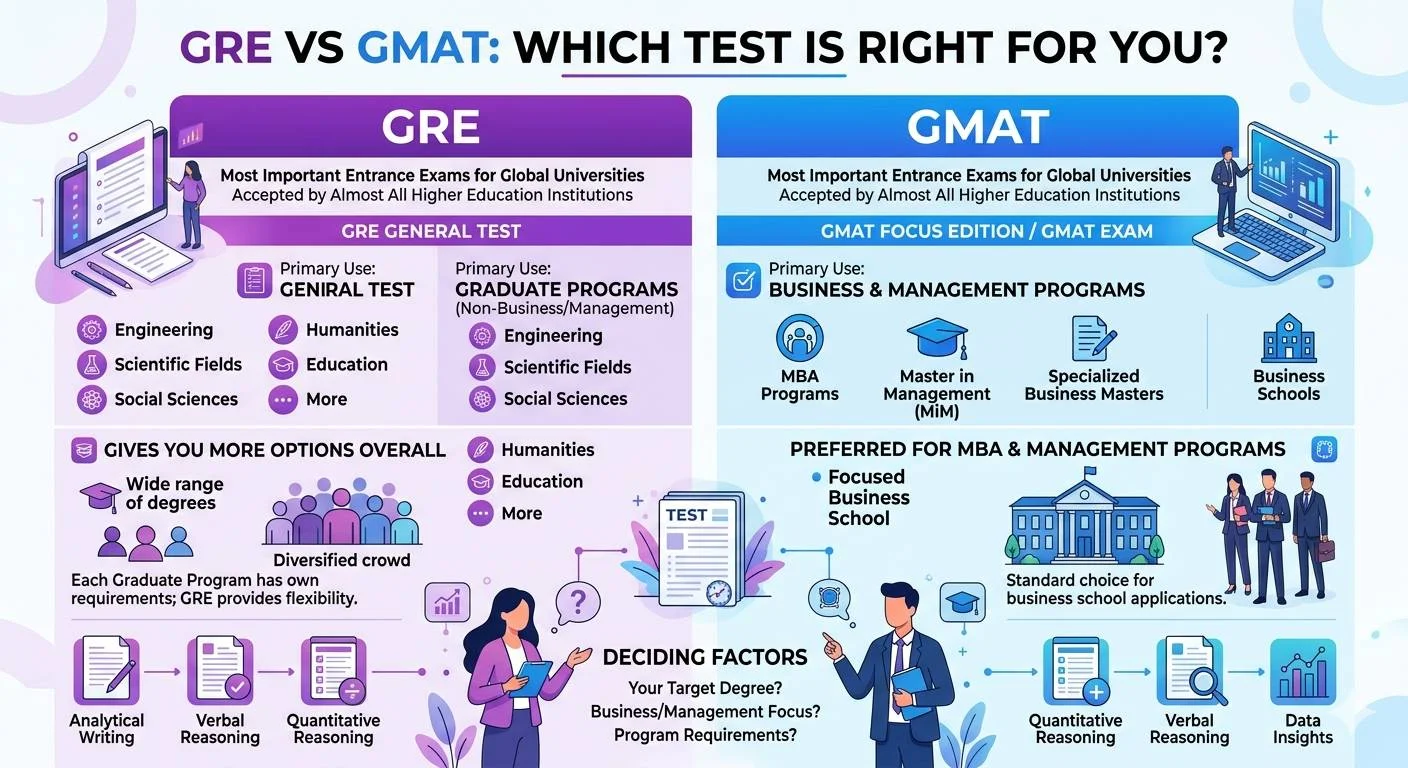
The following chart gives you a general idea of the extent to which either exam will benefit you as an applicant.
| GRE | GMAT |
| Apply for a variety of graduate programs Economics, Biomedical Engineering, Industrial Engineering, Financial Engineering, Political Science, Statistical Science. | Apply for MBA programs and business school. |
| Accepted by many graduate program and law schools | Accepted by business school admissions |
| For students who are stronger in vocabulary, comprehension, and analytical writing. | For students who perform better in logical reasoning, data analysis, and mathematics. |
| Those applying to universities or employers that prefer the GRE. | Those applying to universities or employers that prefer the GMAT. |
In this article we are going to learn the differences between the two exams to decide which is best for you.
What is the GRE?
The Graduate Record Examination (GRE) is one of the most widely accepted standardized tests for graduate school admissions that is designed primarily for master and doctoral degrees applicants, the GRE is accepted by thousands of universities worldwide, including many business and law schools.
The GRE consists of three main sections:
- The Verbal section measures your ability to read, comprehend written material, understand and explain the meaning of words and statements, and use logic to solve problems based on what you’ve read.
- The Quantitative section measures your ability to understand and apply numerical data to solve problems. You will be evaluated on math skills, including solving problems using algebra, geometry, and basic arithmetic, in addition to your ability to analyze and interpret data.
- Analytical Writing: assesses your ability to analyze an issue, develop logical arguments, and communicate ideas perfect in writing.
The scores for each of the sections will be between 130-170, with an Analytical Writing score ranging from 0-6. These scores help the admission boards determine if the applicant has sufficient academic qualifications to be accepted into the program, and provide a way to compare candidates from different educational backgrounds. GRE scores are just one measure used in evaluating an applicant. Other factors that are important to the application process include: GPA, statement of purpose, letters of recommendation and relevant academic or work experience.
GRE Structure and Scoring
The GRE consists of 5 sections for a total of 55 questions in just under 2 hours. The number of questions and time to complete each part is as follows:
- Analytical Writing: one essay and your time is 30 minutes.
- Verbal Reasoning (Section 1): include 12 Questions and you have 18 minutes to complete this part.
- Verbal Reasoning (Section 2): include 15 Questions and you have 23 minutes to complete this part.
- Quantitative Reasoning (Section 1): include 12 Questions and you have 21 minutes to complete this part.
- Quantitative Reasoning (Section 2): include 15 Questions and you have 26 minutes to complete this part.
Analytical Writing
This section includes one essay task that must be completed in 30 minutes. Instead of testing grammar or vocabulary, this section measures your ability to solve a problem by analyzing and developing a logical argument. Many students think this section moderately challenging because it requires critical thinking and strong academic writing skills.
Verbal Reasoning
This part of the exam consists of 27 questions that are divided into two sections (12 questions in the first section and 15 in the second), with a 41 minutes total time limit. Question types include Reading Comprehension, Text Completion, Sentence Equivalence, and Critical Reasoning. Applicants believe this section is the most difficult part for non-native English speakers because it requires advanced vocabulary, strong reading abilities, and the ability to understand complicated academic texts.
Quantitative Reasoning
The following section in the GRE exam includes 27 questions divided into two parts (12 & 15 questions), with only 47 minutes allotted for their completion. The candidates solve Quantitative Comparison, Multiple Choice, Multiple Answers, Numeric Entry, and Data Interpretation problems related to arithmetic, algebra, geometry, and data analysis. While most mathematical concepts are usually derived from high school mathematics, the focus remains more on logical thinking and problem-solving skills than complicated calculations. Many students find this section comparatively easier than GMAT Quantitative Section.
GRE Scoring
The Verbal Reasoning and Quantitative Reasoning sections are each scored from 130 to 170, while the Analytical Writing section is scored separately on a 0–6 scale in half-point increments. Instead of focusing only on the overall score, many universities evaluate applicants by reviewing each part’s scores based on the requirements of their academic programs.
A competitive score may enhance your chances of admission to select a graduation program, especially when it adds with a strong GPA, letters of recommendation, and relevant academic or professional experience.
What is the GMAT?
The GMAT or Graduate Management Admission Test is a global business school entrance exam administered by the Graduate Management Admission Council to measure reasoning and critical thinking skills of applicants.
The GMAT exam consists of three sections:
- Quantitative Reasoning: This section of the exam assesses your ability to apply the foundations of algebra and arithmetic to solve problems.
- Verbal Reasoning: This part was created to test your ability in reading, understanding, and evaluating written materials.
- Data Insights: This section was designed to assess your data literacy, your ability to interpret charts, analyze tables, and synthesize information to make decisions as a MBA student.
GMAT Structure and Scoring
The GMAT exam is divided into 3 sections. The exam has 64 questions and the total test time is 2 hours and 15 minutes.
- Quantitative Reasoning: include 21 Questions and you have 45 minutes to complete this part. Questions in this section cover topics such as arithmetic, algebra, percentages, ratios, probability, and properties of numbers. Although the mathematical topics are at a high school level, the questions require logical thinking and proper time management; for this reason, many candidates find this section challenging.
- Verbal Reasoning: include 23 Questions and you have 45 minutes for this section. The questions in this section include Reading Comprehension and Critical Reasoning, this section tests your reading skills and your ability to understand written material and also to see how you evaluate arguments.
- Data Insights: include 20 Questions and you have 45 minutes for this part. Questions in this section include Data Sufficiency, Multi-Source Reasoning, Table Analysis, Graphics Interpretation, and Two-Part Analysis. Many students think this section is the most difficult section of the test because it requires simultaneous analysis of information from multiple sources.
GMAT Scoring
Each of the three sections of the test is scored on a scale of 60 to 90, and the student ‘s total performance constitutes the final GMAT score, which is reported on a scale of 205 to 805. A good GMAT score is one of the most important factors in admission to MBA and other graduate management programs, and is a must for admission to business schools.
Key Differences Between GRE and GMAT
Here’s a quick comparison between GRE and GMAT exams:
| GRE | GMAT | |
| Test structure | GRE consists of 5 sections | Exam has 3 sections |
| Testing Time | 1 hour 58 minutes | 2 hours 15 minutes |
| Total Questions | 55 questions + 1 essay | 64 questions |
| Sections | Analytical Writing, Verbal Reasoning, Quantitative Reasoning | Quantitative Reasoning, Verbal Reasoning, Data Insights |
| Question Types | Reading Comprehension, Text Completion, Sentence Equivalence, Quantitative Comparison, Numeric Entry, Essay | Critical Reasoning, Problem Solving, Data Sufficiency, Table Analysis, Graphics Interpretation, Multi-Source Reasoning |
| Scoring System | Verbal: 130–170 Quantitative: 130–170 Analytical Writing: 0–6 |
Section Scores: 60–90 Total Score: 205–805 |
| Best for | Designed for students who want to apply for different graduate fields | for applicants whose primary goal is admission to MBA program |
GRE vs GMAT Score Comparison
| Comparison | GRE | GMAT |
| Official Test Score Range | 260-340
Verbal: 130–170 Quantitative: 130–170 Analytical Writing: 0–6 |
Total Score: 205–805 |
| Writing Score | Analytical Writing: 0–6 | No Writing section |
| Score for Good Universities | 315–320 | 625–655 |
| Top Score for MBA Programs | 325–330 | 675–705 |
| Score for Engineering Programs | 320+ | Not required |
| Computer Science & Data Science | 320+ | Not required |
| Economics | 320–328 | 655–695 |
| Psychology & Social Sciences | 310–320 | Not required |
Note: The GRE and GMAT use different scoring scales, so direct score comparisons are approximate.
Which Test is Better for Business School?
For MBA students and management fields, usually you need to have GMAT but many business schools accept both GMAT and GRE test scores as part of their admissions requirements. So, for selecting an appropriate test you should consider your abilities and your educational experiences. Check your future goal and see which skill you have better.
Conclusion
Both tests are valid and the choice depends on your academic goals and your field of study. Before you decide which test to take, check the university website to find out which test they will accept.