
Statement of Purpose (SOP) is definitely the most important document in a university application, which contains your academic history, career goals and reasons for applying to a particular university or program. It outlines what you are, who you are, and why you belong in the program. It focuses on your aspirations, accomplishments, and plans for the future that go beyond your grades and standardized test scores. This article will guide you on how to write a Statement of Purpose.
How to Write a Statement of Purpose: Step-by-Step Guide
A good SOP can really enhance your admission probability in the course you wish to pursue. Knowing how to write an effective Statement of Purpose is your chance to show that you are a competitive applicant.
| Steps | What to include | Purpose |
| Introduction | Introduction of yourself and Academic background | To show your abilities |
| Relevant Experiences | Projects, work, research, achievements, awards | Demonstrate qualifications |
| Program & University Fit | Reasons for choosing a university and institution | To show you know enough about that program or university |
| Future Goals | Career and academic aspirations | Demonstrate long or short-term goals |
Introduce Yourself and Your Background
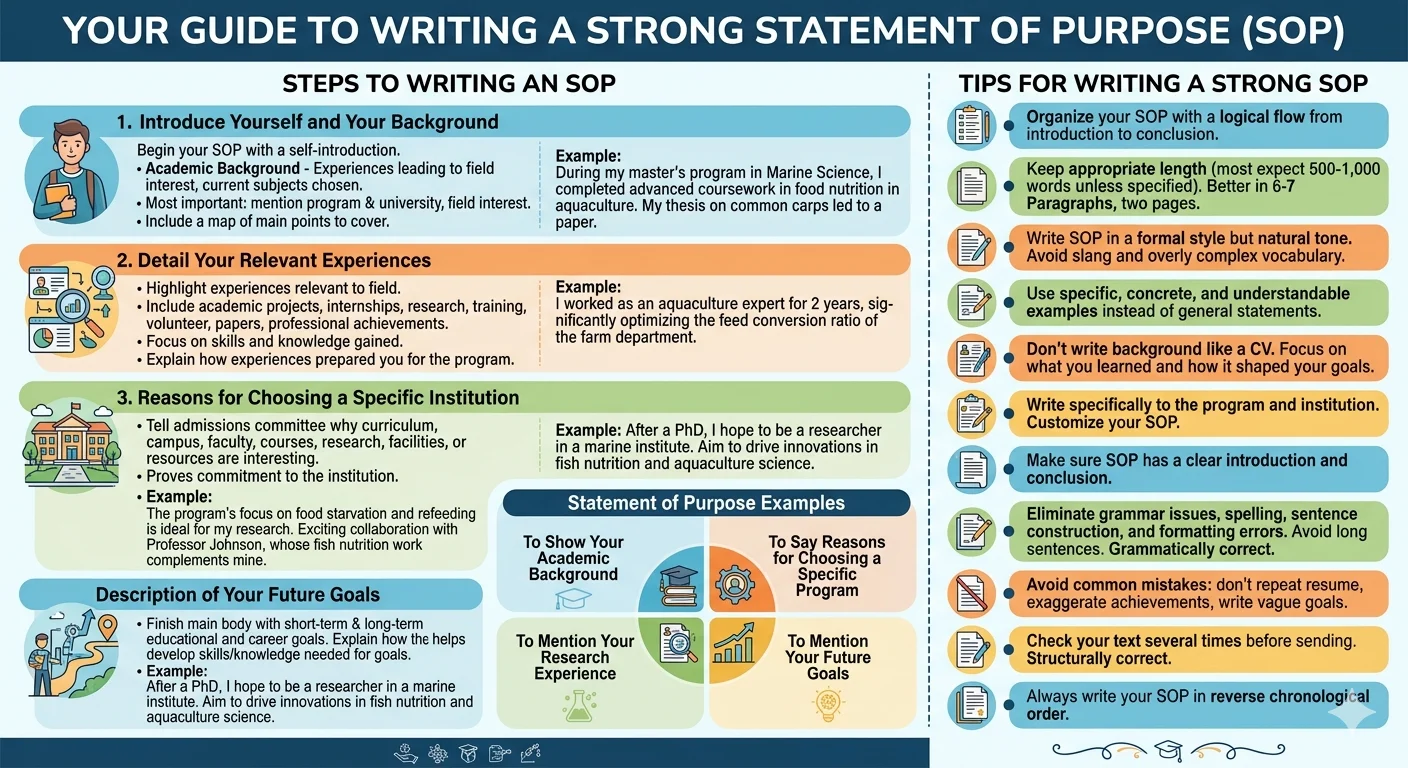
Begin your SOP with a self-introduction. Your Academic Background – Describe the experiences that led you to become interested in the field. Also, explain what subjects you are now taking that led you to choose the course. The most important things to include are the program and university that you are applying to, then some of your own interest in this field. You should also lay out a map of the main points you will cover through the statement in this section.
Detail you Relevant Experiences
In the next step you should highlight your experiences. Your experiences should be relevant to your chosen field of study. Your experience may include academic projects, internships, research activities, training, volunteer work, submitted papers or professional achievements. Focus on the skills and knowledge you gained and explain how these experiences prepared you for a particular program of the institute.
Reasons for choosing a specific institution
The admissions committee wishes to learn about the reasons behind your choice. It is necessary for you to tell them why you find their curriculum, campus, faculty members, courses, research, facilities, or resources interesting. This would prove to them that you are committed to their institution.
Description of your Future Goals
Finish your main body with the description of your future long term and short term educational and career goals. Mention why you think that their institution can assist you in developing the skills and knowledge required to attain those goals in future.
Statement of Purpose Examples
The way you start your text is very important because it attracts the reader to your text. Having an attractive introduction is very important for your acceptance. For this reason, we have listed some examples of each step of SOP below:
To show Your academic background
Example:
During my master’s program in Marine Science, I completed advanced coursework in food nutrition in aquaculture. My thesis on the effect of food deprivation and refeeding on common carps led to a paper on aquaculture research.
To mention your Research Experience
Example:
I worked as an aquaculture expert at the warm-water fish farming department Research Center for 2 years, and during this time I was able to significantly optimize the feed conversion ratio of the farm department.
To say about Reasons for choosing a specific program
Example:
The program’s focus on the effect of food starvation and refeeding makes it an ideal environment for my research. I’m particularly excited about collaborating with Professor Johnson, whose work on fish nutrition complements my expertise.
To mention your Future Goals
Example:
After completing my PhD, I hope to work as a researcher at a research institute focused on food in fishes. I aim to drive innovations in fish nutrition and aquaculture science.
Tips for Writing a Strong SOP
Knowing Tips for writing a strong SOP can significantly improve the quality of your application:
- Organize your SOP with a logical flow from introduction to conclusion.
- Always keep the appropriate length, most universities expect between 500 and 1,000 words unless otherwise specified. Be careful about the length of the text. It’s better to write SOP in 6-7 Paragraphs and in two pages.
- Write SOP in a formal style but natural tone. avoid slang and overly complex vocabulary while writing your SOP.
- Use specific, concrete, and understandable examples instead of general statements.
- don’t write your background like a CV, instead of writing them as a list, focus on what you learned from them and how they shaped your future goals.
- write specifically your SOP to the specific program and institution and customize your SOP.
- Make sure your SOP has a clear introduction and conclusion.
- Eliminate grammar issues, spelling, and sentence construction and formatting errors, long sentences in the SOP and make a really grammatically corrected text.
- Avoid common mistakes like not repeating your resume, exaggerating achievements, or writing vague goals.
- Check your text several times before sending it and make sure it is structurally correct.
- Don’t forget you should always write your SOP in reverse chronological order.
Conclusion
A good Statement of Purpose is very important for your university application. This is because it shows the university what you have studied, what you have done and what you want to do in the future. When you write a Statement of Purpose you are telling the university why you are a fit for the program. So, start writing your Statement of Purpose and begin the process of getting into your dream university. Writing a Statement of Purpose is the step to getting into the university you want to attend.

ScholarLink AI
Your Ultimate Admission Co-Pilot
- 🎓 Professors Database: World’s largest supervisor directory
- 📡 Live Positions: Real-time faculty openings & vacancies
- 👥 Students Database: Connect with successful applicants
- 🎯 Smart Matching: AI-driven professor recommendation
- 💰 Funding Analysis: Real-time lab & research funding data
- 📝 Apply Management: Track applications & cold emails