
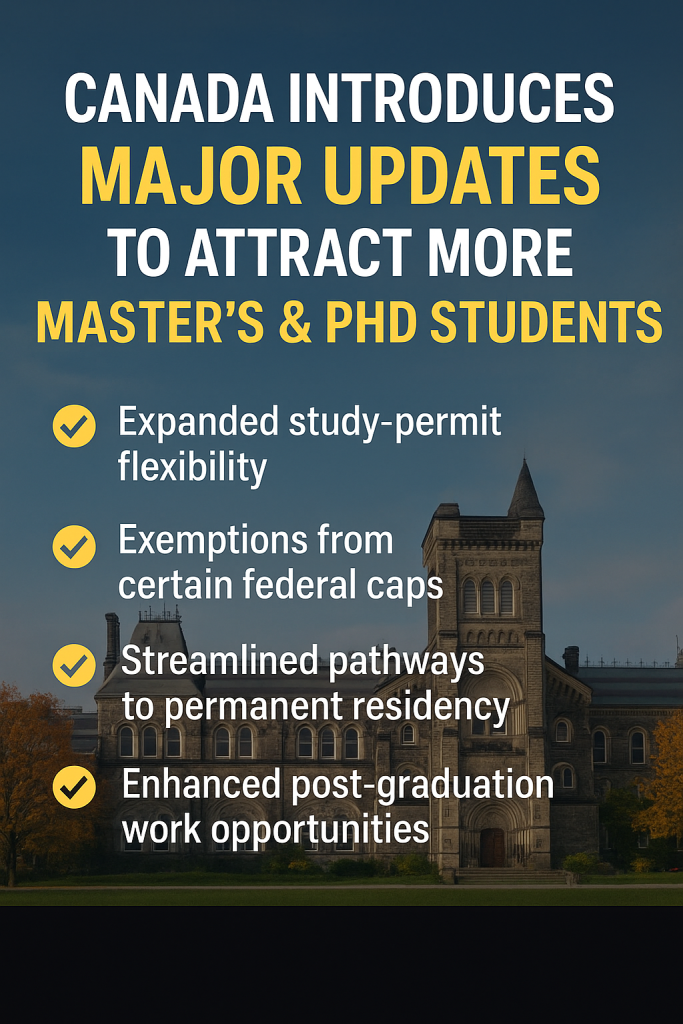
Global competition for international talent is intensifying, and countries are increasingly recognising the value of attracting top researchers. Canada has emerged as a premier destination for graduate studies — especially for those pursuing master’s and PhD programs. A wave of 2026 policy changes, including a study-permit cap exemption for graduate students and expedited permit processing, has reshaped the landscape and opened new doors for international applicants worldwide.
ScholarLink exists to help students navigate this fast-moving environment by connecting them to the right Canadian universities, scholarships, and research opportunities. In this guide we cover why Canada is such a strong choice, the latest policy developments and what they mean in practice, the exact steps to apply, and how ScholarLink can guide you from first shortlist to arrival.
Why Choose Canada for a Master’s or PhD?
Studying for a master’s or PhD in Canada is both exciting and demanding. As one of the world’s most respected higher-education systems, Canada offers a wide range of universities and programs, an outstanding learning environment, and deep research opportunities across STEM, health, social sciences, and the humanities.
For international students in particular, Canada stands out for a few reasons:
- Research intensity. Canadian graduate programs are increasingly assessed on research potential and global collaboration, so strong applicants gain access to well-funded labs and international networks.
- A clear post-study pathway. Post-graduation work permits and immigration routes such as the Canadian Experience Class mean a degree can lead to long-term career growth and permanent residency — not just a credential.
- A welcoming stance on graduate talent. While other major destinations tighten their student-visa rules, Canada has deliberately protected pathways for master’s and PhD candidates.
The application process itself is relatively straightforward for domestic and international students alike — which we break down step by step below.
Canada’s 2026 Graduate Policy Landscape
Canada introduced transformative changes for the 2026 intake that directly benefit graduate applicants. These are now in effect, not merely proposed:
- Study-permit cap exemption. As of January 1, 2026, international students admitted to master’s and doctoral programs at public Designated Learning Institutions (DLIs) are exempt from Canada’s national study-permit cap. Their permits are no longer counted against the annual quota.
- No more attestation letter for graduate students. Master’s and PhD applicants at public DLIs no longer need a Provincial or Territorial Attestation Letter (PAL/TAL). This removes a major administrative hurdle — and, because many students previously had to pay a deposit just to obtain a PAL, it also lowers the upfront cost of applying.
- Fast-track permit processing. Doctoral applicants applying from outside Canada — and their accompanying spouse and dependent children, if applying together — can now receive a decision in as little as 14 days.
- A sharpened focus on research talent. These measures sit inside the 2026–2028 Immigration Levels Plan. While Canada is reducing overall student intake, it has deliberately shielded graduate students, recognising their outsized contribution to innovation in fields such as AI, health care, and climate research.
Taken together, the reforms send a clear signal: Canada is competing hard for the next generation of researchers, and it is removing bureaucratic barriers to win them.
Why These Changes Matter for International Students
1. Broader access to top public universities. The old quota system pushed many strong candidates toward alternative destinations. With graduate applicants now exempt, there is a clear, quota-free pathway into research-intensive public institutions.
2. Faster processing means real planning power. A 14-day standard for doctoral applicants lets you coordinate travel, housing, funding start dates, and research onboarding with far more certainty — and start integrating into your lab sooner.
3. Lower barriers and lower upfront cost. Dropping the PAL/TAL requirement removes both a paperwork step and, in many cases, an early deposit — making the first stage of the journey cheaper and simpler.
4. A more competitive, higher-quality applicant pool. Because the door is genuinely open, expect more high-calibre applicants. That makes early, well-targeted applications more important than ever.
How to Apply: Steps and Documents
The path from shortlist to enrolment follows a predictable sequence. Planning each stage in advance is what separates successful applicants from stressed ones.
- Research programs and shortlist. Identify universities and supervisors whose research aligns with your interests. Prioritise public DLIs, since only these qualify for the graduate cap exemption.
- Prepare your application. This typically includes official transcripts, a strong statement of purpose, proof of English (or French) proficiency, and — depending on the program — letters of recommendation. A focused, well-structured SOP is often the single biggest differentiator.
- Secure admission. Submit to your shortlisted programs, mindful of each unit’s deadlines, and wait for your letter of acceptance.
- Apply for your study permit. Once accepted, apply for the study permit that lets you study in Canada. Graduate applicants at public DLIs skip the PAL/TAL step, and doctoral candidates benefit from the 14-day processing standard.
- Register and prepare your finances. Choose courses, pay tuition, and organise proof of funds. Even with faster processing, proper documentation and evidence of financial capacity remain essential.
- Begin your studies. Depending on the program, you’ll complete coursework, a thesis, and research — and many programs include internships or research placements that build valuable experience.
- Graduate and transition. On completion, you can pursue a post-graduation work permit and, in time, permanent-residency pathways.
Scholarships and Funding for Graduate Students
Canada backs its researchers with substantial funding — but it’s important to target the awards you’re actually eligible for.
The flagship Canada Graduate Research Scholarship – Master’s (CGRS-M, formerly CGS-M) is worth CAD $27,000 for 12 months. Note, however, that this Tri-Agency award is reserved for Canadian citizens and permanent residents, so most international applicants won’t be eligible for it directly.
International graduate students typically fund their studies through other routes:
- University fellowships and graduate funding packages, often bundled into the admission offer at research-intensive institutions.
- Teaching and research assistantships, paid positions tied to a supervisor’s projects and grants.
- Provincial awards such as the Ontario Trillium Scholarship, created specifically to attract international PhD students.
ScholarLink helps you cut through this by surfacing the funding sources you actually qualify for, with deadlines and eligibility criteria in one place — so you can apply proactively rather than discovering awards too late.
Opportunities and Threats: A Balanced View
The new policies are a clear net positive, but strategic applicants weigh both sides.
| Category | Opportunities | Threats |
|---|---|---|
| Policy | Cap exemption and expedited processing remove barriers and shorten timelines. | Only public DLIs qualify; private institutions remain under the standard cap and PAL/TAL rules. |
| Market position | Access to world-class research environments and international recognition. | A more open door means more applicants — and potentially higher admission thresholds. |
| Funding | Strong university, provincial, and assistantship funding for graduate researchers. | Top-tier funding pools are competitive, especially at leading universities. |
| Integration | Faster permits ease preparation for research, relocation, and family logistics. | A rapid influx can strain university housing and support services. |
| Long-term value | Post-graduation work permits and PR pathways add lasting value. | Future immigration-policy shifts could change work and residency options. |
The takeaway: plan early, target eligible institutions, and prepare for a competitive field.
How ScholarLink Supports International Students
ScholarLink is built to turn these policy changes into concrete opportunities:
- Targeted program matching — identifies public DLIs and research-intensive programs so you benefit from the cap exemption.
- Application strategy and timeline planning — guides you through selection, documents, SOP, visa submission, and travel.
- Scholarship navigation — curated, eligibility-filtered lists of funding, with deadlines, so you never miss a window.
- Competition intelligence — insight into admission trends and funding competition to inform where and when to apply.
- Post-study pathways — guidance on work permits, research options, and immigration routes after graduation.
By joining ScholarLink, candidates stay updated on the latest openings that match their academic background — and get a realistic read on their chances against the full requirements for each position.
Practical Tips for Prospective Students
- Start 12–18 months early. Earlier planning meaningfully improves admission and scholarship outcomes.
- Choose eligible institutions. Only public DLIs qualify for the graduate cap exemption — confirm status before you commit.
- Lead with research experience. Canada’s focus on research talent rewards candidates with strong academic or research backgrounds.
- Get your finances and documents in order. Even with faster processing, proof of funds and complete documentation remain critical.
- Use ScholarLink to match programs, track scholarships, and manage your journey from application to arrival.
Trends Shaping Graduate Education in Canada
- Rising graduate enrolment. The cap exemption is expected to lift master’s and PhD numbers at public universities.
- Emphasis on research potential. Programs increasingly evaluate applicants on research capacity and collaboration prospects.
- Stronger post-graduate integration. Work permits and PR pathways make Canada attractive for long-term careers, not just study.
These trends show that Canada views international graduate students as strategic contributors to its research ecosystem and knowledge economy.
ScholarLink in Action: A Quick Example
Consider a prospective PhD candidate applying from abroad. Under the old system she faced quota limits and long processing waits. Under the 2026 rules:
- She can apply to multiple public Canadian universities without quota limitations.
- ScholarLink points her to programs aligned with her research interests and to funding she’s actually eligible for.
- Fast-track processing means she can arrive on time and begin research without delay.
The policy shift becomes an actionable advantage — which is exactly the gap ScholarLink is designed to close.
Why 2026 Is a Strategic Year
The cap exemption and faster timelines make 2026 a pivotal moment for postgraduate study in Canada. Early applicants gain greater access to top public universities, better-timed access to funding, and more room to plan research projects and family relocation. Combined with ScholarLink’s guidance, that adds up to a real edge in a global applicant pool.
Frequently Asked Questions
Are international students exempt from Canada’s study-permit cap in 2026? Yes — as of January 1, 2026, students admitted to master’s and doctoral programs at public Designated Learning Institutions are exempt from the national cap. Undergraduate, college, and private-institution applicants generally remain under it.
Do graduate students still need a PAL or TAL? No. Master’s and PhD applicants at public DLIs no longer need a Provincial or Territorial Attestation Letter.
How fast is study-permit processing for PhD students? Doctoral applicants applying from outside Canada — and accompanying family members applying together — can receive a decision in as little as 14 days.
Can international students get the CGS-M / CGRS-M scholarship? Generally no; that CAD $27,000 award is for Canadian citizens and permanent residents. International students typically fund studies through university fellowships, research/teaching assistantships, and provincial awards such as the Ontario Trillium Scholarship.
When should I start my application? Aim to begin 12–18 months before your intended start date to give admissions and funding applications enough runway.
Conclusion
Canada is positioning itself as a global leader in graduate education — actively recruiting international talent to strengthen its research ecosystem. With the study-permit cap exemption, the removal of the PAL/TAL requirement, faster visa processing, and strong funding for graduate researchers, international students now have unprecedented access to Canadian universities.
For ambitious master’s and PhD applicants, there has rarely been a better time to study in Canada. With careful planning, the right support, and timely action, your academic and professional goals are well within reach.
Ready to start? Create your ScholarLink profile to match with programs, track scholarships, and plan your journey to Canada from application to arrival.