

Changes in international education are happening rapidly and will impact university admission processes and writing SOPs. In addition to grades and test scores, universities now consider many different factors while evaluating their applicants. Therefore, good SOPs must not only describe your background and aspirations but also demonstrate how you, as an individual, have responded to recent changes in international education trends.
Knowing international trends is crucial in writing a successful SOP, so here we are going to talk about the Trends in International Education.
| Trends | Impact on SOP |
| Growing International students from emerging countries | With the increasing competition for university admissions, your SOP should clearly showcase your strengths, characteristics, and unique qualities to show you better than other applicants. |
| Growth of online education | Universities are looking for students who are able to learn independently and adapt to new technologies. Therefore, mentioning online courses, virtual projects, or digital skills in your SOP can be an advantage. |
| Changes in visa and immigration policies | Changes in immigration policies can affect how you write your SOP. In other words, you need to write your SOP based on the changes in these guidelines. |
| Focus on employability and future skills
|
Based on this trend, the future goals section of your SOP should explain how the program will help you develop the skills needed for your future career.
|
Key Trends in International Education
Rising International Student Numbers from Emerging Markets
Countries like India, Nigeria, Vietnam, and Brazil are sending more and more students abroad to study each year. As a result, universities are facing a higher volume of applications and competition for admission to degree programs has increased. This trend has made SOPs even more important. Applicants should clearly show their unique experiences, achievements, and goals in their SOP to stand out from other candidates.
Growth of online education
The growth of online education has allowed students to access high-quality, international education through virtual courses, hybrid programs, and online certificates. This trend has provided more flexible learning opportunities and has made digital skills and independent learning important factors in academic success. In your SOP, you can mention online courses, accredited certificates, virtual projects, and your ability to learn independently to demonstrate your readiness for modern learning environments.
Changes in visa and immigration policies
Recent changes in visa and immigration laws, such as new restrictions on student visas in some countries, have led students to explore a wider range of study options. This has also led to more countries and universities competing to attract international students.
Therefore, in the SOP, you must clearly explain why you have chosen a specific country and university and whether your situation is in line with the immigration rules and restrictions of that university or not.
Focus on employability and future skills
Today, universities are emphasizing practical skills and preparing students for the workplace more than ever before. As a result, a successful SOP should not only address academic interests, but also explain how the chosen program will help your develop skills and achieve your career goals. Relating your education to your future career path can have a positive impact on the evaluation of your application.
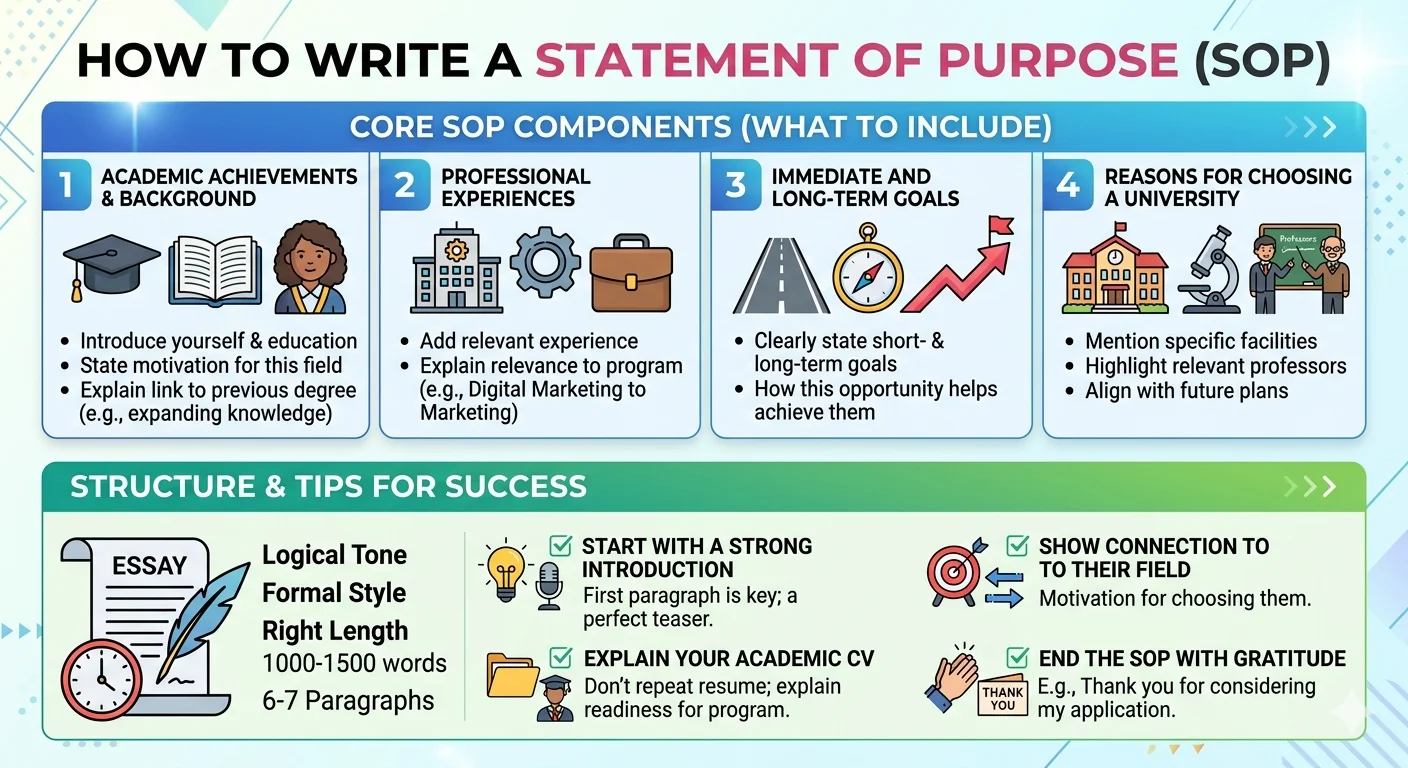
How to Write a Statement of Purpose (SOP)
Writing a statement of Purpose (SOP) may seem challenging at first but by following the steps below you can do it very fast and easy.
- Academic Achievements and background: Briefly introduce yourself and your educational background, along with your motivation for continuing your education in that field or academic project. For example, say, I worked in this field in my previous degree and I want to expand my knowledge in this field.
- Professional experiences: if you have relevant experience add it to your SOP and explain how these experiences are relevant to the field of study of that institute. For example, the field of a university is about marketing and your experiences are about digital marketing so your experience will help you to get an application from that institute.
- Immediate and long-term goals: write clearly about your long and short goals and tell how these opportunities will help you achieve your goals.
- Reasons for choosing a university: If something in that university will help you in your journey to your goals and future jobs and plans mentioned in your SOP, something like their facilities, professors etc….
Structure and Content of a Successful SOP
A professional SOP should be written in a logical tone and in a formal style. It should also be of the right length, meaning it should not be too short or too long.in addition a SOP should have 1000-1500 words and 6-7 paragraphs. In addition to the above for writing an effective SOP consider below factors:
- Start with a strong introduction: The first paragraph is everything and it’s like a teaser for your SOP so write it perfectly.
- Write about your academic CV: Do not simply repeat your resume, explain how your experiences have prepared you for the program..
- Show how your goal is connected with their field: explain your motivation for choosing them.
- End the SOP with gratitude.: for example, write Thank you for considering my application or devoting your time to read my SOP.
Statement of Purpose Examples
Law masters SOP
During high school, I was inspired to pursue a career in law after taking part in a debate in a history lesson. My classmates and I argued whether Julius Caesar was a good or bad leader for the Roman Empire and we all had to provide compelling closing arguments after examining the evidence. I was fully involved in the task and I relished the challenge of debating my classmates and putting forward my case.
This curiosity and determination to make the right decisions and to form arguments based on evidence inspired me to complete an undergraduate course in History in 2017. I demonstrated strong analytical skills in essay writing throughout this course. I also took an interest in the diverse subject matter. For example, I completed modules on European art history where I used evidence shown in paintings from the early-modern period to show how social inequalities took place. But, in another module, I examined how effectively the Nazis controlled the press during World War 2. These experiences show how I can take a variety of subject matter and form a compelling argument based on the facts provided.
However, the main passion in my undergraduate course was social history. I took a keen interest in hearing first-hand accounts from everyday people on their experiences during the Great Depression and I wrote my thesis on this subject. I used the evidence given by people during the Great Depression to argue how the actions of the masses to migrate en masse had more impact compared to government intervention. I also completed a presentation on my findings and answered questions from doctorate-level tutors on the subject and received a distinction for my research.
I thoroughly enjoyed this part of my undergraduate degree. The process of gathering important and impactful evidence and using this to create a solid argument was completely engaging. This inspired me to start getting more experience in law. After graduating, I secured a position working for a local solicitor. In this role, I spoke to clients and supported them with queries. Also, I helped the lawyers organize their files and prepare for court days. Part of this role involved shadowing solicitors in the office and court. During this experience, I learnt from colleagues about legal language and how to make cases for clients based on their needs and requirements. Occasionally, I also helped lawyers when they went to court and seeing the lawyers perform their arguments in a court setting was another huge motivation for me to progress with my law career.
Since a young age, I have been an advocate for justice and fairness in all areas of life. I am determined to bring this core philosophy and my skills and understanding of evidence to become a qualified lawyer. I am a hard-working individual who is always looking to improve my skills and knowledge. I would bring this and a passion for the law to this course in the hope of taking the next step toward my dream career.
Best Regards,
James Jones
Analysis
This student provides a good story to begin their statement that is engaging and personable. Having strong, specific examples that show long-term commitment to an admissions officer is important. Then, this student shows the skills and experience needed to complete an MA Law course. In addition, the student does well to bring some real-life work experience into their statement. Even if the work experience is in an unrelated field, try to find skills that could also apply to your chosen course. At the end of text, the student explains their passion and commitment to the law, whilst also highlighting some strong personal skills that would help them to achieve in that position.
Business masters SOP
From a young age, I went to work with my Dad in his hardware shop. Here, I saw first-hand how he interacted with customers and dealt with queries, and complaints and provided excellent services. But he also showed me that running a business is more than being a people person. After the shop closed, he worked on budgets and finance, talked with suppliers and checked stock items regularly. As I got older, my Dad helped me to become more involved in the business. First, he trusted me to work the tills, process orders and print receipts for customers before I was promoted to shop floor assistant.
Overall, I learnt from this experience that business is many subjects rolled into one. A successful business person is not just a salesman, but they are a leader, a mathematician, a communicator and an organizer.
Even though I had experience running a business, I was not immediately inspired to start my shop or enterprise. Instead, I completed my school education and studied for a degree in English Literature. Here, I regularly demonstrated excellent communication skills. I completed my thesis on the themes of ‘War and Peace and went on to present my findings to a group of 30 first-year students. But I also showed great skill in teamwork and leadership when I formed a research group in the second year of my studies. I realized that I was not achieving as well as I could and I demonstrated initiative and a proactive approach to help support my studies. I first organized an online study forum for my peers and then we decided to meet in person to discuss themes and approaches to the book. The group continued to run until we graduated and I felt proud to start an active group that supported others and myself to complete our degrees.
Towards the end of my studies, I started working as a freelance writer, submitting fiction stories and non-fiction articles to local and national magazines. Over time, I grew my online presence and profiles to attract customers and showcase my work. Shortly after finishing my degree, I went full-time in this line of work as I attracted more clients. In many ways, this was similar to my early experience working in my dad’s shop. Although my role as a writer is different to a shop owner, I still use many of the same business-related skills. I create budgets, talk to clients regularly, speak with potential customers and create invoices each month. All of these skills and tasks are equally as important as my writing to keep my business working.
Something about this entrepreneurial adventure inspired me to apply for a Master’s in Business. Someday, it is my ambition to scale up my writing business and to help and inspire younger writers and entrepreneurs to follow a similar path. However, I want to learn more about the business side of running my enterprise. Ultimately, I want to improve my management and communication skills and learn how to expand from being a sole entrepreneur to a business with multiple employees and staff. In my studies and career so far, I have shown the necessary determination, hard work and initiative that have helped me to succeed. I would bring these skills and my experience to this course and demonstrate my passion to learn and understand more about this subject to help myself and others in the future.
Best Regards,
Jessica Fernandez
Analysis
This statement begins with a good and attractive story and it will catch readers attention. Also, this student did not always show a determination to join a business course straight away. But they use their own experience and context to make it relatable to the course they are applying for. In addition, this student gives a genuine closing statement about their motivations and will to help others.
Tips for Writing a Strong SOP
| Tips | Explanations |
| Make Sure Your Statement Reflects Your Own Work | When you are writing your SOP, follow grammar and spelling tips, but that doesn’t mean you should copy the text or ask someone to do it for you.
|
| Write specific SOP for each program | Prepare a customized statement for each application and mention why this particular program appeals to you. |
| Follow the Rules | When writing SOP, be sure to follow the rules and never write less than the requested amount, and never more. |
| Write a lively SOP | A strong text should stay moderate in tone, clear in expression, and engaging enough to hold the reader’s attention.
|
| Talk about your academic background and goals | If you are applying for a master’s degree or higher, talk about your academic background, research, and future goals. For an undergraduate degree, focus more on your short-term goals and career aspirations. |
| Use clear and concise language | An effective SOP should be written in clear, concise language so that everyone in that university can understand it. |
| Use suitable format and fonts | Use a consistent font, font size, and formatting to keep the document look professional.
|
Conclusion
A strong Statement of Purpose (SOP) is a key part of a successful international university application. By understanding international education trends and writing a good SOP you can increase your chances of being admitted to reputable universities.

ScholarLink AI
Your Ultimate Admission Co-Pilot
- 🎓 Professors Database: World’s largest supervisor directory
- 📡 Live Positions: Real-time faculty openings & vacancies
- 👥 Students Database: Connect with successful applicants
- 🎯 Smart Matching: AI-driven professor recommendation
- 💰 Funding Analysis: Real-time lab & research funding data
- 📝 Apply Management: Track applications & cold emails