
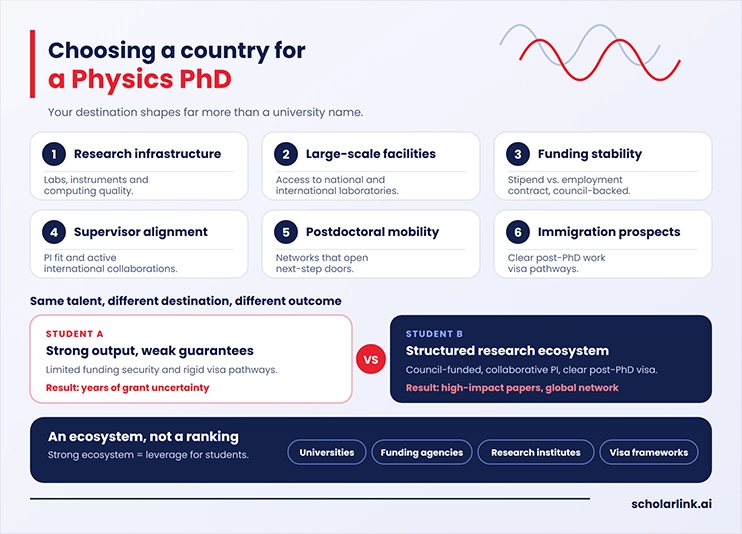
Choosing among the best research destinations for physics is not just about picking a country with a famous university name. For a physics PhD applicant, the destination shapes everything: the quality of research infrastructure, access to large-scale laboratories, funding stability, supervisor alignment, postdoctoral mobility, and even long-term immigration prospects. In practice, your country of study can determine whether you spend four years struggling for grant continuity, or publishing in high-impact journals with global collaborators.
Consider a realistic scenario. Two equally talented students apply for doctoral study in theoretical condensed matter physics. One chooses a country with strong research output but limited funding guarantees and rigid visa pathways. The other selects an international destination for doctoral physics study where funding is structured (through national research councils), supervisors manage active international collaborations, and post-PhD work visas are clear. Five years later, their research profiles and career options may look dramatically different.
That is why evaluating the top countries for physics research requires more than checking global rankings. It involves understanding how funding models (e.g., stipends vs. employment contracts), supervisor-PI (Principal Investigator) structures, national research priorities, and post-study immigration systems interact. These entities (universities, funding agencies, research institutes, and visa frameworks) form an ecosystem. A strong ecosystem creates leverage for doctoral students.
This guide breaks down the best universities for a physics PhD, major global research hubs, and real-world physics research opportunities abroad. We analyze each destination not only by reputation, but by research depth, infrastructure, career mobility, and long-term strategic value.
Quick Answer: Which Country Is Best for a Physics PhD?
There is no single best country. The right one depends on what you optimize for:
- Financial stability: Germany and Switzerland, where PhD candidates are typically employed and paid a salary.
- Scale, facilities and industry breadth: the United States.
- Shorter time-to-degree: the United Kingdom (around 3–4 years).
- Research funding per student and top infrastructure: Switzerland.
- Fast-growing national projects (e.g., quantum): China.
Why Choosing the Right Country for Physics Research Matters
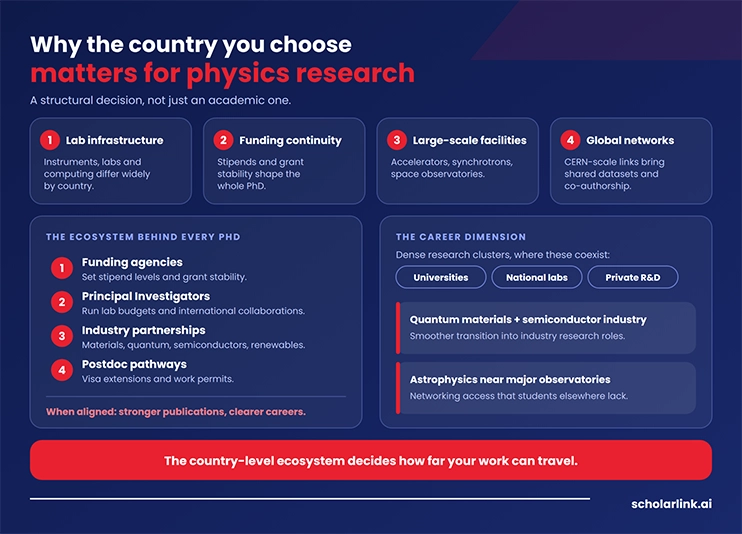
Selecting among the leading research destinations for physics is a structural decision, not just an academic one. A physics PhD is deeply embedded in national research systems. Countries differ in laboratory infrastructure, funding continuity, access to large-scale facilities (such as particle accelerators, synchrotrons, and space observatories), and integration with global research networks. These differences directly influence the quality and visibility of your doctoral work.
For example, a student pursuing experimental high-energy physics in a country closely connected to major international collaborations, such as those linked to CERN-scale facilities, will likely gain access to global datasets, cross-border teams, and co-authorship opportunities. In contrast, studying in a system with limited international research agreements may restrict exposure, even if the university itself is reputable.
The country-level research ecosystem often determines how far your work can travel.
The Ecosystem Behind Every Physics PhD
That ecosystem includes multiple interconnected entities:
- National funding agencies (research councils, science foundations) that determine stipend levels and grant stability
- Principal Investigators (PIs) who manage laboratory budgets and international collaborations
- Industry partnerships that enable applied research in materials science, quantum technologies, semiconductors, or renewable energy
- Postdoctoral mobility pathways, including visa extensions and work permits
When these components align, doctoral students benefit from stronger publication pipelines and clearer career transitions.
The Career Dimension
The top countries for physics research often host dense research clusters: regions where universities, national labs, and private-sector R&D centers coexist. A PhD student working on quantum materials in a country with an active semiconductor industry may transition more smoothly into industry research roles. Similarly, a doctoral candidate in astrophysics studying near major observatories gains networking access that students elsewhere simply do not have.
A physics PhD is not only about completing a thesis under a supervisor. It is about embedding yourself in a system that shapes your postdoctoral trajectory, grant competitiveness, and international mobility. Some destinations offer structured postdoc pipelines and transparent academic career ladders. Others rely heavily on short-term contracts with uncertain long-term prospects.
Choosing the right country influences:
- the scale and sophistication of laboratory infrastructure
- the strength of international collaboration networks
- access to industry-funded research opportunities
- the availability of competitive postdoc positions
- immigration pathways for long-term academic or industrial careers
This decision extends far beyond tuition fees or university rankings. It defines the professional ecosystem you will grow within.
Key Factors for Choosing a Physics PhD Destination
When evaluating the best research destinations for physics, most applicants instinctively look at rankings. Rankings matter, but they are only one layer. A more strategic approach is to assess structural factors that shape your daily research life and long-term career trajectory.
| Factor | What to check | Why it matters |
|---|---|---|
| Funding structure | Employment contract, stipend (RA/TA) or scholarship; duration guarantee | Predictable funding protects research focus |
| Infrastructure | National labs, synchrotrons, observatories, cleanrooms | Equipment defines what questions you can ask |
| Supervisor (PI) | Publications, citations, group size, grant history | Often matters more than institutional prestige |
| Publication ecosystem | High-impact output, international collaborations, conference funding | Early co-authorship strengthens postdoc applications |
| Career pathways | Postdoc fellowships, industry R&D, work permits | Determines your options after the PhD |
Funding Structure and Financial Stability
Funding is not simply about receiving a stipend. It is about how predictable and secure that funding is over 4–6 years. Different countries operate under different models:
- Employment-based PhD contracts (common in parts of Europe), where doctoral candidates are formally employed with salary and benefits.
- Stipend-based systems (common in the United States and other regions), often tied to teaching assistantships (TA) or research assistantships (RA).
- Scholarship-driven models, where funding depends on competitive fellowships.
From experience, unstable funding disrupts research focus. If a PI depends heavily on short-term grants, your project continuity may be affected. Strong physics research opportunities abroad typically exist in systems where funding pipelines are institutionally stable and supported by national research agencies. That financial foundation determines whether you can concentrate on physics, or constantly worry about renewal.
Access to Advanced Laboratories and Research Infrastructure
Physics is infrastructure-intensive. Whether you work in experimental condensed matter, particle physics, photonics, plasma physics, or astrophysics, access to equipment determines the scale of your questions. Ask:
- Are there national labs or shared facilities (e.g., synchrotrons, observatories, accelerator centers)?
- Does your university collaborate with international research facilities?
- Is the laboratory modern and well-funded?
A student researching nanomaterials in a country with outdated cleanroom facilities will inevitably face slower progress compared to someone embedded in a high-tech research cluster. The top countries for physics research typically integrate universities with national laboratories and global consortia. Infrastructure is not optional; it defines feasibility.
Supervisor Quality and Research Alignment
Your supervisor (often called a PI) is the central entity in your doctoral journey. Choosing the right country increases the probability of finding a supervisor whose research program is internationally visible and well-funded. Evaluate:
- publication record in peer-reviewed journals
- citation impact and active collaborations
- size and diversity of the research group
- grant history and funding stability
A strong supervisor provides more than academic guidance. They connect you to global networks, co-author papers with international collaborators, and position you for competitive postdoc roles. In reality, supervisor alignment often matters more than institutional prestige. It is one of the most underestimated variables when selecting the best universities for a physics PhD.
Publication Ecosystem and International Collaboration
Scientific visibility matters. Some countries are deeply integrated into global physics networks, enabling easier cross-border collaboration and co-authorship. Ask:
- Does the department regularly publish in high-impact journals?
- Are there formal collaborations with international institutions?
- Are PhD students encouraged to attend major conferences?
In high-performing destinations, doctoral students often co-author papers before graduation. This early visibility strengthens postdoc and faculty applications. Publication culture is not universal: some systems emphasize teaching over research output, and that distinction can change your CV dramatically.
Post-PhD Career Pathways and Job Market
Finally, think beyond the PhD itself. The decision you make today shapes your access to:
- competitive postdoctoral fellowships
- industry R&D roles (e.g., quantum computing, aerospace, semiconductor physics)
- long-term academic positions
- immigration and work permit options
A country investing heavily in quantum technologies or renewable energy physics may offer stronger industry absorption after graduation. Other systems may provide clearer academic tenure-track pathways. This is where the decision becomes strategic rather than purely academic: the best destinations create leverage, increasing your options rather than limiting them.
If you apply this framework (funding, infrastructure, supervisor alignment, publication culture, and career mobility), you can analyze countries objectively instead of emotionally.
Top Countries for Physics Research in 2026
The following countries stand out among global research destinations for physics based on four structural indicators:
- sustained scientific investment
- research output and global rankings
- international collaboration intensity
- popularity among international doctoral students
These are not arbitrary selections. Each country below has built a research ecosystem where funding agencies, universities, laboratories, and industry partnerships operate in alignment.
The goal is not to declare a universal “best.” Instead, it is to understand what type of doctoral candidate thrives in each system. A student focused on quantum engineering may prioritize industrial integration. Another pursuing theoretical cosmology may value deep international collaboration networks. The destination should match the research ambition.
Physics PhD Countries at a Glance
| Country | Funding model | Best for | Main trade-off |
|---|---|---|---|
| Germany | Employment-based (salary as research staff) | Quantum science, engineering physics, particle physics; financial stability | Credential and language considerations for life outside the lab |
| United States | RA/TA stipends, often with tuition coverage | Scale, national labs, interdisciplinary and industry-linked research | Highly competitive admission; PhD can take 5–6 years |
| United Kingdom | Doctoral Training Partnerships and other competitive funding | Shorter PhD (around 3–4 years), theoretical physics, astrophysics, materials | Competitive funding; international fees may be higher than in continental Europe |
| Switzerland | Employment-based, high salaries | Quantum physics, particle physics, materials science; infrastructure | High cost of living |
| China | Government-backed programs, competitive packages | Quantum communication/computing, large national projects | Language environment, research culture, long-term career alignment |
Physics PhD in Germany
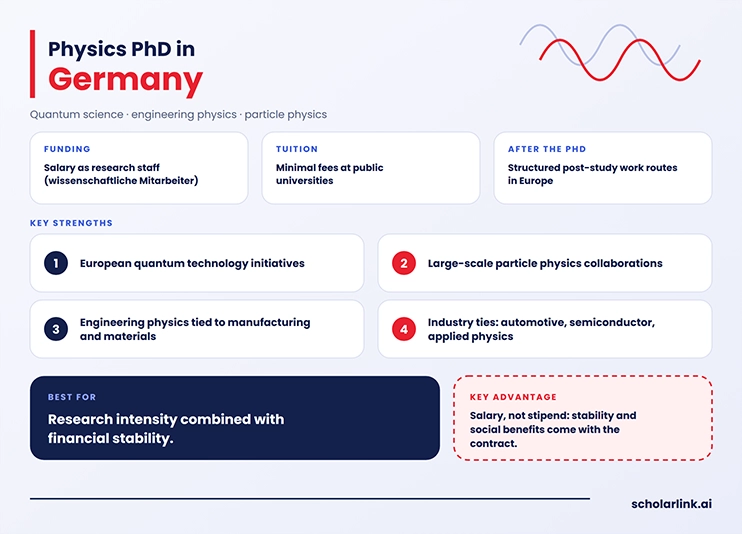
Germany has become one of the most strategically attractive international destinations for doctoral physics study, particularly in quantum science, engineering physics, and particle physics. The country’s strength lies in its layered research ecosystem: universities collaborate closely with institutions such as the Max Planck Society and large European research infrastructures.
From experience, one of Germany’s strongest advantages is its employment-based PhD structure. Many doctoral candidates are hired as research staff (wissenschaftliche Mitarbeiter), receiving a salary rather than a stipend. This model offers financial stability and social benefits, an often overlooked advantage.
Germany also maintains:
- strong integration with European quantum technology initiatives
- deep participation in large-scale particle physics collaborations
- advanced engineering physics infrastructure tied to manufacturing and materials science
- robust industry partnerships in automotive, semiconductor, and applied physics sectors
Another key factor is cost efficiency. Public universities generally charge minimal tuition fees, which reduces financial pressure compared to other top-tier systems. Additionally, Germany offers structured post-study work opportunities, allowing graduates to transition into industry or postdoctoral research roles within Europe.
For students seeking research intensity combined with financial stability, Germany consistently ranks among the best destinations for physics PhD pathways.
Physics PhD in the United States
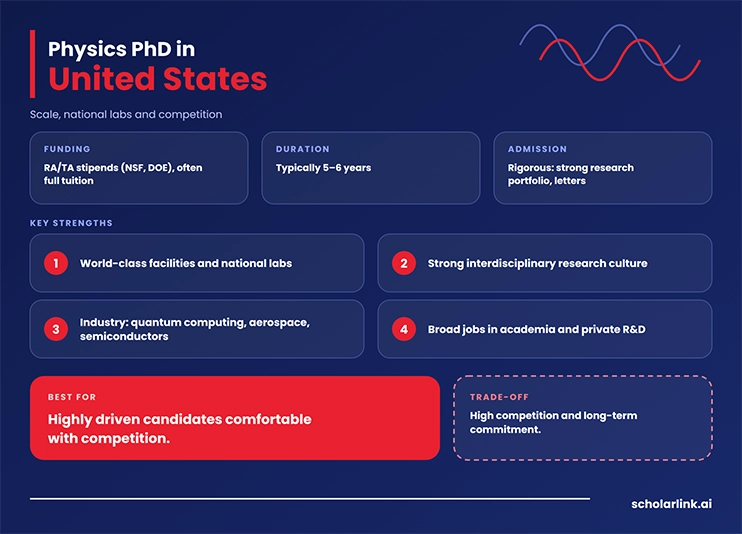
The United States remains one of the most powerful research destinations for physics globally. Its advantage is scale. The country hosts numerous globally recognized universities, national laboratories, and federally funded research centers.
Funding structures are typically based on research assistantships (RA) or teaching assistantships (TA), supported by agencies such as the National Science Foundation (NSF) and the Department of Energy (DOE). In many top programs, PhD students receive full tuition coverage and competitive stipends.
Strengths of the U.S. system include:
- access to world-class research facilities and national labs
- a strong culture of interdisciplinary research
- significant industry collaboration, especially in quantum computing, aerospace, and semiconductor physics
- broad post-PhD employment opportunities in academia and private R&D
However, this ecosystem comes with high competition. Admission processes are rigorous, often requiring strong research portfolios, recommendation letters, and sometimes standardized test components. The PhD duration can also extend 5–6 years.
In practice, the United States favors highly driven candidates comfortable with competitive environments and long-term research commitments. For many, the return on investment, through publication output and global career mobility, remains substantial.
Physics PhD in the United Kingdom
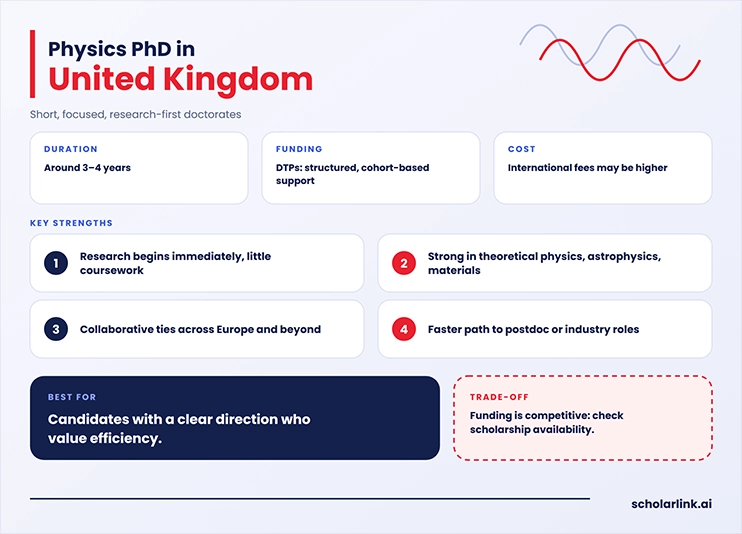
The United Kingdom offers a more streamlined doctoral model. PhD programs are typically shorter (around 3–4 years), with a stronger emphasis on focused research from the outset. Unlike systems with extended coursework phases, UK doctoral programs often expect students to begin research immediately.
This structure benefits students who:
- already possess a clear research direction
- prefer shorter time-to-degree
- aim to enter postdoctoral roles or industry more quickly
The UK also maintains strong collaborative ties within Europe and internationally, particularly in theoretical physics, astrophysics, and materials science. Doctoral Training Partnerships (DTPs) often provide structured funding and cohort-based support systems.
That said, funding can be competitive, and international tuition fees may be higher than in continental Europe. Applicants must carefully evaluate scholarship availability. For students who value efficiency and research intensity, the UK represents a strategic pathway among international destinations for doctoral physics study.
Physics PhD in Switzerland
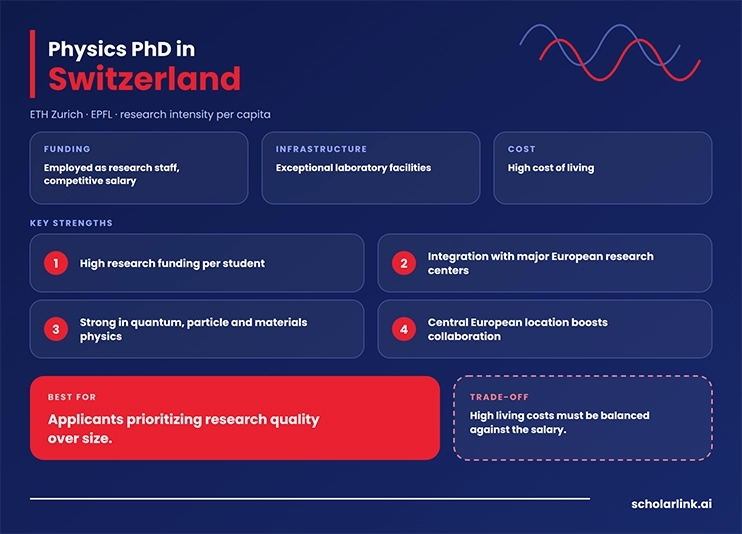
Switzerland consistently ranks among the most research-intensive countries per capita. Institutions such as ETH Zurich and EPFL are globally recognized for excellence in physics and engineering sciences. The Swiss model combines:
- high research funding per student
- strong integration with major European research centers
- competitive salaries for doctoral researchers
- exceptional laboratory infrastructure
Swiss doctoral candidates are typically employed as research staff, receiving salaries that reflect the country’s high living standards. This financial model supports research focus, but it must be balanced against Switzerland’s high cost of living.
Switzerland is particularly strong in quantum physics, particle physics, and materials science. Its central European location enhances international collaboration. For applicants prioritizing research quality over geographic size, Switzerland offers a concentrated and high-impact environment.
Physics PhD in China
China has dramatically expanded its investment in physics research over the past decade. Government-backed funding programs, large-scale research initiatives, and international recruitment strategies have positioned China as an increasingly important research destination for physics. Key characteristics include:
- significant investment in quantum communication and quantum computing
- large-scale national physics projects
- expanding English-language doctoral programs
- growing global research collaborations
China’s research output in physics has grown substantially, and major universities are increasing their international engagement. Funding packages can be competitive, particularly for high-performing international candidates.
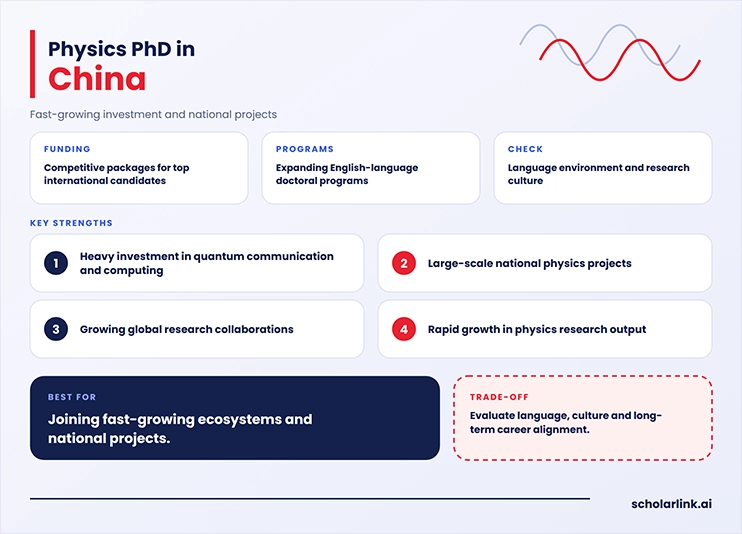
However, applicants should evaluate factors such as language environment, research culture, and long-term career alignment. For students interested in participating in fast-growing research ecosystems and large national projects, China represents an emerging opportunity among top countries for physics research.
Best Universities for a Physics PhD Worldwide
If you only want a single “top list,” rankings can give you that. But most successful physics PhD applicants do something smarter: they start with a research domain (quantum, astrophysics, theory/particle), then identify universities that consistently sit inside strong research ecosystems, meaning active labs, credible supervisors (PIs), reliable funding pathways, and real international collaboration routes.
A practical way to use rankings is as a quality filter, not a decision-maker. Broad subject tables like QS Physics & Astronomy and THE Physical Sciences can help you spot departments with sustained output and reputation, but your final shortlist should be driven by fit: the supervisor’s research agenda, the lab’s capabilities, and the collaboration networks you can realistically enter as a PhD student.
Best Universities by Physics Subfield
| Subfield | Institutions applicants often shortlist | What stands out |
|---|---|---|
| Quantum physics | Caltech (IQIM), TU Delft (QuTech), University of Waterloo (IQC), Chicago Quantum Exchange network | Experimental infrastructure plus links to industry and national initiatives |
| Astrophysics and space science | Center for Astrophysics, Harvard & Smithsonian; University of Cambridge (Institute of Astronomy); Princeton (Astrophysical Sciences); Leiden Observatory | Mission pipelines, instrumentation consortia, dataset access |
| Theoretical and particle physics | Groups inside LHC collaborations (ATLAS, CMS); theory-centric environments such as Perimeter Institute | Collaboration membership, seminar culture, visiting researchers |
Top Universities for Quantum Physics
Quantum is not one field; it is a triangle: quantum computing, quantum materials, and quantum technologies (sensing, networking, hardware engineering). The best destinations for quantum physics tend to have two things at once: (1) serious experimental infrastructure (cleanrooms, cryogenics, device fabrication, measurement), and (2) an ecosystem that connects academia to industry and national initiatives.
A few globally visible quantum hubs that applicants often shortlist:
- Caltech (IQIM): quantum information science intersecting with condensed matter and advanced experimental capability.
- TU Delft (QuTech): quantum computing and quantum internet work with an explicit engineering-and-translation mindset.
- University of Waterloo (IQC): quantum information research with strong training pathways and an ecosystem orientation.
- University of Chicago–anchored network (Chicago Quantum Exchange): multi-institution collaboration spanning national labs and universities, especially relevant if you want your PhD embedded in a broader research network rather than a single lab culture.
Mini-scenario: imagine you want to work on error correction, algorithms, and theory, but you also want to stay close to hardware progress. A “pure theory” department may feel limiting. A quantum center that spans physics, engineering, and national lab partners can make your publication pipeline more diverse (methods papers, experimental collaborations, applied grants), which often helps when you apply for postdoc positions or industry research roles later.
Best Institutions for Astrophysics and Space Science
In astrophysics and cosmology, the highest leverage often comes from research networks: mission pipelines, instrumentation consortia, and collaborations that give doctoral students access to world-class datasets and senior co-authors. The strongest programs usually combine theoretical depth, observational strength, and a steady flow of visiting researchers and postdocs.
- Center for Astrophysics | Harvard & Smithsonian: broad astrophysics research and institutional scale in tools and discovery.
- University of Cambridge (Institute of Astronomy, plus connected cosmology communities): strong cosmology and fundamental physics coverage and a long-standing international research presence.
- Princeton University (Department of Astrophysical Sciences): a wide research surface area across astronomy, plasma physics, and cosmology.
- Leiden University (Leiden Observatory): internationally recognized work across galaxies, exoplanets, and star/planet formation, with deep institutional continuity in astronomy.
Decision point: if you’re aiming for a postdoc, ask a blunt question early: will I be able to publish with data access and collaborators within the first 18–24 months? In astrophysics, this depends heavily on whether the group is plugged into active surveys, missions, and cross-institution pipelines. The “best” university is often the one where the research group already sits inside those networks.
Leading Universities for Theoretical and Particle Physics
For particle physics, especially experimental HEP, universities are often gateways into global collaborations (ATLAS, CMS, and other LHC efforts). The key is not only departmental prestige, but whether the group is an active institutional member contributing hardware, software, and analysis, because that is what turns into papers, conference talks, and serious references.
At the collaboration level, it helps to know what you’re joining: major LHC experiments operate through worldwide networks of universities and laboratories, and doctoral students typically work through their home institution’s role inside that collaboration.
For theoretical physics, the strongest environments are those with dense seminar culture, frequent visitors, and proximity to top researchers across subfields (QFT, gravity, cosmology theory, condensed matter theory). As one example of a theory-centric ecosystem, institutes like Perimeter Institute create a research environment designed around interaction with visiting leaders and intensive theory culture (often linked to nearby university PhD pathways).
Mini-scenario: you’re choosing between a “top-ranked” department where your supervisor is stretched thin across multiple mega-collaborations, versus a slightly less famous department where the PI is hands-on and the group has a well-defined contribution in a major experiment. If your goal is a strong publication record and recognizable internal roles (analysis convener, software lead, detector subsystem work), the second option can outperform the first, because access and mentorship beat brand alone.
Physics Research Opportunities Abroad
Physics opportunities abroad are not one single pathway. They are a set of funding and collaboration structures that determine how you enter a lab, who pays for your work, what you are expected to produce (papers, patents, prototypes), and how portable your research network becomes after graduation. The same country can feel completely different depending on whether you are funded by a national scholarship, a PI grant, or an industrial partner.
A realistic example: two students join the same department. One is fully funded through a national fellowship with freedom to choose a topic within a broad area. The other is funded through a PI’s industry-linked grant with a defined deliverable and tighter deadlines. Both get a PhD. Their day-to-day research life, publication strategy, and job outcomes can diverge sharply.
That’s the lens for this section: not just “where,” but “how” you plug into global physics research.
| Opportunity type | How it works | Best if you… | Watch out for |
|---|---|---|---|
| Fully funded PhD | Tuition coverage plus stipend or salary | Want lower financial risk | Teaching load, duration guarantee, summer funding |
| RA / TA | Paid via PI grant (RA) or teaching duties (TA) | Work in an infrastructure-heavy subfield (RA) | Teaching time slowing experimental work (TA) |
| Industrial PhD | Project co-defined with an industry partner | Want an industry career | IP rules limiting publications |
| Joint PhD / cotutelle | Two universities, often in two countries | Need two ecosystems | Double bureaucracy, two committees |
| Collaboration networks | Multi-institution projects, visits, shared facilities | Want global co-authorship | Access depends on your group’s role |
Fully Funded Physics PhD Programs
A “fully funded PhD” usually means tuition coverage plus a living stipend (or salary), often for the expected duration of the program. For international destinations for doctoral physics study, fully funded models are common, but the funding source matters. Typical sources include:
- University packages allocated at admission (common in some U.S./Canada programs)
- National research council funding awarded competitively (common across many countries)
- Institute-based funding (research institutes or lab-centered programs)
- Supervisor/PI grants that cover doctoral researcher costs
A fully funded offer reduces your financial risk, but check the hidden variables: duration guarantees, teaching load expectations, and whether summer funding is included. Applicants sometimes accept a “funded” offer that quietly assumes heavy teaching or uncertain renewal.
Research Assistantships vs. Teaching Assistantships
In many top countries for physics research, a Research Assistantship (RA) is the most direct way into a productive lab. You are paid through a PI’s grant to work on a research agenda that already has momentum: equipment, collaborators, and often a publication plan. This can accelerate your early output, which matters for postdoc competitiveness.
Teaching Assistantships (TA) can also be valuable, but they trade time for stability. Some students enjoy teaching and build strong academic CV signals; others find that teaching loads slow down experimental work.
Decision point: if your subfield is infrastructure-heavy (experimental condensed matter, photonics, plasma, instrumentation), a strong RA position often produces faster research progress than a TA-heavy structure. If your subfield is theory-heavy, the balance can be more forgiving, but time is still time.
Industrial PhD Programs
An Industrial PhD sits at the intersection of doctoral research and applied R&D. Your research problem is often defined with an industrial partner, and your work may be co-supervised by a university professor and an industry researcher. In physics, this is common in areas like:
- semiconductor physics and device engineering
- quantum technologies (hardware, sensing, control systems)
- photonics and telecommunications
- energy materials and applied computational physics
Industrial PhDs can be a strong option if you want a post-PhD industry pathway. They also tend to provide clearer project direction and, in some cases, better compensation.
Trade-offs exist. Publication timelines can be constrained by intellectual property (IP) rules, and some projects prioritize prototypes over papers. If your long-term goal is a postdoc and academic career, ask early how publication rights are handled and whether peer-reviewed output is expected.
Joint PhD and Cotutelle Pathways
A Joint PhD (sometimes structured as a cotutelle) is a formal doctoral arrangement between two universities, often in two different countries, where you may have:
- two supervisors (one at each institution)
- research time split across locations
- a degree recognized by both institutions (depending on the structure)
For physics research opportunities abroad, joint structures can be powerful when your project needs access to two ecosystems, say advanced instrumentation in one country and a theory group or national lab access in another.
Mini-scenario: you want to work on detector physics for a large experiment, but your home institution is strong in simulation while another partner university has direct access to hardware testing facilities. A joint pathway can create a higher-impact PhD, if the administrative setup is solid and both supervisors are genuinely engaged.
Joint structures can also improve postdoc mobility because your recommendation network becomes international by design. But the coordination burden is real: two committees, two sets of milestones, and sometimes two bureaucracies.
International Collaborations and Research Networks
Not all international experience requires a formal joint degree. Many physics PhD students build global networks through collaboration mechanisms like:
- co-authorship across multi-institution projects (common in particle physics and astrophysics)
- visiting researcher periods at partner labs
- shared facility access (large instruments, cleanrooms, observatories)
- international conference circuits and summer schools
These collaborations matter because physics is increasingly “network science.” Admissions committees, PIs, and postdoc panels pay attention to whether your work travels: whether your papers involve recognized collaborations, whether you can operate inside international teams, and whether your supervisor’s network opens doors.
Choosing a destination that is deeply integrated into global collaborations can create compounding advantages: earlier co-authorship, more conference exposure, and stronger post-PhD references.
Comparing International Physics PhD Destinations
When applicants compare physics PhD destinations, the conversation often gets stuck on prestige. A faster, more reliable way to decide is to compare systems: how PhD funding works, what daily life costs, whether language affects research and employment, and what happens after graduation.
Here’s a real decision snapshot. Imagine you have two offers: one in a world-famous U.S. department with strong facilities but a long PhD timeline and competitive post-study immigration, and another in a high-output European country with lower living risk, clearer post-study work options, and a supervisor whose group publishes consistently. The “better” destination depends on what you optimize for: time-to-degree, income stability, industry access, or migration clarity.
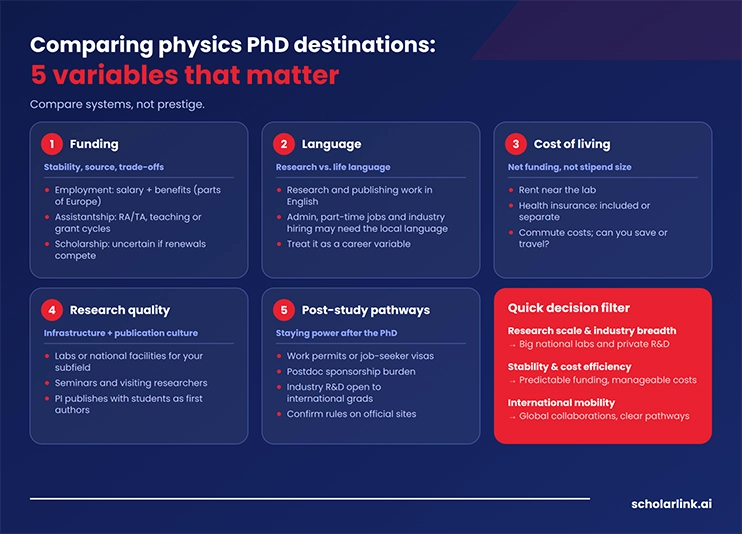
The five variables below usually determine whether a physics PhD feels sustainable or stressful.
1. Funding: Stability, Source, and Trade-Offs
Funding models vary sharply by country, and they shape your freedom and research pace.
- Employment-style funding (common in parts of Europe) often means salary plus benefits, and it tends to be more predictable across the PhD duration.
- Assistantship-based funding (common in the U.S. and Canada) can be generous, but it may include teaching loads or depend on grant cycles.
- Scholarship-heavy systems can be excellent if you secure a top award, but they can create uncertainty if renewals are competitive.
Quick heuristic: if your subfield is experimental and equipment-intensive, prioritize systems where PI grants and institutional infrastructure are strong and consistent. If your subfield is theoretical, you can sometimes tolerate more variation in infrastructure, but funding stability still matters.
2. Language: Research Language vs. Life Language
Physics is globally published in English, but that does not mean language is irrelevant.
- In many countries, you can conduct research and publish in English, yet administration, part-time work, and industry hiring may require the local language.
- Some destinations offer English-friendly doctoral environments but become language-sensitive when you seek internships or post-PhD jobs outside academia.
A practical example: you may complete an English-language PhD smoothly, then discover your strongest job market (industry R&D) expects professional-level local language. If your long-term plan includes staying after graduation, treat language as a career variable, not a lifestyle detail.
3. Cost of Living: Your Real “Net Funding”
A country can offer a strong stipend and still feel financially tight if housing and daily costs are high. The correct comparison is net funding after essentials, not stipend size on paper. Evaluate:
- typical rent near your lab/university
- health insurance structure (included vs. separate)
- transportation costs and commute time
- whether you can realistically save or travel for conferences
High-cost destinations can still be excellent if salaries are aligned with local expenses, but avoid the trap of “great program, constant financial pressure.” Chronic money stress quietly reduces research productivity.
4. Research Quality: Infrastructure + Publication Culture
Research quality is not only about famous names. It is about whether the ecosystem reliably supports publication and collaboration. Key signals:
- access to advanced labs or national facilities relevant to your subfield
- active seminar culture and visiting researchers
- PI track record of publishing with PhD students as first authors
- cross-institution collaboration norms (especially in particle physics and astrophysics)
A slightly less famous institution inside a strong research cluster can outperform a higher-ranked department that lacks infrastructure or hands-on mentorship. This is why “best universities for physics PhD” is often a group-level and PI-level question, not only a university-level one.
5. Immigration and Post-Study Pathways: Staying Power After the PhD
If you want the option to stay after graduation, whether for a postdoc, industry role, or long-term settlement, post-study pathways matter. Compare:
- availability of post-study work permits or job-seeker visas
- how easily postdocs can be sponsored (university vs. employer burden)
- whether industry R&D hiring is friendly to international graduates
- time needed to transition from student status to work status
This is often the make-or-break factor for international destinations for doctoral physics study. Two countries can both be top countries for physics research, yet offer very different levels of clarity for long-term mobility. Visa rules change often, so always confirm current requirements on the official immigration website of each country.
Quick Decision Filter
| If you want to maximize… | Look for systems with… |
|---|---|
| Research scale and industry breadth | Large national labs and big private-sector R&D |
| Stability and cost efficiency | Predictable funding and manageable living costs |
| International mobility | Strong global collaborations and clear post-study pathways |
Final Thoughts: Choosing the Right Destination for Your Physics Career
There is no universal “best” among global research destinations for physics, only the destination that aligns with your research direction, risk tolerance, and long-term ambition. A student aiming for a tenure-track path in theoretical physics may prioritize dense seminar culture, internationally visible supervisors, and early publication exposure. Another pursuing quantum engineering may optimize for industrial integration and applied research funding. The right answer depends on the problem you want to solve, and the system that allows you to solve it well.
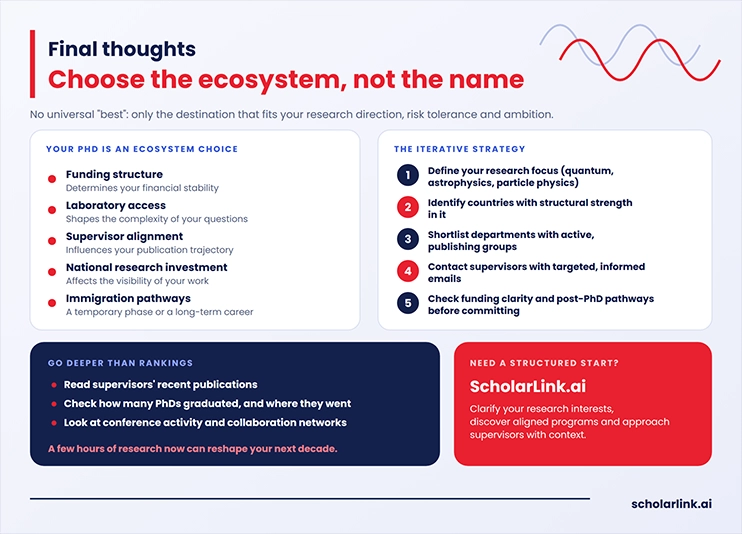
Your physics PhD is not just a degree. It is an ecosystem choice:
- Funding structure determines your financial stability.
- Laboratory access shapes the complexity of questions you can pursue.
- Supervisor alignment influences your publication trajectory.
- National research investment affects the visibility of your work.
- Immigration pathways influence whether your PhD becomes a temporary academic phase or the beginning of a long-term career in that country.
If you feel uncertain, that is normal. Most applicants initially focus on country reputation, then slowly realize that subfield fit and PI alignment matter more. The smartest strategy is iterative:
- Define your research focus clearly (quantum, astrophysics, particle physics, etc.)
- Identify countries with structural strength in that area
- Shortlist departments with active, publishing research groups
- Contact supervisors with targeted, well-informed emails
- Evaluate funding clarity and post-PhD pathways before committing
That process turns an overwhelming global search into a structured decision framework.
Before making a final choice, go deeper than rankings. Read recent publications from potential supervisors. Check how many PhD students they have graduated, and where those graduates went. Look at conference participation and collaboration networks. A few hours of careful research now can reshape the next decade of your career.
If you want a structured way to explore international destinations for doctoral physics study, identify strong supervisors, and compare funding models across countries, ScholarLink.ai can help streamline that process. Instead of searching blindly, you can clarify your research interests, discover aligned programs, and approach potential supervisors with confidence and context.
Your destination will shape your scientific identity. Choose it deliberately.
FAQ: Physics PhD Abroad
Which country is best for a physics PhD?
There is no single best country. Germany and Switzerland stand out for employment-based funding and stability, the United States for scale, facilities and industry breadth, the UK for a shorter PhD of around 3–4 years, and China for fast-growing national projects. Match the country to your subfield, funding needs, and plans after graduation.
Is a physics PhD usually funded?
Fully funded physics PhDs are common in many countries, but the model differs: salaries in parts of Europe, RA/TA stipends with tuition coverage in the U.S., and competitive scholarships or DTP funding in the UK. Always check the duration guarantee, teaching load, and summer funding before accepting an offer.
How long does a physics PhD take in the US vs. the UK?
U.S. programs can extend to 5–6 years, while UK programs are typically shorter, around 3–4 years, because students are expected to start focused research from the outset.
Which country pays PhD students a salary?
In Germany, many doctoral candidates are hired as research staff and receive a salary rather than a stipend. Switzerland also typically employs doctoral researchers, with salaries that reflect its high cost of living.
Which countries are best for quantum physics research?
Germany, the United States, Switzerland and China all invest heavily in quantum technologies. Hubs applicants often shortlist include Caltech (IQIM), TU Delft (QuTech), the University of Waterloo (IQC) and the Chicago Quantum Exchange network.
What are the best universities for an astrophysics PhD?
Commonly shortlisted options include the Center for Astrophysics | Harvard & Smithsonian, the University of Cambridge, Princeton University and Leiden Observatory. What matters most is whether the group is connected to active surveys, missions and data pipelines.
Do I need to speak the local language to do a physics PhD abroad?
Research and publishing are generally in English, but administration, part-time work and industry hiring may require the local language. If you plan to stay after graduation, treat language as a career factor.
Is a research assistantship better than a teaching assistantship?
For infrastructure-heavy subfields, an RA usually speeds up research because you are paid to work on a funded project. A TA offers stability and teaching experience but can reduce research time.
What is a joint PhD (cotutelle)?
A formal doctoral arrangement between two universities, often in different countries, with two supervisors and research time split across locations. It can widen your network but adds administrative load.
Can I stay and work in the country after my physics PhD?
It depends on the country’s post-study work permit or job-seeker visa rules and on how easily postdocs can be sponsored. These rules change, so check the official immigration website of your target country.
Does the university ranking matter for a physics PhD?
Rankings such as QS Physics & Astronomy or THE Physical Sciences are useful as a quality filter, but supervisor fit, lab capabilities and collaboration networks should drive your final shortlist.