

Your university acceptance letter and your tuition payment receipt—both are ready to submit. But you couldn’t write your Study Plan yet because you’ve read stories about study permits being refused because applicants mentioned wanting to work in Canada after graduation, and now you’re thinking that one wrong sentence could affect your entire application. Now the most important question you may have is what does a visa officer really want from a study plan? A strong study plan in Canada is not about impressive writing. It’s about proving that your studies make sense under their rules, that your financial situation is acceptable to pay for your expenses, and that you understand the temporary nature of your study permit.
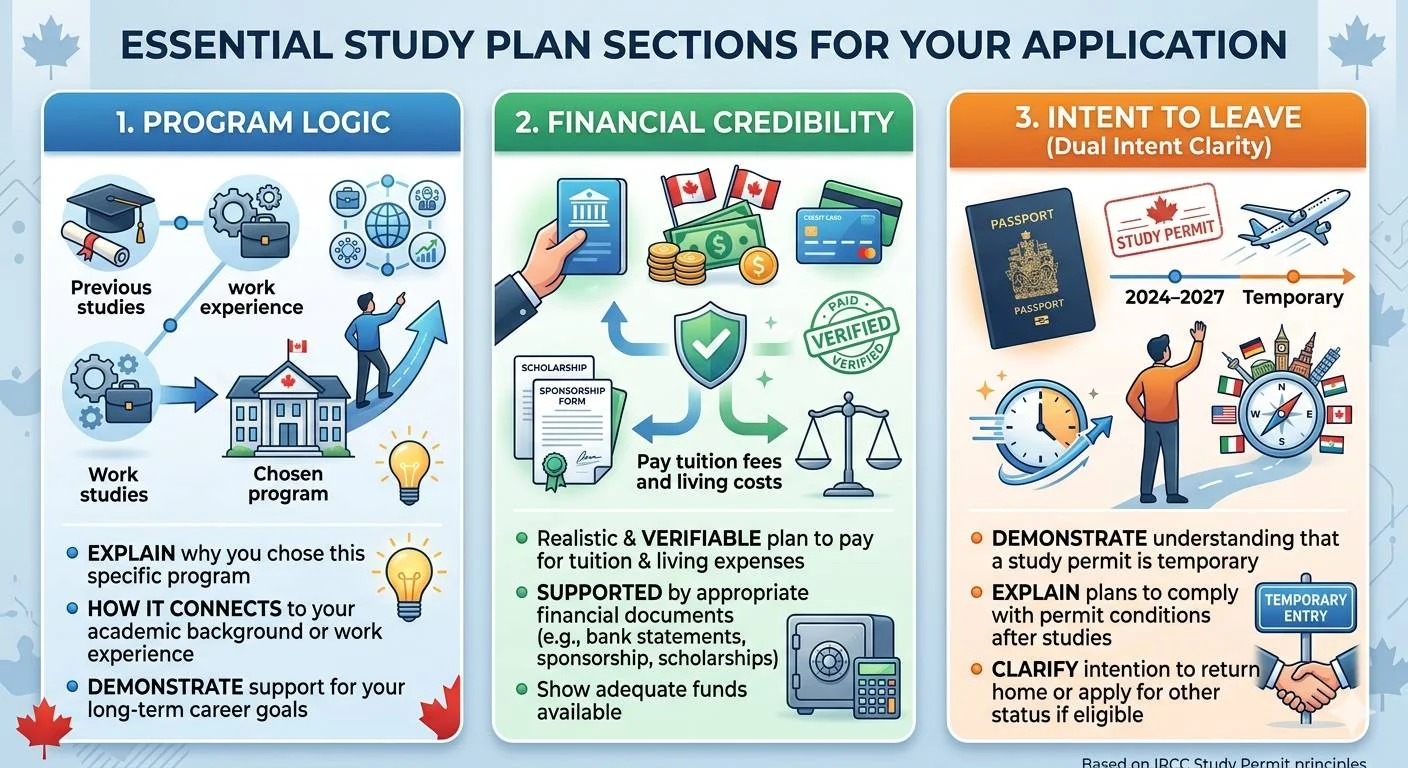
| Study Plan Sections | description |
| Program Logic | Explain why you chose your program, how it connects to your academic background or work experience, and how it supports your future career goals. |
| Financial Credibility | Show that you have a realistic and verifiable plan to pay for your tuition and living expenses, supported by appropriate financial documents. |
| Intent to Leave (Dual Intent Clarity) | Demonstrate that you understand a Canadian study permit is temporary and explain your plans to comply with its conditions after completing your studies. |
- Don’t focus more on staying in Canada than on clearly explaining your academic purpose and program choice.</li>
- Don’t use vague or generic statements that could apply to any applicant without showing your personal academic logic.</li>
- Don’t ignore financial clarity or post-study plans, as visa officers look for consistency across your entire application.</li>
This guide explains exactly what officers evaluate, how to structure your study plan, and how to avoid the common mistakes that can affect your study permit refusals.
What Is a Study Plan and Why It Matters
A study plan is a personal document sometimes also called as Canada study plan statement of purpose and help students to explain why they choose a specific program, institute, and Canada, and what they plan to do after finishing that program.
A study plan is not mandatory but it’s recommended and will help you to get your Canadian Student Visa. Some people think that a study plan is the same as a Letter of Explanation, while they are completely different. In fact, Letter of Explanation usually answer to a specific gap or concern in the application process, while a study plan explain the applicant’s overall academic background and long-term educational direction.
In evaluating your study plan, the visa officer is basically determining the following: Logic of the program to your career :</strong> If your choice of program is logically sound based on your academic background, work experience, and future career intentions.
Financial viability: </strong> If it is feasible for you to pay for your tuition and maintenance based on consistent and credible financial documents.
Temporary intent (dual intent explained): </strong> If you realize that the study permit is only temporary, although any long-term intentions should be stated legally and credibly.
Comparing Study Plan vs. Letter of Explanation
| Document | Purpose |
| Study Plan | An academic document in structured form that outlines your entire academic experience – why you selected your program, university, and country; how it relates to your academic profile and career ambitions; and what skills or achievements you expect to gain upon completion. It is concerned with your academic reasoning and program progression.
|
| Letter of Explanation | A supplementary immigration document provided to IRCC for clarification purposes regarding various issues in your application, such as gaps in studies, finances, previously denied visa applications, peculiar documents, and more.
|
Understanding What Visa Officers Are Really Looking For
As the most common misconception concerning a Canada study permit visa officer evaluation criterion, the belief lies in the idea that your study plan is assessed as an ordinary writing task. Actually, visa officers do not evaluate your language skills, the way you structure your text or the range of vocabulary used by you. Instead, they assess your level of risk, credibility and consistency throughout the whole process of application. Each sentence of your study plan will be checked in conjunction with your academic background, financial documents and future plans.
Canada study permit visa officer evaluation criteria are as follow:
- A logical educational and career path: Visa officers want to see a natural link between your previous education or professional experience and your future job’s goal. In case if your path seems unclear, there will be doubts about your true goal.
- Financial preparedness without contradictions: It is not enough just to declare that you can pay for your studies in Canada. You have to show in your study plan how it all matches with your bank account statements, sponsors’ details and your proof of financial support. The contradiction between what you write and what you submit can reduce credibility.
- Confidence in temporary intent: Officers must be convinced that you understand the temporary nature of a Canadian study permit and that you will comply with its conditions. This does not mean you cannot have future immigration ambitions, but your application must clearly show that your immediate purpose is education.
In recent years, Canada’s study permit system has changed greatly due to higher application volumes and evolving immigration policies. As a result, decision-making has become more detailed and evidence-focused; this means that inconsistencies or unclear narratives will lead to rejection in the process.
Understanding Dual Intent (And Why It’s Not Disqualifying)
Many students applying for study permits in Canada fear mentioning their future intentions of working and/or staying in Canada will prevent them from obtaining their study permits. Fortunately, this is not true; Canadian immigration legislation recognizes dual intent Canada study permit by IRCC meaning that applicants who wish to study temporarily in Canada may also have an intention of applying for PR if they are eligible and wish to do so at a later date.
The dual intent does not, however, negate the requirement that an applicant demonstrate their ability to meet the definition of a genuine temporary resident. Therefore, an applicant’s study plan must indicate the same intent to attend school in Canada as they would if they were applying for an S1 Visa or any other form of temporary residency while in Canada. A study plan would need to clearly outline that the sole purpose of completing their education is to satisfy the requirements of a Canadian study permit. In addition, should an applicant’s long-term plans to immigrate to Canada fail (i.e. failure to gain PR), then the applicant would have to prove that they intend to leave Canada upon completion of the terms of their study permits.
An applicant’s reference to their long-term plans within their study plan could greatly influence whether their study permits will be approved or disapproved.
A strong Canadian student visa study plan acknowledges future possibilities honestly while keeping the focus on your education. Your immediate objective should always be presented as successfully completing your program, respecting the conditions of your study permit, and applying the knowledge and skills you gain—whether your future career develops in Canada or in your home country.
| Safer Framing | Riskier Framing |
| My first goal is to complete my degree and apply the knowledge and skills I gain to advance my career. | My main reason for studying in Canada is to immigrate permanently. |
| After graduation, I hope to gain professional experience through the Post-Graduation Work Permit (PGWP). If I become eligible, I may explore permanent residence pathways while complying with Canadian immigration laws. | I choose this program because it is the easiest path to permanent residence. |
| If I am not eligible to remain in Canada, I plan to return to my home country and find an opportunity that align with my new skills. | I do not have plan to return to my home country after graduation. |
How to Structure Your Study Plan
If you’re planning to study in Canada, one of the most important parts of your student visa application is about to know how to structure a Canada study plan.
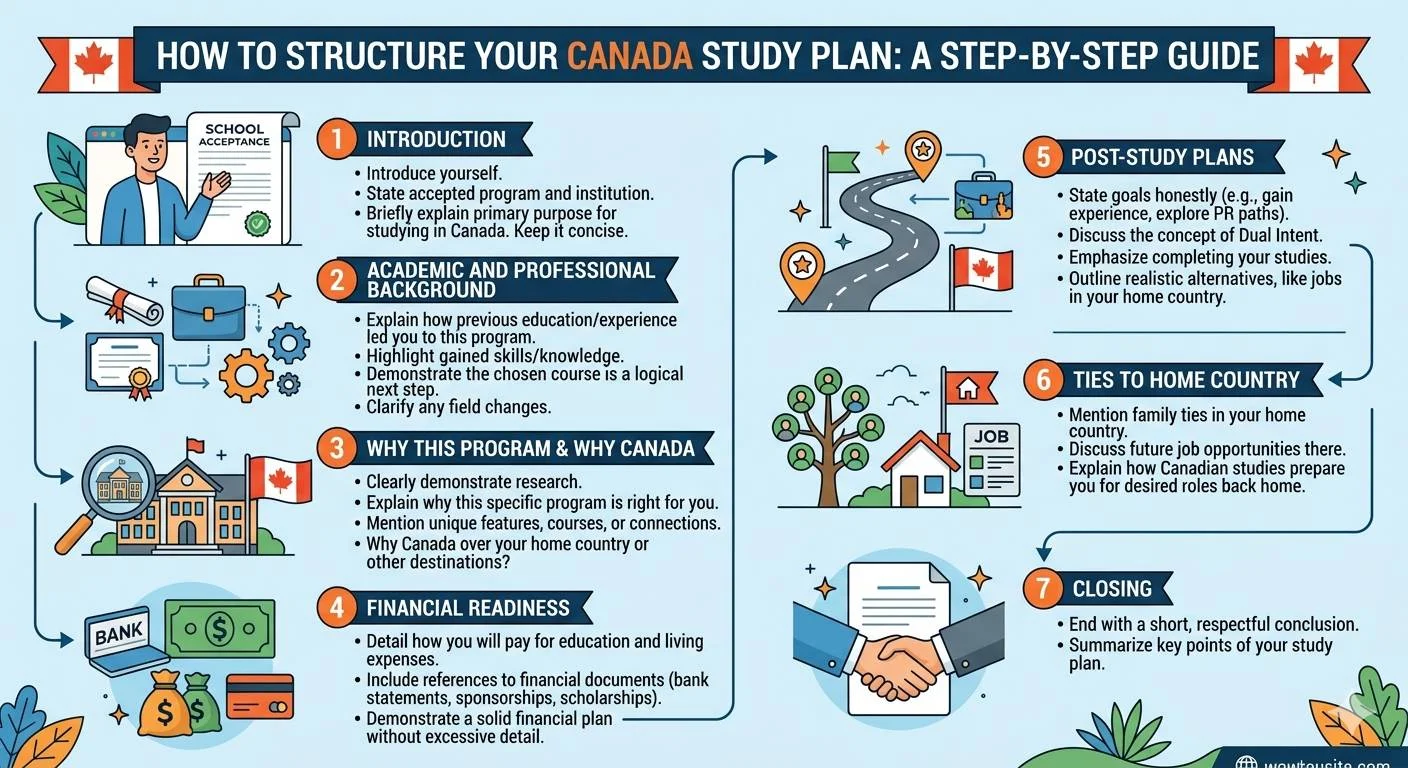
Here is a step-by-step guide to write your Canada study plan:
Step 1: Introduction
introduce yourself and state the essentials of your application. Mention the program you have been accepted into, the institution you will attend, and include a brief statement explaining your primary purpose for studying in Canada. Keep this section concise and set the context for the rest of your study plan.
Step 2: Academic and Professional Background
Explain how your previous education, training, or work experience has led you to this program. Highlight the skills and knowledge you have already gained and demonstrate why your chosen course is the logical next step in your academic or professional development. If you are changing fields, explain the reason for the transition and how it supports your long-term goals.
Step 3: Why This Program and Why Canada
Clearly demonstrate you have researched both your program and you’re your university. Instead of making generic statements such as “Canada has a great education system,” explain why this particular program is appropriate for you. You can refer to specific courses or expertise, practical learning opportunities, industry connections, or unique features that support your career goals. Also explain why studying in Canada is a better fit for your goals than studying a similar program in your home country or another destination. Totally answer this clearly and honestly: Why is Canada your preferred destination?
Step 4: Financial Readiness
Exactly tell how you will pay your education and living expenses. Your study plan should contain financial documents included in your application, such as bank statements, sponsorship letters, scholarship awards, or proof for your income. Avoid unnecessary detail—simply demonstrate that you are able to handle your financial plan.
Step 5: Post-Study Plans
Explain what you plan to do after you complete your studies. If you hope to gain professional experience in Canada through a Post-Graduation Work Permit (PGWP) or explore permanent residency pathways in the future, you should explain your goals by mentioning the concept of dual intent, so be sure to state your goals honestly in this section and emphasize that your goal is to complete your studies and meet the requirements of your study permit. Your text should clearly tell that your study program has a realistic alternative, such as following job opportunities in your home country, if your long-term plans failed.
Step 6: Ties to Home Country
For this question, you need to say if you have family in the country where you live or are a citizen. talk about the different jobs you’ve looked for in your country. Maybe you found a good job, but you don’t have the right education for it. in that case, you can explain how studying in Canada will help you get ready for that job.
Step7: Closing
End your study plan with a short and respectful conclusion and add key points as a summary.
Demonstrating Strong Ties to Your Home Country
One of the most common reasons for a Canadian student visa to be rejected is the student’s inability to convince the visa officer that they will be leaving Canada after the end of their authorized period of study. This is why demonstrating strong ties to your home country is an important part of your study plan. Your goal is not to simply state that you have ties to that country, but rather to provide specific, demonstrable details that show what your plans are after completing your course.
Here are some of the strongest ways to show ties to your home country:
Addressing Family Ties: To show your ties to your town for Canada study permit you must state you have family in your country of residence or citizenship. Family ties may include children, parents, a spouse, or a partner. mention who they are and, where relevant and your responsibilities toward them.
Property or financial assets: Show your documents include: Property ownership documents or title deeds, Mortgage or loan statements, Long-term rental or lease agreements, Utility bills in your name to proof that your life is established elsewhere not in Canada.
Employment or career opportunities: if you have a position to return to or a job opportunity that aligns with your expected graduation date explain them and mention how Canadian education will help you improve your career situation back home.
Professional or community involvement: Membership in professional organizations, family businesses, community projects, or other commitments can demonstrate that you have a real goal outside Canada.
| Type of Tie | How to Reference It in Your Study Plan |
| Family | Explain which your family members (such as your spouse, children, or dependent parents) will remain in your home country and briefly describe your responsibilities toward them. |
| Property | Mention any property, business, or significant assets you own and explain how they will persuade you to return after end of your program. |
| Employment | Describe you have a current job, a confirmed job offers, or realistic career opportunities that make you return after graduation, and explain how your Canadian qualification supports those goals. |
| Community | Include a professional association, community organizations, volunteer work, or a family business to demonstrate you have a long-term personal and professional connections to your home country. |
Common Mistakes That Weaken a Study Plan
- Tell your program choice clearly: Generic statements like “Canada have a good education system” don’t explain why you chose a specific program or institution.
- Focusing more on immigration than education: Emphasize on staying in Canada more than your academic goals may increase concerns about your true intent.
- Skipping your post-study plans: Don’t leave the visa officer guessing about what comes next. Briefly explain how you plan to use your Canadian education after graduation.
- Using a generic template: A study plan that sounds copied or could apply to anyone is not appropriate. Write a personal writing about your goals and experiences.
- Refuse to talk about previous refusals or study gaps: Unexplained refusals, career changes, or education gaps may be viewed as red flags.
- Providing wrong information: Your study plan should match your financial, academic, and supporting documents to avoid credibility concerns.
Frequently Asked Questions
What is a study plan for a Canada student visa?
A Canada study plan is a personal document that explains why you chose your program, your institution, and Canada as your study destination. It also outlines your academic background, career goals, financial readiness, and post-graduation plans to help a visa officer understand that your application is genuine and well planned.
Is a study plan mandatory for a Canadian study permit?
A study plan is not always a mandatory document for a Canadian study permit. However, it is strongly recommended because it helps explain the purpose of your studies and addresses factors that visa officers evaluate.
What is dual intent and how should I mention it in my study plan?
Dual intent means you may hope to become a permanent resident in the future while genuinely intending to enter Canada as a temporary student today. If you mention it, focus on completing your studies first and explain that you will respect the conditions of your study permit if your long-term immigration plans do not succeed.
How long should a Canada study permit study plan be?
Most effective study plans are between one and two pages, or approximately 500 to 1,000 words. Rather than making it longer, focus on providing clear, specific, and evidence-based explanations that match the supporting documents in your application.
How do I show strong ties to my home country in a study plan?
Describe specific ties instead of making general statements. Mention immediate family members who remain in your home country, property or business ownership, employment or future career opportunities, and community or professional commitments that support your intention to return after completing your studies.
What is the difference between a study plan and a Letter of Explanation?
A study plan presents your overall academic journey, explains why you chose your program, and connects your education to your future career goals. A Letter of Explanation, on the other hand, is usually written to clarify a specific issue in your application, such as a study gap, previous refusal, or unusual circumstances.

ScholarLink AI
Your Ultimate Admission Co-Pilot
- 🎓 Professors Database: World’s largest supervisor directory
- 📡 Live Positions: Real-time faculty openings & vacancies
- 👥 Students Database: Connect with successful applicants
- 🎯 Smart Matching: AI-driven professor recommendation
- 💰 Funding Analysis: Real-time lab & research funding data
- 📝 Apply Management: Track applications & cold emails