

Applying to study in the United States is an exciting step in your academic way.Postgraduate programs attract a diverse range of students, and the United States is the destination of many of the world’s most respected educational institutions. Before you apply to study at a United state university, know the application process for your desired program and institution. student requirements different in each major, some subjects also need a portfolio.
The postgraduate application procedure can present multiple opportunities to international students. Coming to study in the USA will expose students to world-class education, facilities for research, networks, access to internships and research, and gain professional skills which will enhance one’s career prospects in a globalised workforce.
Nonetheless, international students will face multiple problems in this application procedure. Problems in applying to study in the USA are as follows: Application documentation, English and Standardized Testing (TOEFL/IELTS, GRE/GMAT), Visa and Immigration and Adaptation to the new learning and cultural environment.
Careful planning, diligent research and application deadlines must be met for successful application procedure in post-graduate education.
In this article, we will discuss the application process of postgraduate studies for International students in the USA.
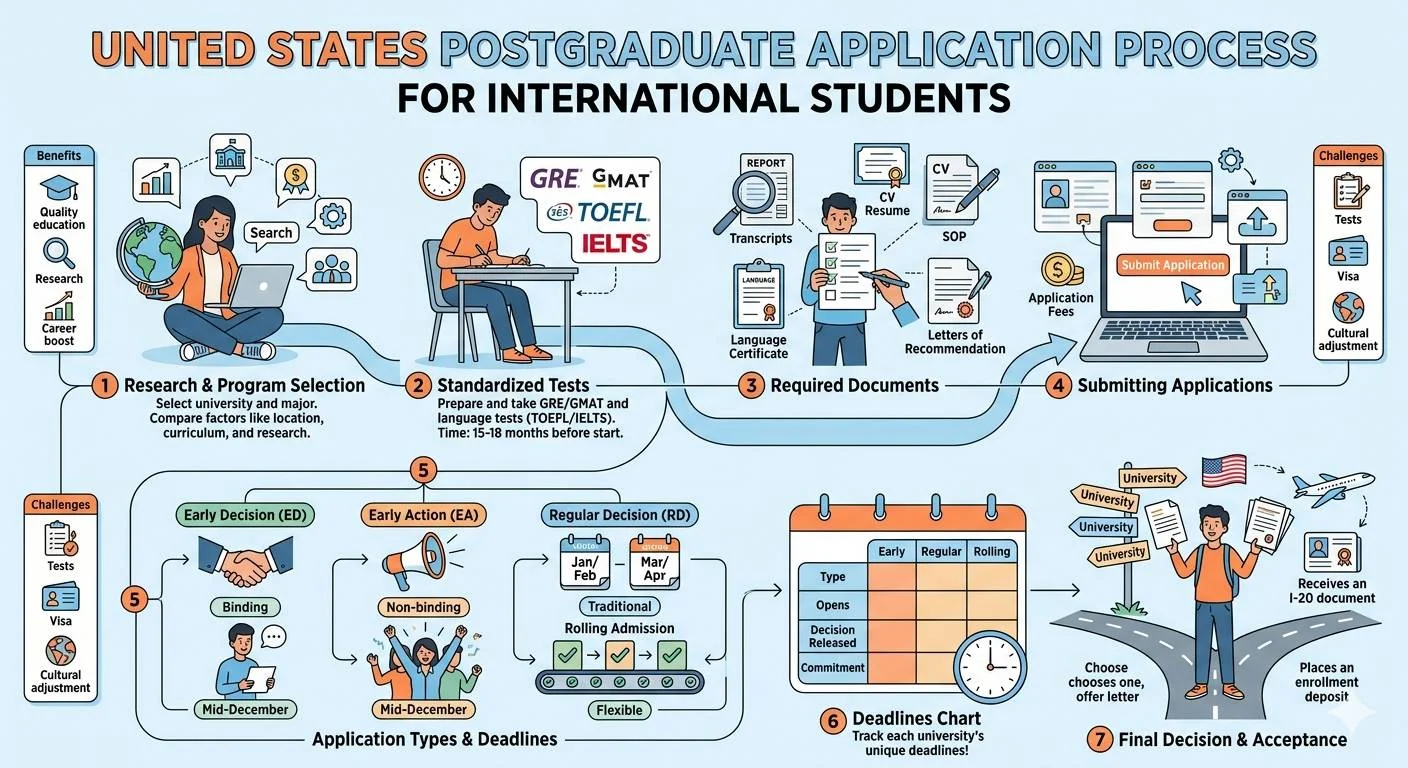
United States Postgraduate Application Process for International Students
Step 1 – Research and Program Selection
To choose the best university for a postgraduate program, students should carefully evaluate several important factors. They should compare different universities, academic programs, and majors to find one that best matches their academic interests and career goals. Other factors to consider include university rankings, tuition and other program costs, the location of the university, the quality of its educational programs, research opportunities, faculty expertise, and the availability of scholarships or financial aid. Evaluating these factors will help students make an informed decision and select the university that best meets their needs.
Step 2 – Standardized Tests
Postgraduate programs in the United States require students to submit standardized test scores as part of the admission process. The GMAT and GRE are the most important standardized tests for postgraduate programs. These exams help universities evaluate applicants’ academic readiness, English language proficiency, and subject-specific skills. The required tests depend on the program and university, so international students should carefully review the admission requirements of their universities before registering for an exam.
The Graduate Record Examination (GRE) is one of the most widely accepted standardized tests for admission to master’s and doctoral programs across a variety of academic majors. The GRE General Test measures three core skills: verbal reasoning, quantitative reasoning, and analytical writing. A strong GRE score can strengthen an application and may improve opportunities for scholarships, fellowships, or graduate assistantships for international students.
GMAT is designed for applicants to MBA and other business-related graduate programs. GMAT specifically accepted for business school admissions. The exam evaluates analytical, quantitative, verbal, and data interpretation skills that are essential for success in business education.
International students also should have standardized language tests such as the Test of English as a Foreign Language (TOEFL) or the International English Language Testing System (IELTS). These examinations assess four language skills: reading, listening, speaking, and writing.
Applicants should take the GRE or GMAT approximately 15 to 18 months before their intended program start date. English proficiency tests should also be completed several months before application deadlines.
Step 3 – Required Documents
| Postgraduate Application Process Required Documents | Purpose | Preparation Tips |
| Academic Transcripts | Official transcripts provide a record of the applicant’s academic performance, including courses completed and grades earned. Universities use transcripts to evaluate academic ability of students | Request official transcripts from all previously attended institutions well in advance. If the transcripts are not in English, provide certified English translations. |
| English Language Certificate (TOEFL/IELTS) | International students whose first language is not English must have English Language Certificate | Try to take the language tests required for your desired field and get a high score in this area to increase your chances of being accepted. |
| Curriculum Vitae (CV) or Resume | A CV or resume demonstrate the student’s educational background, research experience and work experience. It’s given committee information about applicant’s qualifications beyond academic transcripts. | Strongly show your achievements, research projects, internships, technical skills, certifications, and extracurricular activities relevant to the field of your study. |
| Statement of Purpose (SOP) or Personal Statement | The Statement of Purpose is one of the most important parts of the application. It explains the student’s academic background, research interests, career goals and reasons for choosing the program | Create a professional and polished SOP that explains your academic interests, career goals, and why you are applying to that university. Avoid general statements and tailor each SOP to the specific program. |
| Recommendation letters | They help admissions committees to understand better student’s abilities from the perspective of professors, supervisors, or employers. | Find recommenders who well know your academic or professional work.
Request letters early, and ask them to provide a good recommendation letter they will prepare strong recommendations with your CV and program information at a sufficient time. |
Step 4 – Applications submission
Majority of universities use an on-line system, where students register an account, enter their personal and academic data, upload all required documents and pay the admission fee. Make sure to double-check all fields of the application form and to be consistent with the uploaded documents before you submit it.
The most crucial element of an application strategy is the timing. Should you apply for Early Decision (ED), Early Action (EA), Regular Decision (RD) or Rolling Admission? Let’s explore the meanings of each application type.
Application Type
- Early Decision (ED): Early Decision is almost similar to Early Action in terms of deadlines but is binding. In case students get accepted, they are supposed to attend that particular university and will have to cancel all the other applications they made elsewhere.
- Early Action (EA): Early Action allows students to apply for colleges earlier than other students and receive their admission responses earlier too. Students will receive the admission response usually in mid-December. Early action programs are not binding; therefore, students can still apply to other colleges after applying through early action.
- Regular Decision (RD): Regular Decision is the traditional form of college application whereby students will apply in January and February and receive admission responses between March and April.
- Rolling Admission: Rolling Admission refers to a more flexible application procedure, whereby universities assess students’ applications as soon as they arrive, rather than after the deadline. Generally, candidates get a response about whether they have been accepted or not within four to six weeks of their application. As the universities keep on filling vacancies right through the admission season, submitting your application early increases the likelihood of acceptance.
Tips to complete application
students should carefully follow all university instructions and ensure that every requirement is ready. Before submit an application, check the following recommendations:
- Read through the admission criteria and procedure of each university.
- Fill out the form truthfully and completely.
- Ensure consistency of names, dates, grades, and other personal details on all documents.
- Ensure that you have uploaded the correct type and size of files.
- Check if the recommendation letters and test scores have been uploaded.
- Pay the necessary application fees on time, if any.
- Check everything and then click “submit.”
- Keep copies of all the documents you upload.
Step 5 – Deadlines and Admission Requirements
Early Action Deadlines
An early action program is an option offered by some colleges that allows students to apply early and be considered for admission, financial aid and new student scholarships along with the opportunity to apply without commitment and no enrollment guarantee if admitted. Early action programs usually open in early to mid-November and an admission decision is usually released in December. Early action is a nonbinding option. Students may have other options open. Students may apply Early Action or Early Action to colleges. If a student is accepted into a college via Early Action, then the decision is nonbinding. If accepted via Early Action, then the decision is nonbinding. A student may choose to accept or decline the admission offer or postpone a decision until another college’s deadline, usually May 1 or National College Decision Day.
You may be required to deferred from Early Action to the regular decision applicant pool. If this happens, contact the college and try to strengthen your application for the regular decision pool by May 1.
Early Decision Deadlines
Early Decision is a program that lets students submit their application early and typically get a response in mid-December.
Unlike Early Action, it’s a commitment, so if accepted, you have to enroll, send a nonrefundable deposit and cancel applications to other colleges.
Because financial aid packages usually arrive after the acceptance letter, those who rely on aid should think twice before applying ED.
Some schools may help you explore additional aid options, but adjustments aren’t guaranteed.
Regular Decision Deadlines
Regular Decision or RD is the usual procedure most colleges follow. Candidates submit their applications in the winter, between December and January and decisions are issued in March and April. By May 1, candidates either accept or decline the offer. The advantage is that applicants get time to compare offers from different universities or even wait till the next admission cycle to reapply, in case of not being admitted or being on a waiting list.
Rolling Admission Deadlines
Rolling Admission or process is where universities review applications as they are received, making decisions and accepting applications as spots become available. While most applications are accepted between September and the spring deadlines may vary. Even though spaces are filled on an ongoing basis, applying early increases chances of admission. Applicants should, however, check with the respective institution as review and requirements may differ from one institution to another.
Step 6 – Final Decision and Acceptance
Once an applicant receives an offer from one or several universities has to carefully consider options. The most important aspects to focus on during the selection process may include the following: university reputation, quality of study programs, tuition fees, financial support, location, laboratory or other facilities, career services, etc. Choosing a university that would meet your requirements would greatly increase chances of a successful academic experience.
After making your decision on what university to choose, you have to officially accept the offer using the online admission portal. In many cases, you will have to make an enrollment payment to lock your place at the university. In addition, there is a deadline for responding, failing which would lead to your acceptance offer being cancelled. Hence, it would be reasonable to respond to the university in a timely manner.
After accepting your acceptance offer, the university will send you documents necessary for getting the visa to the country where the university is located.
Prepare for studying in the US. It’s important to become familiar with university policies, academic expectations, and campus resources.
Conclusion
Applying to a postgraduate program in the United States consists of a number of steps and requires preparation, organization and planning. From research of universities and application program selection to standardized tests preparation, gathering application documents, application submission, following important application deadlines and accepting an admission offer, each step is important for the success of the application.
Being early in this application process allows enough time to prepare high quality applications, obtain acceptable test results, request for recommendation letters and to apply for financial aid or scholarships. Careful attention to the admission requirements and dates at each university you plan on applying to will help you to avoid many pitfalls and increase your chances of admission.