

The GRE (Graduate Record Examination) is a standardised admissions test, run by ETS, that many graduate schools use to compare applicants from very different backgrounds on the same scale. It measures verbal reasoning, quantitative reasoning, and analytical writing — the general academic skills a master’s or doctoral programme leans on — rather than knowledge of a specific subject. This guide walks through what the test is, whether you actually need it, how the current format and scoring work, and how to build a study plan that fits your target score.
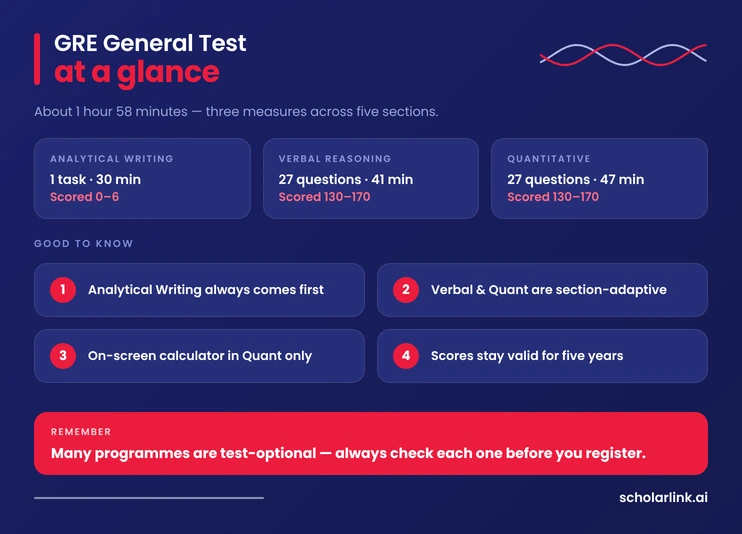
Quick answer: The GRE General Test now runs about 1 hour 58 minutes across three measures. Verbal and Quantitative are each scored 130–170; Analytical Writing is scored 0–6. Whether you need it depends entirely on your target programmes — many are test-optional, so always check the official admissions page before you register.
What Is the GRE?
The GRE General Test is owned and administered by ETS, a non-profit testing organisation. It’s accepted by thousands of graduate and business programmes worldwide as one way to judge whether an applicant is ready for graduate-level work. Because applicants come from different universities, countries, and grading systems, a common test gives admissions committees a single reference point alongside your transcript and the rest of your file.
The test deliberately avoids specialised content. Instead of checking what you studied, it measures three broad skills: how well you read and reason with text, how comfortably you handle quantitative problems, and how clearly you build a written argument. A score is one input among many — it sits next to your GPA, statement of purpose, references, and research or work experience, and rarely decides an application on its own.
It’s worth saying plainly: not every graduate programme requires the GRE. Over the past few years many departments have made it optional or dropped it entirely, while others still expect it. So the real first question isn’t how to prepare — it’s whether your specific programmes want a score at all.
Who Needs to Take the GRE?
There’s no universal rule. Whether you need the GRE depends on the university, the specific programme, the discipline, and even the application cycle — policies change from year to year. The only reliable source is the official admissions page for each programme on your list, usually under “admission requirements” or “how to apply.” When in doubt, email the graduate admissions office and ask directly.
Is the GRE Required for a Master’s or PhD?
Programmes generally fall into one of three camps, and two departments at the same university can land in different ones:
- Required — you must submit a valid score for your application to be complete.
- Optional (test-optional) — you may submit a score if you think it strengthens your case, but it isn’t mandatory. A strong score can still help; a weak one you can leave out.
- Not accepted — some programmes no longer consider GRE scores at all, so sending one does nothing.
Research-heavy PhD programmes in some fields still lean on the GRE, while many taught master’s programmes have moved away from it. Don’t assume based on the subject — check each one.
Quick Checklist: Do You Need the GRE?
- ☐ Listed the exact programmes you’re applying to
- ☐ Found each programme’s official admissions requirements page
- ☐ Noted whether the GRE is required, optional, or not accepted
- ☐ Checked whether a Subject Test is also required
- ☐ Confirmed the score deadline and how scores must be sent
- ☐ Emailed admissions if any policy was unclear or missing
GRE vs. GMAT: What Is the Difference?
The GRE and the GMAT are both graduate admissions tests, but they were built for different audiences. The GRE is a general test used across most graduate disciplines; the GMAT is aimed at business and management programmes. Many MBA and business master’s programmes now accept either, which is why applicants increasingly weigh the two. Neither is universally “easier” — they suit different strengths, and the right choice depends on your target schools and how your skills line up.
| Factor | GRE General Test | GMAT (Focus Edition) | What applicants should check |
| Mainly used for | Most graduate disciplines, including some MBAs | Business and management programmes | Whether your target schools accept one, the other, or both |
| Structure | Verbal, Quantitative, Analytical Writing | Quantitative, Verbal, Data Insights | Which format plays to your strengths |
| Total time | About 1 hr 58 min | About 2 hr 15 min | Current timing on each official site |
| Total score | 260–340 (two measures combined) | 205–805 | How your target programmes read each scale |
| Essay | One Analytical Writing task | No separate essay | Whether writing is weighted in your field |
If you’re applying only to business schools, confirm whether they prefer or more commonly see one test. If you’re applying across disciplines — say, some PhD programmes and some MBAs — the GRE’s broader acceptance can make it the simpler single choice. Either way, verify the current requirements of each school rather than relying on reputation.
GRE General Test Format and Sections
The GRE was shortened in September 2023, so ignore any older guide that still describes a 3-hour-45-minute exam. The current test runs about 1 hour 58 minutes across five sections and three measures. Analytical Writing always comes first; Verbal and Quantitative sections can appear in any order after it. An unscored section may be mixed in without being marked, and a research section, if present, comes last and doesn’t count. Here’s the structure at a glance, drawn from ETS:
| Measure | Questions / tasks | Time | Score scale |
| Analytical Writing | One “Analyze an Issue” task | 30 minutes | 0–6 |
| Verbal Reasoning | 12 + 15 questions (two sections) | 18 + 23 minutes | 130–170 |
| Quantitative Reasoning | 12 + 15 questions (two sections) | 21 + 26 minutes | 130–170 |
Analytical Writing
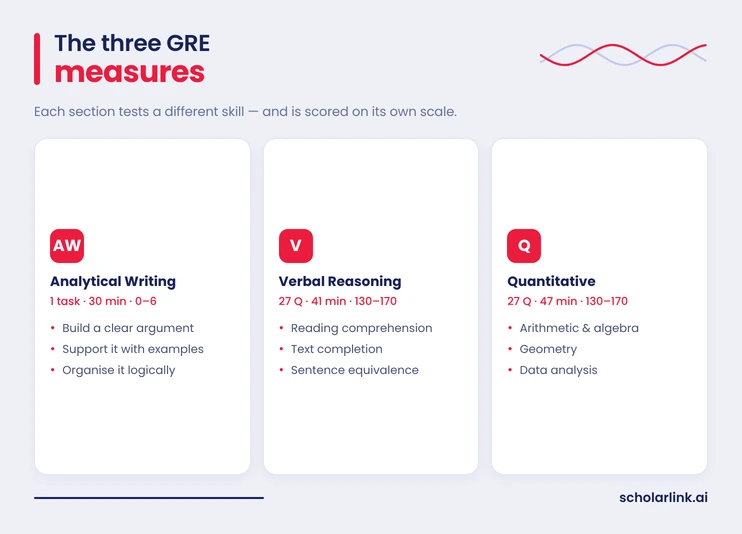
There’s now a single task: Analyze an Issue. You’re given a short statement on a topic of general interest and 30 minutes to build a reasoned response — taking a position, supporting it with relevant examples, and organising it clearly. It’s scored 0–6 in half-point steps. The section rewards structured, evidence-based argument far more than elaborate vocabulary.
Verbal Reasoning
Verbal has two sections (12 then 15 questions) and tests how well you read, interpret, and reason with written material. Expect three question types: Reading Comprehension, Text Completion, and Sentence Equivalence. Skills assessed include:
- Understanding the meaning of words, sentences, and whole passages
- Distinguishing a writer’s main point from supporting detail
- Drawing conclusions and reasoning from incomplete information
Quantitative Reasoning
Quant also has two sections (12 then 15 questions) and covers arithmetic, algebra, geometry, and data analysis — roughly high-school-level maths applied to problem-solving, not advanced calculus. An on-screen calculator is available in this measure only. Skills assessed include:
- Interpreting and analysing quantitative information
- Solving problems with mathematical models and basic maths
- Reading data from tables and graphs
Both Verbal and Quantitative are section-level adaptive: the difficulty of your second section depends on how you did in the first, and your score reflects both the number correct and the difficulty of the questions you saw.
GRE Scoring System Explained
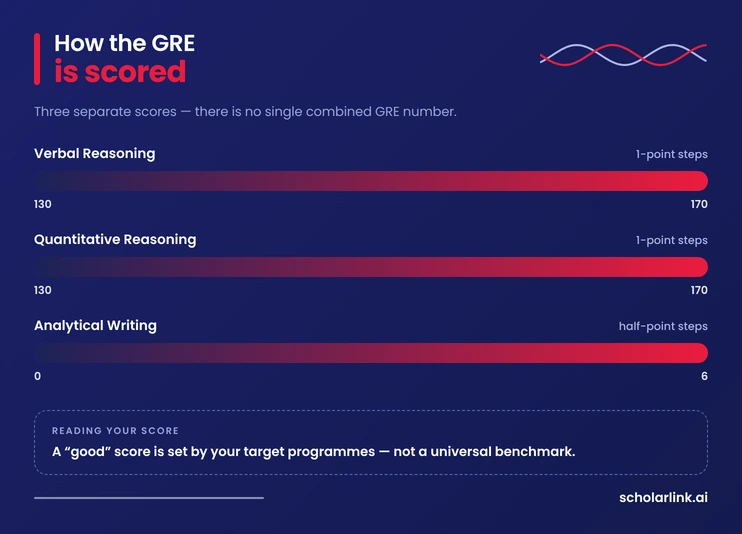
The GRE reports three separate scores — one each for Verbal, Quantitative, and Analytical Writing — rather than a single combined number. Verbal and Quant each run 130–170 in one-point steps, and Analytical Writing runs 0–6 in half-point steps. Because each measure is section-level adaptive, your score reflects both how many questions you answered correctly and how hard those questions were.
| Measure | Score scale | What it measures | How to interpret it |
| Verbal Reasoning | 130–170 | Reading, interpreting, and reasoning with text | Compare against your target programmes’ published ranges |
| Quantitative Reasoning | 130–170 | Problem-solving with basic maths and data | Often weighted more heavily in quantitative fields |
| Analytical Writing | 0–6 | Clarity and logic of a written argument | Read as a threshold rather than a fine ranking |
What Is a Good GRE Score?
There’s no single “good” score, and any guide that gives you one is guessing. What counts as competitive depends entirely on your target programme and discipline: a strong Quant score matters more for engineering or economics, while Verbal and Writing carry more weight in the humanities. The useful benchmark is the score range of recently admitted students in your field at your target schools — not a universal number pulled from a blog.
GRE Score Requirements by University and Program
Where programmes publish GRE data, read it carefully. A minimum requirement is a floor you must clear; an admitted-student average describes the people who got in, which is usually higher and more informative. Many programmes publish neither and simply review scores in context. Look on the official admissions or programme page first, and treat any average as a guide to aim for, not a guaranteed cutoff.
GRE General Test vs. GRE Subject Tests
These are two different things, and it’s easy to confuse them. The General Test measures broad reasoning skills and is what most people mean by “the GRE.” A Subject Test digs into knowledge of one academic field and is designed for applicants to graduate programmes in that discipline.
ETS currently offers three Subject Tests: Mathematics, Physics, and Psychology. Each is scored on its own scale, separate from the General Test. A Subject Test is worth taking only if a programme on your list asks for it or recommends it — it’s an addition to, not a replacement for, the General Test. Because the line-up and details have changed over the years, confirm the current subjects, format, and scoring on the ETS Subject Tests page before you plan around one.
How to Prepare for the GRE
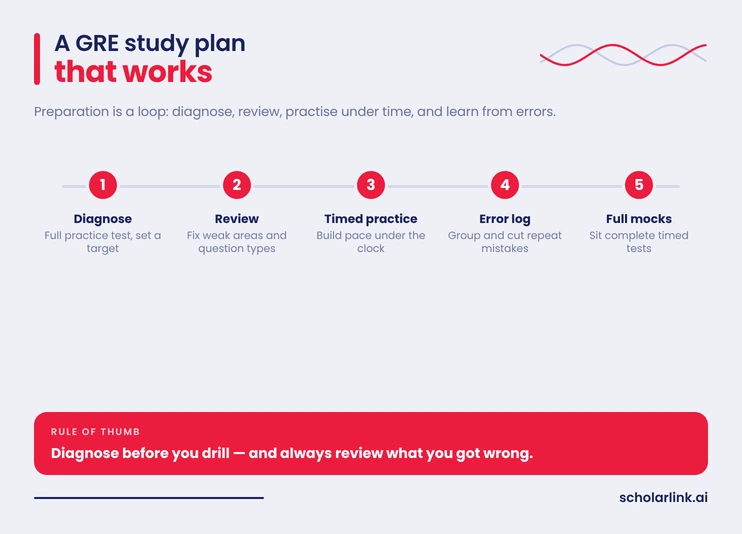
Good preparation is a loop, not a pile of practice questions: find out where you stand, fix the weak spots, practise under time pressure, and learn from your mistakes. The stages below turn that into a workflow you can actually follow.
| Stage | Main task | Expected output | How to measure progress |
| 1. Diagnose | Take a full official practice test | A baseline score per measure | Gap between baseline and target score |
| 2. Review | Study weak areas and question types | Notes and corrected concepts | Accuracy on topic-focused practice sets |
| 3. Timed practice | Practise sections against the clock | Faster, steadier pacing | Questions completed within section time |
| 4. Error analysis | Log and categorise every mistake | A list of recurring error types | Fewer repeat mistakes over time |
| 5. Full mocks | Sit complete timed practice tests | Scores under real conditions | Scores trending toward your target |
How Long Should You Study for the GRE?
There’s no fixed answer — it depends on your starting point, your target score, and how many hours a week you can give it. As a planning example, many test-takers spend roughly one to three months of steady study, but someone close to their target may need far less, and someone with a big gap may need more. Set the timeline backward from your test date and your diagnostic result, not from a number in a guide.
Best Official GRE Preparation Resources
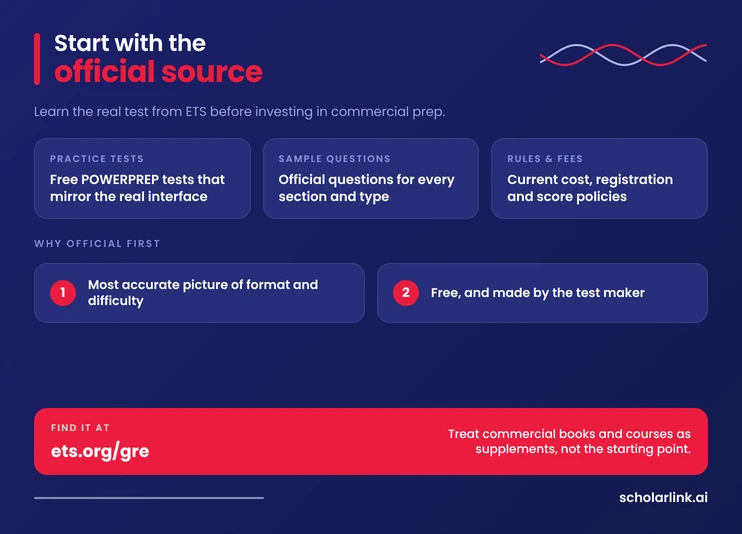
Start with the source. ETS publishes the official preparation materials, including free POWERPREP practice tests that mirror the real interface and official sample questions for every section. Because these come from the test maker, they’re the most accurate picture of format and difficulty. Commercial books and courses can help with extra drills and strategy, but treat them as supplements — learn the real test from the official material first, then decide what else you need.
GRE Study Plan: A Step-by-Step Approach
An adaptable weekly rhythm keeps the loop above moving:
- Week 1 — take a diagnostic test and set a target score per measure.
- Weeks 2–4 — review one weak area at a time, with short topic-focused practice sets.
- Weeks 5–6 — add timed sections and start an error log, grouping mistakes by cause.
- Final weeks — sit full-length mocks, review every error, and taper so you’re rested before test day.
Adjust the length to your own timeline, but keep the order: diagnose before you drill, and always review what you got wrong.
GRE Test-Day Tips and Time Management
- ☐ Pace yourself — don’t let one hard question eat your time
- ☐ Use the mark-and-review feature and come back to skipped questions
- ☐ Make an educated guess rather than leaving a question blank
- ☐ Use the on-screen calculator only when it genuinely saves time
- ☐ Know the test-day rules and what to bring beforehand
- ☐ Rest the night before rather than cramming
Common Preparation Mistakes to Avoid
- Skipping the diagnostic and studying with no target in mind
- Practising without a timer, then struggling with pace on the day
- Grinding through questions without reviewing mistakes
- Over-relying on commercial materials before using official ones
- Memorising rare vocabulary while neglecting reading and reasoning
- Booking the test before checking whether your programmes even need it
GRE Registration, Cost, and Score Validity
You register for the GRE through your ETS account, where you can pick a test date and location and choose between the test centre and the at-home option where it’s available. Book early for popular dates, especially in the busy autumn application season.
The test fee varies by country and changes over time, so check the current price on the official ETS GRE page rather than trusting a figure quoted in an article. The same page covers rescheduling and cancellation rules, fee reductions for eligible test-takers, and how to send scores to programmes.
One thing that stays stable: GRE scores are valid for five years from your test date. That means you can take the test a little ahead of applying without the score expiring, and you can reuse one score across several application cycles. If you retake the test, ETS’s ScoreSelect option lets you choose which scores to send — check the current details on the ETS site.
Frequently Asked Questions About the GRE
How long is the GRE?
The current General Test runs about 1 hour 58 minutes across five sections and three measures.
Do I need the GRE for graduate school?
It depends on the programme. Many are now test-optional or don’t accept the GRE at all, while others still require it. Check each programme’s official admissions page.
What’s a good GRE score?
There’s no universal number — a competitive score is defined by your target programmes and discipline. Compare against recently admitted students in your field.
Can I use a calculator?
Yes, an on-screen calculator is provided, but only in the Quantitative Reasoning sections.
How long are GRE scores valid?
Five years from your test date, so you can take it a little ahead of applying.
Can I retake the GRE?
Yes. ETS limits how often you can test within a rolling period, and ScoreSelect lets you choose which scores to send — confirm the current rules on the ETS site.
How much does the GRE cost?
The fee varies by country and changes over time, so check the current price on the official ETS page rather than a quoted figure.
GRE or GMAT for business school?
Many programmes accept both. Confirm what your target schools prefer, then pick the test that suits your strengths.
Figuring out whether the GRE even fits your plans starts with knowing where you’re applying. Explore graduate programmes, research positions, and admission requirements on ScholarLink.ai to see which of your target schools ask for a score — before you register for anything.