
Choosing a postgraduate path is rarely a simple academic decision. For international students, PhD applicants, and even parents advising their children, it is a strategic turning point. A master’s degree can redefine a career trajectory. A PhD can shape a decade of research, publications, funding applications, and professional identity. The difficulty is not the lack of options—it is the overwhelming abundance of them.
This is where a Postgraduate Study Fair becomes more than just an event. It becomes a structured opportunity to compare universities, clarify doubts, and assess alignment between your goals and institutional offerings. Instead of browsing dozens of university websites in isolation, you step into a space designed for direct interaction—where admissions officers, professors, international recruitment managers, and scholarship representatives are available to answer questions in real time.
Imagine a student named Leila, considering a Master’s in Data Science in Europe or Canada. Online research gives her rankings and brochures, but it does not reveal how competitive funding really is, whether co-op options exist, or how supervisors select research assistants. At a postgraduate program exhibition, she can ask those exact questions. She can compare funding models, visa pathways, and research expectations across institutions within a single afternoon. That shift—from passive browsing to active evaluation—often changes everything.
Graduate study fairs and events also create opportunities to explore postgraduate courses beyond brand-name universities. Smaller institutions, interdisciplinary programs, and emerging research hubs often participate. These institutions may offer generous scholarships, strong supervisor support, or industry partnerships that are less visible online. Meeting universities at study fairs allows applicants to uncover these hidden strengths and evaluate academic culture firsthand.
This matters because postgraduate education is deeply relational. Admission committees assess fit. Supervisors (often called Principal Investigators or PIs in research-intensive systems) evaluate research alignment. Funding decisions depend on project feasibility and departmental budgets. When you attend a Postgraduate Study Fair, you are not just collecting brochures—you are observing institutional priorities, communication style, and openness to international applicants.
In practice, these fairs also help clarify procedural questions that websites rarely explain clearly:
- How competitive is internal funding?
- Are research assistantships guaranteed or conditional?
- What are realistic visa timelines for international students?
- How early should you contact a supervisor?
- Does the program prioritize coursework, thesis research, or publication output?
Each of these questions influences long-term academic and career outcomes. And asking them directly often leads to more nuanced answers than any FAQ page can provide.
That sets the foundation; now let’s examine how postgraduate study fairs are structured and what you should expect when you attend one.
What is a Postgraduate Study Fair?
A Postgraduate Study Fair is a specialized academic exhibition where universities, research institutions, and related organizations present information about master’s degrees, PhD programs, and other advanced qualifications. Unlike general education expos, these events focus exclusively on graduate-level study—meaning the conversations are deeper, more technical, and often centered on research, funding, and long-term career development.
At a typical postgraduate program exhibition, you will find representatives from graduate schools, faculty departments, admissions offices, scholarship bodies, and sometimes government agencies responsible for student visas. Many institutions also bring faculty members, program directors, or doctoral recruitment coordinators. This matters because postgraduate education is rarely just about enrollment—it is about research alignment, supervisor availability, and funding structure.
Consider a scenario: David is exploring PhD opportunities in Engineering. At a Postgraduate Study Fair, he speaks directly with a department representative who explains how their doctoral funding model works—combining teaching assistantships, research grants, and industry collaboration. That level of clarity is difficult to extract from a website alone. Graduate study fairs and events create space for these nuanced, high-stakes conversations.
Who Participates in These Events?
Postgraduate Study Fairs typically include:
- Universities offering master’s and PhD programs
- Research-intensive institutions and laboratories
- Scholarship providers and funding agencies
- International education consultants
- Government or embassy representatives (especially for visa guidance)
In some cases, large global universities—such as members of research consortia or national higher education networks—participate to attract international postgraduate talent. The presence of these entities turns the event into more than a marketing showcase; it becomes an ecosystem of decision-making stakeholders.
That distinction becomes even clearer when you compare these events with undergraduate fairs.
How Postgraduate Study Fairs Differ from Undergraduate Events
Undergraduate fairs focus primarily on bachelor’s degrees. The conversations often revolve around campus life, entry requirements, tuition fees, and student experience. These are important topics—but they are entry-level decisions.
In contrast, a Postgraduate Study Fair addresses advanced academic questions:
- Research topics and supervisor match (often referred to as “PI fit”)
- Publication expectations and academic output
- Funding models (fully funded vs. self-funded)
- Teaching assistantships and research assistant roles
- Industry partnerships and applied research pathways
- Post-study work visas and immigration policies
For example, an undergraduate applicant may ask, “What is the minimum GPA requirement?” A PhD applicant, however, might ask, “How many doctoral candidates does this supervisor currently oversee, and what is their recent publication record?” The level of specificity—and the stakes—are fundamentally different.
Another key difference lies in audience maturity. Graduate applicants usually have prior academic training, sometimes professional experience, and clearer research interests. Parents may attend undergraduate fairs with their children; postgraduate events more often involve independent decision-makers planning a career strategy.
In practice, this means that meeting universities at study fairs at the postgraduate level feels more like a professional consultation than a campus tour. The tone is serious. The questions are strategic. The outcomes influence years of research, funding stability, and employability.
Understanding this distinction helps you approach these events with the right expectations.
Types of Graduate Study Fairs and Events
Not all graduate study fairs and events are structured the same way. Some are large, international exhibitions held in convention centers. Others are highly focused, virtual sessions dedicated to one discipline. Understanding the different formats helps you choose the right event based on your goals, budget, and stage in the application process.
Broadly speaking, postgraduate study fairs fall into four main categories: in-person fairs, online events, international exhibitions, and discipline-specific fairs. Each serves a different strategic purpose.
Let’s break them down.
1. In-Person Postgraduate Study Fairs
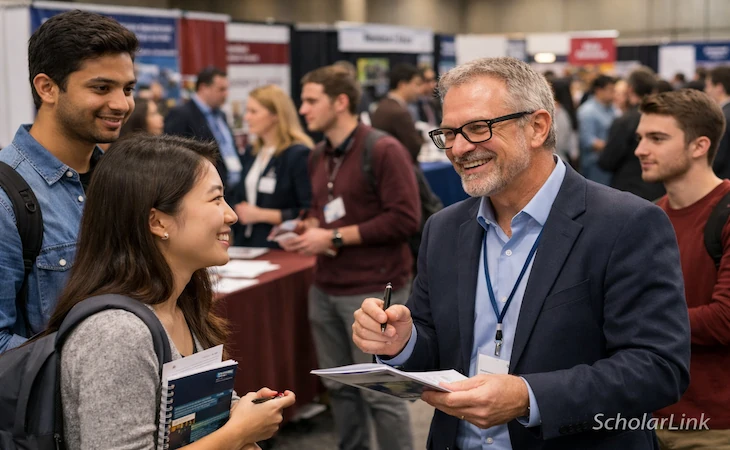
Traditional, face-to-face Postgraduate Study Fair events are typically hosted in major cities or university campuses. Universities set up booths, admissions officers attend in person, and sometimes faculty members or doctoral coordinators participate.
Advantages:
- Direct, personal interaction with representatives
- Ability to read non-verbal cues and assess institutional culture
- Opportunity for spontaneous conversations
- Networking with other applicants
In practice, these events are particularly useful for students who are undecided between multiple countries or institutions. For example, an applicant considering both Australia and Germany can compare visa policies, tuition structures, and funding expectations in one afternoon.
However, in-person fairs require travel time and often occur on fixed dates. They are ideal if you want high-impact conversations and are early in your decision-making process.
That’s the traditional model. But the digital shift has expanded access dramatically.
2. Online Graduate Study Fairs and Virtual Events
Virtual postgraduate program exhibitions have become increasingly common. These events usually involve scheduled webinars, live Q&A sessions, digital booths, downloadable brochures, and one-on-one video appointments.
Advantages:
- Global access without travel costs
- Easier participation for international students
- Recordings available for later review
- Flexible scheduling
For example, a student in India can attend a Canadian university’s virtual graduate fair and speak with admissions staff about supervisor availability and funding models—all without leaving home.
The trade-off? Online interactions may feel less personal. It can also be harder to stand out unless you ask thoughtful, well-prepared questions. Still, for cost efficiency and international reach, virtual fairs provide significant opportunities to explore postgraduate courses across multiple regions.
Now let’s look at scale and geography.
3. International and Multi-Country Study Fairs
Large international exhibitions often feature universities from several countries—such as the United Kingdom, United States, Canada, Australia, Germany, and emerging research hubs in Asia and Europe.
These events are designed for cross-border recruitment and typically include:
- National education agencies
- Embassy representatives
- Scholarship organizations
- Immigration advisors
In these environments, you are not just comparing universities—you are comparing higher education systems. Funding structures, doctoral duration (3–4 years vs. 5–7 years), publication requirements, and post-study work visas differ significantly by country.
For PhD applicants, these fairs are especially useful when evaluating research ecosystems rather than just individual institutions. Understanding how a country supports doctoral research can influence long-term academic or industry career outcomes.
But sometimes, broad comparison is less useful than depth.
4. Discipline-Specific or Specialized Graduate Fairs
Some graduate study fairs focus on specific fields—Engineering, Business, Life Sciences, Social Sciences, or Creative Arts. These specialized events often include program directors, faculty members, and industry partners from within the discipline.
Advantages:
- More technical discussions
- Direct exposure to research labs and projects
- Stronger alignment with supervisor interests
- Industry-academic collaboration insights
Imagine a prospective PhD student in Artificial Intelligence attending a specialized AI-focused postgraduate event. Instead of generic admissions information, the conversation centers on research funding cycles, publication expectations in top journals, and lab infrastructure. That level of depth is difficult to achieve at broader exhibitions.
These events are ideal if you already have a defined research direction and want to evaluate supervisor fit and funding feasibility.
So how do you decide which format is right for you?
How to Choose the Right Type of Graduate Study Event
The best choice depends on your stage and objective:
- Exploration stage (broad comparison): International or large multi-university fairs
- Shortlisting stage (specific questions): In-person or virtual institutional fairs
- Research-focused stage (PhD or thesis-based master’s): Discipline-specific events
- Budget constraints or location limits: Online graduate study fairs
From experience, many applicants make the mistake of attending events randomly. A more strategic approach is to define your primary goal first—country comparison, funding clarity, supervisor identification, or visa planning—and then select the format that best supports that objective.
Who Exhibits at Postgraduate Program Exhibitions?
A Postgraduate Study Fair is not just a room full of university banners. It is a concentrated ecosystem of decision-makers, advisors, and institutions connected to advanced education. Understanding who exhibits at postgraduate program exhibitions helps you ask better questions—and extract more valuable information.
Most attendees assume they will only meet university admissions staff. In reality, the range of participants is broader and strategically important.
Let’s examine the key exhibitor categories and what you can realistically gain from each.
Universities and Graduate Schools
The core exhibitors at postgraduate program exhibitions are universities offering master’s and PhD programs. These may include:
- Graduate admissions offices
- Faculty departments (e.g., Engineering, Business, Life Sciences)
- Doctoral schools
- Research centers and laboratories
At this level, conversations often go beyond entry requirements. For example, a master’s applicant can clarify:
- Coursework vs. thesis structure
- Internship or co-op opportunities
- Class size and student-to-faculty ratio
A PhD applicant can ask:
- Supervisor availability
- Funding guarantees (fully funded vs. competitive funding)
- Publication expectations
- Teaching assistant responsibilities
In practice, this is where “fit” becomes tangible. If a department representative struggles to explain funding pathways clearly, that may signal internal competition or limited resources. If they articulate research themes and lab collaboration confidently, it often reflects a structured doctoral ecosystem.
That insight alone can reshape your shortlist.
Research Institutes and Specialized Laboratories
Some postgraduate program exhibitions include independent research institutes, government-funded labs, or collaborative research networks. These entities may not always award degrees directly but often partner with universities for doctoral supervision.
For research-driven applicants, especially in STEM fields, this is critical. A research institute representative can clarify:
- Current funded projects
- Industry partnerships
- Access to laboratory infrastructure
- Co-supervision models
For example, in certain countries, PhD candidates are embedded in national research institutes while formally enrolled at a university. Understanding that structure helps applicants evaluate research intensity, publication output, and long-term academic positioning.
This is often overlooked—but highly strategic for serious researchers.
Funding Bodies and Scholarship Organizations
Scholarships frequently determine whether postgraduate study is feasible. Many graduate study fairs and events include:
- Government scholarship agencies
- International funding programs
- Research councils
- Philanthropic foundations
These representatives can provide clarity on:
- Eligibility criteria
- Application timelines
- Selection competitiveness
- Coverage (tuition only vs. living stipend)
For example, a funding officer may explain that doctoral funding in a particular country is project-based rather than automatically attached to admission. That distinction changes how and when you contact a supervisor.
Funding and supervisor alignment are closely linked. Without funding clarity, even the strongest academic offer may not be practical.
International Education Representatives and Government Agencies
Some postgraduate program exhibitions include national education promotion agencies or embassy representatives. Their role often involves:
- Visa regulations
- Post-study work policies
- Immigration pathways
- National research priorities
This is particularly relevant for international students evaluating long-term mobility. A country’s post-graduation work permit policy can significantly influence return on investment for a master’s degree.
In experience, many applicants underestimate how much visa structure shapes academic strategy. A strong research program combined with restrictive immigration policies may limit career flexibility. These events allow you to compare those frameworks side by side.
Educational Consultants and Academic Advisors
While not always university-affiliated, some postgraduate study fairs host academic advisors or consultants. They can provide guidance on:
- Application timelines
- Document preparation
- Statement of purpose refinement
- Interview preparation
However, applicants should approach this category critically. Independent consultants vary widely in expertise. Use them for structural guidance—not for replacing your own due diligence.
A Strategic Perspective
Consider a scenario: Maria attends a postgraduate program exhibition intending to compare Business Analytics programs. She ends up speaking not only with universities but also with a government scholarship body and a national education agency. By the end of the event, she realizes one country offers structured doctoral funding and post-study work flexibility, while another has limited research assistantships.
That broader ecosystem understanding would have taken weeks to piece together online.
The key is to approach exhibitors not as information booths—but as strategic nodes in a higher education network. Each one represents a different piece of your postgraduate journey: admission, supervision, funding, research infrastructure, and immigration.
Now that you understand who participates, the next step is learning how to approach them effectively—because asking the right questions is what turns attendance into advantage.
How to Meet Universities at Study Fairs Effectively
Attending a Postgraduate Study Fair without preparation is like going to a research interview without reading the lab’s publications. You may collect brochures—but you will not create meaningful academic connections. The difference between a passive attendee and a strategic participant lies in preparation, positioning, and follow-up.
Graduate study fairs and events are networking environments. Universities are not only presenting programs—they are identifying serious, informed candidates. If you approach these conversations thoughtfully, you can stand out even before submitting an application.
Let’s break this into practical steps.
Prepare Before the Event
Effective engagement begins days before the fair.
Research participating universities in advance. Most postgraduate program exhibitions publish exhibitor lists. Review:
- Program structure (course-based vs. thesis-based)
- Entry requirements
- Funding models
- Research strengths
- Faculty profiles (especially potential supervisors)
If you are a PhD applicant, identify 1–2 potential supervisors (often called Principal Investigators or PIs). Read at least one recent publication. This allows you to ask informed questions such as:
“I noticed Professor Chen’s recent work on renewable energy optimization. Are PhD candidates typically funded through external grants or internal fellowships?”
That level of specificity signals seriousness.
Also prepare a short, clear self-introduction—30 seconds, structured:
- Academic background
- Research interests
- Career goals
- What you are currently exploring
Think of it as an academic elevator pitch.
Preparation transforms random booth visits into targeted conversations.
Ask Strategic, Not Generic, Questions
At a Postgraduate Study Fair, avoid questions that are easily answered on the website. Instead, focus on:
- How competitive is internal funding?
- What distinguishes successful applicants?
- How many PhD students does a typical supervisor oversee?
- Are research assistantships guaranteed?
- How does the admissions committee evaluate research proposals?
- What percentage of international students secure funding?
For master’s applicants, consider:
- Industry partnerships and internship pipelines
- Alumni outcomes
- Class size and student engagement
- Pathways to PhD progression
In practice, the quality of your questions determines the quality of the answers.
This is often overlooked: representatives remember applicants who ask thoughtful questions. That memory can matter when applications are reviewed later.
Now let’s discuss how to introduce yourself effectively.
Introduce Yourself with Clarity and Confidence
When you meet universities at study fairs, your introduction should be concise and professional. Avoid long autobiographies.
Example structure:
“Hello, my name is Daniel. I completed my Master’s in Mechanical Engineering with a focus on computational modeling. I’m currently exploring funded PhD opportunities in sustainable materials. I’m particularly interested in programs that integrate industry collaboration.”
This format accomplishes three things:
- Establishes academic credibility.
- Clarifies your objective.
- Invites the representative to respond strategically.
If speaking with a faculty member, briefly reference their research area. If speaking with admissions staff, focus on program structure and funding.
Remember: postgraduate events are professional environments. Treat them as mini-consultations, not casual chats.
That professional tone sets you apart.
Take Notes and Collect Meaningful Contacts
Instead of collecting every brochure, focus on actionable information:
- Representative’s name and role
- Specific advice given
- Funding timelines
- Suggested next steps
Ask for a business card or official contact email. Some institutions use QR codes or digital lead forms—complete them thoughtfully.
Networking at graduate study fairs and events is not transactional. It is relational. When you demonstrate genuine interest and preparation, representatives are more likely to respond positively to follow-up emails.
Which brings us to the step most applicants neglect.
Follow Up Professionally After the Event
Within 48 hours, send a short, professional email:
- Thank them for their time.
- Reference your conversation.
- Reiterate your interest.
- Ask one clear follow-up question if necessary.
For example:
“Thank you for discussing the doctoral funding structure in your department. I am reviewing your program requirements and would appreciate clarification on whether external grant funding is required before applying.”
This reinforces your seriousness and keeps the communication channel open.
From experience, this simple step differentiates proactive candidates from passive attendees.
A Realistic Scenario
Consider Amina, an international applicant exploring master’s programs in Public Health. She attends an international Postgraduate Study Fair with a shortlist of four universities. Instead of visiting every booth randomly, she speaks deeply with two institutions aligned with her research interests. She asks about thesis supervision models, scholarship competitiveness, and post-study work options.
After the event, she sends follow-up emails and later references those conversations in her statement of purpose.
Months later, during her interview, the admissions committee recalls her thoughtful engagement. That early interaction helped position her as prepared and serious.
Effective engagement at postgraduate program exhibitions is not about volume—it is about quality.
Preparation → meaningful questions → professional introduction → structured follow-up. That sequence turns attendance into advantage.
Opportunities to Explore Postgraduate Courses
One of the most underestimated benefits of a Postgraduate Study Fair is discovery. Many students arrive with a fixed idea—“I want to study Business,” or “I’m applying for a PhD in Biology”—but leave with a more refined, sometimes completely different, academic direction. Graduate study fairs and events create structured exposure to options that are difficult to discover through isolated online searches.
In practice, these events function as comparison environments. Instead of analyzing one university at a time, you can evaluate multiple postgraduate courses side by side—program structure, funding model, research expectations, and career outcomes.
That shift from isolated browsing to active comparison changes decision quality significantly.
Comparing Program Structures and Academic Models
Postgraduate programs vary more than most applicants realize. Even within the same discipline, differences may include:
- Coursework-based vs. thesis-based master’s degrees
- Structured doctoral programs vs. supervisor-led PhD models
- Industry-integrated programs vs. purely academic tracks
- One-year intensive master’s vs. two-year research pathways
For example, two universities may both offer a Master’s in Data Science. One emphasizes applied projects and internships with industry partners. The other focuses on statistical theory and research publications. Both are valid—but suitable for different career paths.
At postgraduate program exhibitions, representatives can clarify these structural distinctions quickly. You can ask:
- Is a thesis mandatory?
- How early do students begin research?
- Are internships embedded in the curriculum?
- What percentage of master’s graduates transition to PhD programs?
When you meet universities at study fairs, you are not just comparing rankings—you are comparing educational philosophies.
That perspective often leads to more intentional choices.
Accessing Funding and Scholarship Information
Funding is often the decisive factor in postgraduate education. Yet university websites sometimes present scholarship information in fragmented ways.
At a Postgraduate Study Fair, you can clarify:
- Whether funding is automatic upon admission or competitive
- The difference between internal fellowships and external scholarships
- Teaching assistantship requirements
- Research assistant opportunities
- Deadlines and selection timelines
For PhD applicants especially, funding structure is closely linked to supervisor alignment. In some systems, doctoral funding is attached to specific research grants managed by a Principal Investigator. In others, doctoral schools allocate centralized scholarships.
A direct conversation can reveal how realistic funding prospects are—information that rarely appears transparently online.
Understanding funding frameworks early prevents misaligned applications later.
Discovering Emerging and Interdisciplinary Fields
Many students discover new academic directions at graduate study fairs and events. Emerging areas—such as sustainability analytics, AI in healthcare, digital humanities, or climate policy—may not appear clearly categorized on university websites.
At exhibitions, interdisciplinary programs are often presented more holistically. Representatives may explain how departments collaborate across faculties. For example:
- Engineering + Public Policy
- Computer Science + Medicine
- Environmental Science + Business Strategy
This exposure allows applicants to explore postgraduate courses beyond traditional labels.
Consider a student planning to pursue a Master’s in Economics. At a postgraduate exhibition, she learns about a program in Behavioral Data Science that integrates psychology, statistics, and machine learning. After discussing curriculum structure and career outcomes, she realizes it aligns better with her long-term goals.
Discovery in these environments is often strategic, not accidental.
Clarifying Career Pathways and Outcomes
Advanced study is not only academic—it is career-defining. Postgraduate Study Fairs allow applicants to ask practical questions about:
- Graduate employability rates
- Industry partnerships
- Alumni career destinations
- PhD placement success (postdoctoral positions, faculty roles, industry research)
- Post-study work visas
For international students, understanding how postgraduate education connects to immigration policies and labor markets is essential. Some countries provide extended post-study work permits; others have restrictive employment pathways.
These structural differences influence return on investment.
In experience, students who connect academic choice with career trajectory early make more confident decisions. They ask not only, “Is this program interesting?” but also, “Where does this program realistically lead?”
That question is transformative.
A Scenario to Illustrate the Opportunity
Imagine Karim, who plans to pursue a Master’s in Environmental Engineering. At a Postgraduate Study Fair, he compares three universities:
- University A offers strong laboratory research but limited industry engagement.
- University B integrates co-op placements and has partnerships with renewable energy companies.
- University C offers partial scholarships but requires early supervisor commitment.
After discussing funding, program duration, and alumni outcomes, Karim realizes his priority is industry exposure rather than purely academic research. The fair helped him refine his criteria—and avoid a misaligned application.
That is the real opportunity these events create: clarity through structured comparison.
When used strategically, postgraduate program exhibitions become more than informational—they become decision-shaping environments.
Benefits of Attending a Postgraduate Study Fair
A well-planned Postgraduate Study Fair is not just an informational event—it is a strategic accelerator. For international students, PhD applicants, professors advising prospective candidates, and even parents seeking clarity, these events reduce uncertainty and increase decision quality.
The value lies in concentrated access: multiple institutions, funding bodies, and education systems presented in one structured environment. That efficiency alone changes how applicants approach postgraduate planning.
Let’s examine the core benefits in detail.
Direct Access to Reliable, First-Hand Information
University websites are curated. They highlight strengths, summarize funding options, and simplify complex structures. But they cannot anticipate every individual concern.
At postgraduate program exhibitions, you can ask context-specific questions:
- “How competitive was last year’s doctoral cohort?”
- “Are international students equally eligible for internal scholarships?”
- “What distinguishes successful applicants in your department?”
When representatives respond directly, nuance emerges. You hear how admissions committees evaluate research proposals. You learn whether funding is guaranteed or conditional. You understand how supervisors allocate grants.
This access to unfiltered, contextual information significantly reduces application risk.
And more importantly, it replaces assumptions with clarity.
Understanding Institutional Culture and Academic Expectations
Graduate study fairs and events reveal more than program structure—they reveal institutional culture.
Is the representative precise and research-focused? Do they emphasize industry collaboration? Are they transparent about funding competitiveness? These signals matter.
Postgraduate education is relational. Supervisor-student dynamics, departmental collaboration, and research expectations vary widely between institutions. A five-minute conversation can reveal whether a program prioritizes publication output, applied industry engagement, or interdisciplinary exploration.
In practice, culture fit is often overlooked until problems arise. Meeting universities at study fairs provides early insight into communication style and academic tone.
That subtle observation can prevent years of misalignment.
Time Efficiency and Structured Comparison
Evaluating postgraduate courses individually can take weeks of online research. At a single Postgraduate Study Fair, you can compare:
- Funding models
- Visa pathways
- Program duration
- Research infrastructure
- Career outcomes
Side-by-side comparison is powerful. Instead of switching between browser tabs, you can ask similar questions to multiple institutions and immediately identify differences.
For example, if three universities offer a similar master’s degree but only one guarantees research assistantships in the first year, that distinction becomes immediately visible.
Time saved translates into better-informed shortlists.
Strengthening Your Application Position
Although attending a Postgraduate Study Fair does not guarantee admission, it can improve application quality.
Here’s how:
- You refine your program selection.
- You align your research proposal more accurately.
- You reference conversations in your statement of purpose.
- You clarify funding timelines and submission strategy.
In some cases, representatives remember engaged, well-prepared applicants. If you follow up professionally, your name may already be familiar when your application arrives.
From experience, applicants who attend graduate study fairs and events tend to submit more focused and realistic applications. They understand program expectations more clearly—and that clarity shows in their documents.
Supporting Informed, Long-Term Decision-Making
Perhaps the most important benefit is strategic clarity. Postgraduate education influences career trajectory, research direction, financial planning, and immigration pathways.
These events help you evaluate:
- Academic rigor
- Funding feasibility
- Supervisor compatibility
- Career mobility
- Country-specific research ecosystems
Instead of making decisions based on rankings alone, you make decisions based on alignment.
Consider an international student deciding between two countries. One offers strong funding but limited post-study work flexibility. The other offers moderate funding but broader immigration options. A Postgraduate Study Fair allows side-by-side evaluation of these structural realities.
That broader lens supports informed, sustainable choices.
A Realistic Example
Imagine Sofia, who is choosing between a thesis-based master’s in Europe and a professional master’s in Canada. At a postgraduate exhibition, she discovers that the European program offers fully funded research positions, while the Canadian program provides structured co-op placements with industry.
By asking targeted questions, she clarifies her priority: industry integration over academic research. The fair helps her avoid a decision based solely on tuition cost.
That kind of clarity rarely emerges from passive browsing.
Attending a Postgraduate Study Fair does not replace independent research—but it amplifies it. It compresses information, reveals nuance, and sharpens strategic thinking.
Tips for Making the Most of a Study Fair
Attending a Postgraduate Study Fair without a plan is surprisingly common. Students walk in, collect brochures, speak briefly with a few representatives, and leave feeling overwhelmed. A few weeks later, they struggle to remember which university offered what.
That outcome is avoidable.
Graduate study fairs and events reward preparation, structure, and follow-up. Below is a practical framework you can apply immediately—whether you are exploring master’s programs or funded PhD pathways.
Bring a Focused, One-Page Academic CV
Even if representatives do not explicitly request it, carrying a concise academic résumé positions you as serious.
Your CV should include:
- Education history (with GPA or classification, if strong)
- Research projects or thesis title
- Publications (if any)
- Technical skills
- Relevant work or internship experience
- Scholarships or awards
For PhD applicants, highlighting research alignment is essential. For master’s applicants, emphasize academic performance and career direction.
In practice, handing over a CV during a meaningful conversation allows representatives to give more tailored advice. They can respond to your background—not just generic inquiries.
Preparation shifts the dynamic from “information seeker” to “potential candidate.”
Prepare Specific, Tiered Questions
Avoid broad questions like “Tell me about your university.” Instead, categorize your questions:
Program Structure
- Is the master’s thesis mandatory?
- How early are supervisors assigned?
Funding
- Are teaching assistantships guaranteed?
- How competitive are internal fellowships?
Career Outcomes
- What percentage of graduates enter industry vs. academia?
- Do PhD graduates secure postdoctoral positions?
International Considerations
- Visa processing timelines?
- Post-study work options?
Bring these questions in written form (digital or printed). During a busy Postgraduate Study Fair, clarity prevents rushed, unproductive exchanges.
Well-structured questions also signal maturity and focus.
Attend Talks, Panels, and Information Sessions
Many postgraduate program exhibitions include:
- Country-specific briefings
- Funding workshops
- Application strategy panels
- Alumni testimonials
These sessions provide broader system-level insight. For example, a panel on doctoral funding models may clarify how research grants, teaching assistantships, and scholarships interact.
Sometimes, these talks reveal patterns not obvious at individual booths—such as common mistakes in research proposals or visa delays for specific regions.
Allocate time strategically. Choose sessions aligned with your stage and objective.
That broader context often enhances your one-on-one conversations later.
Manage Your Time Strategically
Large graduate study fairs and events can feel overwhelming. Do not attempt to visit every booth.
Instead:
- Prioritize 4–6 institutions aligned with your goals.
- Allocate deeper time for your top 2.
- Leave buffer time for unexpected discoveries.
For example, if your primary focus is funded PhD programs in Engineering, spend more time at research-intensive institutions rather than general master’s booths.
Structured time management prevents fatigue and superficial conversations.
Quality interactions matter more than quantity.
Network Intentionally
Networking at a Postgraduate Study Fair is professional—not transactional.
Introduce yourself clearly. Ask thoughtful questions. Listen carefully. Avoid dominating the conversation.
If a representative gives advice—write it down immediately.
If appropriate, ask:
- “May I follow up via email if I have further questions?”
- “Is there a recommended contact for supervisor inquiries?”
Collect business cards or official contact information. Digital QR codes are common—use them carefully and label contacts afterward so you remember context.
Relationships built here can influence application refinement later.
Follow Up Within 48 Hours
This step separates strategic applicants from casual visitors.
Send a short email:
- Thank them for their time.
- Reference a specific point discussed.
- Reaffirm interest.
- Ask one focused follow-up question if needed.
For example:
“Thank you for explaining your doctoral funding structure during the fair. I am reviewing potential supervisor alignment and would appreciate clarification on whether external grant funding is required before submitting a PhD application.”
Professional follow-up reinforces seriousness.
From experience, many applicants skip this step—missing an opportunity to deepen connection.
Reflect Before Making Decisions
After the event:
- Review your notes.
- Compare institutions objectively.
- Reassess your criteria (funding, location, research intensity, career goals).
- Eliminate options that clearly do not align.
Attending a Postgraduate Study Fair should refine your shortlist—not expand it endlessly.
Reflection transforms information into strategy.
A Practical Scenario
Imagine Noor, exploring master’s programs in Public Policy. She arrives with a clear CV, structured questions, and a prioritized list of universities. She attends a funding workshop, speaks deeply with two institutions, and follows up via email the next day.
Two months later, when writing her statement of purpose, she references specific research themes discussed at the fair.
Her application feels informed, targeted, and credible.
That is what effective participation looks like.
Preparation → strategic engagement → structured follow-up → reflective refinement. This sequence maximizes the value of any Postgraduate Study Fair.
Are Postgraduate Study Fairs Worth It for International Students?
For international students, a Postgraduate Study Fair is not just helpful—it is often essential.
Domestic applicants usually understand their own education system, funding structures, and visa regulations. International applicants, however, must evaluate an entirely new ecosystem: academic expectations, immigration policies, funding competitiveness, cultural adaptation, and long-term career mobility. That complexity makes structured, direct access to information far more valuable.
Consider a realistic scenario. An applicant from India is choosing between a PhD in Germany, a master’s in Canada, and a research program in Australia. Each country has a different doctoral duration, funding structure, and post-study work policy. Without direct comparison, the decision becomes fragmented and confusing. At a well-organized Postgraduate Study Fair, she can compare immigration pathways, scholarship competitiveness, and research culture in one setting.
That comparative clarity significantly reduces uncertainty.
Understanding Visa and Immigration Pathways
For international applicants, academic decisions are inseparable from immigration considerations.
Graduate study fairs and events often include representatives who can explain:
- Student visa requirements
- Work restrictions during study
- Post-study work permits
- Pathways to permanent residency (where applicable)
- Processing timelines
These are not minor details. A country may offer an excellent funded PhD program—but if post-study work opportunities are limited, the long-term career trajectory may be restricted.
Meeting universities at study fairs allows students to ask integrated questions:
- Does the institution provide visa support letters promptly?
- Are international doctoral students eligible for the same funding pools?
- What percentage of international graduates remain in the country?
These structural realities shape strategic decision-making.
Adapting to Different Education Systems
Education systems vary significantly across countries. For example:
- Some doctoral programs are supervisor-led with no coursework.
- Others include structured doctoral schools with mandatory training modules.
- Master’s programs may be research-intensive or industry-focused.
- Funding may be centralized (national scholarships) or decentralized (grant-based supervisor funding).
International students often struggle to interpret these differences from websites alone.
At postgraduate program exhibitions, representatives can clarify expectations regarding:
- Publication requirements
- Thesis format
- Teaching assistant obligations
- Research timelines
- Evaluation criteria
Understanding these frameworks in advance prevents cultural and academic misalignment later.
In practice, informed adaptation reduces academic stress.
Cultural and Academic Fit
International study is not only academic—it is personal. Cultural expectations, communication style, and academic hierarchy differ between systems.
For example:
- In some systems, doctoral candidates work very independently.
- In others, supervisors provide structured weekly guidance.
- In certain countries, research groups function collaboratively.
- In others, research is highly individualized.
A Postgraduate Study Fair allows you to observe tone, openness, and communication style directly. Even short interactions provide subtle signals about institutional culture.
For international students especially, these insights can influence long-term satisfaction.
Financial Clarity and Risk Reduction
Funding misunderstandings are common among international applicants. Some assume that admission automatically includes financial support. In reality, many programs separate admission and funding decisions.
At graduate study fairs and events, you can clarify:
- Whether funding is guaranteed
- Living cost estimates
- Health insurance requirements
- Tuition differences for international students
- Scholarship competitiveness
This clarity prevents costly miscalculations.
International study represents significant financial and personal investment. Reducing uncertainty early is strategic.
A Practical Perspective
Imagine Farah, considering a Master’s in Public Health abroad. She attends an international Postgraduate Study Fair and learns that one country offers extended post-study work permits and structured industry placements, while another provides stronger academic research funding but limited employment flexibility.
Before the event, she focused only on tuition cost. After the event, she evaluates long-term career mobility.
That shift from short-term cost comparison to long-term strategic evaluation illustrates why these fairs are particularly valuable for international students.
For international applicants, postgraduate study fairs are not optional extras. They are structured environments for system comparison, immigration clarity, and informed academic alignment.
Now that we’ve explored the international perspective, let’s summarize why attending these events can be a decisive step in your postgraduate journey.
Conclusion: Why You Should Attend Graduate Study Fairs and Events
A Postgraduate Study Fair brings together universities, funding bodies, and education systems in one accessible space. It allows you to compare postgraduate courses, clarify funding structures, understand visa implications, and assess academic culture—efficiently and directly.
Throughout this guide, we explored how graduate study fairs and events provide:
- Direct access to reliable information
- Structured comparison across institutions and countries
- Funding and scholarship clarity
- Networking opportunities with admissions staff and faculty
- Strategic insights for international mobility
Postgraduate education is not simply about choosing a degree. It is about aligning research interests, funding feasibility, supervisor compatibility, and long-term career objectives.
Attending these events does not replace independent research—but it significantly strengthens it.
If you are serious about postgraduate study, begin by identifying upcoming fairs through official university websites, national education agencies, or reputable higher education platforms. Register early, prepare strategically, and approach the event with clear objectives.
And if you want to take your search further—beyond exhibitions—platforms like ScholarLink.ai can help international students identify suitable professors, research supervisors, and programs aligned with their goals. Combining structured events with targeted digital tools creates a smarter, more efficient postgraduate strategy.
Your postgraduate journey is a long-term investment. Engaging with the right information—at the right time—can make all the difference.

ScholarLink AI
Your Ultimate Admission Co-Pilot
- 🎓 Professors Database: World’s largest supervisor directory
- 📡 Live Positions: Real-time faculty openings & vacancies
- 👥 Students Database: Connect with successful applicants
- 🎯 Smart Matching: AI-driven professor recommendation
- 💰 Funding Analysis: Real-time lab & research funding data
- 📝 Apply Management: Track applications & cold emails