

A PhD recommendation letter is an important part of many doctoral applications. It gives an admissions committee an independent assessment of an applicant’s academic background, research abilities, and potential to succeed in advanced study.
Unlike a transcript or CV, a recommendation letter can explain how an applicant approaches research, responds to academic challenges, and contributes to a project. A strong letter supports its evaluation with specific examples rather than relying only on general statements of praise.
The quality of a recommendation letter depends on the referee’s knowledge of the applicant and their ability to provide a credible assessment. This guide explains what a PhD recommendation letter should include, how it is structured, which qualities it may address, and what effective examples and templates look like.
If you are applying for a PhD and need help choosing referees or requesting references, read our separate guide to References for a PhD Application.
What Is a PhD Recommendation Letter?
A PhD recommendation letter is a formal assessment written by someone who has worked with an applicant in an academic, research, or relevant professional setting.
The referee uses their experience with the applicant to explain why they believe the person is suitable for doctoral study.
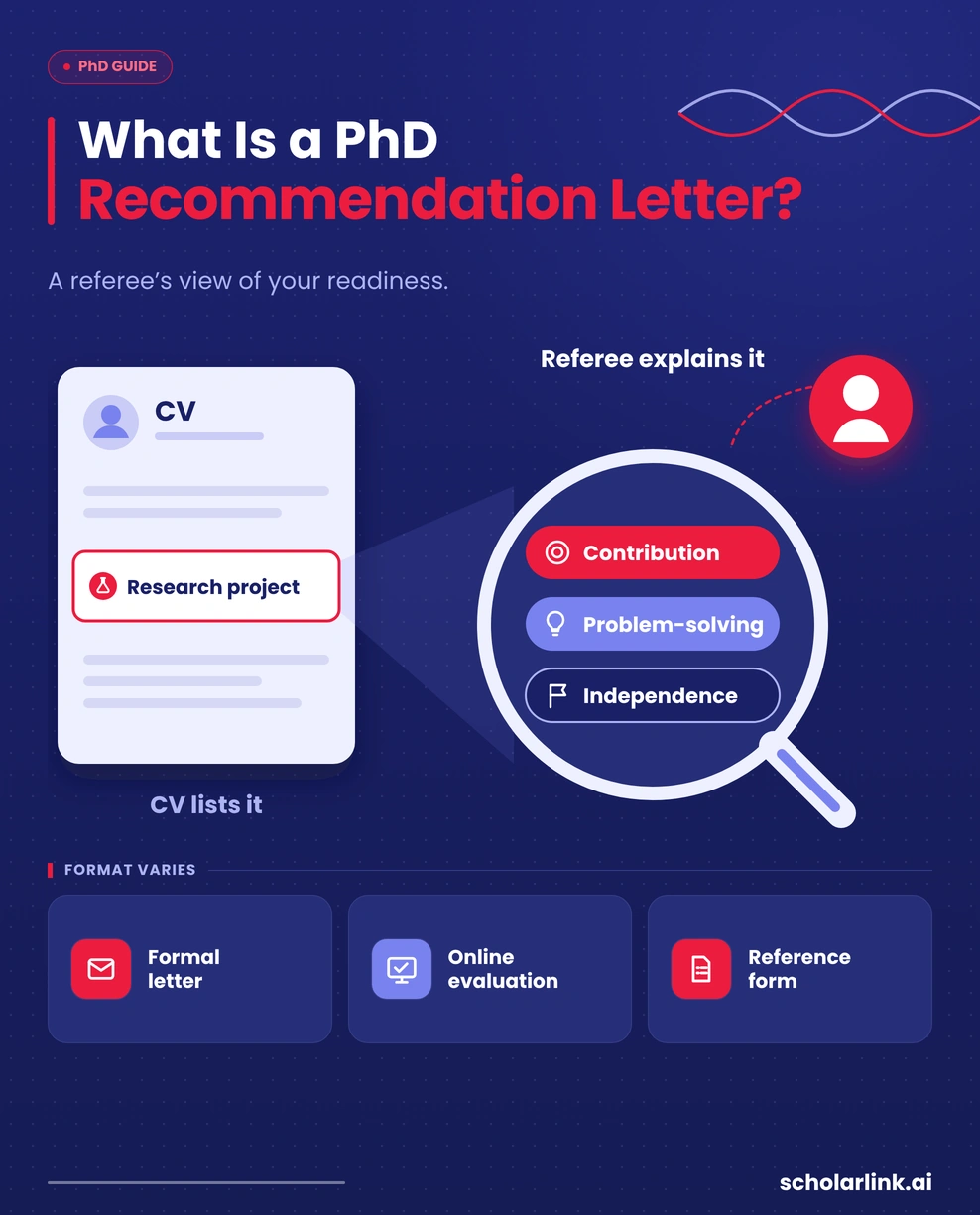
Depending on the university, a recommendation may be submitted as a formal letter, an online evaluation, or a structured reference form. The required format and questions vary between institutions.
A recommendation letter is particularly useful because it can provide context that other application documents may not show. For example, a CV may list a research project, but a supervisor can explain the applicant’s actual contribution, problem-solving approach, and level of independence.
What Should a PhD Recommendation Letter Include?
A strong PhD recommendation letter should provide a clear and evidence-based assessment of the applicant.
Although the exact format varies, most effective letters address several important areas.
1. The Referee’s Relationship With the Applicant
The letter should explain who the referee is and how they know the applicant.
Useful details include:
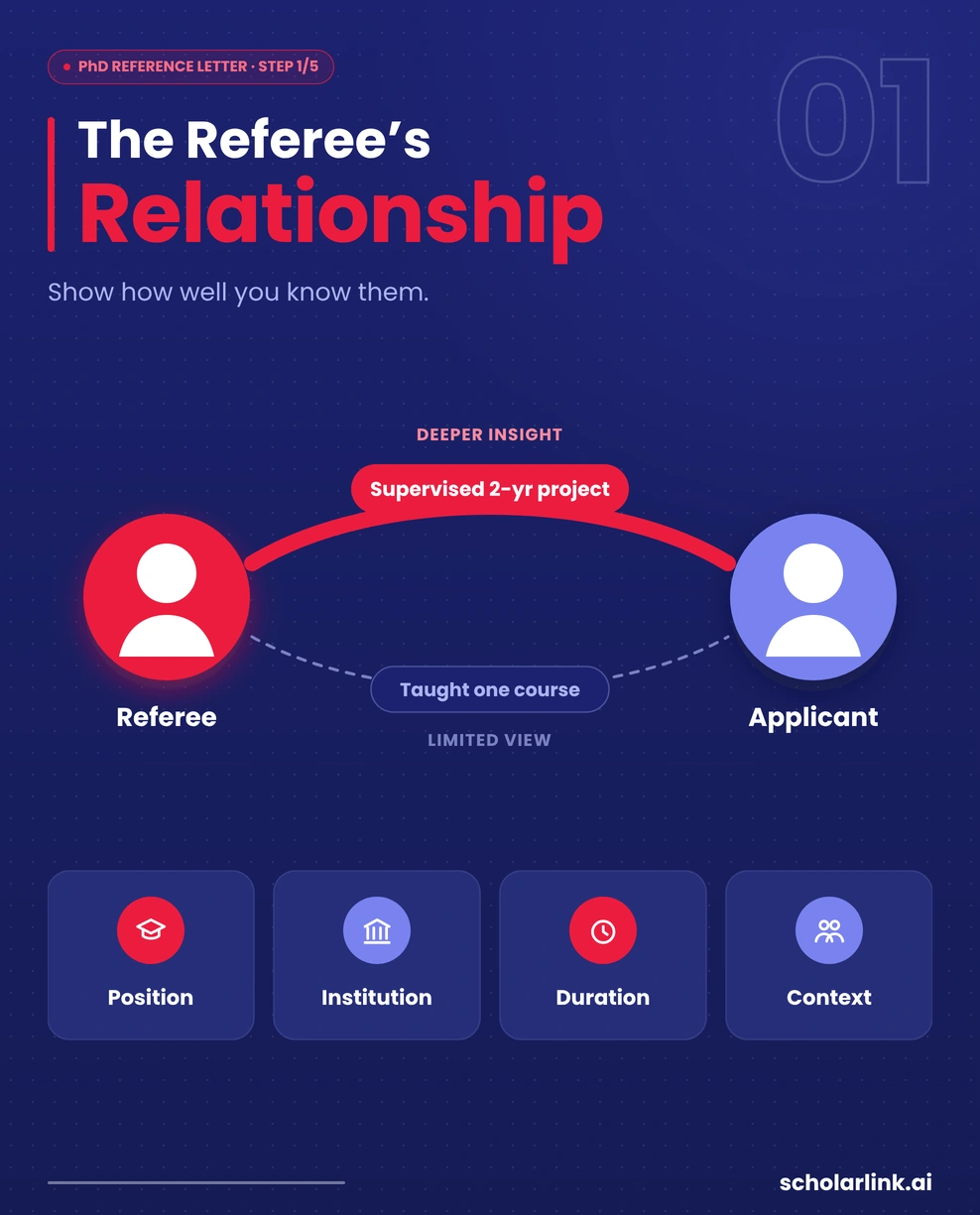
- The referee’s academic or professional position.
- The institution or organisation where they worked with the applicant.
- The length of their professional relationship.
- The context in which they supervised, taught, or collaborated with the applicant.
This information helps the admissions committee understand the basis of the referee’s evaluation.
A professor who supervised a two-year research project may be able to assess different aspects of an applicant’s abilities than a lecturer who taught them in a single course.
2. Academic and Research Performance
The referee should describe the applicant’s academic performance in a way that is relevant to doctoral study.
Depending on the relationship, this may include:
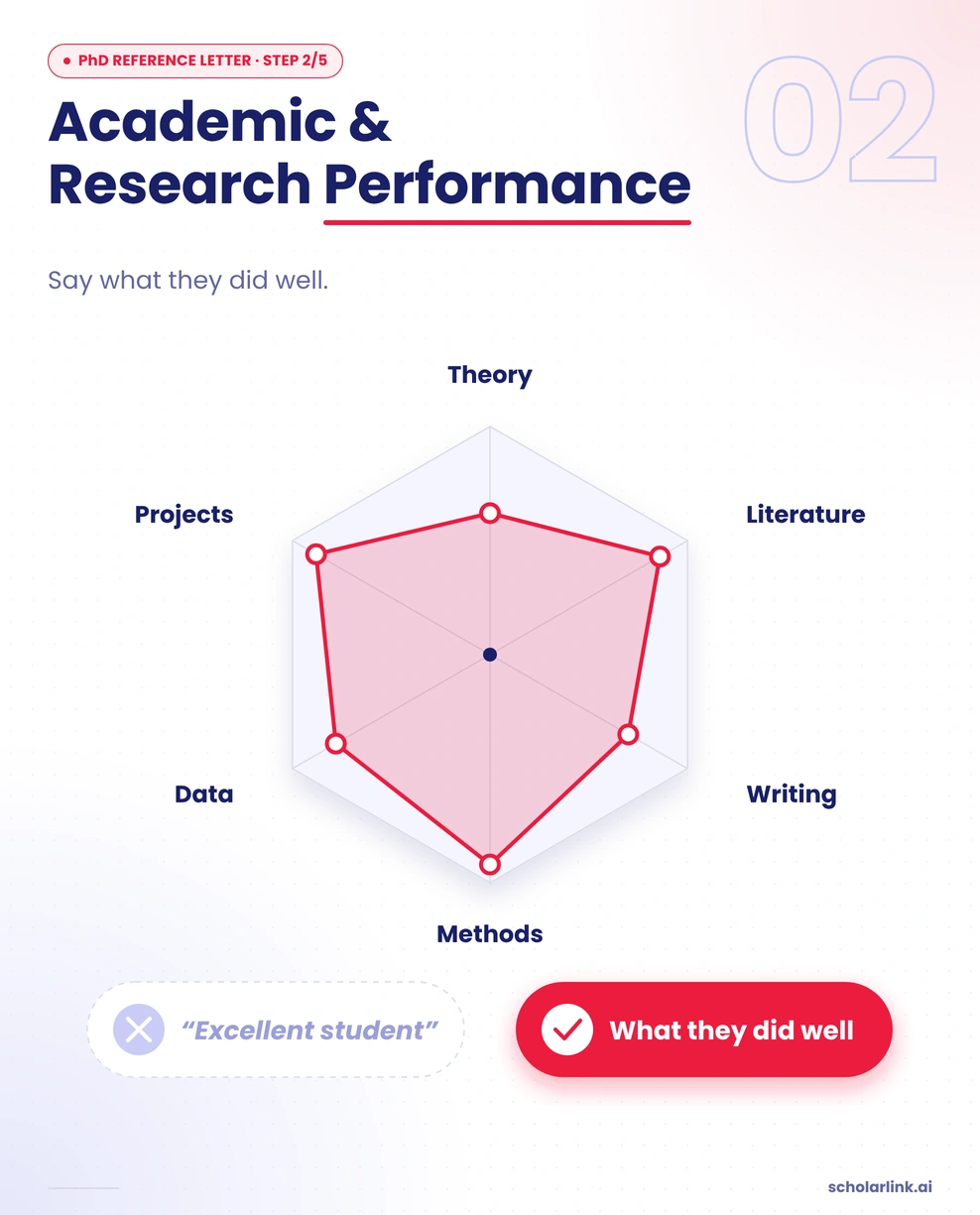
- Understanding of theoretical concepts.
- Ability to analyse academic literature.
- Quality of written research.
- Knowledge of relevant research methods.
- Ability to interpret data and findings.
- Performance in advanced coursework or research projects.
Rather than simply describing an applicant as an excellent student, the referee should explain what they did particularly well.
3. Research Independence and Problem-Solving
Doctoral research requires more than the ability to follow instructions. PhD candidates must gradually develop the ability to make decisions, identify problems, and conduct independent investigations.
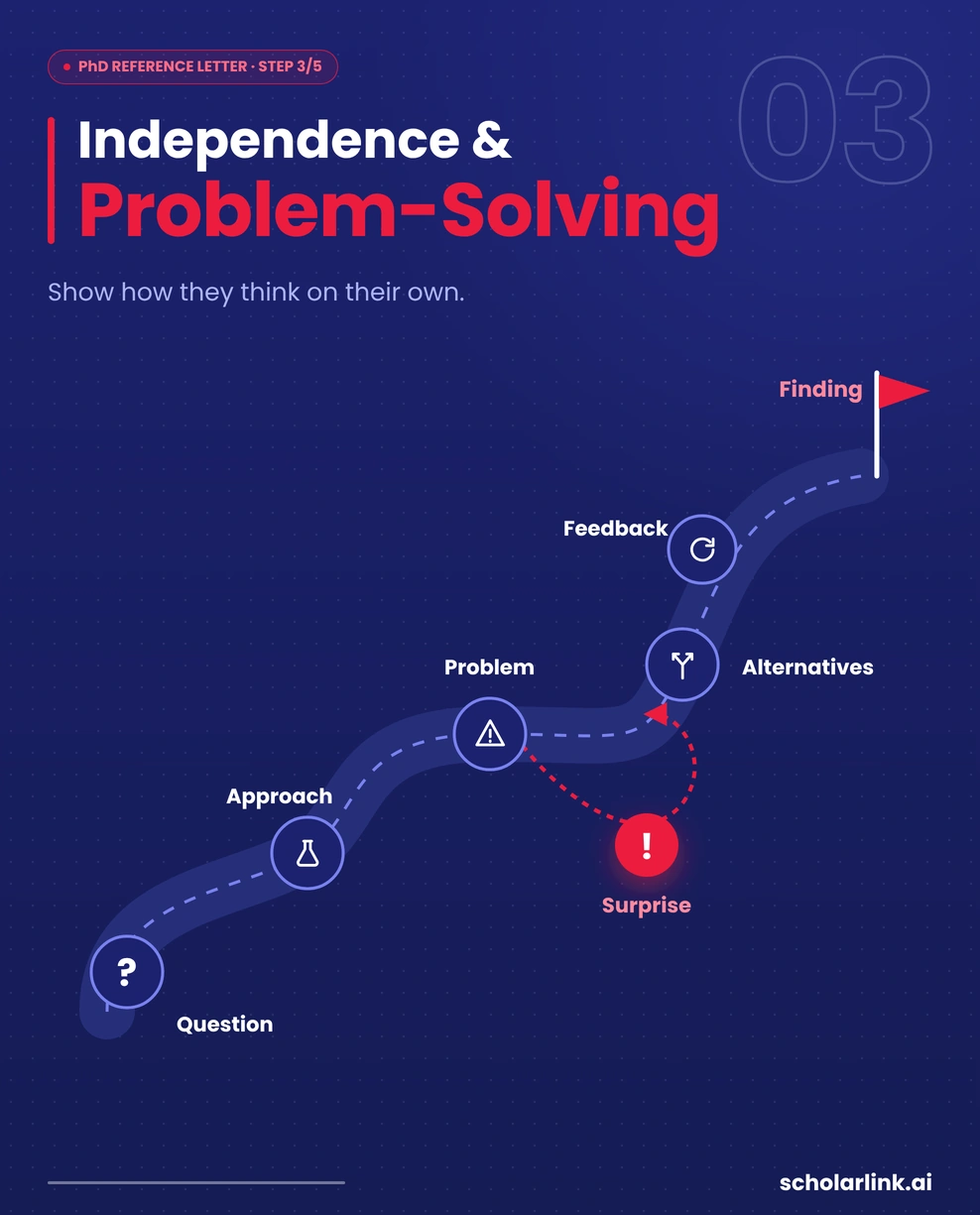
A useful recommendation letter may describe how the applicant:
- Developed or refined a research question.
- Selected an appropriate research approach.
- Identified problems during a project.
- Evaluated alternative explanations.
- Responded to unexpected results.
- Improved their work after receiving feedback.
These examples help the committee understand how the applicant may perform in a research environment.
4. Specific Evidence and Examples
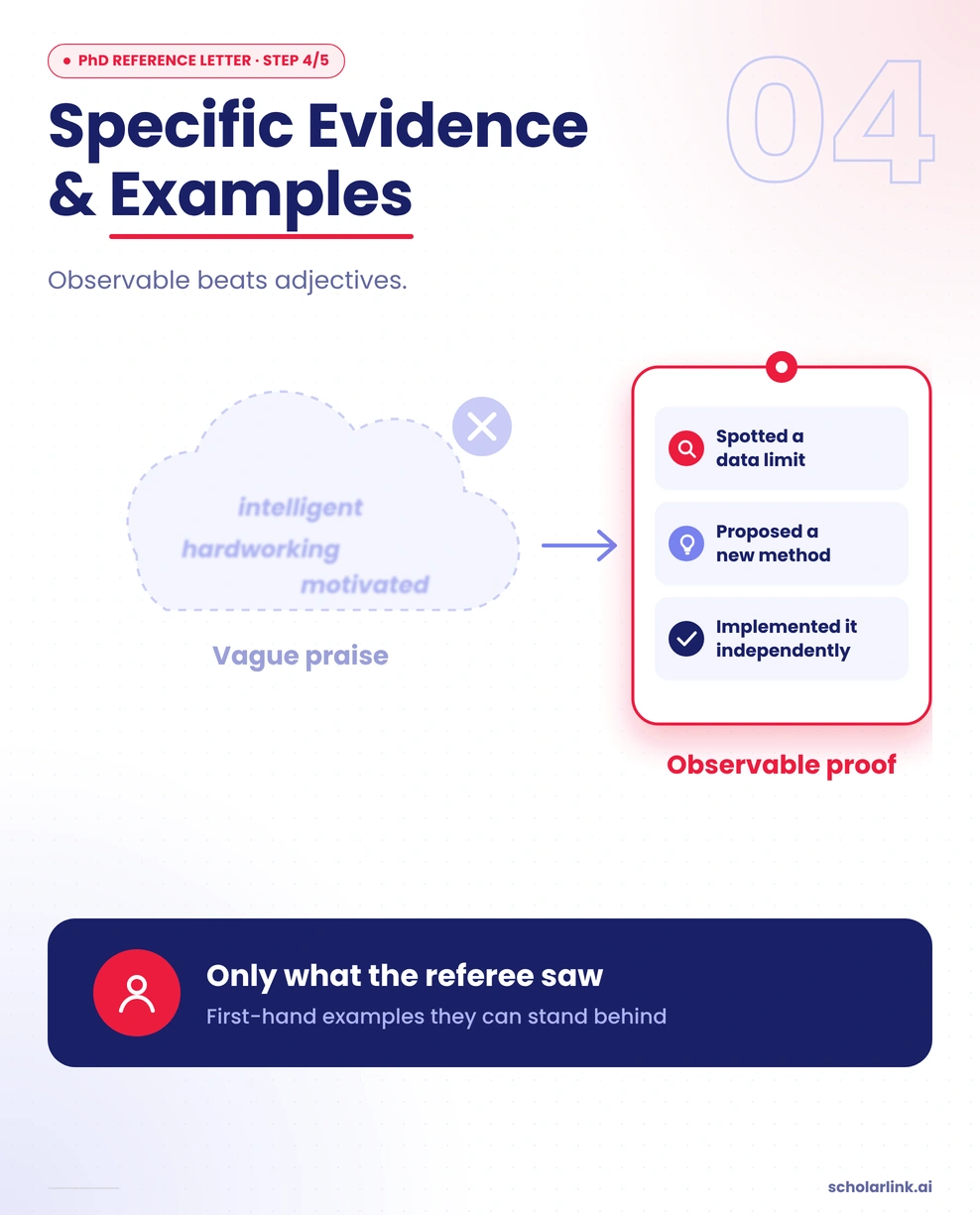
One of the most important characteristics of an effective recommendation letter is the use of specific evidence.
Consider the difference between these two statements:
Generic praise:
“She is an intelligent, hardworking, and highly motivated student.”
Evidence-based evaluation:
“During her master’s research project, she identified a limitation in the initial data collection approach and proposed an alternative method. She independently reviewed the relevant literature, discussed the methodological implications, and implemented the revised approach with minimal supervision.”
The second statement is more informative because it describes an observable contribution.
Referees should use examples they can genuinely support through their own experience.
5. A Clear Recommendation
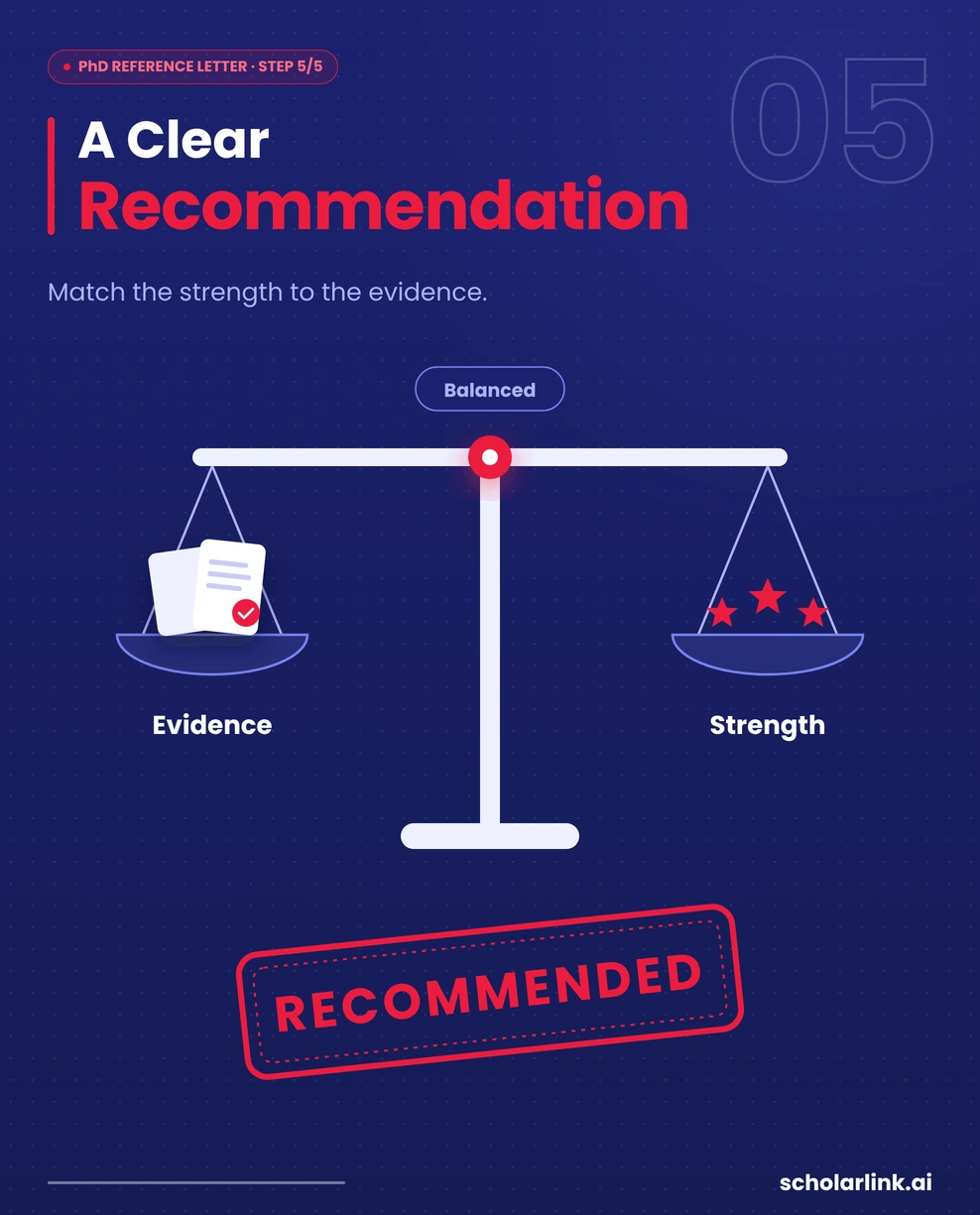
The letter should conclude with a clear assessment of the applicant’s suitability for doctoral study.
The referee may explain why they believe the applicant is prepared for advanced research and whether they recommend the applicant for the programme.
The strength of the recommendation should reflect the referee’s actual knowledge of the candidate. Unsupported claims or exaggerated praise can make a letter less credible.
Typical Structure of a Strong PhD Recommendation Letter
A recommendation letter does not need to follow one universal template, but a clear structure makes it easier for admissions committees to understand the evaluation.
Opening: Introduction and Recommendation
The referee introduces themselves, identifies their position, and explains the purpose of the letter.
The opening should establish the referee’s professional context and their basis for evaluating the applicant.
Relationship and Academic Context
The next section explains how the referee knows the applicant.
For example, the referee may have supervised the applicant’s master’s thesis, taught an advanced research course, or managed their work in a research laboratory.
Evaluation of Research Skills
The referee discusses the applicant’s relevant academic and research abilities.
This section should focus on qualities that matter for the proposed doctoral programme.
Specific Examples of Academic Achievement
The letter should include one or more examples that support the referee’s evaluation.
These could involve a thesis, research project, publication, laboratory contribution, or substantial academic assignment.
Final Recommendation and Closing
The final section summarises the referee’s assessment and provides a clear recommendation.
The letter should include the referee’s professional contact details and signature when required by the university.
| Letter section | Purpose |
|---|---|
| Introduction | Establish the referee’s identity and purpose |
| Relationship | Explain how the referee knows the applicant |
| Academic evaluation | Assess academic and research abilities |
| Evidence | Provide specific examples |
| Final recommendation | Summarise the applicant’s suitability |
What Qualities Do PhD Admissions Committees Look For?
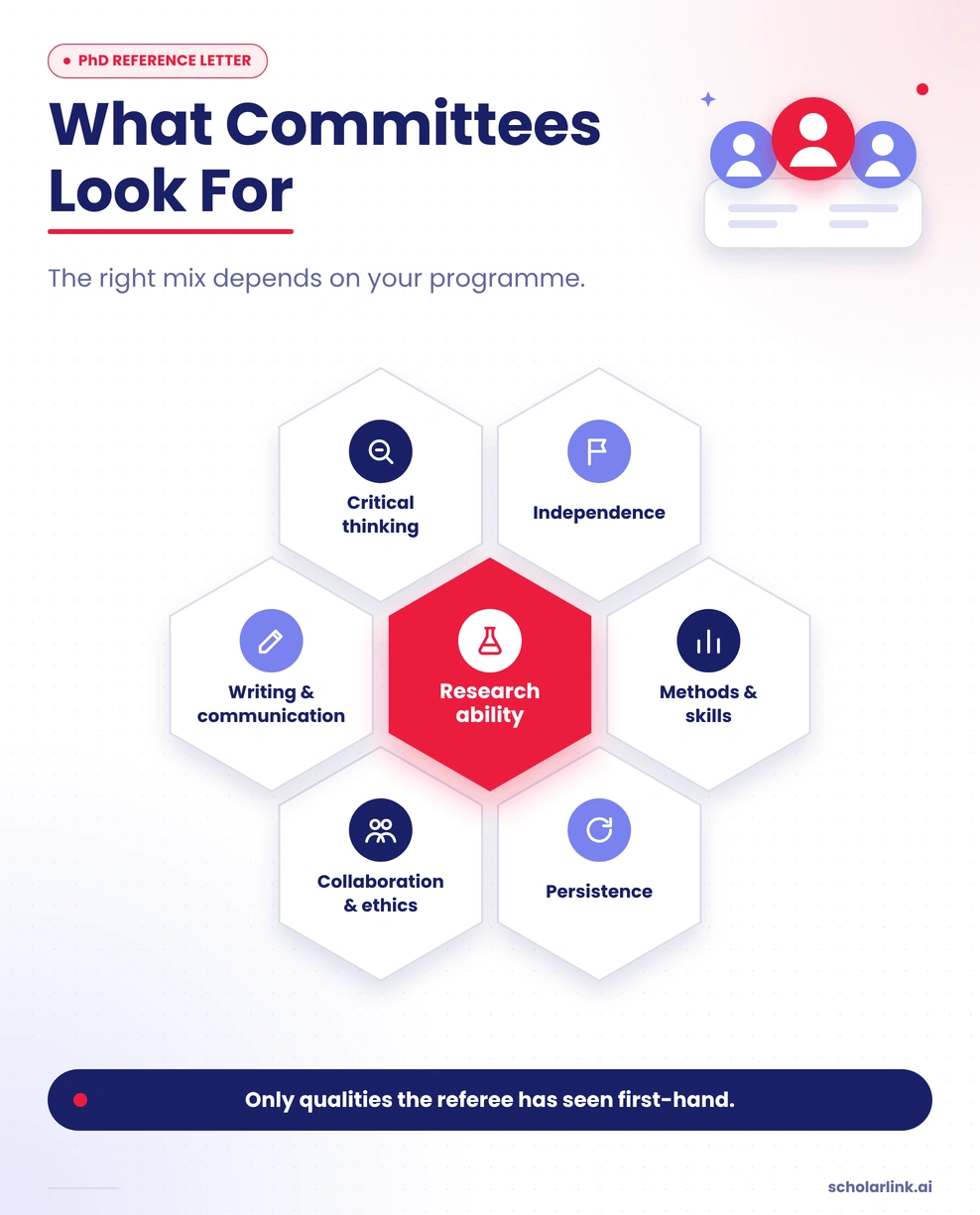
The qualities discussed in a recommendation letter should reflect the applicant’s research area and the expectations of the specific doctoral programme.
Not every applicant needs to demonstrate the same combination of skills. However, several abilities are frequently relevant to doctoral research.
Research Ability
Research ability involves understanding how to investigate a question, evaluate existing knowledge, select suitable methods, and interpret findings.
A referee may discuss the applicant’s contribution to a thesis, research project, laboratory study, or academic publication.
Critical Thinking
Critical thinking is the ability to examine evidence, question assumptions, evaluate different explanations, and develop reasoned conclusions.
A useful example might describe how an applicant identified a weakness in an existing argument or evaluated competing interpretations of research findings.
Intellectual Independence
PhD candidates are expected to develop increasing independence throughout their studies.
A referee may describe situations in which the applicant took initiative, proposed solutions, or made informed decisions without requiring constant supervision.
Research Methods and Technical Skills
Depending on the discipline, relevant skills may include:
- Statistical analysis.
- Laboratory techniques.
- Qualitative research methods.
- Computational modelling.
- Programming and data analysis.
- Archival research.
- Experimental design.
- Fieldwork.
The referee should mention only skills they have directly observed or can credibly assess.
Academic Writing and Communication
Research requires the ability to communicate complex ideas clearly.
A recommendation letter may discuss the quality of the applicant’s thesis, research reports, presentations, academic writing, or ability to explain findings to different audiences.
Persistence and Response to Feedback
Research projects rarely progress without challenges.
A referee can provide valuable insight by explaining how the applicant responded to setbacks, revised their work, and incorporated constructive criticism.
Collaboration and Research Ethics
Many research environments require collaboration with supervisors, colleagues, and other researchers.
When relevant, a referee may discuss the applicant’s ability to work in a team, communicate professionally, acknowledge limitations, and follow appropriate research practices.
PhD Recommendation Letter Examples
The following examples are illustrative templates. They are not real letters from actual professors or universities. Each example demonstrates how a referee from a different academic or professional relationship might structure an assessment.
The details should always be adapted to the applicant’s actual experience and the referee’s direct knowledge.
Example 1: PhD Recommendation Letter From a Thesis Supervisor
This example is suitable for a referee who supervised the applicant’s undergraduate or master’s thesis.
Sample letter:
Dear Members of the Admissions Committee,
I am pleased to recommend [Applicant Name] for admission to the PhD programme in [Research Field] at [University Name].
I am [Referee Name], [Academic Position] in the Department of [Department Name] at [University Name]. I supervised [Applicant Name]’s master’s thesis, titled “[Thesis Title],” during [Academic Period]. Through this experience, I had the opportunity to evaluate their research skills, academic judgement, and ability to work independently.
During the project, [Applicant Name] demonstrated a strong understanding of the relevant literature and an ability to connect theoretical concepts with practical research questions. One particularly notable aspect of their work was [specific research contribution or achievement]. They approached this challenge by [brief explanation of the action taken], demonstrating an ability to analyse problems and consider alternative approaches.
I was also impressed by their response to feedback. Throughout the research process, [Applicant Name] revised their methodology and improved the clarity of their analysis based on critical discussion. Their final thesis reflected careful reasoning, consistent effort, and a clear understanding of the research topic.
In addition to their technical and academic abilities, [Applicant Name] demonstrated the independence and persistence required for advanced research. They were able to manage their responsibilities, identify areas requiring further investigation, and communicate their findings effectively.
Based on my experience supervising their work, I believe [Applicant Name] has the academic foundation and research potential needed to pursue doctoral study in [Research Field]. I am pleased to recommend their application.
Please feel free to contact me if further information is required.
Sincerely,
[Referee Name]
[Academic Position]
[Department and University]
[Institutional Email Address]
Why this example works:
- It establishes the referee’s relationship with the applicant.
- It identifies the research context.
- It includes a specific contribution rather than relying entirely on praise.
- It discusses research independence and response to feedback.
- It connects the assessment to the demands of doctoral study.
Example 2: Recommendation Letter From a Research Project Supervisor
This example is designed for applicants who have worked in a laboratory, research centre, or academic research project.
Sample letter:
Dear Members of the Admissions Committee,
I am writing to recommend [Applicant Name] for admission to the PhD programme in [Research Field] at [University Name].
I am [Referee Name], [Position] at [Research Centre or Institution Name], where I supervised [Applicant Name] during their involvement in the research project “[Project Title]” from [Start Date] to [End Date].
During this period, [Applicant Name] contributed to [brief description of the research project]. Their responsibilities included [specific tasks, methods, or technical contributions]. They quickly developed an understanding of the project’s objectives and demonstrated the ability to apply relevant research methods carefully.
One example of their contribution was [specific example]. When the team encountered [research problem], [Applicant Name] helped address the issue by [specific action]. This demonstrated their analytical thinking, attention to detail, and willingness to take responsibility for their work.
Beyond their technical contribution, [Applicant Name] worked effectively with other members of the research team. They communicated their findings clearly, accepted feedback constructively, and showed a consistent interest in understanding the broader implications of the project.
I believe their experience in [relevant research area] has provided a valuable foundation for further academic development. Their ability to engage with research questions, work through methodological challenges, and collaborate with others makes them a promising candidate for doctoral study.
I am happy to recommend [Applicant Name] for your programme and would be pleased to provide any additional information.
Sincerely,
[Referee Name]
[Position]
[Research Centre or Institution]
[Institutional Email Address]
Why this example works:
- It explains the applicant’s actual role in the research project.
- It connects technical skills with research outcomes.
- It includes an example of problem-solving.
- It demonstrates teamwork without making collaboration the only focus.
- It provides evidence relevant to doctoral research.
Example 3: Recommendation Letter From an Industry Research Supervisor
A professional supervisor may be an appropriate referee when the applicant has relevant research-oriented work experience and the PhD programme accepts professional references.
This example should not be interpreted as evidence that all universities accept employer references instead of academic ones.
Sample letter:
Dear Members of the Admissions Committee,
I am writing in support of [Applicant Name]’s application to the PhD programme in [Research Field] at [University Name].
I am [Referee Name], [Position] at [Company or Organisation Name]. I have supervised [Applicant Name] since [Date], during which time we have worked together on projects involving [relevant research or technical area].
Although my professional relationship with [Applicant Name] is based in an industry research environment, I have had several opportunities to evaluate their analytical abilities, technical knowledge, and approach to complex problems.
During [Project Name or Description], [Applicant Name] was responsible for [specific responsibilities]. They demonstrated an ability to examine technical information, evaluate alternative solutions, and apply evidence-based reasoning when making decisions.
A particularly relevant example was [specific achievement or challenge]. In this situation, [Applicant Name] [describe the action taken and its outcome]. This experience demonstrated their ability to approach unfamiliar problems systematically and communicate their reasoning effectively.
[Applicant Name] also showed a strong willingness to learn and improve. They responded constructively to feedback, worked effectively with colleagues from different technical backgrounds, and maintained a careful approach to project responsibilities.
Based on my experience working with them, I believe [Applicant Name] has developed analytical and research-related skills that may support their transition into doctoral study in [Research Field].
I recommend their application and would be happy to provide further information about their professional experience and contributions.
Sincerely,
[Referee Name]
[Professional Position]
[Company or Organisation Name]
[Professional Email Address]
Why this example works:
- It clearly identifies the professional relationship.
- It focuses on research-related abilities rather than general employment performance.
- It provides a specific example of analytical work.
- It avoids claiming that the referee can assess academic performance they have not observed.
- It makes the limits of the referee’s perspective clear.
PhD Recommendation Letter Template
The following template provides a practical structure for a referee preparing a recommendation letter.
It should be adapted to the applicant, the research field, and the requirements of the target university.
PhD Recommendation Letter Template
[Referee’s Full Name]
[Academic or Professional Position]
[Department or Organisation]
[Institutional Address]
[Email Address]
[Date]Dear Members of the Admissions Committee,
I am writing to recommend [Applicant Name] for admission to the [PhD Programme Name] at [University Name].
I am [Referee Name], [Position] at [Institution Name]. I have known [Applicant Name] for [Duration] in my capacity as their [Thesis Supervisor / Course Professor / Research Supervisor / Professional Supervisor].
During our time working together, I had the opportunity to evaluate their abilities in [Relevant Academic or Research Area]. In particular, [Applicant Name] demonstrated [Relevant Strengths], as shown by their work on [Project, Thesis, or Relevant Activity].
One example of their ability was [Specific Example]. In this situation, they [Describe the Applicant’s Contribution], which demonstrated [Relevant Skill or Quality].
In addition to this achievement, [Applicant Name] has demonstrated [Additional Relevant Skills], particularly in [Specific Context]. I was especially impressed by their ability to [Specific Observation or Achievement].
Based on my experience with [Applicant Name], I believe they have the [Academic Foundation / Research Skills / Relevant Experience] necessary to pursue doctoral study in [Research Field].
I am pleased to recommend their application. Please feel free to contact me if you require any further information.
Sincerely,
[Referee Name]
[Position]
[Department and Institution]
[Professional Email Address]
[Signature, if required]
How to Use This Template Effectively
A template should provide structure, not replace the referee’s own judgement.
Before finalising the letter:
- Replace every placeholder with accurate information.
- Include only achievements the referee can verify.
- Use examples from the referee’s direct experience.
- Adapt the letter to the research area and programme.
- Check whether the university requires a specific form or format.
- Follow any instructions about letterhead, signatures, length, and submission.
Applicants can share this template as a reference if a professor asks for guidance, but the final assessment should remain the referee’s own work.
Common Mistakes in PhD Recommendation Letters
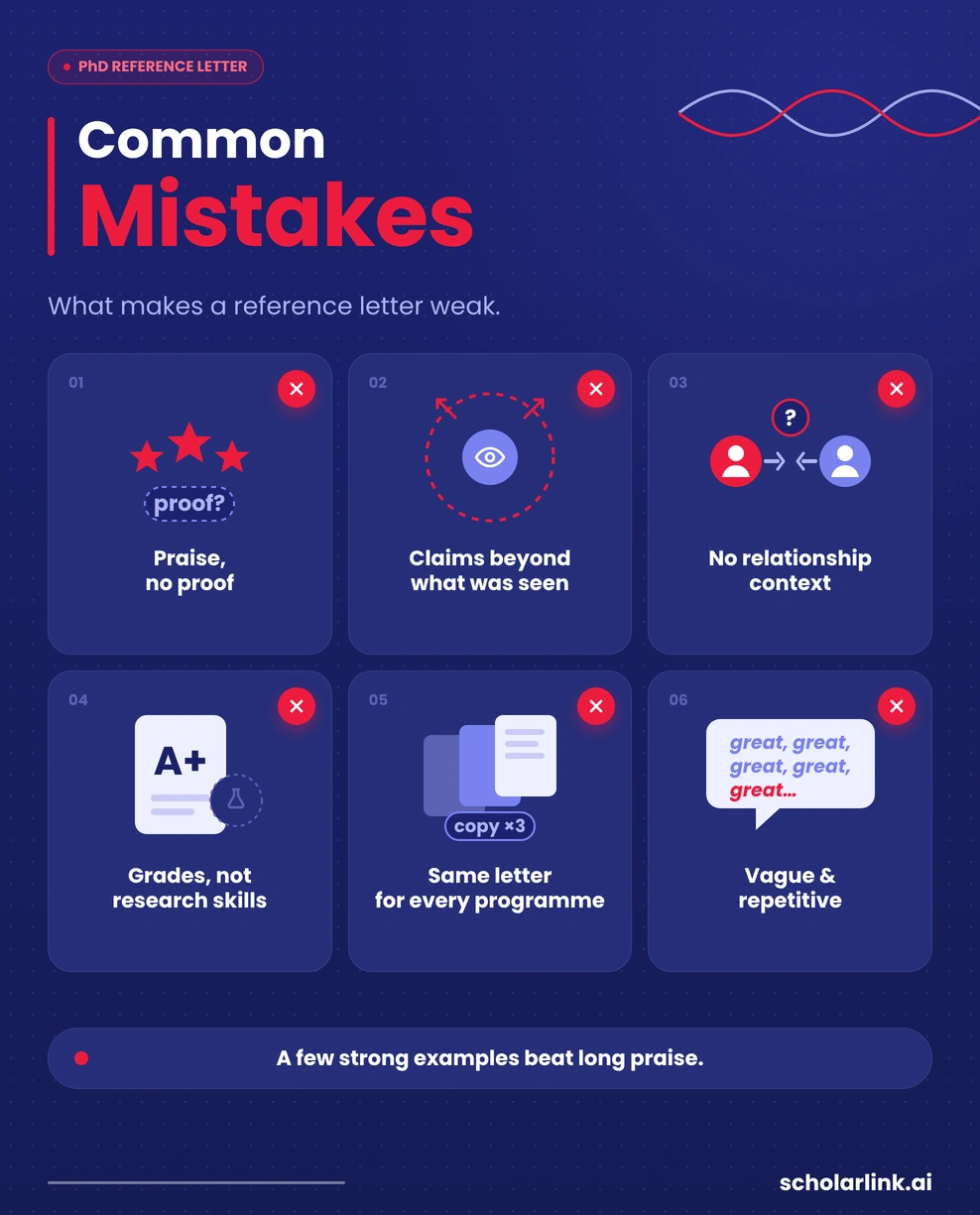
A recommendation letter may lose its value when it contains broad praise but little meaningful evaluation.
The following mistakes are worth avoiding.
Using Generic Praise Without Evidence
Statements such as “the applicant is excellent” or “one of the best students I have ever taught” are not very informative without an explanation.
A stronger letter describes what the applicant did and why that work was impressive.
Making Unsupported Claims
A referee should avoid claims that cannot be supported by their experience.
For example, a professor who supervised one course project should not make broad claims about the applicant’s entire research career.
The scope of the evaluation should match the referee’s actual knowledge.
Failing to Explain the Referee’s Relationship With the Applicant
Admissions committees need to understand the context of the assessment.
A letter that does not explain how the referee knows the applicant makes it difficult to judge the depth and reliability of the evaluation.
Ignoring Research-Specific Skills
A letter that discusses only attendance, grades, or general personality may not demonstrate the applicant’s readiness for doctoral research.
Where relevant, the referee should address research methods, analytical ability, independence, and academic writing.
Using the Same Generic Letter for Every Programme
A recommendation letter should reflect the applicant’s intended research area and the programme’s requirements.
This does not mean inventing different achievements for each application. It means selecting relevant examples and ensuring that the letter accurately supports the applicant’s goals.
Making the Letter Too Vague or Repetitive
Repeating the same positive adjectives does not make a letter stronger.
A focused letter with a few well-developed examples is generally more useful than a long letter filled with repeated praise.
Final Checklist for a Strong PhD Recommendation Letter
Before submitting a recommendation letter, check whether it includes:
- The referee’s name, position, and professional affiliation.
- A clear explanation of the referee’s relationship with the applicant.
- The length and context of their academic or professional interaction.
- An assessment of relevant academic abilities.
- An evaluation of research skills where appropriate.
- Specific examples that support the evaluation.
- Evidence of relevant independence, analytical ability, or problem-solving.
- A clear connection between the applicant’s abilities and doctoral study.
- A professional and credible final recommendation.
- The referee’s contact information and signature, if required.
Frequently Asked Questions
What should a PhD recommendation letter include?
A PhD recommendation letter should explain the referee’s relationship with the applicant, assess relevant academic and research abilities, provide specific examples, and offer a clear evaluation of the applicant’s suitability for doctoral study.
How do you write a strong recommendation letter for a PhD student?
A strong letter is based on the referee’s direct experience with the applicant. It should use specific examples, explain the applicant’s research contributions, and evaluate skills relevant to the proposed doctoral programme.
How long should a PhD recommendation letter be?
There is no universal word limit. The required length may depend on the university’s instructions or whether the referee is completing an online form. The letter should be detailed enough to provide meaningful evidence without unnecessary repetition.
Can an employer write a PhD recommendation letter?
Some programmes accept professional references, particularly when the applicant has relevant research-oriented work experience. However, other programmes require academic referees. Applicants should check the specific requirements before relying on an employer’s recommendation.
Is a PhD reference letter the same as a recommendation letter?
The terms are often used interchangeably, but the submission format may differ. A university may request a formal letter, an online reference form, or a structured assessment from the referee.
Does a PhD recommendation letter need to be signed?
This depends on the university’s submission requirements. Some institutions require a signed letter on official letterhead, while others collect references through secure online forms. Follow the instructions provided by the programme.