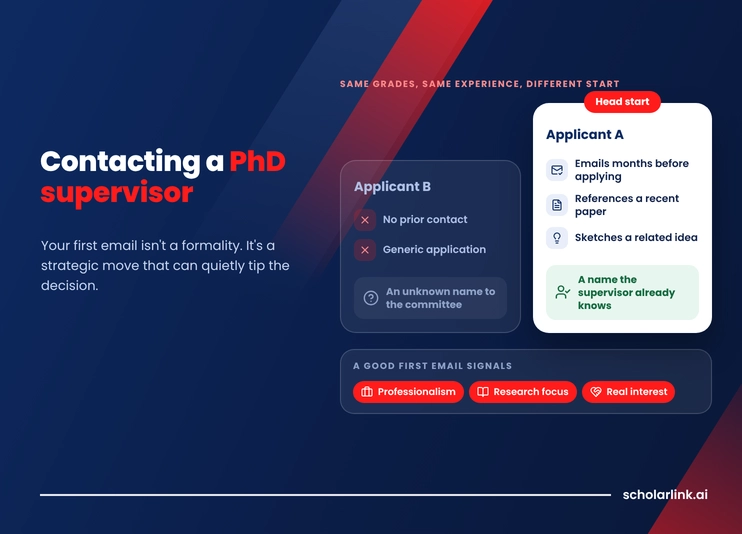
A well-written first email to a potential PhD supervisor should make three things clear: who you are, why you are contacting that particular researcher, and what you are asking about. The strongest messages are specific without becoming long. They refer to a real research connection, provide enough evidence of relevant preparation, and make one clear request.
The examples below cover common situations, including a first inquiry, an advertised PhD project, a self-proposed research topic, funding availability, and a request for a meeting. Use them as starting points rather than messages to copy unchanged. Replace every bracketed detail, remove any sentence that does not apply to your background, and check the professor’s current research before sending.
For the broader process of identifying and evaluating potential advisors, see our complete guide to how to approach a PhD supervisor.
| Important: A supervisor inquiry is not a request for guaranteed admission. In many universities, formal admission is decided through a separate application and selection process. Your email should ask about supervision or research opportunities, not ask the professor to promise an offer. |
PhD Email Subject Lines
A useful subject line tells the professor what the message is about before they open it. Keep it direct and specific. Include your status, research area, the project title, or the intake year when that information helps identify your inquiry.
| Purpose | Subject line example |
| General first contact | Prospective PhD Student – [Research Area] – [Intake Year] |
| Supervision inquiry | Inquiry About PhD Supervision in [Field] – [Your Name] |
| Research alignment | Prospective Doctoral Student – Research Interest in [Specific Topic] |
| Advertised project | Application Inquiry: [Exact Project Title] – [Your Name] |
| Self-proposed research | PhD Supervision Inquiry – Proposed Research on [Topic] |
| Funding availability | Inquiry About Funded PhD Opportunities in [Field] – [Intake Year] |
| Meeting request | Request for a Brief Discussion About PhD Supervision |
| Follow-up | Re: [Original Subject Line] |
| Avoid: Vague subjects such as “Hello Professor,” “PhD,” or “Admission.” Do not imply that you have been selected for a position when you are only making an inquiry. |
Before Sending Your Email
Use this short check before sending any PhD inquiry email:
- Confirm that the professor is an appropriate contact for the program or project and that the department permits direct inquiries.
- Check the professor’s name, title, university, and official email address.
- Read at least one relevant recent publication or project description and identify the specific connection to your interests.
- Replace every placeholder and remove claims, skills, publications, or achievements that do not accurately describe you.
- Attach a concise academic CV when relevant or requested; include other documents only when they help answer the professor’s likely questions or are specifically requested.
- Use a professional email address, proofread the message, and open the attachments once to confirm they are correct.
Initial Inquiry Email Templates
Use an initial inquiry when you have identified a potential supervisor but are not responding to a specific advertised vacancy. The message should introduce your academic background, connect it to the professor’s current work, and ask whether they may be available to supervise a new doctoral student.
General PhD inquiry email
Template: General first contact
| Subject: Prospective PhD Student – [Research Area] – [Intake Year]
Dear Professor [Last Name], My name is [Your Name], and I am currently [completing / have completed] a [Master’s degree / relevant degree] in [Field] at [University]. My academic work has focused on [specific research area or question]. I am preparing to apply for a PhD in [Field] for the [Term/Year] intake and am interested in your research group because of your work on [specific topic or project]. I recently read your paper, “[Paper Title],” and was particularly interested in [specific finding, method, or research question]. My [thesis / research project] examined [brief description], where I gained experience in [relevant method, tool, or subject area]. I see a possible connection between this work and your group’s research on [area of alignment]. May I ask whether you expect to accept new PhD students for [Term/Year], and whether my research interests might be relevant to your group? I have attached my CV for context. Thank you for your time and consideration. Kind regards, [Your Name] [Degree / University] |
Why it works: The message gives the professor enough context to assess the inquiry, names a specific piece of research, and ends with a clear question about supervision availability.
Cold email to a professor with no prior connection
A cold email is a first contact with a professor who does not know you and has not invited your inquiry. In this situation, the research connection should appear early and should be more specific than a general statement that you admire the professor’s work.
Template: PhD cold email
| Subject: PhD Supervision Inquiry – [Specific Research Topic]
Dear Professor [Last Name], I am [Your Name], a [Master’s student / graduate] in [Field] at [University]. I am exploring PhD opportunities in [research area] for [Term/Year] and am contacting you because of your work on [specific topic]. I read your recent paper, “[Paper Title],” and was particularly interested in its discussion of [specific point]. My current research on [your topic] addresses a related question through [method / dataset / theoretical approach]. This has led me to consider how [one-sentence research connection] could be explored further. I would be grateful to know whether this direction could fit your group’s current research and whether you may be considering new PhD students for the upcoming cycle. My CV is attached for reference. Thank you for considering my inquiry. Best regards, [Your Name] |
Why it works: It establishes why this particular professor was selected and frames the contact as a research conversation rather than a mass request for admission.
Short and direct PhD inquiry email
A minimalist email can work when your research match is straightforward and the professor does not need extensive background to understand your inquiry. Keep the core facts and the question; do not remove the research reference that makes the message personal.
Template: Short initial inquiry
| Subject: Prospective PhD Student – [Research Topic] – [Intake Year]
Dear Professor [Last Name], I am a [Master’s student / graduate] in [Field] at [University], researching [specific topic]. I am interested in your recent work on [paper / project], particularly [specific aspect], which closely relates to my work on [your research topic]. I am exploring PhD opportunities for [Term/Year] and would like to ask whether you expect to accept new students in this area. I would be glad to share my CV or further details if helpful. Thank you for your time. Best regards, [Your Name] |
Why it works: It removes background detail that is not essential while preserving the reason for contacting this particular professor and a direct next-step question.
Email highlighting publication experience
Use this version when a peer-reviewed publication, conference paper, or comparable research output is directly relevant to the professor’s work. Mention the contribution accurately; do not imply that a manuscript under review has already been published.
Template: Highlighting a relevant publication
| Subject: Prospective PhD Student – [Research Area] – [Your Name]
Dear Professor [Last Name], I recently completed a [Degree] in [Field] at [University], where my research focused on [topic]. I am contacting you because of your work on [specific research area], especially your recent publication on [paper / topic]. I have recently published [paper title] in [Journal / Conference], where I investigated [research question or contribution]. The project involved [method, dataset, archive, or analytical approach], and it led me to become particularly interested in [next research question]. I see a strong connection between this work and your group’s research on [specific area]. May I ask whether you are considering new PhD students for [Term/Year] and whether this research direction could be relevant to your group? Thank you for your consideration. Kind regards, [Your Name] |
Why it works: It presents a concrete research output as evidence of preparation and uses it to explain the applicant’s next research direction, rather than simply listing a publication as a credential.
Advertised PhD Project Email Templates
When a university advertises a defined PhD position, refer to the exact project title and explain how your experience matches its stated objectives. The purpose is to make it easy for the supervisor to connect your profile with the selection criteria.
Email about an advertised PhD position
Template: Advertised project inquiry
| Subject: Application Inquiry: [Exact Project Title] – [Your Name]
Dear Professor [Last Name], I recently came across the advertised PhD position, “[Exact Project Title],” in [Department / Research Group] at [University]. I am interested in applying and would like to ask a brief question about the project. I am currently [completing / have completed] a [Degree] in [Field] at [University]. My research has focused on [relevant topic], and I have gained experience in [two relevant methods, tools, or research tasks]. In particular, my work on [project / thesis] involved [specific result or responsibility], which appears relevant to the project’s focus on [project objective]. I have also read your group’s recent work on [related publication or project], which strengthened my interest in this opportunity. Could you please confirm whether the position is still open and whether my background appears relevant to the advertised requirements? I would be happy to provide any additional information. My CV is attached for your consideration. Thank you for your time. Sincerely, [Your Name] |
Why it works: It identifies the exact vacancy, maps the applicant’s experience to the project requirements, and asks a focused question without requesting a guarantee of selection.
Highly targeted research-alignment email
Use this variant when you can identify a particularly close connection between a specific publication and your previous research. It is especially useful when the advertised project has a defined methodological or technical focus.
Example: Engineering / AI project
| Subject: Prospective PhD Applicant – [Project Area] – [Your Name]
Dear Professor [Last Name], I am completing a Master’s degree in Computer Science at [University], where my thesis focuses on deep-learning methods for medical image analysis. I am writing about the advertised PhD project on [exact project title]. Your recent paper on [specific method or problem] caught my attention because my thesis examines [closely related issue]. In my current work, I have used [relevant tools or methods] to [briefly describe a concrete task or result]. This experience appears closely related to the project’s goal of [project goal]. I would appreciate the opportunity to clarify whether this background matches the profile you are seeking and whether you recommend that I submit a formal application. Thank you for your consideration. Best regards, [Your Name] |
Why it works: The applicant does not merely claim to be a good fit; they point to a specific overlap between the advertised project, a publication, and their own work.
Self-Proposed Research Email Templates
Use a self-proposed research email when you have an initial doctoral research direction and are looking for a supervisor whose expertise could support its development. The first message should communicate the central question and its relevance, not attach a lengthy, finished proposal unless the professor or department requests one.
Template: Self-proposed PhD research
| Subject: PhD Supervision Inquiry – Proposed Research on [Topic]
Dear Professor [Last Name], My name is [Your Name], and I recently completed a [Master’s degree] in [Field] at [University]. My previous research focused on [topic], particularly [specific question or problem]. I am currently developing an initial PhD research direction on [proposed topic]. The central question I hope to explore is [one-sentence research question]. I became interested in this direction after reading your work on [specific publication / project], especially your discussion of [specific concept or finding]. My background in [relevant methods, theory, or subject area] could provide a starting point for investigating [possible contribution or angle]. I would, however, be open to refining the scope in response to the research priorities and expertise of your group. Would you be open to considering supervision in this area, or to a brief discussion about whether the proposed direction could fit your current research? I would be glad to share a short concept note if useful. Thank you for your time and consideration. Best regards, [Your Name] |
Why it works: It presents an identifiable research question, explains the connection to the professor’s work, and shows initiative while leaving room to refine the idea collaboratively.
Example: Environmental Science / Climate Research
Example: Self-proposed environmental research
| Subject: Prospective PhD Research – Urban Climate Resilience
Dear Professor [Last Name], I recently completed a Master’s degree in Environmental Policy at [University], where my thesis examined climate-resilience strategies in coastal cities, with a focus on urban flood mitigation. I am developing a possible PhD project on how local climate-adaptation policies can be integrated into urban planning in rapidly growing coastal regions. Your recent research on climate adaptation and flood-management frameworks in European cities is closely related to the questions I hope to investigate. I would be interested in exploring how comparative policy analysis could extend this work to [specific region or case study]. I would welcome your view on whether this research direction could be a suitable basis for doctoral work in your group. If you are considering new PhD students for [Term/Year], I would be grateful for the opportunity to discuss potential supervision. I can share a short concept note and my CV if helpful. Thank you very much for your time. Kind regards, [Your Name] |
Why it works: The example translates a broad interest in sustainability into a researchable topic, a defined context, and a clear link to the supervisor’s work.
Funding Inquiry Email Templates
A funding inquiry should be connected to the research opportunity. Avoid making financial support the only reason for contacting a professor. First establish why the research group is relevant, then ask whether funded doctoral positions, project-based studentships, or suitable funding routes may be available.
Template: Asking about funded PhD opportunities
| Subject: Inquiry About Funded PhD Opportunities in [Field] – [Intake Year]
Dear Professor [Last Name], I am [completing / have completed] a [Degree] in [Field] at [University], with research experience in [specific area]. I am planning to pursue doctoral research in [topic] for the [Term/Year] intake. I have been following your group’s work on [specific project or research theme], particularly [specific publication or result]. My experience with [method / skill / research project] is relevant to this direction, and I would be interested in contributing to related work within your group. May I ask whether you anticipate recruiting new PhD students for the upcoming cycle and whether any funded positions or project-based studentships may be available? I would also appreciate any guidance on relevant departmental or external funding routes for applicants in my situation. I have attached my CV for reference and would be happy to provide further details about my research background. Thank you for your time and consideration. Best regards, [Your Name] |
Why it works: The message frames funding as part of the feasibility of a research match and asks about concrete routes without sounding entitled to financial support.
Meeting Request Email Templates
A meeting request is most appropriate when the professor has shown interest, invited further discussion, or when a brief conversation would help clarify a specific research or project question. Make the request modest and easy to answer.
Template: Requesting an informal meeting
| Subject: Request for a Brief Discussion About PhD Supervision – [Research Area]
Dear Professor [Last Name], Thank you for considering my inquiry about potential PhD supervision in [research area]. I would value the opportunity to learn a little more about your group’s current work on [specific project or topic] and to discuss whether my background in [relevant area] could be a suitable fit. Would you be available for a brief 15–20-minute online meeting in the coming weeks? I would be happy to work around your availability and can send a short agenda in advance if useful. Thank you again for your time. Kind regards, [Your Name] |
Why it works: It explains why a meeting would be useful, sets a reasonable time expectation, and gives the professor flexibility over scheduling.
Follow-up Email Templates
If a professor has not replied, allow time for academic workload and scheduling before following up. The G01 action plan uses approximately 10–14 days for the first follow-up. Keep the message in the original email thread so the context remains visible.
Template: First follow-up after no response
| Subject: Re: [Original Subject Line]
Dear Professor [Last Name], I hope you are doing well. I am writing to follow up on my email of [Date] regarding potential PhD supervision in [research area] for the [Term/Year] intake. I remain very interested in your group’s work on [specific topic] and would appreciate any guidance on whether you may be considering new doctoral students for the upcoming cycle. I understand that you have a busy schedule, so I would be grateful for an update whenever convenient. For ease of reference, I have reattached my CV. Thank you again for your time and consideration. Best regards, [Your Name] |
Why it works: It reminds the professor of the original inquiry, restates the research connection, and makes a courteous request without implying that a reply is owed.
Final follow-up when there is still no reply
If there is a clear reason to send one final message, the G01 plan places it approximately two to three weeks after the first follow-up. Do not continue sending repeated reminders. After this final note, move forward with other suitable supervisors unless the professor responds.
Template: Final follow-up
| Subject: Re: [Original Subject Line]
Dear Professor [Last Name], I wanted to send one final follow-up to my messages of [Date] and [Date] about potential PhD supervision in [research area]. I remain interested in your group’s work, but I understand that you may not have capacity to take on additional students or may be unable to respond at this time. If you are not currently accepting PhD students, no further reply is necessary. Thank you for considering my inquiry, and I appreciate your time. Kind regards, [Your Name] |
Why it works: It closes the communication respectfully and gives the professor a simple way to signal that no position is available.
Response to a Positive Reply
When a professor responds positively, acknowledge the message, answer any questions directly, and send only the documents requested or clearly relevant to the next step. If the professor suggests a meeting, offer practical availability rather than sending a long explanation.
Template: Replying to a positive response
| Subject: Re: [Original Subject Line]
Dear Professor [Last Name], Thank you very much for your reply and for considering my interest in your research group. I appreciate the opportunity to discuss potential PhD supervision. As requested, I have attached my [CV / transcript / short research proposal / writing sample]. The document includes further information about my work on [relevant topic] and my experience with [relevant method or skill]. I would be pleased to arrange a brief meeting to discuss the project and possible research directions. I am available on [Option 1] or [Option 2], but I would be happy to accommodate another time that suits your schedule. Please let me know if there is any additional information I can provide before we speak. Thank you again for your time. Best regards, [Your Name] |
Why it works: It acknowledges the reply, supplies the requested material, and moves the conversation toward a specific next step without assuming that admission has been granted.
If the professor cannot supervise you
Template: Responding when no place is available
| Subject: Re: [Original Subject Line]
Dear Professor [Last Name], Thank you for letting me know. I appreciate your taking the time to respond and understand that you are not able to accept additional PhD students at the moment. I remain interested in research on [area]. If there is another colleague or research group at [University / Department] whose work may be relevant to my interests, I would be grateful for any suggestion, although I completely understand if no recommendation comes to mind. Thank you again for your time and consideration. Kind regards, [Your Name] |
Examples by Academic Discipline
The basic structure of a PhD inquiry remains similar across fields, but the evidence of research fit changes. Technical disciplines often emphasize methods, tools, datasets, and experimental experience. Social sciences and humanities more often foreground research questions, theoretical frameworks, sources, and scholarly debates. Adapt the central research paragraph to the conventions of your discipline.
Computer Science and Artificial Intelligence
Research-fit paragraph: Computer Science / AI
| Subject: Prospective PhD Student – [AI Research Area] – [Your Name]
My Master’s thesis examined [specific AI / machine-learning problem], using [model, method, or dataset] to investigate [research objective]. I was particularly interested in your recent work on [paper or project], especially its approach to [specific technical issue]. I would be keen to explore how my experience with [relevant tools or methods] could contribute to related work in your group. |
Engineering and Applied Research
Research-fit paragraph: Engineering
| Subject: PhD Inquiry – [Engineering Topic] – [Your Name]
My previous project focused on [engineering problem], where I worked with [experimental method, simulation environment, or technical tool] to evaluate [system or process]. Your research on [specific project] is closely related to this experience, particularly your work on [specific method or application]. I would be interested in developing this background further through doctoral research in your group. |
Environmental Science
Research-fit paragraph: Environmental Science
| Subject: PhD Research Interest – [Environmental Topic] – [Your Name]
My research interests focus on [environmental issue] and its relationship with [policy, ecosystem, or community context]. In my previous work on [thesis or project], I examined [specific case or question] using [method]. Your recent research on [specific topic] offers a strong connection to the questions I hope to investigate at doctoral level. |
Social Sciences
Research-fit paragraph: Sociology / Migration Studies
| Subject: PhD Supervision Inquiry – [Social Research Topic] – [Your Name]
My Master’s research examined [social issue] in [population, location, or institutional context], with particular attention to [theoretical concept or research question]. I was interested in your comparative work on [specific topic], especially your analysis of [specific finding or framework]. I hope to develop this line of inquiry through a doctoral project that examines [proposed extension or comparative angle]. |
Humanities and History
Research-fit paragraph: Humanities / History
| Subject: Prospective PhD Researcher – [Historical / Cultural Topic] – [Your Name]
My previous research focused on [period, author, archive, text, or cultural question], particularly [specific research problem]. Your work on [scholarship, source base, or interpretive framework] is closely related to the direction I hope to pursue. I would be interested in exploring [specific question or corpus] in greater depth and considering how it may contribute to the discussions developed in your research. |
| How to use these examples: These discipline-specific paragraphs are modular. Insert one into the relevant email template, then add a genuine reference to the professor’s work. Do not send a paragraph that describes methods or experience you have not actually used. |
What These Email Examples Have in Common
Although each template serves a different purpose, effective PhD supervisor emails share a small number of features:
- They identify the applicant and the reason for writing near the beginning.
- They show clear research alignment through a specific paper, project, question, method, or field connection.
- They give evidence of relevant preparation instead of relying on broad claims such as “I am passionate about research.”
- They communicate mutual value by showing what the applicant could contribute to the research group, not only what the applicant hopes to receive.
- They make one specific and reasonable request, such as confirming supervision availability, clarifying a project requirement, or arranging a short discussion.
- They respect the professor’s time and use a concise, professional tone.
The goal is not to make every email sound identical. It is to make each message relevant to the professor, the research opportunity, and the stage of the application process.
Frequently Asked Questions
What is the best sample email to a PhD supervisor?
The best email is the one that accurately reflects your background and the professor’s current research. It should introduce you briefly, explain a specific research connection, and ask a clear question about potential supervision or a defined PhD opportunity.
How do I write a cold email to a professor for PhD admission?
Use a specific subject line, identify your academic status, refer to a relevant recent paper or project, explain how your experience connects to it, and ask whether the professor is considering new PhD students. Avoid sending a generic message to multiple faculty members.
Should I ask about funding in my first email?
You may ask about funded positions when funding is essential to your ability to undertake the PhD, but connect the question to your research fit and the group’s recruitment plans. You can also ask about relevant departmental or external funding routes.
How long should a PhD supervisor email be?
Keep the message concise and focused. The source articles use different ranges, so there is no single word limit that applies to every case. Include enough detail to establish your background, research alignment, and purpose, then remove anything that does not help the professor assess the inquiry.
When should I send a follow-up email to a professor?
The G01 action plan recommends sending the first follow-up approximately 10–14 days after the initial inquiry. If a final message is appropriate, it can be sent around two to three weeks after the first follow-up. Avoid repeated reminders.
Should I attach my CV to a PhD inquiry email?
A concise, relevant academic CV is commonly useful, unless the university or professor provides different instructions. Attach additional documents only when requested or when they are directly relevant to the specific opportunity.
Can I use the same email for several professors?
Use the same basic structure if helpful, but personalize every message. The research reference, explanation of fit, and question should reflect the individual professor and their current work.
Does a positive reply mean I have been admitted to the PhD program?
No. A positive reply may lead to a discussion about research fit or supervision, but formal admission remains subject to the university’s application and selection process.