

A strong SOP for Computer Science does one job well: it shows an admissions committee that you’re prepared for graduate-level work, that you have a clear intellectual direction, and that you and the programme are a genuine fit. It isn’t a list of achievements or a plea about how much you love technology — it’s a focused argument, built from real evidence, about why you’re ready to do this work and why here. This guide covers all of that: what a CS statement of purpose actually is, how MS and PhD expectations differ, a step-by-step writing framework, a complete illustrative sample with annotations, the mistakes that weaken applications, and a revision checklist. The SOP is one important part of your file, not the single thing that decides admission — so the goal here is a clear, credible essay, not a “perfect” one.

What Is a Statement of Purpose for Computer Science?
A Computer Science statement of purpose is a short essay that explains your academic preparation, your technical and research interests, and why a specific graduate programme fits your goals. It’s an argument about readiness and direction — written in your own voice, backed by concrete experience.
It’s easy to confuse it with three neighbouring documents, so keep them distinct. A resume lists what you did; the SOP explains what it meant and where it points. A personal statement, where a university asks for one separately, leans more on personal background, motivation, and perspective. A research statement, more common at the PhD level, goes deep on your research agenda. Some programmes ask for more than one of these, so read each prompt carefully rather than reusing one essay for all of them.
When committees read a CS SOP, they’re typically weighing a few things: your preparation (do your coursework, projects, and experience add up?), your intellectual direction (do you know roughly what you want to work on?), your fit with the programme, and how clearly you can communicate technical ideas. What counts, and what each document is even called, varies by university — always follow the official instructions for the programme you’re applying to.
How Long Should a Computer Science SOP Be?
There’s no universal word count, and any guide that gives you one fixed number is guessing. Length is set by each programme’s prompt and application portal — some cap it at 500 words, some at one or two pages, and some leave it open but expect concision. The rule is simple: follow the official instructions for your target programme, and when a limit exists, respect it exactly.
Even where no limit is stated, shorter and sharper usually wins. Purdue’s Computer Science department puts it plainly:
“There is no word limit but it is in your best interest to be concise.” — Purdue University, Department of Computer Science
In practice that means every paragraph should earn its place. Before you worry about length, confirm the actual requirements for each programme:
| Requirement | What applicants should verify |
|---|---|
| Word / page limit | The official department page and the application portal field |
| Required prompt | The exact questions or statement instructions |
| Research expectations | Whether research interests or faculty names are requested |
| Additional essays | Whether a personal statement or research statement is separate |
| Formatting | File type, font, spacing, and upload instructions |
MS vs. PhD SOP: Key Differences
The biggest mistake applicants make is treating every graduate SOP the same. A coursework-focused master’s, a research (thesis) master’s, and a PhD are reading for different things, and your emphasis should shift accordingly.
For a coursework MS, the committee mainly wants to see that you can handle advanced classes and have a clear professional direction. Your projects and applied experience are the evidence. For a research MS, you’re expected to show research preparation and thesis potential, so research experience and potential supervisors matter more. For a PhD, the whole essay turns on original research potential: what questions drive you, what you’ve already done, and which specific faculty and labs you’d want to work with. Keep in mind that the line isn’t rigid — many MS programmes are themselves research-intensive, so read the programme before deciding how research-heavy to make your SOP.
| Feature | Coursework-focused MS | Research MS | PhD |
|---|---|---|---|
| Main emphasis | Advanced coursework and career development | Research preparation and thesis potential | Original research potential |
| Project evidence | Technical projects and applied experience | Projects, research, and thesis work | Research contributions and methods |
| Faculty fit | Relevant courses and specialisation | Potential supervisors and research groups | Specific faculty and research alignment |
| Future goals | Industry, applied research, or further study | Research, industry, or PhD progression | Independent research career or advanced R&D |
How to Write an SOP for Computer Science Step by Step
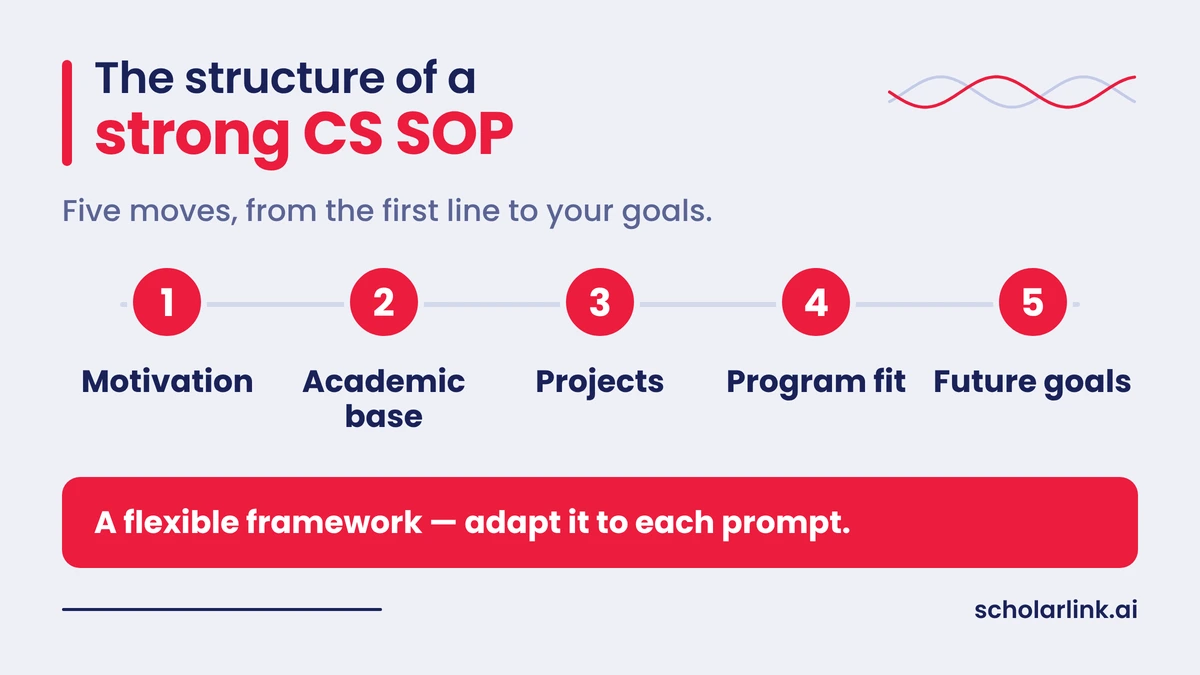
A good SOP moves in a logical arc: what sparked your interest, what prepared you, what you’ve done about it, where you want to go, and why this programme. Here’s how to build each part.
Start with a Specific Technical or Intellectual Motivation
Skip “I have always loved computers.” Open with a concrete moment or problem that actually shaped your direction — a bug that revealed how little you understood about distributed systems, a dataset that wouldn’t behave, a paper that changed how you thought about a problem. Specificity signals a real mind at work and sets up everything that follows.
Explain Your Academic Foundation
Show that you’re prepared without reciting your transcript. Highlight the coursework and foundations that matter for your intended area — algorithms, systems, machine learning, theory — and connect them to what you want to study next. The point is readiness, not a complete list.
Present Projects and Research as Evidence
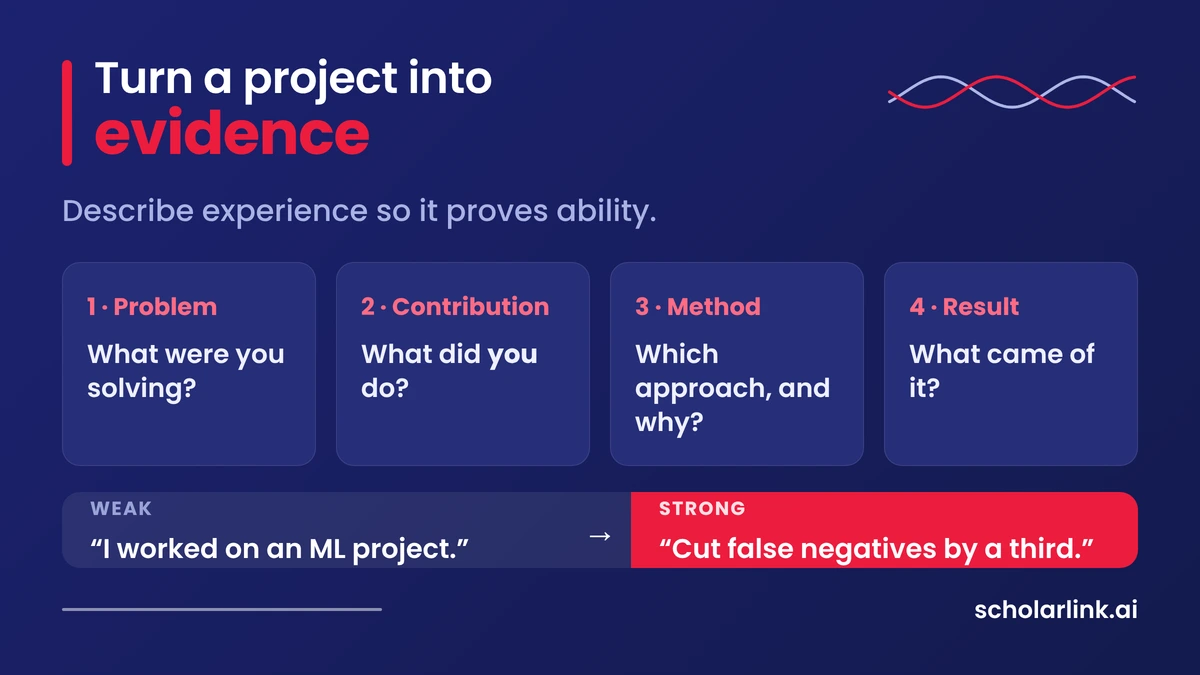
This is the core of the essay. For each project, explain the problem, your contribution, the method, and the result — not just that it happened. Vague claims of interest carry little weight; evidence does. As MIT’s EECS faculty put it:
“Compelling application essays should talk about actual accomplishments.” — Prof. Hal Abelson, MIT EECS
So instead of “I worked on a machine learning project,” write what you built, the approach you chose and why, and what came of it — an accuracy gain, a deployed tool, a publication, a surprising negative result you learned from.
Describe Relevant Work or Internship Experience
If you have industry or internship experience, use it to show engineering maturity and problem-solving — the scale you worked at, a hard technical decision you made, the impact. Tie it back to your academic direction rather than leaving it as a standalone job description.
Demonstrate Why This Program Is the Right Fit
Generic flattery (“your university is prestigious”) is wasted space. Instead, name specific courses, labs, research groups, or faculty whose work connects to your interests, and explain the connection. This takes real research into the programme — and it’s the paragraph that must be rewritten for every university you apply to.
Connect Your Degree to Your Future Goals
State where you’re heading in a realistic, specific way: the kind of role, research area, or problem you want to work on after the degree, and how this programme gets you there. “I want to be successful in technology” says nothing; a concrete direction shows intent.
Write a Focused Conclusion
Close by tying the threads together — your preparation, your fit with this programme, and what you intend to contribute. Keep it short and confident, without restating the whole essay.
Computer Science SOP Format and Structure
Most effective CS statements follow a similar shape, paragraph by paragraph. Treat this as a flexible framework, not a mandatory template — merge or reorder sections to fit your story and the programme’s prompt.
| Section | Purpose | What to include |
|---|---|---|
| Introduction | Establish direction | A specific motivation, your technical interest, your objective |
| Academic preparation | Demonstrate readiness | Relevant coursework and foundations |
| Projects / research | Show evidence | Problem, contribution, methods, results |
| Program fit | Demonstrate alignment | Faculty, labs, courses, research themes |
| Future goals | Show direction | Immediate and long-term goals |
| Conclusion | Tie it together | Preparation, fit, and intended contribution |
As a rough guide, the projects/research and program-fit sections usually deserve the most space, since that’s where you prove both capability and fit. The introduction and conclusion should be the shortest parts.
SOP for MS in Computer Science: Sample and Writing Tips
An MS applicant should emphasise solid academic preparation, concrete projects, and a clear professional or research direction. The sample below shows how that comes together. It is illustrative only — the experiences and names are invented to demonstrate structure. Replace every detail and every bracketed placeholder with your own truthful information; never submit invented achievements.
During my third year, a recommendation system I built for a campus marketplace kept surfacing irrelevant results, and chasing that failure is what pulled me toward machine learning in earnest. I’m applying to the MS in Computer Science at [University] to deepen that work under rigorous supervision.
My undergraduate training in [degree] gave me the foundations I now rely on — algorithms, linear algebra, and two graduate-level machine learning courses in which I implemented models from scratch rather than calling libraries. That habit of building things end to end shaped how I approach problems.
For my capstone, I worked on near-duplicate detection in a 400,000-image dataset. The problem was that exact-match hashing missed visually similar images; my contribution was a pipeline combining perceptual hashing with a lightweight CNN embedding, and after tuning the similarity threshold against a hand-labelled validation set, we cut false negatives by roughly a third. The most useful lesson was methodological: my first approach overfit badly, and diagnosing why taught me more than the final result did.
At [Company], a summer internship on the data platform team, I shipped a feature that reduced a nightly pipeline’s runtime by profiling and rewriting its slowest join. Working at that scale taught me how much engineering discipline real systems demand.
[University]’s MS programme is a strong fit for where I want to go next. [Professor]’s work on efficient model inference connects directly to my interest in making ML systems practical, and the [specific course or lab] would let me build the systems background my projects have only hinted at. After the degree, I want to work as a machine learning engineer on production systems, and eventually on the efficiency problems that sit between research and deployment.
Why it works, paragraph by paragraph:
- The opening starts with a specific technical failure, not a cliche, and states a clear objective. A reader immediately knows what the applicant cares about.
- The academic paragraph proves preparation through how they studied (building from scratch), not a transcript dump.
- The project paragraph is the strongest: it names the problem, the applicant’s contribution, the method, and a concrete result — and it reflects honestly on a failure, which reads as maturity.
- The internship paragraph adds engineering credibility and ties back to the academic direction.
- The fit paragraph points to a specific professor, course, and research theme, then connects the degree to a realistic goal. This is the part you rewrite for each university.
SOP for PhD in Computer Science: Research-Focused Guidance
A PhD SOP is fundamentally about research potential. The committee wants to see that you can identify a meaningful question, that you’ve already engaged with research in some real way, and that you understand what doing research actually involves. Structure your evidence around the research arc: the question that interests you, your prior research on it or something adjacent, the methods you used, the findings (including what didn’t work), and the future direction you’d want to pursue.
Faculty and lab fit matters far more than at the MS level. Read recent papers from the groups you’re targeting, and show — specifically, without name-dropping for its own sake — how your interests connect to theirs and where you might contribute. A short research-focused paragraph might read:
My undergraduate thesis examined fairness in ranking systems. I reproduced a well-known debiasing method, found it degraded sharply under distribution shift, and proposed a reweighting scheme that held up better on two of three benchmarks. That result left me with the question I want to pursue in a PhD: how to make fairness guarantees robust when deployment data drifts — which is exactly the direction [Professor]’s recent work on distribution-robust learning is moving.
That paragraph works because it shows a real research cycle, an honest result, and a forward-looking question tied to a specific group — everything a PhD committee reads for.
Common Computer Science SOP Mistakes to Avoid
Most weak SOPs fail in predictable ways: a generic opening about loving technology, a paragraph that just re-lists the resume in prose, buzzwords with no substance behind them, grand claims with no evidence, and flattery that could apply to any school. The fix for each is the same — replace the vague version with something specific and verifiable. The table below shows the shift in practice.
| Weak approach | Stronger approach |
|---|---|
| “I have always loved computers.” | Name a specific technical problem that shaped your interest. |
| “I worked on a machine learning project.” | Explain the problem, your contribution, the method, and the result. |
| “Your university is prestigious.” | Connect a specific course, lab, or faculty research area to your goals. |
| “I want to become successful in technology.” | State a realistic, specific career or research direction. |
| “I am passionate and hardworking.” | Show it through an accomplishment, not an adjective. |
Two more worth naming: don’t let the SOP simply duplicate your resume — the resume lists, the SOP interprets. And don’t claim the SOP will guarantee admission or call it your “winning essay”; it’s one strong, honest part of a larger application.
Computer Science SOP Checklist Before Submission
Run through this before you submit each application:
- Followed the programme’s official prompt and length limit exactly
- Opened with a specific motivation, not a cliche
- Described projects as problem → contribution → method → result
- Every claim of skill or interest is backed by concrete evidence
- The program-fit paragraph names real courses, labs, or faculty
- Rewrote the fit paragraph for this specific university
- Stated a realistic, specific future direction
- Removed buzzwords, filler, and resume repetition
- Checked whether a separate personal or research statement is required
- Replaced every placeholder with truthful personal detail
- Proofread for clarity, grammar, and consistent naming of the university
FAQ
What is an SOP for Computer Science?
It’s a short essay explaining your academic preparation, technical and research interests, and why a specific graduate programme fits your goals. It argues that you’re ready for graduate-level CS work, backed by concrete evidence from your projects and experience.
How do I write an SOP for MS in Computer Science?
Open with a specific motivation, show your academic preparation, present projects as problem-contribution-method-result, explain why this programme fits, and state a realistic goal. Emphasise applied projects and a clear professional direction.
How is a PhD SOP different from an MS SOP?
A PhD SOP centres on original research potential — your research questions, prior research, methods, and specific faculty fit. An MS SOP leans more on coursework readiness and applied projects, though research-focused MS programmes expect more research emphasis.
How long should a Computer Science SOP be?
There’s no universal length. Follow the official prompt and portal limit for each programme; where none is given, aim for concise and focused rather than long.
Can I use the same SOP for multiple universities?
You can reuse the core, but you must rewrite the program-fit section for each school — naming its specific courses, labs, or faculty. A copy-pasted fit paragraph is easy to spot.
What if I have no research experience?
Draw on technical projects, coursework, internships, or self-directed work that show analytical ability and problem-solving. For coursework MS programmes especially, strong applied projects can carry the essay.
Should I mention professors in my SOP?
For PhD and research-focused applications, yes — naming faculty whose work genuinely aligns with yours shows real fit. Mention them specifically and accurately, not as decoration. Check whether the programme asks for this.
Is a Statement of Purpose the same as a personal statement?
Not always. Some universities use the terms interchangeably; others ask for both, with the personal statement focusing more on background and perspective. Read each programme’s instructions.
Can I use an SOP sample as a template?
Use samples to understand structure and what strong writing looks like — not to copy. Any sample you find is illustrative; your SOP must reflect your own truthful experiences.
Find Your Next Computer Science Graduate Program
A sharp SOP only matters once you know where you’re applying — and the fit paragraph is far easier to write when you’ve found programmes whose faculty and research genuinely match your interests. ScholarLink AI helps you discover graduate programs in Computer Science, potential supervisors, and graduate scholarships and funding, so you can target the right schools before you start writing. Explore programmes that fit your research direction, then come back and tailor your SOP to each one.