

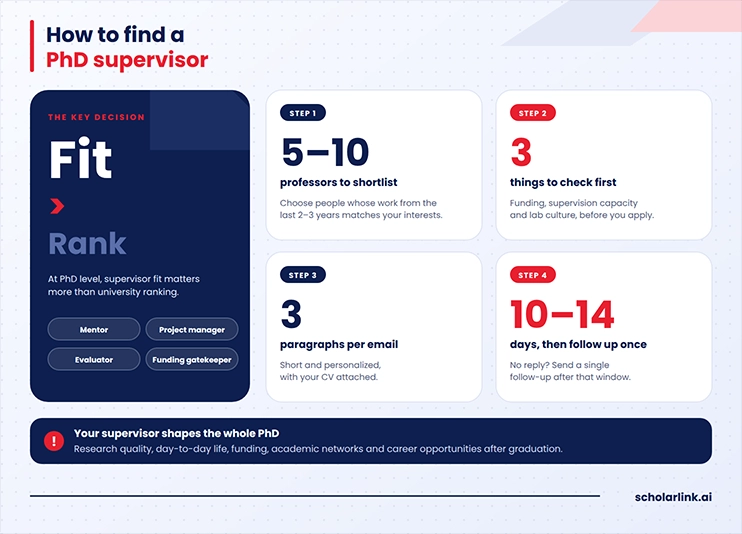
Finding the right supervisor is arguably the single most important decision you will make when applying for a doctoral program. While many prospective students spend months focusing on university rankings or standardized test scores, your choice of research advisor directly determines the trajectory of your academic career, the quality of your research output, and your day-to-day life as a PhD candidate. A supervisor acts as a mentor, a project manager, a primary evaluator, and often the key gatekeeper to funding, academic networks, and post-graduation career opportunities.
This guide shows you how to find a PhD supervisor, how to choose and evaluate one, how to contact them, and which red flags to avoid.
Key Takeaways
- Supervisor fit matters more than university ranking at the PhD level.
- Shortlist 5-10 professors whose recent work (last 2-3 years) matches your interests.
- Always check funding, supervision capacity, and lab culture before applying.
- Send a short, personalized email (about three paragraphs) with your CV attached.
- If there is no reply, send one follow-up after 10-14 days.
What Does a PhD Supervisor Do?
Understanding the role of a PhD supervisor is the first step toward making an informed choice. In academia, terms like “PhD supervisor,” “research advisor,” and “doctoral advisor” are often used interchangeably depending on the country or university system.
| Term | Where it is most common |
|---|---|
| Research advisor / major professor | North America |
| PhD supervisor | Europe, the UK, Australia |
| Doctoral advisor | Used internationally, especially in formal documents |
Regardless of the label, this individual is responsible for:
- Overseeing your research methodologies
- Guiding your dissertation progress
- Evaluating your scholarly writing
- Helping you navigate academic conferences, journal submissions, and grant funding
Why Prestige Alone Should Not Decide Your Choice
Selecting a research advisor should never be based solely on a university’s prestige or brand recognition. A world-famous institution may house a laboratory where a specific professor is unavailable, underfunded, or unsupportive. Conversely, a mid-tier university might have a highly active, well-funded research group led by a brilliant mentor who provides individual guidance and excellent career placement for graduates. Finding a research advisor for doctoral studies requires looking beyond institutional rankings to evaluate individual faculty performance, lab dynamics, and direct alignment with your scholarly goals.
How to Find a PhD Supervisor
Finding a PhD supervisor requires a systematic approach to searching academic departments globally. The goal of this phase is to move from a broad academic field down to a targeted list of professors actively working on questions related to your interests.
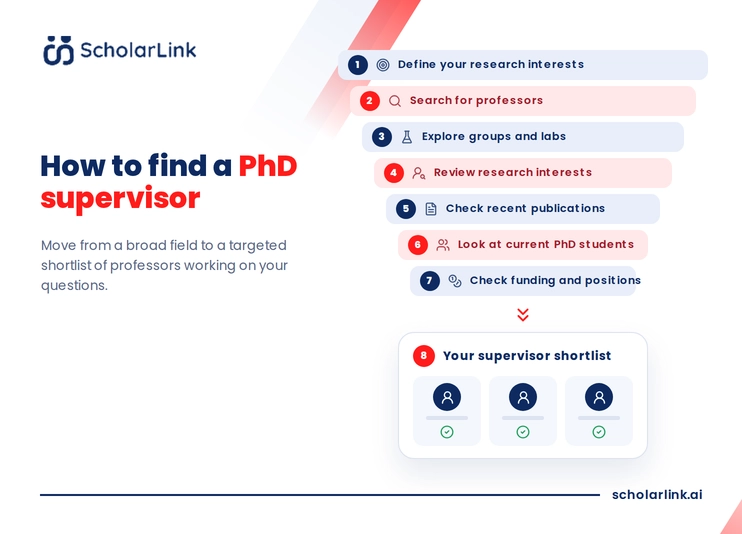
Step 1: Define Your Research Interests
Before looking for faculty members, clearly define what you want to study. You do not need a finalized dissertation proposal, but you should articulate:
- Your primary subfield
- Your core research questions
- Your preferred methodologies
- Your key theoretical frameworks
A defined focus lets you search effectively rather than browsing faculty directories aimlessly.
Step 2: Search for Professors in Your Field
Identify key scholars who write the foundational literature in your field. Look at the authors of major journal papers, book chapters, and conference proceedings that align with your proposed focus, and list the scholars whose recent work directly addresses your questions.
Step 3: Explore University Research Groups and Labs
Most major scientific, engineering, and social science research takes place within research groups, centers, or labs. Browse department websites at target universities to see how faculty members group themselves. A research group page shows collective projects, ongoing grants, and available equipment.
Step 4: Review Professor Research Interests
Faculty profile pages list a professor’s current research interests, teaching background, and department affiliations. Check that their declared interests are current and aligned with your intended domain of study.
Step 5: Check Recent Publications
A profile page may list research interests from ten years ago that a professor no longer pursues. Use academic databases to examine their output over the last two to three years:
- Google Scholar
- Scopus
- Web of Science
- PubMed
Recent papers show their exact current research focus and theoretical direction.
Step 6: Look for Current PhD Students and Projects
Investigate who currently works in the professor’s lab. Current PhD students reveal the topics the professor actually supervises, the size of the team, and whether the group is growing or contracting.
Step 7: Check Funding and Open PhD Positions
In many disciplines, particularly STEM and quantitative social sciences, a doctorate means working on a specifically funded project. Check university job boards, research group news pages, and project announcements for open, funded PhD positions in the upcoming intake.
Step 8: Build a Shortlist of Potential Supervisors
Synthesize your findings into a curated shortlist. Aim for a balanced list across different institutions, with each entry a realistic match in terms of expertise, research activity, and supervision capacity.
Quick summary of the search process:
| Step | Action | Where to look |
|---|---|---|
| 1 | Define research interests | Your master’s thesis, reading list |
| 2 | Find key scholars | Journals, conference proceedings |
| 3 | Explore labs and groups | Department websites |
| 4 | Review research interests | Faculty profile pages |
| 5 | Check recent publications | Google Scholar, Scopus, Web of Science, PubMed |
| 6 | Look at current students | Lab or group pages |
| 7 | Check funding and positions | Job boards, group news pages |
| 8 | Build a shortlist | Spreadsheet or tracker |
How to Choose a PhD Supervisor
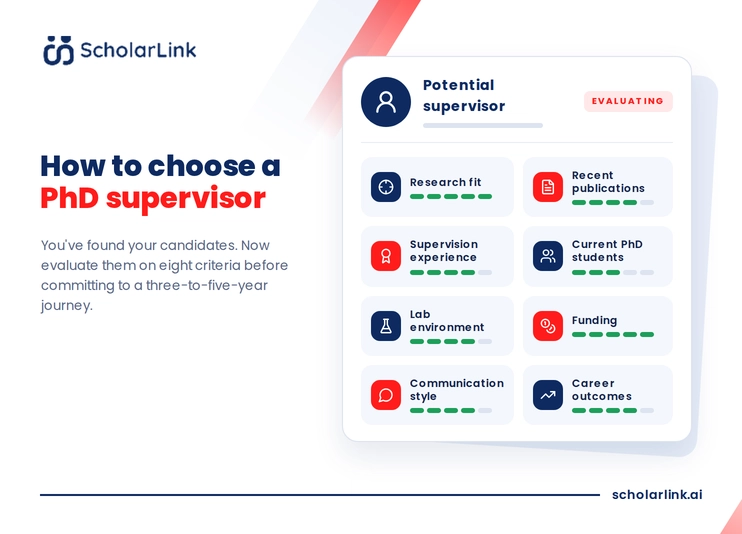
Once you have identified candidates, the process shifts from searching to evaluating. Learning how to choose a PhD supervisor means analyzing academic and interpersonal criteria to ensure success over a three-to-five-year doctoral journey.
| Criterion | What to look for | Why it matters |
|---|---|---|
| Research fit | Their work addresses your topics, models, or analytical approaches | With no overlap, a professor will rarely accept your application |
| Recent publications | Regular papers in reputable journals or top conferences | Shows they can guide you through peer review |
| Supervision experience | Career stage: early-career vs. tenured | Affects availability and institutional clout |
| Current PhD students | A reasonable number, neither too many nor zero | Too many means slow feedback; none may signal funding problems |
| Lab environment | Collaborative, supportive, junior researchers co-author | Shapes your daily experience |
| Funding | Active grants covering tuition, stipend, travel, consumables | Financial security affects completion |
| Communication style | Matches your preference for structure or autonomy | Prevents misunderstandings during the writing phase |
| Career outcomes | Alumni in postdocs, faculty roles, or industry research | Shows investment in students’ careers |
Research Fit
The fundamental baseline is research fit. Evaluate whether a professor’s current work directly addresses the topics, theoretical models, or analytical approaches you intend to use.
Recent Publications and Research Activity
Choose an advisor who actively publishes in reputable journals or top-tier conferences. High research activity shows that the supervisor is engaged with the academic community, earning peer recognition, and capable of guiding you through peer-review publication.
Supervision Experience
Consider where the professor is in their career:
- Early-career assistant professors are often highly motivated, hands-on, and eager to publish, though they may have less experience navigating university administration.
- Tenured full professors offer deep institutional clout and extensive networks, but may have less day-to-day time for direct mentoring.
Current PhD Students
A supervisor with too many students may struggle to give timely feedback on draft chapters, whereas an advisor with no current students might indicate a lack of funding or limited interest in supervising.
Research Group and Lab Environment
Consider whether the lab operates collaboratively or independently, whether junior researchers co-author papers with senior faculty, and whether the team fosters a supportive environment.
Funding and Project Availability
Evaluate whether the supervisor has active grant funding to cover your tuition, living stipend, research expenses, travel to international conferences, and lab consumables.
Communication Style
Pay attention to how a supervisor communicates in early emails or preliminary interviews. Whether you thrive under weekly check-ins or prefer autonomous, monthly updates, a compatible style is crucial.
Career Outcomes of Previous Students
Investigate where former PhD candidates ended up. If alumni consistently secure academic postdocs, tenure-track appointments, or high-level industry research roles, the supervisor invests in students’ long-term development.
Matching Your Research Interests With a PhD Supervisor
A common misconception is that your proposed topic must duplicate a professor’s previous work. In reality, matching research interests with a PhD supervisor is about conceptual, methodological, and thematic alignment, not an identical match.
- Compare your topic with their work: Look for points where your project builds upon, tests, or extends their published theories and findings.
- Look beyond exact keyword matches: A professor may use different terminology or apply a familiar framework to a different context. Read the introductions and conclusions of their recent papers to understand the broader themes.
- Identify shared research methods: If your project relies on advanced quantitative modeling, qualitative ethnography, machine learning pipelines, or archival or visual analysis, choose an advisor who specializes in those techniques.
- Find overlapping research problems: Even if your context or geographical focus differs, addressing similar core challenges (such as resource allocation algorithms, policy evaluation frameworks, or cellular signal pathways) creates a valid basis for supervision.
- Consider complementary expertise: If your research sits between two fields, a supervisor expert in one domain can guide you effectively, provided they are open to interdisciplinary collaboration or co-supervision.
How to Evaluate a Potential PhD Supervisor
Thorough evaluation uses publicly available data.
| What to check | Where to check it | What a good sign looks like |
|---|---|---|
| Publication record | Google Scholar, Scopus | Steady peer-reviewed output in respected journals; healthy citation and co-authorship patterns |
| Projects and funding | Lab website, grant databases | Consistent competitive grants, which translate into resources for doctoral researchers |
| Team size and stability | Lab or group page | A stable team with a reasonable number of members |
| Academic position | Faculty profile | Assistant, Associate, or Full Professor, with long-term commitment to the university (Emeritus status may limit new supervision) |
| Availability | Profile notice, direct email | Actively accepting new doctoral candidates for the upcoming term |
Confirm that the professor is accepting students for the upcoming term before investing time in a tailored application.
How to Find Professors With Funded PhD Opportunities
Securing a fully funded PhD position is a top priority for most applicants. Rather than applying through general admissions and hoping for financial aid afterward, target pre-funded projects or professors with active grants to significantly increase your chances of admission and financial support.
Where to look:
- University PhD position pages, job boards, and departmental vacancy listings, where funded projects are advertised like job openings
- Research group websites and professor homepages, where academics often announce grant-funded openings in news feeds before advertising elsewhere
- International funded PhD databases, fellowship registries, and scholarship search engines that aggregate opportunities across regions
Platforms like ScholarLink streamline this process by making it easier to discover faculty members, match research interests, evaluate open project positions, and reach out to supervisors without navigating dozens of disconnected university portals.
Tips for Contacting Potential PhD Supervisors
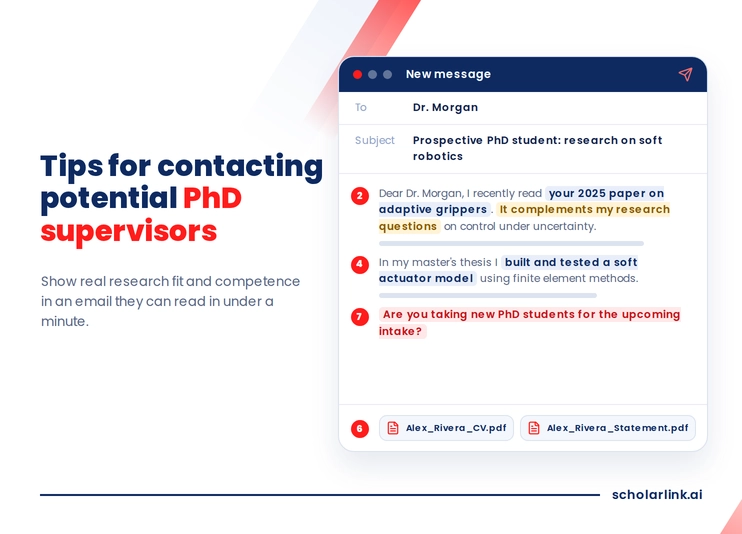
Professors receive dozens of prospective student emails every week, so your message must immediately demonstrate genuine research fit and academic competence.
- Research the professor before emailing. Never send generic mass emails. Review their recent publications, active projects, and lab focus.
- Write a personalized email. Use the correct academic title, mention specific papers or projects, and explain why their lab is the right place for your training.
- Explain your research fit. Summarize your central research questions in two or three sentences and explain how they complement the professor’s agenda.
- Mention relevant experience. Highlight prior research projects, master’s thesis outcomes, methodological training, technical skills, or publications.
- Keep the email concise. Aim for about three short paragraphs, readable in under a minute.
- Attach the right documents. Include a clean academic CV and, if relevant, a brief research statement. Save files as PDF with your full name in the file name.
- Ask a specific question. Ask whether they are taking new PhD students for the upcoming intake, or whether they would be open to a brief call.
For detailed strategies, structures, and outreach templates, read our guide: [Email to Professor for PhD Admission: Samples & Templates].
What to Include in a PhD Supervisor Email
| Section | What to write |
|---|---|
| Short introduction | Your name, current academic standing, degree, and institution |
| Academic background | Major area of study and overall academic performance |
| Research interests | Your core research focus and primary questions |
| Relevant experience | Research projects, publications, or technical skills |
| Reason for contacting | Why you are writing to this specific professor |
| Specific research fit | The link between your goals and their recent publications or grants |
| Direct inquiry | Whether they are accepting new PhD students for the target term |
| CV attachment | Mention that your updated academic CV is attached |
How Many PhD Supervisors Should You Contact?
Prioritize quality over quantity. Sending copy-pasted emails to dozens of professors is ineffective and often leads to non-responses or rejections.
Instead, create a curated shortlist of five to ten professors whose research genuinely matches your background and goals. Rank them by research fit, funding availability, and institutional preference, and personalize every email.
Keep a spreadsheet to track:
- Outreach dates
- Responses
- Follow-up timelines
- Notes from preliminary interactions
What If a Professor Does Not Respond?
Professors manage heavy teaching schedules, research deadlines, grant applications, and administrative duties, so your email can easily get buried. A lack of response does not automatically mean rejection.
- Wait 10-14 days, then send one polite, concise follow-up on the same email thread, restating your interest and asking if they had a chance to review your inquiry.
- If there is still no reply, check whether their faculty profile says they are not taking new students.
- Move on to another eligible supervisor in the same department or research group, or to the next name on your shortlist.
For step-by-step follow-up strategies, read our guide: [Email to Professor Follow-Up / No Response].
Red Flags When Choosing a PhD Supervisor
Identifying warning signs early can save you years of frustration, delays, or project failure.
| Red flag | What it looks like | Why it is a risk |
|---|---|---|
| Persistent lack of communication | Weeks to reply to basic emails; missed introductory calls without explanation | Signals communication barriers during your degree |
| Stagnant research output | No recent publications or funded projects for several years | Suggests an inactive program that may struggle to support you |
| Overcrowded supervision load | Too many doctoral candidates at once | Little time for regular, individual mentoring |
| Lack of funding or equipment | Unclear answers about tuition coverage, stipends, or lab resources | Puts degree completion at risk |
| Unclear or unrealistic expectations | No outline of work hours, publication targets, timelines, or authorship rights | Leads to conflicts down the road |
| Poor graduate outcomes | Frequent dropouts, unusually long completion times, weak employment results | Points to problems in the lab environment |
| Mismatch in research focus | Supervisor has little interest or competence in your topic | Poor guidance and delays |
| No supervisory capacity | Near retirement, on extended sabbatical, or moving into administration | May be unavailable to supervise new students |
PhD Supervisor vs. University Ranking: Which Matters More?
Many applicants face a choice between a higher-ranked university and a better supervisor fit. While prestige carries weight for undergraduate and master’s degrees, doctoral education works differently.
At the PhD level, success depends primarily on your research output, publication record, conference presentations, and the mentorship you receive. A famous university name will not offset an inactive supervisor, a toxic lab environment, or a lack of funding. Conversely, working with a leading expert in a well-funded, supportive group at a moderately ranked institution often yields stronger publication records and better career placements.
| Priority | Factor |
|---|---|
| 1 (primary) | Research and supervisor fit |
| 2 | Project funding |
| 3 | Research group culture |
| 4 (secondary) | Overall institutional ranking |
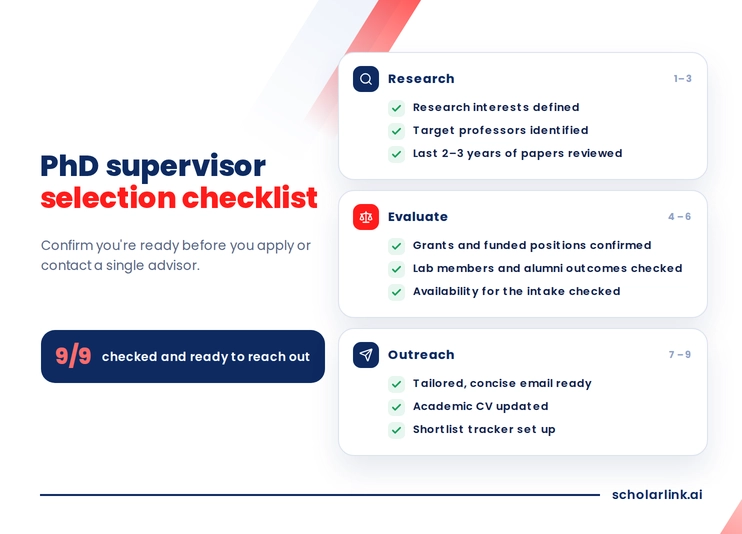
PhD Supervisor Selection Checklist
Before submitting applications or contacting advisors, confirm your readiness:
- Core research interests and dissertation themes are clearly defined
- Target professors identified through recent journal publications and research databases
- Faculty publication records from the last two to three years reviewed
- Active grants, funded positions, and lab resources confirmed
- Current lab members and former student career outcomes evaluated
- Supervision availability for the upcoming intake checked
- Tailored, concise introductory email emphasizing research fit prepared
- Updated, professionally formatted academic CV ready to attach
- Shortlist tracking system set up to manage outreach and follow-ups
Frequently Asked Questions
How do I find a supervisor for my PhD?
Start by reviewing the literature in your subfield to identify active researchers. Browse department faculty directories, research center websites, and funded project databases at target universities to build a shortlist of professors whose current work matches your goals.
How do I choose the right PhD supervisor?
Evaluate potential supervisors on research alignment, recent publication activity, active grant funding, supervision capacity, lab culture, communication style, and the career placements of past PhD graduates.
How do I find a research advisor for doctoral studies?
Look for faculty who regularly publish peer-reviewed papers in your field, lead funded research groups, or advertise open doctoral positions. Databases like Google Scholar and platforms like ScholarLink can streamline your search.
How do I contact a potential PhD supervisor?
Send a concise, personalized email addressed to the professor. Explain your background, state your research interests, highlight the alignment between your goals and their recent work, attach your CV, and ask whether they are accepting new students.
What should I include in an email to a PhD supervisor?
Include a brief self-introduction, your academic background, core research interests, relevant research experience, a clear statement of why you want to work with them, and an inquiry about supervisory availability, with your academic CV attached.
How do I know if a professor is a good PhD supervisor?
A good supervisor actively publishes, maintains consistent grant funding, communicates clearly, gives regular feedback, fosters a healthy lab environment, and has a proven record of helping former students graduate on time and secure strong positions.
Should I contact multiple PhD supervisors?
Yes, but contact a selective, well-researched shortlist rather than sending generic mass emails. Personalize every message.
Should my research topic exactly match my supervisor’s research?
No. Your topic should align closely with the professor’s broader research agenda, methodological approach, or theoretical frameworks, showing that your project complements their ongoing work.
How do I find a funded PhD supervisor?
Look for pre-funded project listings on university employment pages, departmental research portals, and international PhD databases. Target professors who have recently received major research grants, as they often have funding allocated for new doctoral researchers.
What should I do if a potential supervisor does not reply?
Wait ten to fourteen days, then send one polite, brief follow-up on the same thread. If you still receive no response, check whether the professor is taking students, or reach out to another advisor on your shortlist.
Conclusion
The right supervisor shapes your research, your funding, and your career. Define your interests, build a shortlist of five to ten well-matched professors, evaluate them using the criteria above, and contact them with a short, personalized email. Ready to start your search? Explore supervisors and funded PhD opportunities on ScholarLink.

ScholarLink AI
Your Ultimate Admission Co-Pilot
- 🎓 Professors Database: World’s largest supervisor directory
- 📡 Live Positions: Real-time faculty openings & vacancies
- 👥 Students Database: Connect with successful applicants
- 🎯 Smart Matching: AI-driven professor recommendation
- 💰 Funding Analysis: Real-time lab & research funding data
- 📝 Apply Management: Track applications & cold emails