
Reaching out to a prospective doctoral advisor is one of the most critical steps in the graduate application process. A well-crafted initial message establishes early academic rapport, demonstrates your grasp of a shared field, and confirms whether a research group has the capacity and funding to accept new candidates. Securing a supportive mentor before formal submission significantly elevates your chances of admission, as faculty members frequently advocate for applicants whose prospective projects align with their ongoing lab initiatives.
This guide covers how to email a PhD supervisor, what to include and attach, a ready-to-use sample email, what to do after you hit send, and the mistakes to avoid.
Key Takeaways
- Contacting a supervisor first is essential in the UK, Europe, and Australia and helpful (but not always required) in North America.
- Email 3-6 months before application deadlines.
- Keep your email concise: about 150-250 words, with your purpose stated in the first paragraph.
- Attach an academic CV in PDF; add a one-page research summary only if relevant.
- Never mass-mail. Personalize every email and reference a specific paper or project.
- If there is no reply after about two weeks, send one polite follow-up.
Do You Need to Contact a Supervisor Before Applying?
Timing and necessity vary depending on the regional academic system and specific department guidelines.
| Region | Is prior contact needed? | Why |
|---|---|---|
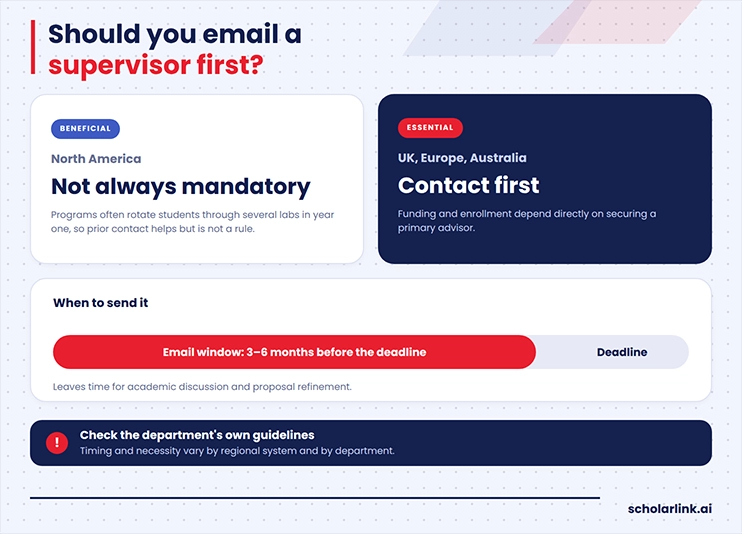
| North America | Beneficial, but not always mandatory | Structured graduate programs often rotate students through multiple laboratories during the first year |
| United Kingdom, Europe, Australia | Essential | Funding and enrollment depend directly on securing a primary advisor |
Prospective candidates should reach out between three to six months prior to application deadlines, allowing adequate time for academic discussion and proposal refinement.
How to Approach a PhD Supervisor
Successfully approaching a potential mentor begins long before drafting an email. The first phase requires identifying faculty members whose scholarly work closely intersects with your academic background and future goals. Scholars who find a clear thematic overlap between their own background and a faculty member’s output are far more likely to receive a positive response. For a comprehensive walkthrough on discovering and evaluating potential mentors, consult our dedicated guide on [How to Find a PhD Supervisor].
After shortlisting potential advisors, conduct a thorough review of their academic profile. Examine:
- Their recent journal publications
- Active research grants
- Departmental lab pages
This shows you their current thematic directions. Professors frequently pivot between subfields over time, so relying solely on paper titles published years ago can lead to misaligned inquiries. Confirm that the professor actively supervises doctoral candidates and is accepting new students for the upcoming academic intake, saving time and ensuring your efforts target available research opportunities.
How to Contact a Potential PhD Supervisor
Direct email communication remains the standard method for establishing initial contact with university faculty. Locate the professor’s official institutional email address listed on their official university faculty profile or lab website to ensure delivery and avoid spam filters. Personalizing your outreach is vital, as faculty members instantly dismiss generic templates sent indiscriminately across departments.
Best Time to Email a PhD Supervisor
Timing your outreach strategically can dramatically improve response rates.
- Avoid: end-of-semester grading weeks, major grant application deadlines, and peak holiday seasons.
- Aim for: early morning delivery, mid-week, which often yields the best visibility.
When formulating your message, state your purpose immediately within the first paragraph, articulating clearly why you are reaching out and how your specific background aligns with their ongoing research agenda.
How to Write an Email to a PhD Advisor
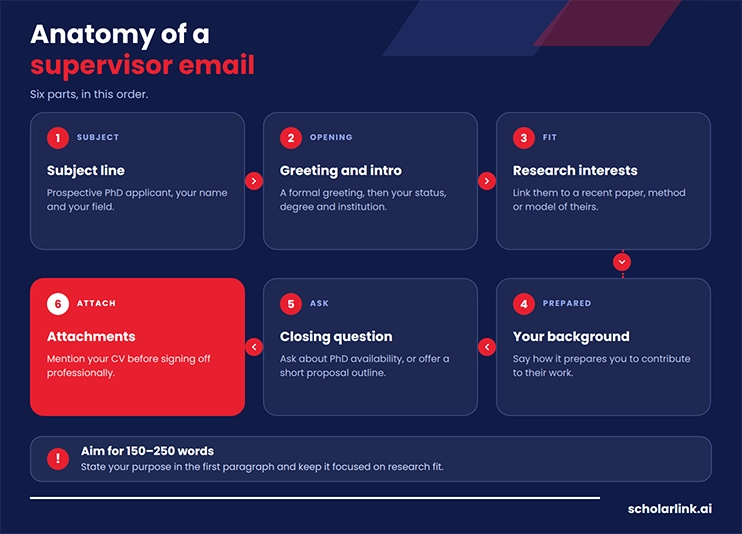
Writing a compelling email to a prospective advisor requires balance, precision, and academic brevity. Your subject line should be direct and informative, incorporating key terms like prospective PhD applicant, your name, and the specific field of study. Start the body of your email with a polite, formal greeting, followed by a brief introduction outlining your current academic status, degree background, and institutional affiliation.
Next, articulate your core research interests and explicitly connect them to the professor’s published work or active lab projects. Demonstrate genuine engagement with their research by referencing a recent paper, methodological approach, or theoretical model they developed, explaining how your background prepares you to contribute to that line of inquiry. Conclude by asking a focused question regarding PhD availability or offering a short proposal outline, mentioning relevant attachments like your curriculum vitae before signing off professionally.
PhD Supervisor Email Structure
| Part | What to include |
|---|---|
| Subject line | Prospective PhD applicant, your name, and your field of study |
| Greeting | A polite, formal greeting (e.g., “Dear Professor [Last Name],”) |
| Introduction | Current academic status, degree background, and institutional affiliation |
| Research fit | Your core research interests, tied to a recent paper, method, or model of theirs |
| Your preparation | How your background prepares you to contribute to that line of inquiry |
| Closing question | A focused question about PhD availability, or an offer to share a short proposal outline |
| Attachments | Mention your CV (and any other relevant file) before signing off |
PhD Supervisor Email Sample
You can copy and adapt this template. Replace everything in brackets with your own details.
Subject: Prospective PhD Applicant – [Your Full Name] – [Your Research Focus / Field]
Dear Professor [Last Name],
I hope this email finds you well.
My name is [Your Name], and I recently completed my [Master’s/Bachelor’s Degree] in [Your Major] at [Your University], where my work focused on [Brief mention of thesis topic or core research area]. I have been following your research on [Specific Topic/Project Name] with great interest, particularly your recent paper on [Title or Concept from Professor’s Paper].
My previous research experience includes [Briefly mention 1-2 relevant research achievements, lab skills, or publications]. I am planning to apply for the PhD program in [Department Name] for the [Term/Year] intake, and I am keen to explore doctoral research opportunities under your supervision. My proposed project aims to investigate [1-2 sentences summarizing your research goal], which directly aligns with your group’s focus on [Professor’s Research Area].
I have attached my academic CV and a brief research summary for your review. I would welcome the opportunity to discuss prospective supervision if you are accepting new doctoral students for the upcoming term.
Thank you for your time and consideration.
Sincerely,
[Your Name]
[Your Contact Information]
[Link to LinkedIn or Academic Profile]
Tips for Approaching a Doctoral Research Supervisor
Thorough preparation remains the foundation of any successful supervisor inquiry. Invest time in reading multiple papers from the professor’s recent catalogue to ground your email in solid academic context. Avoid sending long, autobiographical essays detailing your entire life story; professors scan emails quickly and prefer concise, well-structured prose that highlights your primary research competence and academic trajectory.
Maintain an exceptionally professional tone across every interaction.
| Do | Don’t |
|---|---|
| Read multiple recent papers before writing | Send long, autobiographical essays |
| Keep your prose concise and well structured | Mass-mail identical inquiries to faculty in the same department (professors routinely discuss prospective applicants with colleagues) |
| Send from an institutional (e.g., .edu) or clean, professional email address | Use casual personal accounts |
| Show research fit through targeted questions | Rely on generic praise |
| Give concrete evidence of past academic output | Overload the email with unrelated details |
| Choose supporting attachments carefully | Attach everything you have |
What to Attach to an Email to a PhD Supervisor
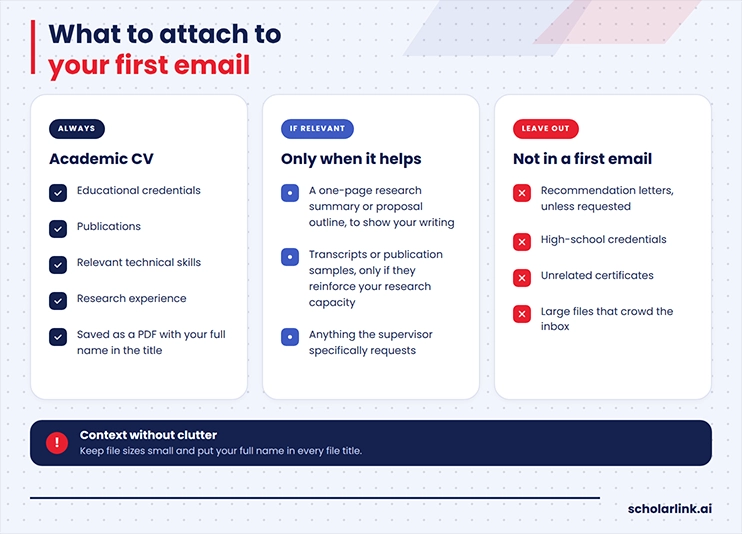
Attaching the correct documentation provides context without overwhelming the recipient’s inbox. Keep document file sizes manageable and use standard naming conventions, such as including your full name in every PDF title.
| Document | Attach? | Notes |
|---|---|---|
| Academic CV | Always | Mandatory. Highlight educational credentials, publications, relevant technical skills, and research experience |
| One-page research summary or proposal outline | If relevant or requested | Showcases your scholarly writing ability |
| Official transcripts or publication samples | Only if they directly reinforce your capacity for advanced research | Otherwise, leave them out |
| Recommendation letters, high-school credentials, unrelated certificates | No | Avoid attaching them during initial outreach unless requested |
Additional documentation should only be attached if specifically requested or highly relevant to the supervisor’s onboarding process.
What to Do After Contacting a PhD Supervisor
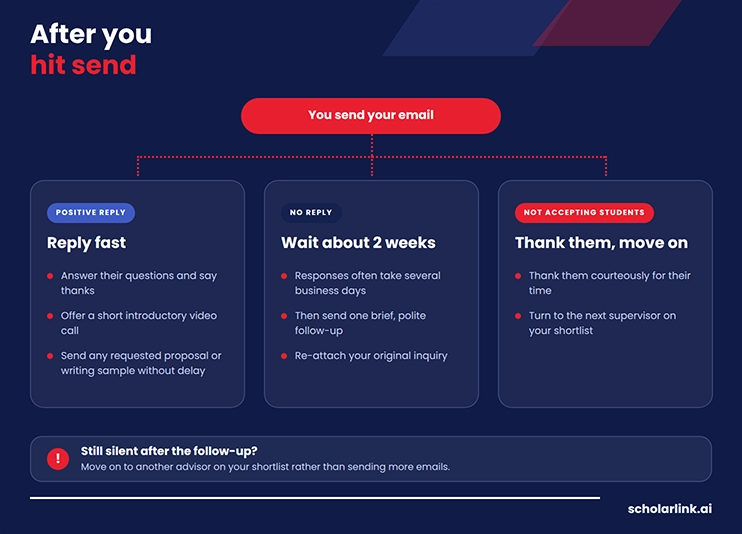
If a professor replies positively, respond promptly with gratitude, answering any specific questions they posed and offering to arrange a brief introductory video call to discuss research possibilities. If they request additional material, such as a full project proposal or writing sample, provide polished documents without delay to maintain momentum.
If a professor does not reply immediately, exercise patience before sending additional correspondence. Academic schedules are demanding, and responses often take several business days. If two weeks pass without a reply, a brief, polite follow-up email re-attaching your initial inquiry is entirely appropriate. For detailed guidance on navigating extended delays or crafting follow-up messages, refer to our guide on [Email to Professor Follow-Up / No Response].
If a professor says they are not accepting students, thank them courteously for their time and pivot your focus toward other potential supervisors on your shortlist.
Building a Relationship With Your PhD Supervisor
Once preliminary communication is established, maintaining a professional dialogue sets the groundwork for a productive advisor-advisee relationship.
- Communicate with clarity, accuracy, and efficiency across all digital correspondence.
- Early in your interactions, work together to clarify expectations regarding meeting frequency, academic feedback timelines, and research milestones.
- Arrive thoroughly prepared for every scheduled discussion, bringing structured agendas, updated project outlines, and clear research questions.
- Engage receptively with critical feedback; it demonstrates your capacity for advanced scholarly development.
For an in-depth analysis on maintaining long-term academic synergy throughout your program, explore [The Relationship With Your PhD Supervisor: Communication, Roles & Tips for Success].
Common Mistakes When Contacting a PhD Supervisor
| Mistake | Why it hurts |
|---|---|
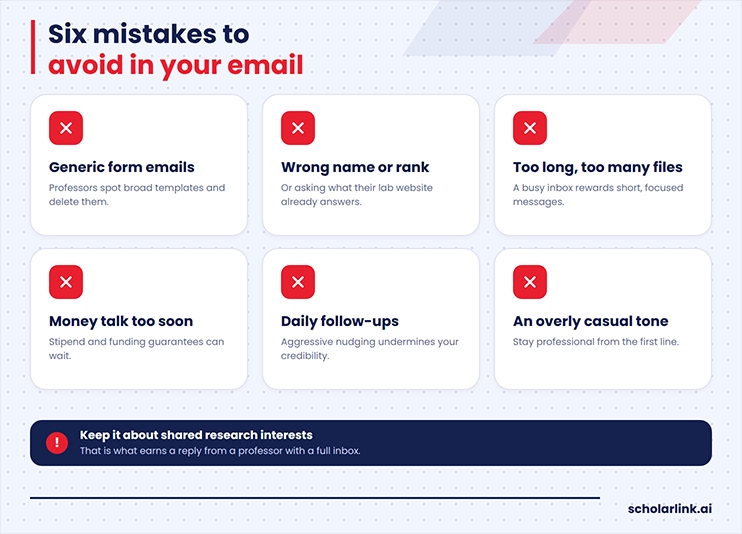
| Sending generic form emails | Professors easily recognize broad templates, leading to immediate deletion |
| Wrong name, wrong academic rank, or questions already answered on their lab website | Reflects poorly on an applicant’s attention to detail |
| Over-attaching files or writing very long messages | They require substantial reading time |
| Asking premature administrative questions (stipend figures, funding guarantees) in the first message | Keep the focus on shared intellectual interests |
| Aggressive daily follow-ups | Undermines your professional credibility before your academic evaluation begins |
| An informal, overly casual tone | Same: weakens your credibility from the start |
PhD Supervisor Email vs. PhD Application Email
Understanding the distinction between an informal supervisor inquiry and a formal university application is essential for a smooth admission process.
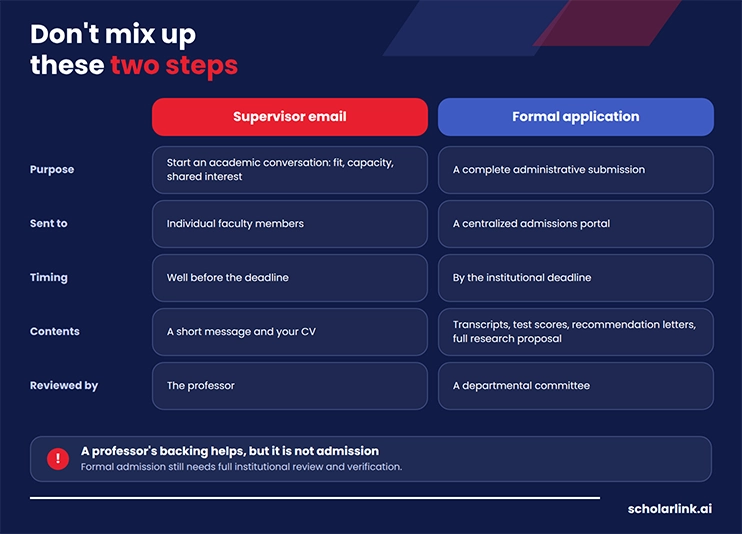
| Supervisor email | Formal application | |
|---|---|---|
| Purpose | Establish an academic line of communication: thematic alignment, research capacity, mutual project interest | Comprehensive administrative submission |
| Sent to | Individual faculty members | Centralized admissions portal |
| Timing | Well before institutional deadlines | By the institutional deadline |
| Contents | Concise, personalized message plus CV | Official transcripts, standardized test scores, formal letters of recommendation, and a complete research proposal |
| Reviewed by | The professor | A departmental committee |
While a prospective advisor’s backing significantly strengthens an application, formal admission remains subject to full institutional review and administrative verification.
Checklist Before You Hit Send
- I found the professor’s email on their official faculty profile or lab page
- I read their recent papers and confirmed they are accepting new students
- My subject line includes “prospective PhD applicant,” my name, and my field
- My purpose is clear in the first paragraph
- I referenced a specific paper, project, or method of theirs
- The email is concise (about 150-250 words)
- My CV is attached as a PDF with my full name in the file name
- I did not attach unrequested documents
- I double-checked the professor’s name and academic title
- I am sending from a professional email address
Frequently Asked Questions
How do I approach a potential PhD supervisor?
Begin by thoroughly investigating the professor’s recent publications and active research projects. Craft a concise, personalized email that introduces your academic background, highlights a shared research interest, and politely inquires whether they are accepting new doctoral candidates for the upcoming academic cycle.
How do I contact a PhD supervisor?
Send a professional email directly to the professor’s university account. Ensure your message includes a clear subject line, a brief summary of your academic background, a clear explanation of research fit, and an attached academic CV.
What should I write in an email to a PhD advisor?
State your purpose immediately in the first paragraph. Briefly outline your educational qualifications, explain why their specific research resonates with your goals, propose a clear research direction, and ask a specific question regarding doctoral supervision availability.
How long should a PhD supervisor email be?
An effective initial email should remain concise, ideally ranging between 150 to 250 words. Long emails are often postponed or left unread, so keep your introduction direct and focused on research compatibility.
Should I attach my CV?
Yes, attaching an updated academic CV in PDF format is standard practice. Keep the file size small, use a professional file-naming format, and avoid attaching unrequested supporting documents like high school records or non-academic certificates.
Should I contact a professor before applying for a PhD?
In most academic systems, particularly in the UK, Europe, and Australia, contacting a supervisor before formal submission is highly recommended or required. In North American programs with first-year lab rotations, prior contact is beneficial but sometimes optional depending on department policy.
How long should I wait for a professor to reply?
Allow at least seven to fourteen days before assuming a professor will not respond. Academic workloads, teaching obligations, and conference travel frequently delay response times.
Should I send a follow-up email?
If you have not received a reply after two weeks, sending a brief, polite follow-up message is appropriate. Reiterate your interest in one or two sentences and re-attach your original inquiry along with your CV.
What should I do if a PhD supervisor does not respond?
If a professor does not reply after a follow-up email, it is best to move on to another prospective advisor on your shortlist. Faculty members face extreme email volume, and a lack of response often simply indicates a lack of capacity or time.
How do I build a good relationship with my PhD supervisor?
Maintain open, professional communication, set mutual expectations early, arrive fully prepared for all progress meetings, and actively integrate their constructive feedback into your research work.
Conclusion
A short, personalized email that shows real research fit is the best way to start a conversation with a potential supervisor. Do your homework on their recent work, write concisely, attach a clean CV, and follow up once if needed. Still building your shortlist? Start with [How to Find a PhD Supervisor].

ScholarLink AI
Your Ultimate Admission Co-Pilot
- 🎓 Professors Database: World’s largest supervisor directory
- 📡 Live Positions: Real-time faculty openings & vacancies
- 👥 Students Database: Connect with successful applicants
- 🎯 Smart Matching: AI-driven professor recommendation
- 💰 Funding Analysis: Real-time lab & research funding data
- 📝 Apply Management: Track applications & cold emails