

For many international students, the academic path looks fixed: Bachelor’s → Master’s → PhD. But that sequence is not universal. In some countries a master’s is treated as the standard bridge between undergraduate study and doctoral research; in others, direct entry into a PhD after a bachelor’s degree is well established. That difference is where most of the confusion begins. Applicants compare systems across the US, UK, Canada, Germany, Australia, China, Italy, and the rest of Europe without realizing that admission rules are shaped by national education structures, funding models, and departmental expectations.
The short answer is yes: in some cases you can be admitted to a PhD without a master’s degree. But the real answer is more nuanced. A direct-entry PhD usually depends on the country, the university, the discipline, your academic record, your research potential, and sometimes your fit with a supervisor or principal investigator (PI). A strong bachelor’s degree, a clear research direction, excellent references, and evidence of academic maturity can sometimes outweigh the absence of a master’s credential. Admissions committees are not only asking whether you hold a degree. They are asking whether you are ready to produce independent research at doctoral level.
Imagine two applicants. One has a master’s degree but a vague research focus and limited evidence of independent work. The other has only a bachelor’s degree, but graduated at the top of the class, completed a thesis, worked as a research assistant, and already understands the methods and literature in the field. In many direct-entry systems, the second applicant is more competitive. This is easy to miss, because applicants tend to think in terms of degree titles while universities think in terms of research readiness.
Key takeaway: Universities think in terms of research readiness, not degree titles.
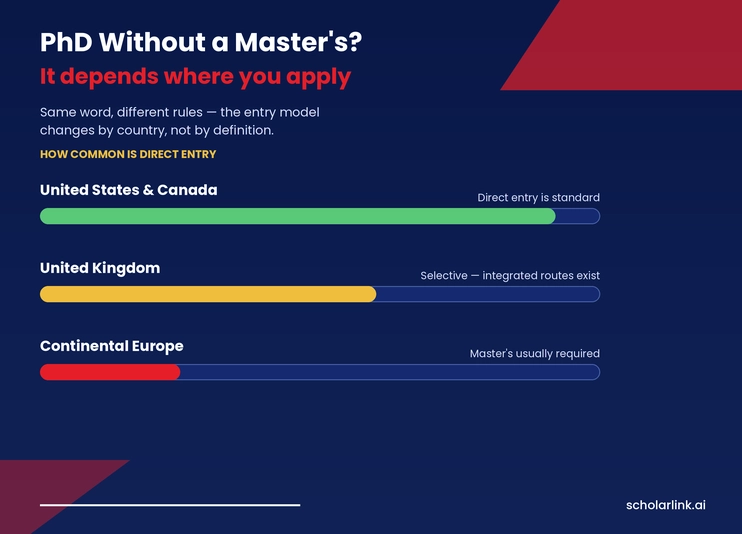
That distinction matters because “PhD without a master’s” does not mean “PhD without preparation.” It usually means the preparation was gained through another route. In the US and Canada, many PhD programs are designed to include coursework and research training at the start, which makes direct entry from a bachelor’s degree realistic. In systems where a PhD is expected to begin with a fully developed research proposal and advanced specialization, a master’s may be strongly preferred or effectively required.
So the better question is not simply whether it is possible. The better question is where it is possible, for whom it makes sense, and how to build an application that convinces a university you are ready.
In this guide you will learn:
- how direct-entry PhD pathways work country by country
- which universities and departments are more open to applicants without a master’s
- what admissions committees actually look for
- how funding and supervisor expectations affect your chances
- what integrated PhD programs are and how they differ from direct and traditional routes
- when this route is a smart decision, and when it is a costly shortcut
For international students, this clarity has real stakes. A wrong assumption can waste a full application cycle, cost money in application fees, and lead you to target countries or institutions that don’t match your profile. The smarter approach is to understand the structure first, then match your background to the right kind of PhD system.
Can You Do a PhD Without a Master’s?
Yes, in several countries and disciplines you can move directly from a bachelor’s degree into a PhD. But the answer depends heavily on how a national higher education system is designed. A PhD in the United States is not structured like a PhD in the UK, and neither works exactly like most doctoral routes in continental Europe. That is why applicants get mixed signals online: they are often reading advice from one system and applying it to another.
The key distinction: in some systems a master’s degree is structurally embedded into the PhD; in others it is a formal prerequisite. Understanding that difference before you start preparing applications will save you the most time.
PhD Without a Master’s in the United States: Direct Entry Is Standard
In the United States, starting a PhD directly after a bachelor’s degree is common, not the exception. Most US doctoral programs are built as longer, integrated tracks: students complete advanced coursework in the first one to two years, effectively covering master’s-level training inside the doctoral structure. In other words, the early part of the PhD absorbs the academic development that a separate master’s provides elsewhere.
A typical US path looks like this:
- Enter the PhD after a bachelor’s degree
- Complete graduate coursework and select a research group (years 1–2)
- Pass qualifying / comprehensive exams
- Advance to candidacy and focus on dissertation research (years 3–5+)
Some programs even award a master’s “en route” to the PhD. From experience, US admissions committees care far more about research potential than about a separate master’s diploma. Strong undergraduate research, publications, conference presentations, or substantial thesis work can outweigh the absence of a master’s, especially in STEM, economics, psychology, and some social sciences.
PhD Without a Master’s in the UK: Selective but Possible
The UK picture is more mixed. Traditional PhD routes often expect applicants to arrive with a master’s, partly because UK doctorates are shorter and more research-intensive from day one; the assumption is that the student already has advanced subject knowledge and some research training. However, direct entry still exists for exceptional cases, and many universities offer integrated doctoral routes designed specifically for students who don’t yet have a master’s.
For direct or integrated entry in the UK, panels typically expect:
- a First-Class or strong upper second-class (2:1) honours degree
- demonstrated research experience
- a clear, viable research proposal
- alignment with a supervisor
In practice, UK direct-entry routes are more competitive than US programs because they assume higher initial research maturity.
Continental Europe: A Master’s Is Often Required
In much of continental Europe (Germany, France, the Netherlands, Italy, Scandinavia), the Bologna Process structures higher education into a clear Bachelor → Master → PhD sequence. In Germany, for example, a completed master’s (or an equivalent 300 ECTS credits) is typically required, because the PhD is viewed as pure research training rather than coursework-based education.
Exceptions exist, but they are limited and usually require:
- an exceptional academic record
- formal recognition of an equivalent qualification
- institutional approval at faculty level
This is where confusion often arises. Applicants assume that because direct PhD programs exist somewhere, they exist everywhere. They don’t. “Possible somewhere in Europe” is not the same as “common everywhere in Europe.”
Canada and Australia: Hybrid Models
Canada resembles the US in many departments. Direct entry after an honours bachelor’s is common when the GPA is strong (often a 3.7+/4.0 equivalent) and research readiness is clear. Some programs also let students transfer from a master’s to a PhD after 8–18 months if performance is excellent. In both patterns, supervisor fit and funding availability are decisive, because many Canadian PhDs are tied to a faculty member’s research grant.
Australia offers fewer direct-entry options but may allow them for students with first-class honours, a significant research thesis, and strong supervisor endorsement. A standard taught bachelor’s alone is often not enough.
China and Elsewhere
China generally follows a more structured academic hierarchy, but some research-intensive institutions offer direct doctoral routes for highly qualified students. The wider point holds everywhere: the word “PhD” is global, but the entry model is not.
A concrete example. A computer science student with a strong bachelor’s thesis, research-lab internship experience, and a conference paper is a realistic direct-entry candidate in the US or Canada. The same student may face resistance in Germany or Italy unless there is a formal fast-track mechanism or a supervisor willing to champion an exceptional case.
Which Fields Are More Open to Direct PhD Entry?
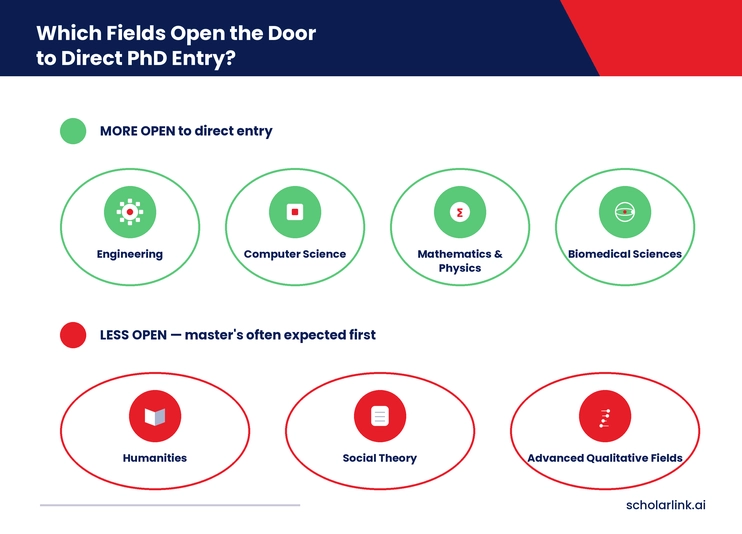
Field matters too: engineering, computer science, mathematics, physics, and some biomedical sciences are usually more open to direct entry than fields where advanced theoretical reading and independent methodological training are expected before the PhD begins.
Direct PhD Programs After a Bachelor’s Degree
A growing number of international applicants explore direct PhD programs after a bachelor’s degree because the pathway can be faster, cheaper, and, in the right system, academically normal. The core idea is simple: instead of doing a separate master’s first, you enter a doctoral track and complete any missing “master’s-level” training inside the PhD.
What Is a Direct PhD?
A Direct PhD lets a student begin doctoral study without completing a separate master’s first. In most cases the program includes one or more of these elements:
- graduate coursework in the early phase (often comparable to a master’s curriculum)
- a research rotation or lab placement to identify a supervisor/PI (common in STEM)
- milestones such as qualifying exams, candidacy exams, or a formal proposal defense
- a transition into full-time dissertation research after the initial training period
The difference from a traditional PhD is not the dissertation; doctoral research is doctoral research. The difference is the entry point. Traditional models assume you already have master’s-level training; direct models build that training into the first stage. Universities use different labels for this: “PhD track,” “direct-entry PhD,” “integrated PhD,” “1+3 doctoral program,” or “PhD with embedded master’s.” Look for the structure, not the marketing phrase.
Pros and Cons of the Direct PhD Route
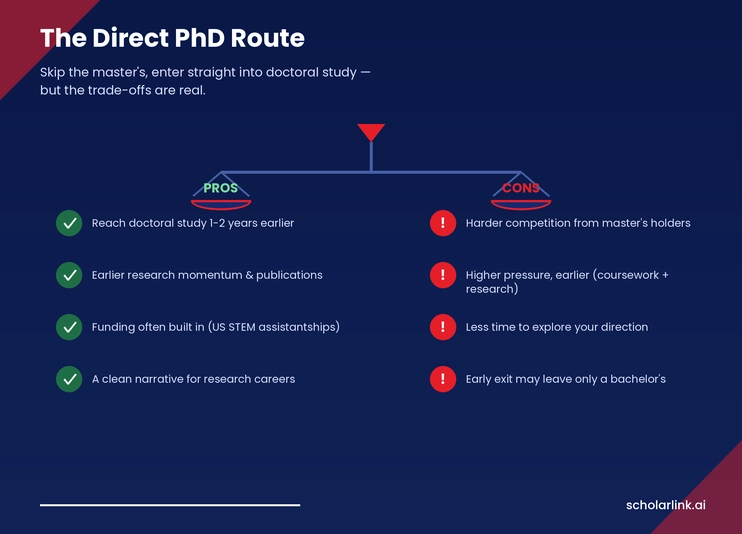
A Direct PhD can be a smart move, but only when your readiness matches the program’s demands.
| Advantages | Disadvantages |
|---|---|
| Time and cost efficiency. You may reach doctoral study one to two years earlier and avoid a separate, often expensive master’s timeline. | Harder competition. You may be competing against applicants who already hold master’s-level training. |
| Earlier research momentum. Joining a lab sooner can mean earlier publications, stronger networks, and clearer specialization. | Higher pressure, earlier. Coursework, research, and milestone exams can overlap while you also adapt to a new academic culture. |
| Funding alignment. Many direct PhD programs, especially US STEM ones, are built around assistantships, stipends, and tuition coverage. | Less time to discover your direction. A master’s can act as a low-risk exploration phase; a direct PhD rewards applicants who already have clarity. |
| A coherent narrative for research careers. If your goal is academia, R&D, or industry labs, a direct path can be strategically clean. | Harder pivots. Changing fields or supervisors is more complicated once you are inside a doctoral track. |
| Credential risk on early exit. If a program does not award a master’s en route and you leave early, you may exit with only your bachelor’s. |
The decision point many applicants overlook: direct entry is not just about skipping a degree. It is about proving you already have, or can quickly build, the research maturity a master’s usually develops.
Integrated PhD Programs Explained
An integrated PhD combines master’s-level research training and doctoral research into a single, continuous program. Instead of completing a standalone master’s and then reapplying, the university builds the transition into one pathway. These routes are especially common in the UK, and similar models appear in some European doctoral training frameworks and structured graduate pathways elsewhere. You may see labels such as 1+3 programs, integrated doctoral training, doctoral training partnerships, or combined MRes/PhD routes.
The logic is straightforward: some students have strong potential but still need formal research training before full doctoral progression. Rather than asking them to complete a separate master’s, the institution builds that training into the doctoral path. A traditional PhD assumes readiness; an integrated PhD develops readiness before demanding full doctoral independence.
How an Integrated PhD Is Structured
Most integrated PhDs begin with a preparatory phase, usually in the first year. Depending on the field, that stage may include:
- research methods training
- advanced subject-specific coursework
- academic writing and critical reading support
- statistics, qualitative methods, or technical skills workshops
- research ethics and compliance training
- supervisor meetings and project refinement
- lab rotations or exploratory research placements (common in STEM)
- preparation of a formal proposal or an “upgrade” review
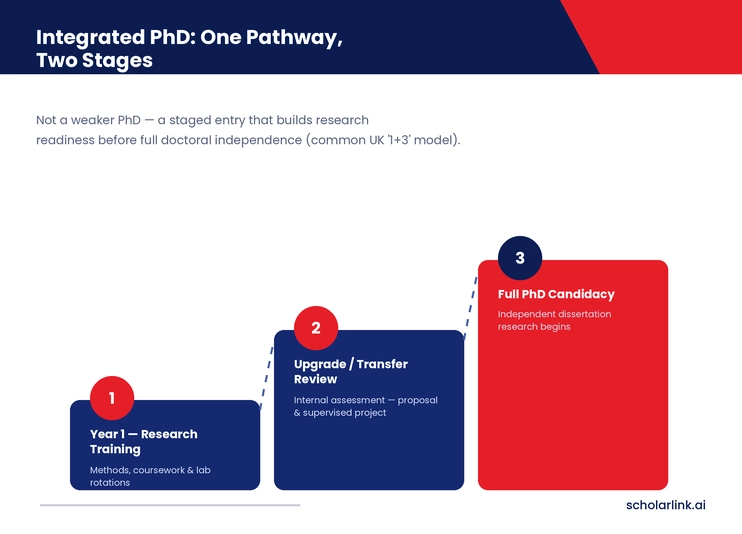
The first year is not a formality. It is usually a serious stage where the university evaluates whether you should progress to the full PhD phase, through taught modules, a research proposal, internal assessments, or a supervised project. Admission into the integrated route does not always guarantee unconditional progression all the way to the doctorate.
Some integrated programs formally award an MRes (Master of Research) or similar qualification during the early stage. In many UK universities, students complete a year of advanced methods, proposal development, and supervised research before officially upgrading to full PhD status.
A concrete example. An international student enters an integrated PhD in biomedical sciences in the UK. In year one they take research methods classes, complete lab training, join seminars on ethics and data analysis, and run a smaller supervised project. Only after passing that stage do they formally move into the main PhD research phase. The structure reduces risk for both sides: the student gains preparation, and the department gets evidence of readiness.
Integrated PhD vs Direct PhD vs Traditional Route
These three are easy to confuse, so it helps to separate them cleanly:
| Traditional route | Direct PhD | Integrated PhD | |
|---|---|---|---|
| How it works | The master’s is a standalone qualification. You complete it, graduate, and then reapply, often separately, for a PhD. | You are admitted straight into a doctoral program without a master’s. Any coursework is embedded, and you are already registered as a PhD candidate (sometimes conditionally). | The first stage functions like a research-intensive master’s year, but progression to the PhD is internal; you don’t reapply externally. You complete research-training modules, refine a proposal, demonstrate competence, and pass a formal upgrade/transfer review. |
| Best suited to | Applicants who already have advanced research preparation and a mature project direction. | Applicants with strong research experience and a clear direction. | Strong graduates who need structured research training first. |
An integrated PhD is not a “weaker” PhD and not simply a longer one. It is a different entry architecture: a deliberately staged transition designed to reduce risk for both student and institution.
Where Integrated PhD Programs Are Common
- United Kingdom: the strongest example. Many doctoral training centres and research-council-funded programs use 1+3 or four-year models, often awarding an MRes before students transfer to PhD registration. Common in STEM, interdisciplinary centres, and council-funded programs.
- United States: rarely uses the term, but many direct-entry PhDs function this way, with coursework and milestone exams serving as the integrated phase. A separate MRes is uncommon.
- Australia and Canada: integrated-style models exist but less systematically; some universities offer structured research-training years before full candidacy.
- Continental Europe: less common, since many systems require a completed master’s, though some structured doctoral schools offer integrated pathways in competitive or interdisciplinary programs.
Who Should Consider an Integrated PhD?
- High-performing bachelor’s graduates with limited independent research experience: strong grades but a short or applied thesis. The integrated year builds deeper methodological skills before full commitment.
- Students shifting slightly across subfields: e.g., Mechanical Engineering into Biomedical Engineering. The bridge year builds domain-specific competence.
- International students adapting to a new academic system: a chance to adjust to supervision style, research culture, and writing standards before full registration.
- Applicants who want faster progression but with safety built in: compared to a pure Direct PhD, the staged evaluation point means that if the research fit is weak, you may still leave with an MRes rather than empty-handed.
Universities offer these routes for their own reasons too: they improve doctoral preparation, reduce mismatch, and lower early-stage attrition, something departments care about deeply even when they rarely state it openly.
Eligibility for a PhD Without a Master’s
Applying for a PhD without a master’s is not about bypassing a degree. It is about convincing an admissions committee that you already meet, or can rapidly reach, doctoral-level research standards. Universities rarely publish a checklist that says “no master’s required.” Instead, they evaluate whether your profile demonstrates the same research maturity a master’s would normally develop. That evaluation is holistic and contextual.
Academic Performance (GPA and Degree Type)
Your undergraduate GPA is often the first screening filter. In competitive systems such as the US and Canada, successful direct-entry applicants frequently present:
- a GPA equivalent of roughly 3.6–3.9/4.0 (or top 10–15% of class)
- honours degrees with a thesis component
- strong performance in advanced or graduate-level electives
In the UK and Australia, a First-Class or strong 2:1 honours degree is often the baseline.
But GPA alone is never decisive. Committees look for rigour: Did you complete a substantial research thesis? Were your courses theory-heavy or applied? Did you take research-methodology modules? In practice, a slightly lower GPA with strong research output can outperform a perfect GPA with no research depth.
Research Experience: The Real Differentiator
If you are applying without a master’s, research experience is the central credibility marker. Committees typically expect at least one of:
- a substantial undergraduate thesis (not just a short capstone)
- research-assistant experience in a lab or research group
- co-authored publications or conference presentations
- demonstrated independent research initiative
Consider two candidates. Applicant A has a 3.9 GPA but no serious research exposure. Applicant B has a 3.7 GPA, completed a nine-month thesis, and co-authored a paper. In most research-intensive programs, Applicant B is stronger. The committee is really asking one question: can this person contribute to publishable research within one to two years?
Letters of Recommendation
For direct entry, recommendation letters carry more weight than usual and should come primarily from research supervisors, not just course instructors. Strong letters:
- comment on research independence and critical thinking
- provide comparative evaluation (“top 5% of students I’ve supervised”)
- speak directly to readiness for doctoral inquiry
A vague letter praising “hard work” is not persuasive; a detailed letter describing how you designed experiments, handled setbacks, or contributed to theory is. Because these letters serve as a proxy for graduate-level performance, committees read them especially carefully when a master’s is absent.
Technical and Methodological Skills
Readiness is discipline-specific.
- STEM: committees may expect programming (Python, MATLAB, R), laboratory techniques, statistical modelling, or familiarity with relevant instrumentation.
- Humanities and social sciences: they look for theoretical literacy, academic writing quality, methodological clarity (qualitative, quantitative, mixed methods), and the ability to formulate a viable research question.
Holding a bachelor’s is not the same as being methodologically fluent; showing clear research-design thinking, not just topic interest, is what signals PhD readiness.
Supervisor Fit and Funding Alignment
In many systems, especially Canada, Australia, and much of Europe, admission is closely tied to supervisor support. A potential PI must believe your interests align with their research agenda, that you can integrate into their group, and that funding is available. In the US, admission may be committee-based first, but supervisor alignment becomes decisive later. For a direct applicant, a supportive faculty advocate can offset concerns about the missing master’s, sometimes more than any other single factor.
Statement of Purpose (SOP)
The SOP becomes especially critical here. It must articulate a clear research direction, demonstrate intellectual maturity, connect past experience to future doctoral goals, and show real awareness of the field’s debates. This is not the place for generic motivation (“I am passionate about research and want to contribute to knowledge”). A precise, well-argued research narrative can override doubts about a missing credential; a weak, unfocused one confirms the committee’s fear that you are not yet ready.
The Underlying Evaluation Framework
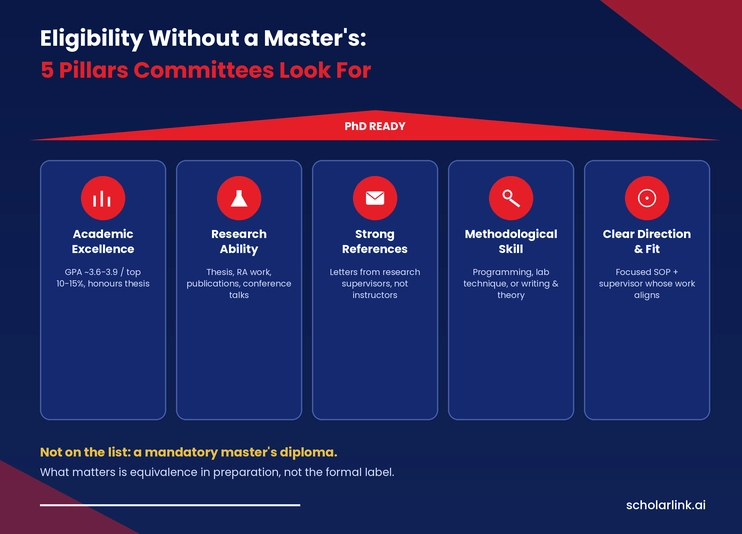
Across countries and disciplines, eligibility for a PhD without a master’s rests on five pillars:
- academic excellence
- demonstrated research ability
- strong academic endorsements
- methodological competence
- clear research direction and supervisor fit
Notice what is not on the list: a mandatory master’s diploma. What matters is equivalence in preparation, not the formal label.
One final caution: eligibility is not the same as competitiveness. A university may technically allow direct admission, but only a small group of applicants will be strong enough to succeed through that route. The smart question is not just “Can I apply?” but “Does my profile give the committee a convincing reason to say yes?”
How to Apply for a PhD Straight from Undergraduate
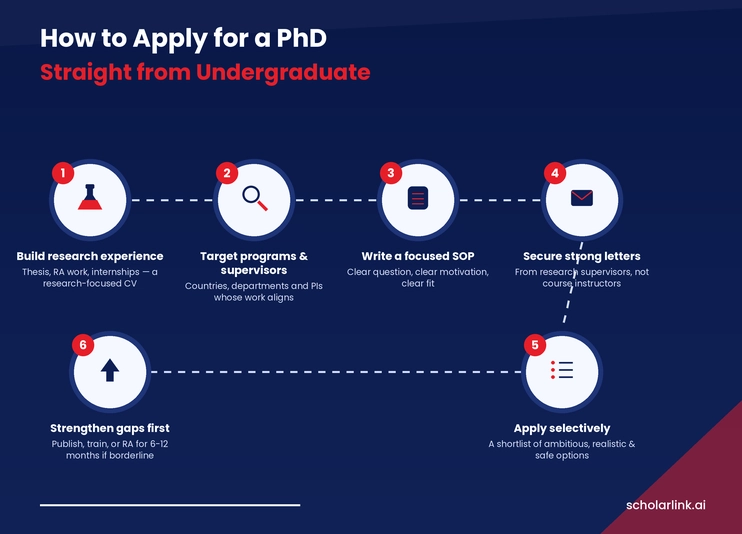
Applying to a PhD straight from undergraduate study is possible, but it needs a more deliberate strategy than a standard application. Without a master’s, every part of your profile has to work harder. You are effectively asking a university to treat your undergraduate preparation as equivalent to master’s-level readiness, so your application must be sharper, more focused, and more evidence-driven than average. The goal is to answer one question clearly: why are you ready now?
Step 1: Build Research Experience (and a Research-Focused CV)
The strongest direct-entry applicants start preparing before graduation, because research experience reduces uncertainty for the university. Useful forms include:
- a bachelor’s thesis or dissertation
- research-assistant work
- lab or technical project work
- summer research internships
- conference posters or presentations
- co-authored papers
- an independent literature-review project tied to a clear topic
Your CV should be an academic document showing trajectory, not a generic resume. Instead of “Worked in a lab during summer,” write: “Conducted supervised research on X under Dr. Y; implemented statistical modelling in R; contributed to dataset analysis used in a departmental publication.” A focused thesis with strong supervision usually matters more than a long list of unrelated activities. If you are still an undergraduate, be proactive now: volunteer for research projects, ask faculty whether they supervise research assistants, and choose final-year projects that can become writing samples or future PhD topics.
Step 2: Identify Programs and Contact Supervisors Strategically
A direct-entry application works best when it is targeted. Sending generic applications to famous universities rarely works when you are trying to overcome the absence of a master’s. Identify:
- countries where direct entry is realistic
- departments that explicitly accept applicants without a master’s
- supervisors whose work aligns with yours
- funding models that support early-stage students
- integrated or structured routes where needed
When you email a supervisor, keep it short and professional: who you are, what you studied, your research interest, why their work is relevant, and one or two lines showing you have actually read their recent research. For example, a psychology student whose thesis focuses on adolescent cognitive development, reaching out because it overlaps with a supervisor’s work on memory formation, reads very differently from a generic “are you accepting students in any area?” Supervisor fit can compensate for structural concerns, and this step also tests feasibility: is the supervisor taking students, is funding available, is your topic viable in that group?
Step 3: Prepare a Focused Research Proposal or Statement of Purpose
Not every application requires a formal proposal (US programs often don’t), but almost every strong one requires a clear research direction. A good proposal or SOP answers:
- What broad problem interests you?
- Why does it matter?
- What specific question do you want to explore?
- Why are you prepared to work on it now?
- Why this department and supervisor?
You don’t need to pretend your project is final and perfect; that can sound unrealistic. You need a thoughtful, grounded direction that shows you understand how questions are framed in the field. A public-health applicant studying migrant access to mental-health services in Canada, for instance, should narrow the issue, name a realistic angle and relevant methods, and explain why it fits the department’s expertise. The strongest statements make the committee feel the applicant already thinks like a researcher, not like a student seeking another degree.
Step 4: Secure Strong, Research-Based Recommendation Letters
Letters should come primarily from research supervisors. When you ask, give each referee your CV and draft SOP, remind them of specific projects, and explain that you are applying directly to a PhD. Ask them to speak to research independence, analytical thinking, problem-solving under uncertainty, and your comparative strength among peers. “Excellent student” is generic; “demonstrated independent hypothesis formation and managed data analysis with minimal supervision” signals PhD readiness. Many applicants over-polish the SOP but choose recommenders who barely know their work, a costly mistake when the committee is already looking for reassurance.
Step 5: Apply Selectively, Not Randomly
Avoid mass applications. Build a shortlist based on structure, fit, and probability:
- direct-entry programs in the US and Canada
- integrated programs in the UK
- departments whose faculty interests align strongly with yours
- programs with transparent funding for international students
Aim for a balance of ambitious, realistic, and safer options. Confirm eligibility criteria (GPA thresholds, honours requirements) and align your proposal with department strengths. For a PhD, brand name and rankings matter less than people think if research fit, supervisor quality, and funding are poor. A lower-profile department with the right supervisor and a supportive structure can beat a top-rated university with no alignment.
Step 6: Strengthen Gaps Before Applying (If Needed)
Applying directly does not mean applying immediately. If your profile is borderline, short-term moves can convert a rejection into a funded offer:
- publish or present your undergraduate thesis
- complete advanced methodological training
- work as a research assistant for six to twelve months
Waiting one cycle to strengthen your profile is often the highest-return decision available.
The mindset shift: you are not asking, “Will they accept me without a master’s?” You are demonstrating, “I already operate at graduate research level.” That reframing changes how you prepare every document.
Advantages and Disadvantages of Skipping a Master’s
Choosing the direct route can feel like taking the express lane. Sometimes it is exactly the route the system expects. And sometimes it is a decision people quietly regret because they misunderstood what the master’s stage actually provides. A master’s is not only a credential; in many fields it is a buffer: a structured period to develop research habits, test whether you truly enjoy scholarly work, and refine your topic before the stakes rise.
Here is a common scenario. An applicant finishes a bachelor’s in Biology, enters a direct-entry PhD, and realizes six months in that the daily reality is not “learning more biology.” It is writing, troubleshooting experiments that fail repeatedly, navigating supervisor expectations, and living inside uncertainty. Some students thrive; others wish they had used a master’s year to calibrate their direction and stamina.
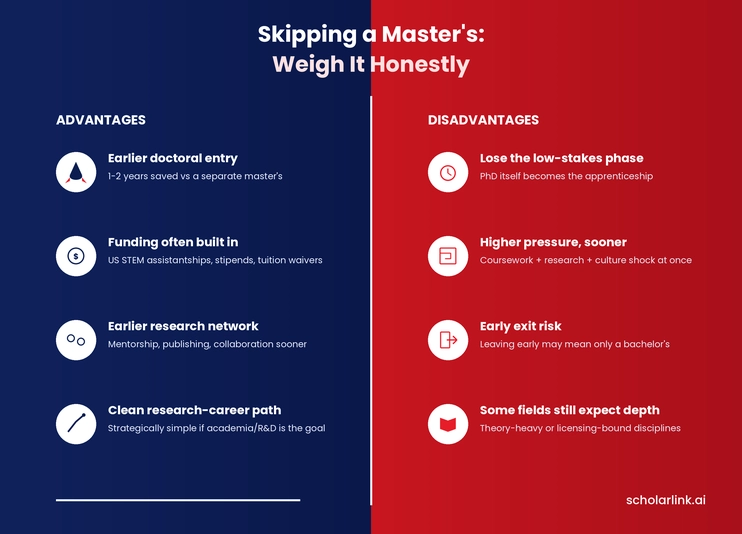
Advantages
- Time and cost efficiency when funding is aligned: you may reach doctoral study one to two years earlier and avoid tuition-heavy master’s years.
- Earlier access to research networks and supervision: earlier mentorship, earlier exposure to publishing, earlier collaboration with PhD candidates and postdocs. This head start can compound when you are well supported.
- A clearer pathway in systems built for direct entry: in the US especially, skipping a master’s is simply how graduate education is structured, not a hack.
- Faster positioning for research-focused careers: being a year or two earlier in the publication cycle can matter in competitive fields.
Disadvantages and Risks
- You lose a low-stakes research transition phase. A master’s often functions as a research apprenticeship. Skip it, and the PhD itself becomes the apprenticeship, with higher expectations.
- The pressure is higher, earlier. Coursework, research, qualifying exams, and cultural adjustment can all land at once. “Skipping a master’s” can mean more pressure sooner, not less.
- Topic uncertainty becomes expensive. Choosing a direction too early is a major hidden risk; in a PhD, changing topics or supervisors can create serious delays and funding strain.
- Early exit can leave you with no standalone credential. If a program does not award a master’s en route and you leave early, you may exit with only your bachelor’s, a real issue in job markets where a master’s is a valued signal. Integrated PhDs with an MRes reduce this risk; pure direct tracks may not.
- Some fields and countries still expect master’s-level depth: highly theoretical disciplines, fields with strict licensing routes, and research areas with extensive methodological training. The question is not only “Can I get in?” but “Will I be competitive and supported once I’m in?”
Who Should (and Shouldn’t) Skip a Master’s?
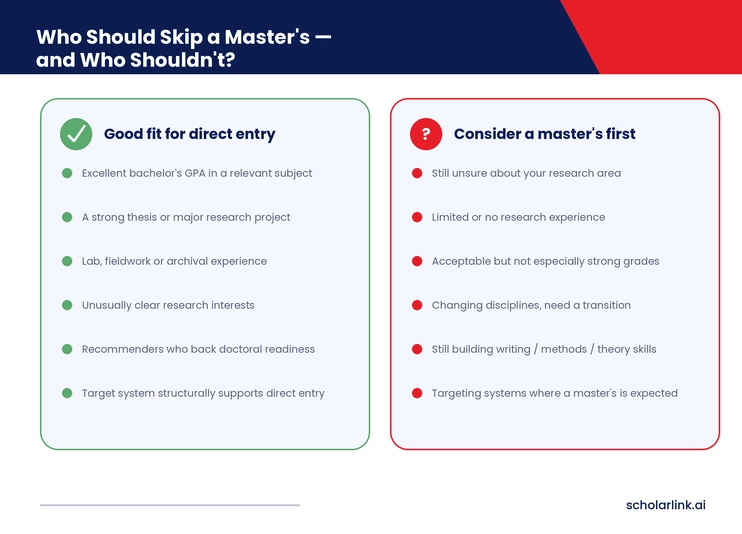
Students better suited to direct entry tend to share several traits: strong grades, serious undergraduate research experience, clear academic goals, and genuine comfort with independent work. They are not avoiding a master’s to save time; they are choosing the PhD because they are already moving toward research-level work.
| A good fit for direct entry | Think carefully before skipping a master’s if you are… |
|---|---|
| an excellent bachelor’s GPA in a relevant subject | still unsure about your research area |
| a strong thesis or major research project | limited in (or without) research experience |
| lab, fieldwork, archival, or methodological experience | carrying acceptable but not especially strong grades |
| unusually clear research interests | changing disciplines and needing an academic transition |
| recommenders who can strongly support doctoral readiness | still building writing, methods, or theory skills |
| a target country or program whose structure supports direct entry | targeting systems where a master’s is strongly preferred in practice |
Quick Decision Check
Ask yourself:
- Do I already have meaningful research experience?
- Can I explain a focused research direction, not just a broad interest?
- Do I have strong references from research supervisors?
- Am I prepared for long cycles of uncertainty and feedback?
- Does my target country and system support direct entry structurally and financially?
If most answers are “yes,” skipping a master’s can be a genuine advantage. If several are “not yet,” a master’s is not a detour; it can be the step that turns a weak doctoral application into a compelling one.
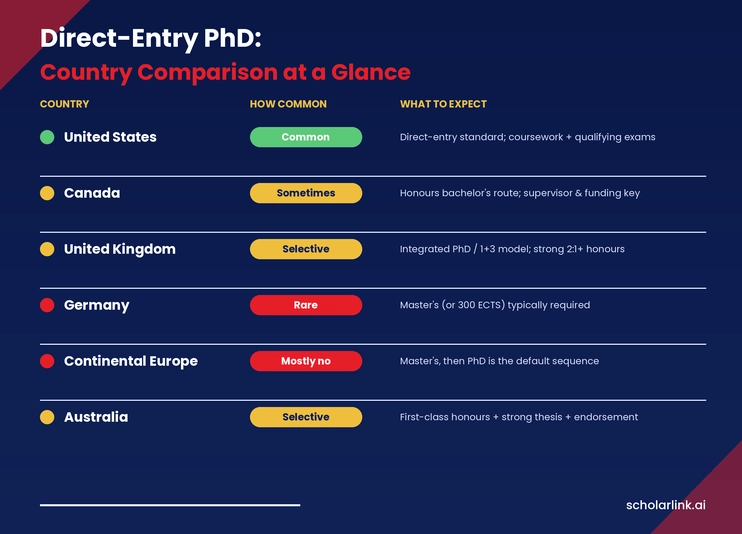
Country Comparison at a Glance
Applicants lose the most time when they treat “direct PhD” as a universal concept. It isn’t. The same phrase can mean “standard route” in one country and “special exception” in another. Use the table below to shortlist destinations by structure and entry rules.
| Country / Region | PhD without a master’s common? | Typical pathway(s) | What bachelor’s-only applicants usually need | Notes for international students |
|---|---|---|---|---|
| United States | Yes (common in many fields) | Direct-entry PhD with coursework + qualifying exams; sometimes master’s “en route” | Strong GPA, research experience, strong SOP, references; department/lab fit | Funding often structured (assistantships), especially in STEM; admissions can be committee-based first, PI fit matters later |
| Canada | Sometimes (varies by department) | Direct-entry PhD (often honours bachelor’s) or MSc → transfer to PhD | High GPA, honours thesis/research, strong references; supervisor support often key | Decisions closely linked to supervisor capacity and funding availability |
| United Kingdom | Selective (possible, not default) | Integrated PhD / 1+3 model; PhD with a structured training year; occasional direct entry for exceptional candidates | Strong 2:1 / First-Class honours, research readiness, proposal clarity, supervisor alignment | Integrated routes may include an MRes; funding (e.g. doctoral training centres) can shape entry rules |
| Germany | Rare (master’s usually required) | Master’s → PhD; limited fast-track routes at some institutions | Master’s-equivalent training typically expected; exceptions need an outstanding record + formal approval | Many paths are research appointments tied to a chair/professor; credential equivalency is a common barrier |
| Continental Europe (general) | Mostly no (varies by country) | Master’s → PhD; occasional structured doctoral schools; rare integrated/fast-track | Master’s-level preparation typically required; exceptions are program-specific | Often position-based (funded project roles) rather than cohort admissions; check each university’s doctoral regulations |
| Australia | Selective (possible via honours) | Honours bachelor’s → PhD; sometimes MPhil → PhD | First-class honours / strong research thesis + supervisor endorsement | Research readiness heavily emphasized; scholarship competitiveness is a key variable |
Conclusion: Is a PhD Without a Master’s Right for You?
Yes, it is possible to do a PhD without a master’s degree. But the real issue is not simple eligibility; it is fit. In the United States and Canada, direct entry is a normal part of doctoral admissions. In much of continental Europe, a master’s is still the expected route. The UK sits in between, with both traditional PhDs and integrated programs creating different entry points for strong applicants.
What matters most is whether your background already shows doctoral readiness. A strong GPA, real research experience, a focused direction, persuasive recommendation letters, and good alignment with a supervisor can make direct entry realistic. Without those elements, the same route becomes far harder than it looks from the outside. For international students, that distinction is decisive: applying without a master’s can save time, reduce costs, and open earlier access to funded research, but only when your profile matches the country, department, and doctoral structure you are targeting.
So the smartest applicants don’t only ask, “Can I apply?” They ask, “Which PhD model actually fits my preparation and goals?” A PhD without a master’s is not a shortcut. It is a different admissions pathway, one that rewards clarity, research readiness, and strategic targeting.
If you are now trying to identify funded PhD opportunities, suitable supervisors, or countries where direct-entry routes are realistic for your profile, ScholarLink.ai can help you approach the search with more clarity: finding relevant professors, doctoral pathways, and application directions that make sense for international students, instead of guessing which programs might fit.
FAQ
Is getting a PhD without a master’s harder?
Often, yes, not always because the rules block you, but because you need stronger evidence of research readiness. Without a master’s, your undergraduate research, GPA, recommendation letters, and academic direction usually carry more weight.
Which countries commonly allow direct PhD admission after a bachelor’s?
The United States and Canada are among the most common direct-entry destinations. The UK offers some direct-entry and integrated routes. In many continental European countries, a master’s is more commonly expected before doctoral admission.
What is an integrated PhD?
An integrated PhD combines master’s-level preparation and PhD-level research in one pathway. The first stage often includes coursework, methods training, and workshops (sometimes leading to an MRes) before full doctoral research begins.
Do I need publications to apply for a PhD without a master’s?
No, publications are not always required, but research experience helps a lot. A strong thesis, lab work, a conference presentation, or a research-assistant role can also make your application competitive.
Is direct entry more common in certain fields?
Yes. STEM fields, economics, psychology, and some quantitative social sciences are often more open to direct entry. Fields that expect deeper prior specialization tend to be less flexible.
Can you get funding for a PhD without a master’s?
Yes, but it depends on the country and funding model. Many US direct-entry programs are built around funding packages (assistantships, tuition waivers, stipends), especially in STEM. In Canada and Australia, funding often tracks the supervisor’s grant capacity or scholarship competitiveness. the UK and parts of Europe, funding can be structured around specific cohorts or funded projects, and integrated routes (sometimes with an MRes) can be a common funded pathway. In every case, strong research potential and departmental fit matter more than the master’s credential itself.
Does skipping a master’s hurt your career prospects after the PhD?
In most research-focused careers, employers and academic committees care far more about your dissertation, publications, technical skills, and references than about whether you held a master’s before the PhD. A completed doctorate is usually the terminal research qualification. The main edge case is an early exit: if you leave before finishing and the program does not award a master’s en route, you may have fewer standalone credentials.
Is it worth doing a master’s later if you already have a PhD?
Usually not necessary. It can make sense for a career pivot into a professional domain, for credential alignment in regulated fields, or for structured training in a new methodology. For most traditional research careers, postdoctoral experience, publications, and project leadership matter more than an additional degree.
Should I skip a master’s if I can?
Only if your profile is already strong enough for doctoral-level work and the target program’s structure supports that route. If you still need research training, clearer focus, or stronger academic writing, a master’s may be the better investment.