

How to Email a Potential PhD Supervisor: Timing, Templates, and What Professors Actually Read
For many international students, “contacting a PhD supervisor” sounds simple: send an email, introduce yourself, ask about opportunities. In reality, that first message often decides whether your application gets serious attention or quietly disappears into an inbox.
Across doctoral systems in the United States, United Kingdom, Canada, Germany, Australia, and most of Europe, the relationship between a PhD supervisor (or Principal Investigator, PI) and a student sits at the center of the whole research journey. Undergraduate and taught master’s admissions usually run through an admissions office. Doctoral programs work differently. They hinge on research fit between you and a specific supervisor, and that fit shapes funding, project choice, publications, and whether the PhD succeeds at all.
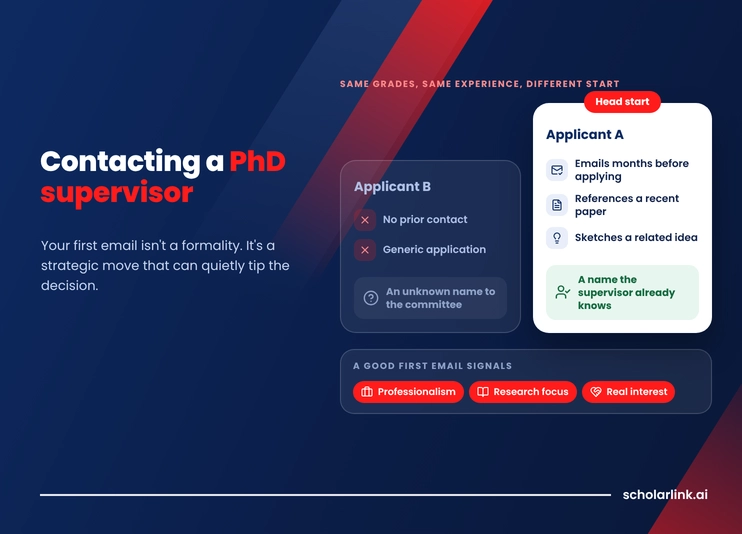
Picture two applicants going for the same PhD in biomedical engineering. Both have strong grades and research experience. One emails a professor months before applying, references a recent paper, and sketches a related research idea. The other submits a generic application with no prior contact. When the committee sits down to review, the first applicant is already a name the supervisor recognizes. That head start can quietly tip the decision.
Here’s what becomes obvious after advising applicants and talking to professors: the first email to a potential PhD supervisor isn’t a formality — it’s a strategic move. Done well, it signals professionalism, research awareness, and real interest, and it can open conversations about funding, collaboration, or an informal nudge to apply.
This guide walks through the whole process:
- When to contact professors during the PhD application timeline
- How to email a potential PhD supervisor professionally
- What professors actually look for in a first email
- Sample emails you can adapt across different fields
- Common mistakes that get applicants ignored
Timing is where most people either win or lose their first move, so that’s where we’ll start.
When Should You Contact a PhD Supervisor?
One of the first questions applicants ask is also one of the most consequential: when should you reach out? The answer shapes whether your email gets a thoughtful read or sinks under forty other unread messages.
Short version: earlier than most applicants think — but not so early that your email is irrelevant.
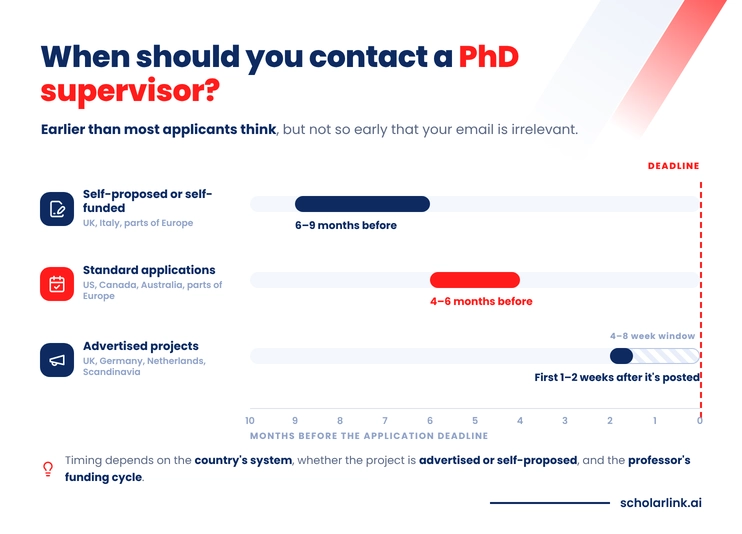
Good timing depends on three things: the admission system in the target country, whether the project is advertised or self-proposed, and the professor’s funding cycle. Here’s how each one plays out.
Standard PhD applications (US, Canada, Australia, parts of Europe)
In these systems, applications tend to open 8–12 months before the program starts, and the sweet spot for contacting a supervisor is 4–6 months before the deadline.
Take Elena, who wants to start a PhD in environmental policy in September 2026. Most of her target programs close in December 2025 or January 2026. If she starts emailing supervisors in July or August 2025, she gives each professor enough runway to:
- review her research interests
- suggest improvements to her proposal
- confirm whether they expect to take on a new PhD student
Early contact also surfaces things you’d never learn from a program page. A professor might reply: “I’ll likely take one funded student next year, but it depends on grant funding.” That one sentence lets you adjust your whole strategy. Reaching out months ahead turns a blind submission into a guided one.
Advertised PhD projects (UK, Germany, Netherlands, Scandinavia)
Here, many PhD positions are advertised research jobs — the topic, funding, and supervisor are all defined before applications open. These windows are short, sometimes just 4–8 weeks.
When you spot a listing like:
“Funded PhD position in Machine Learning for Medical Imaging – University of Manchester”
contact the named supervisor within the first 1–2 weeks. A brief, sharp email lets you ask whether your background fits, whether they welcome international applicants, and what skills the selection committee values. Just keep it tight — nobody expects a full proposal at this stage.
Self-proposed or self-funded PhD projects (UK, Italy, parts of Europe)
When you bring your own research proposal and look for a supervisor to back it, timing stretches earlier: 6–9 months before the deadline. The extra runway lets you refine the idea, collect feedback, and hunt down scholarships or fellowships.
An applicant working on urban climate resilience, for instance, might reach out to several researchers on sustainable cities. One professor’s feedback on the research question alone can meaningfully sharpen the final proposal. That back-and-forth is normal — often expected — in proposal-based applications.
The risk of contacting too early
More isn’t always better. Email a professor a year or more out, and academic timelines will have shifted by the time applications open — funding decisions, grant approvals, and departmental priorities all move within a few months. The likely reply:
“Please contact me again closer to the deadline.”
Aim for the window when professors are actively thinking about next year’s students — usually the six months around when applications open or close. That keeps your message tied to their current planning.
Quick reference:
| Application type | Common regions | When to email |
|---|---|---|
| Standard application | US, Canada, Australia, parts of Europe | 4–6 months before deadline |
| Advertised project | UK, Germany, Netherlands, Scandinavia | Within 1–2 weeks of the posting |
| Self-proposed / self-funded | UK, Italy, parts of Europe | 6–9 months before deadline |
Knowing when to send is only half the battle. The harder part is writing a message professors actually answer.
How to Email a Potential PhD Supervisor
That first email is often the very first academic exchange between you and a potential mentor. In the UK, Europe, Australia, and increasingly Canada and the US, supervisors heavily influence whether your application moves forward. So the email isn’t really about introducing yourself — it’s about showing research awareness, intellectual alignment, and professional communication in a few short paragraphs.
Professors receive dozens, sometimes hundreds, of these every year. Most get ignored not because the students lack potential, but because the message reads generic, rushed, or under-researched. Something like “Dear Professor, I want to do a PhD with you. Please guide me.” almost never gets a reply. A message that references the professor’s actual work and spells out the research connection stands out immediately.
A quick real-world contrast: a data science master’s student at the University of Bologna wants a PhD in machine learning for healthcare. Instead of blasting the same note to ten professors, she studies the work of a PI at the University of Toronto working on AI-assisted diagnostics. Her email cites a recent paper on medical image classification and explains how her thesis on neural network interpretability connects to it. That alignment is what earns a reply.
One pattern shows up again and again: professors answer emails that show preparation, clarity, and genuine research interest. The message doesn’t need to be long — it needs to send the right signals. The five steps below are how strong applicants build that message, and it all starts before you type a single word.
Step 1 – Research before you email
The biggest mistake applicants make is emailing before understanding the professor’s research. A copy-paste message is obvious from the first line.
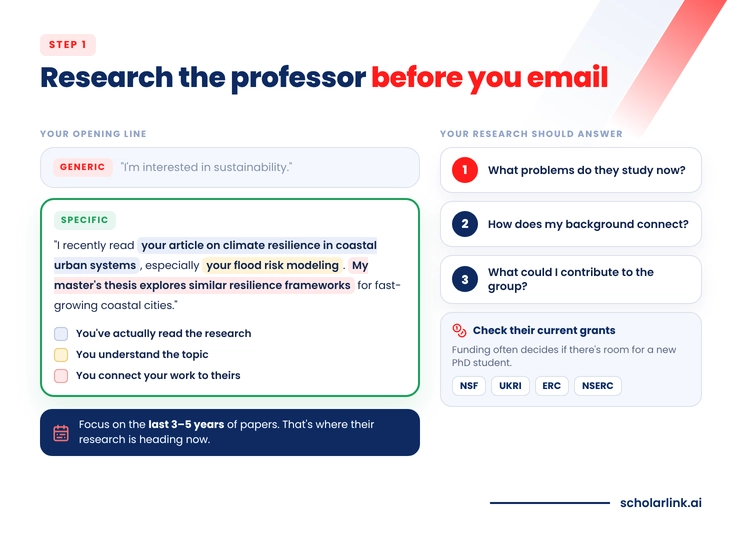
Start with the professor’s recent publications — Google Scholar, the faculty page, or databases like Scopus and Web of Science. Focus on the last three to five years, since that reflects where their research is actually heading. Cite something from a decade ago and you may accidentally signal that you didn’t look closely.
Say you’re interested in urban sustainability and want to contact a professor at University College London (UCL). Instead of “I’m interested in sustainability,” you notice they recently published on climate resilience in coastal cities and urban flooding models. Now you can write:
“I recently read your article on climate resilience strategies in coastal urban systems, particularly your analysis of flood risk modeling in European cities. My master’s thesis explores similar resilience frameworks for rapidly growing coastal cities in Southeast Asia.”
That single sentence tells the professor three things at once:
- You’ve actually read the research.
- You understand the topic.
- You can connect your own work to theirs.
One more step people skip: check the professor’s current projects and grants. Many run funded work backed by the NSF (US), UKRI (UK), the European Research Council (ERC), or NSERC (Canada) — and that funding often decides whether there’s room for a new PhD student.
Boiled down, your research should answer three questions:
- What problems does this professor currently study?
- How does my background connect to those problems?
- What could I actually contribute to their group?
Once those are clear, the email more or less writes itself.
Step 2 – Write a strong subject line
A lot of applicants underestimate the subject line. For a professor juggling a research group, teaching, and grant deadlines, it’s the thing that decides whether your email gets opened now, later, or never.
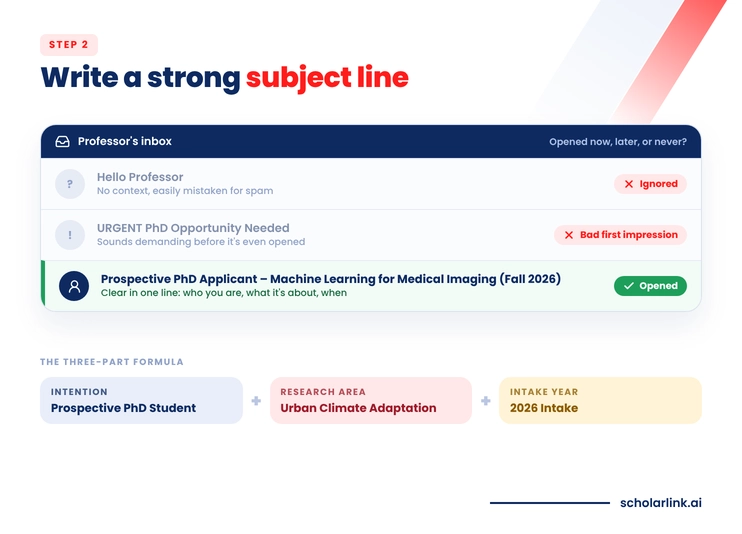
Keep it clear, concise, and informative:
Prospective PhD Applicant – Machine Learning for Medical Imaging (Fall 2026)
In one line, the professor knows exactly what this is. Compare that to the weak versions:
- ❌ “Request for Guidance” or “Hello Professor” — no context, easily mistaken for spam
- ❌ “URGENT PhD Opportunity Needed” — sounds demanding and creates a bad first impression before the email is even open
Most supervisors prefer a subject line with three parts: your intention + research area + intake year. For example:
Prospective PhD Student – Urban Climate Adaptation Research (2026 Intake)
Step 3 – Introduce yourself briefly
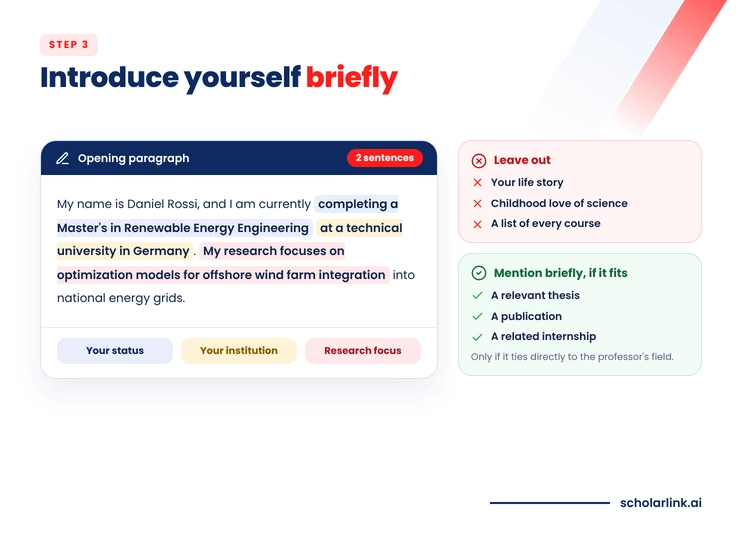
Your opening paragraph is a professional introduction, not a life story. It covers three things: your current academic status, your institution, and your general research interest.
A master’s student in renewable energy engineering at the Technical University of Munich, writing to a professor at the University of British Columbia, might open like this:
My name is Daniel Rossi, and I am currently completing a Master’s degree in Renewable Energy Engineering at the Technical University of Munich. My research focuses on optimization models for offshore wind farm integration into national energy grids.
Two sentences, and the professor already has your level, background, and focus. What to avoid: paragraphs on your childhood love of science or a list of every course you’ve taken. If you have a thesis, publication, or internship that directly fits the professor’s field, mention it — briefly.
Step 4 – Show research fit
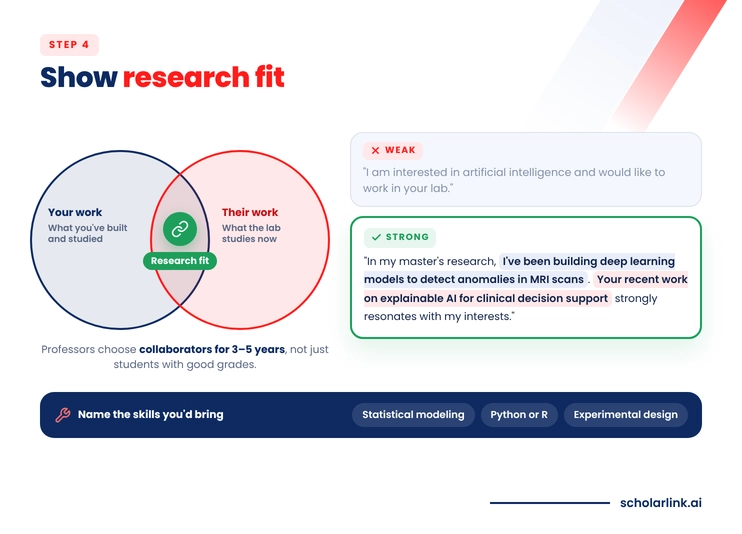
If one factor decides whether a professor replies warmly, it’s research alignment. Supervisors aren’t just picking students with good grades. They’re choosing collaborators for three to five years of closely related work. When the fit is unclear, they hesitate.
A student working on AI for healthcare diagnostics, writing to a Stanford professor who studies ML models for radiology, might write:
During my master’s research, I have been developing deep learning models to detect anomalies in medical imaging datasets, particularly MRI scans related to early-stage neurological disorders. Your recent work on explainable AI methods for clinical decision support systems strongly resonates with my interests, especially your approach to improving transparency in neural network predictions.
That shows the applicant understands both their own work and the professor’s. Contrast it with the weak version:
I am interested in artificial intelligence and would like to work in your lab.
True, maybe — but it proves nothing. One more lever: name the skills you’d bring to the group. If the professor runs an ERC-funded project, a line about your experience in statistical modeling, Python or R, or experimental design helps them picture you in the lab. That’s the moment an email turns into a real conversation.
Step 5 – End professionally
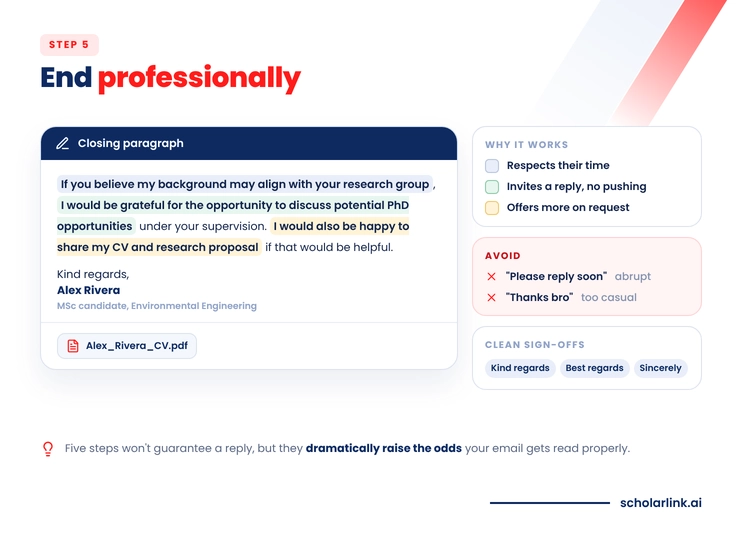
Close with the same tone you opened with, and leave the door open. Skip the abrupt “Please reply soon” and the too-casual “Thanks bro.” Something like this works:
If you believe my background may align with your research group, I would be grateful for the opportunity to discuss potential PhD opportunities under your supervision. I would also be happy to share my CV and research proposal if that would be helpful.
It respects their time, offers more on request, and invites a reply without pushing. Attach a CV or mention it’s available — professors often skim it right away to gauge your preparation. Then sign off cleanly:
Kind regards, / Best regards, / Sincerely,
[Full name, institution]
Follow these five steps and you won’t be guaranteed a reply — but you dramatically raise the odds that your email gets read properly.
Tips for Contacting Research Supervisors
You can know the structure cold and still trip on small execution mistakes. Professors judge fast — on clarity, professionalism, and relevance — and a few practical habits separate the emails that get answered from the ones that vanish.
Picture a computational biology lab head at the University of Melbourne opening two emails the same morning. One runs six paragraphs of life story with a pile of transcripts attached and a vague ask. The other is 150 words: it references the professor’s recent paper on protein structure prediction and links the student’s thesis on bioinformatics algorithms to it. The second one reads as serious and prepared. Same qualifications, totally different outcome.
Keep the email concise but meaningful
Overlong emails are the most common misstep. Supervisors are researchers, teachers, and administrators all at once, and many field dozens of inquiries a week. If your email takes several minutes to read, it gets postponed — and postponed usually means forgotten.
A solid rule of thumb: keep the core message to 120–200 words. That’s enough to introduce yourself, show fit, and ask your question without burying any of it. Clarity beats length every time.
Attach only what’s necessary
Should you attach your CV, transcripts, proposal, and publications all at once? Usually not. The safe move is one concise academic CV — enough for the professor to size up your preparation and move the conversation along.
Piling on attachments backfires. Multiple transcripts, recommendation letters, a full thesis, a long proposal — none of it is needed at first contact, and the bulk can stop a professor from opening the email at all. A student writing to an ETH Zurich professor on climate-adaptive infrastructure, for example, is better off sending a short note with a two-page CV and a line saying the proposal is available on request.
Follow up politely if you hear nothing
Silence rarely means no. It usually means busy — teaching, conference travel, grant deadlines, admin. A polite follow-up after 10–14 days is completely fine:
Dear Professor Chen,
I hope you are doing well. I wanted to briefly follow up on my previous email regarding potential PhD opportunities in your research group. I remain very interested in your work on machine learning for climate modeling and would greatly appreciate any guidance you may have.
One follow-up shows persistence. Chasing every few days reads as impatience. If there’s still nothing after one or two nudges, move on to other supervisors — professionalism matters more than persistence.
Avoid the mistakes professors notice instantly
A few errors do outsized damage:
- Generic mass emails — “Dear Professor, I want to join your research group” with no mention of their work screams copy-paste.
- Wrong name, title, or university — the classic template slip-up, and an instant credibility hit.
- Demanding tone — leading with funding or guaranteed admission makes professors uncomfortable. Open with research interest instead.
- Typos and unclear sentences — a minor slip is forgivable for international students writing in English; an email littered with errors is not.
None of this requires perfection. It requires care.
Sample Emails to Prospective PhD Advisors
Structure is useful, but applicants still ask the practical question: what does a real email actually look like? There’s no single perfect template — tone shifts depending on whether you’re answering an advertised project, pitching your own idea, or asking about funded spots, and fields differ too. Engineering and CS emails lean on technical skills and datasets; social sciences and humanities lean on theory and research questions.
One warning: professors spot copy-pasted templates easily. Treat the five below as starting points to adapt, not scripts to send verbatim. Each keeps the same three ingredients — clarity, research alignment, professionalism.
Example 1 – Advertised PhD project (Engineering / AI)
Dear Professor Williams,
I hope you are doing well. My name is Chen Li, and I am currently completing a Master’s degree in Computer Science at Tsinghua University, where my research focuses on deep learning applications for medical image analysis.
I recently came across the advertised PhD position in Machine Learning for Medical Imaging in your research group at the University of Manchester. Your recent publication on explainable convolutional neural networks for radiology diagnostics particularly caught my attention, as my master’s thesis explores interpretability techniques for neural network models used in MRI image classification.
Through my thesis work and research internship at a medical AI startup, I have gained experience working with PyTorch, large medical imaging datasets, and model optimization techniques. I believe this background aligns closely with the objectives described in the PhD project.
If possible, I would greatly appreciate the opportunity to learn more about the project and whether my background may be suitable for the position. I would be happy to share my CV and further details about my research.
Thank you for your time and consideration.
Kind regards,
Chen Li
Why it works: specific project, a relevant publication, and concrete technical skills.
Example 2 – Self-proposed research topic (Environmental Science)
Dear Professor Martinez,
My name is Elena Rossi, and I recently completed a Master’s degree in Environmental Policy at the University of Bologna. My research focused on climate resilience strategies in Mediterranean coastal cities, particularly the role of urban planning in flood mitigation.
While exploring potential doctoral programs, I read your recent research on climate adaptation strategies in European urban regions, especially your article examining integrated flood management approaches in coastal cities. The interdisciplinary approach you describe strongly resonates with the research questions I hope to pursue.
I am currently developing a doctoral research proposal examining how climate adaptation policies can be integrated into urban planning frameworks for rapidly growing coastal cities. I believe your expertise in urban climate governance would make your research group an ideal environment for this project.
If you are open to supervising new PhD students in this area, I would be very grateful for the opportunity to briefly discuss whether my proposed research direction could align with your work.
Thank you for your time and consideration.
Best regards,
Elena Rossi
Why it works: it leads with intellectual alignment instead of just asking to be supervised.
Example 3 – Asking about funded opportunities (Computer Science)
Dear Professor Thompson,
I hope this message finds you well. My name is Ahmed Hassan, and I am currently completing a Master’s degree in Data Science at Cairo University. My research focuses on large-scale natural language processing models for multilingual text analysis.
I have been following the work of your research group at the University of Toronto, particularly your recent projects on large language models and cross-lingual representation learning. Your work on multilingual NLP systems aligns closely with my current research and long-term academic goals.
I am planning to apply for PhD programs beginning in Fall 2026 and was wondering whether you anticipate recruiting new PhD students in your research group, particularly for projects related to multilingual NLP or large-scale language models.
I would be grateful for any advice you may have regarding potential opportunities in your group. I would also be happy to share my CV and research background if helpful.
Thank you for your time.
Kind regards,
Ahmed Hassan
Why it works: it asks about funding without sounding like funding is the only goal.
Example 4 – Social sciences (Sociology / Migration Studies)
Dear Professor Schneider,
My name is Sofia Alvarez, and I am currently completing a Master’s degree in Sociology at the University of Barcelona. My research interests focus on migration, labor markets, and social integration policies in European cities.
I recently read your work on migrant labor integration in urban labor markets, particularly your comparative analysis of migration policies across Germany and Southern Europe. Your research on institutional barriers to labor mobility strongly relates to my master’s thesis, which examines the economic integration of migrant workers in Spain’s service sector.
I am currently exploring PhD opportunities that would allow me to expand this research into a comparative European study of migrant labor market integration. Your research group at Humboldt University appears to be an excellent intellectual environment for pursuing this work.
If you anticipate supervising doctoral students in this area, I would greatly appreciate the opportunity to discuss potential research directions with you.
Thank you very much for your time.
Best regards,
Sofia Alvarez
Why it works: it demonstrates conceptual understanding and research relevance, which matter more than technical tooling in social science.
Example 5 – Humanities (History / Cultural Studies)
Dear Professor Bennett,
I hope you are well. My name is Daniel Kim, and I recently completed a Master’s degree in History at Seoul National University, where my research focused on cultural exchanges between East Asia and Europe during the nineteenth century.
While exploring potential doctoral supervisors, I came across your work on transnational intellectual networks in nineteenth-century Europe. Your recent book on cross-cultural knowledge circulation between Europe and Asia was particularly inspiring, as it closely relates to the themes I explored in my master’s thesis.
I am currently interested in developing a doctoral research project examining intellectual exchange between Korean scholars and European intellectual networks during the late nineteenth century. I believe this topic could build upon some of the transnational historical frameworks you have developed in your research.
If you are accepting PhD students in the coming academic cycle, I would be honored to discuss whether my research interests might align with your supervision.
Thank you very much for your time and consideration.
Sincerely,
Daniel Kim
Why it works: humanities emails center on research questions and scholarly dialogue rather than methods and tools.
Across all five, the same thread holds: say clearly who you are, what you study, and why your research connects to theirs.
Common Mistakes When Approaching Professors for PhD Opportunities
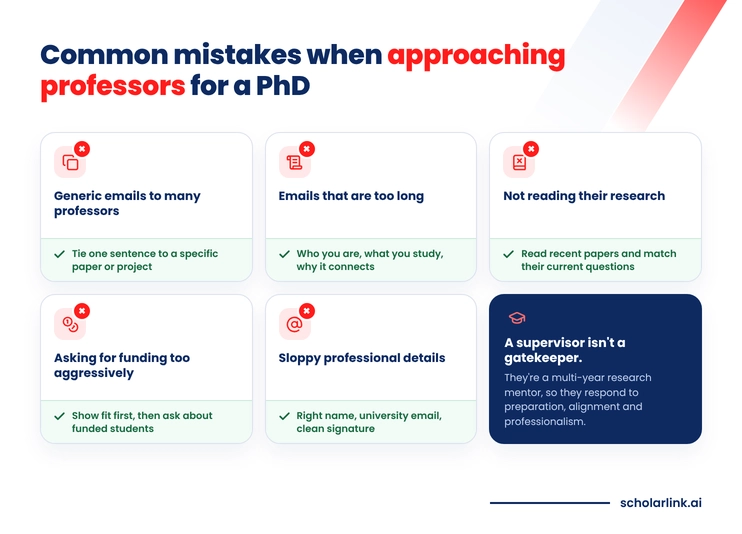
Even strong applicants sabotage themselves before the conversation starts. These slip-ups rarely come from a lack of intelligence — they come from misunderstanding what a supervisor relationship is. A PhD supervisor isn’t an admissions gatekeeper; they’re a multi-year research mentor. That’s why they respond to preparation, alignment, and professionalism, and tune out everything else.
Sending generic emails to multiple professors
The most visible mistake. A note like:
Dear Professor, I am interested in pursuing a PhD in your university. Please let me know if there are any opportunities.
is polite and says nothing. Often the professor’s name isn’t even in it — a dead giveaway it went to forty people. A computational neuroscience professor at UC has no reason to believe you care about their work, so the email dies. One sentence tied to a specific paper or project flips it from generic to credible.
Writing emails that are too long
Thousand-word emails tracing your journey from undergrad to now feel sincere but land badly. Professors skim between meetings; a message that demands several minutes gets shelved. Lead with the essentials — who you are, what you study, why it connects — and nothing else.
Not reading the professor’s research
The most damaging mistake of all, and it shows up in subtle ways:
- Writing “I’m very interested in renewable energy” to someone who actually does energy policy modeling, not engineering.
- Citing a paper from ten years ago while ignoring everything recent.
Fix it by reading a few recent papers and identifying the questions they’re working on now. If an ETH Zurich professor publishes on sustainable urban infrastructure and climate adaptation, connect your work to those themes — not to a vague “urban studies.”
Asking for funding too aggressively
Funding matters, and most doctoral programs in the US, Canada, Germany, and Australia run on assistantships and grants. But opening with:
Dear Professor, do you have fully funded PhD positions available?
makes it sound like money is the only point. Establish research alignment first, then ask whether they expect to recruit funded students. That phrasing shows you understand how academic funding actually works.
Overlooking professional details
The small stuff adds up:
- Wrong name or university from a reused template
- Overly casual, social-media-style greetings
- A non-institutional email address or a missing signature
Use your university email and a clean signature with your name, institution, and program. These signals quietly build — or erode — credibility.
What to Do If You Don’t Get a Reply
Sending a careful email and hearing nothing is one of the most deflating moments in the whole process. The instinct is to assume the worst: not interested, not strong enough, already closed. Usually it’s far simpler — the professor hasn’t seen it yet, or hasn’t had time.
Academic life is unpredictable. Teaching, supervising current students, writing grants, reviewing papers, conferences, committees — during peak weeks, a prospective student’s email slips down the pile easily. A non-response in the first week is normal and almost never a final no.
Give the professor enough time
Patience first. A second email after a few days adds pressure. Wait 10–14 days — long enough to be reasonable, short enough to stay fresh. If you emailed a Toronto robotics professor on March 1 and heard nothing by March 12, a short follow-up then is perfectly appropriate.
Write a polite, brief follow-up
Don’t resend the whole thing. Just remind them and ask if they had a chance to look:
Dear Professor Johnson,
I hope you are doing well. I wanted to briefly follow up on my previous message regarding potential PhD opportunities in your research group, particularly related to reinforcement learning for robotics. I remain very interested in your recent work on adaptive control systems and would greatly appreciate any guidance you might have regarding potential PhD openings in your lab.
Thank you again for your time and consideration.
Best regards, Maria Lopez
Short, respectful, non-demanding — and often enough to resurface the thread.
Avoid repeated follow-ups
Several messages in a short span read as pressure. If the first follow-up gets nothing, wait another two to three weeks before a final, gracious note:
I understand that you likely have a very busy schedule. If there are no available PhD opportunities at this time, I completely understand and appreciate your consideration.
After that, move on. A PhD application is almost never riding on one professor.
Consider other ways to connect
Silence sometimes just means email is the wrong channel right now — the professor might be traveling, running fieldwork, or buried in a grant deadline. A few alternatives:
- Check the lab or group website for posted PhD openings.
- Watch academic job boards like Euraxess, FindAPhD, or university graduate pages.
- Identify other faculty in the same department working on related topics — big departments often have several.
Stay strategic and keep momentum
The applicants who succeed rarely bet on a single email or a single supervisor. They line up several mentors whose work overlaps with their interests. Someone focused on urban sustainability, for example, might reach out to groups at UCL, ETH Zurich, the University of British Columbia, and the University of Melbourne — all strong in environmental planning and climate policy. Contact several thoughtfully, and you raise the odds of a real match and a real conversation.
Final Checklist Before You Hit Send
Professors often decide within seconds whether an email deserves a closer read. A clean message signals professionalism; a small slip — wrong professor, missing CV — can undercut an otherwise strong note. One applicant wrote a sharp email to an Imperial College London professor on sustainable energy infrastructure, then realized after sending that it was addressed to a different professor at another university entirely. Strong fit, instant credibility hit.
Run through this before sending:
- Correct name and title — Dear Professor Smith, spelled right, at the right university
- Relevant subject line — e.g. Prospective PhD Student – Urban Climate Adaptation Research (2026 Intake)
- Clear, concise intro — who you are, your degree, your institution
- Evidence of research alignment — at least one specific paper, project, or topic of theirs
- Focused length — the main message reads in under a minute
- Professional tone — polite, no slang, no demands
- Correct attachment — the right file, actually attached
- Clean file name —
FirstName-LastName-CV.pdf, notdocument1.pdf - Academic signature — name, university, program, optional LinkedIn or webpage
- Grammar and spelling — quick proofread for typos and unclear lines
- Correct recipient address — their institutional email, double-checked
- Sensible timing — sent during working hours in their time zone
A minute of checking can be the difference between being overlooked and starting a real academic conversation.
Frequently Asked Questions
How do you email a potential PhD supervisor?
Research their recent work first, then write a short email (120–200 words) with a clear subject line, a two-sentence introduction, one paragraph showing how your research connects to theirs, and a polite close offering your CV. Personalize every message — generic emails get ignored.
When should you contact a PhD supervisor?
For standard applications, 4–6 months before the deadline. For advertised projects, within 1–2 weeks of the posting. For self-proposed research, 6–9 months ahead. Emailing a year or more in advance is usually too early.
What should the subject line of a PhD inquiry email be?
Include your intention, research area, and intake year — for example, “Prospective PhD Applicant – Machine Learning for Medical Imaging (Fall 2026).” Avoid vague lines like “Hello Professor” or anything that sounds urgent or demanding.
Should I attach my CV to the first email?
Yes — a concise, two-page academic CV. Hold back transcripts, recommendation letters, and full proposals until the professor asks; too many attachments can stop them opening the email at all.
What if the professor doesn’t reply?
Wait 10–14 days, then send one short, polite follow-up. If there’s still no response after one or two nudges, move on to other supervisors. Silence usually means “busy,” not “no.”
How long should an email to a PhD supervisor be?
Around 120–200 words. Long enough to introduce yourself, show research fit, and ask your question — short enough to read in under a minute.
Summary
Contacting potential PhD supervisors is one of the most important — and most underrated — steps in the doctoral application process. A thoughtful email can introduce you to the right research group, clarify funding, and build an early connection that strengthens your whole application. Research supervisors carefully, write concise and professional emails, and follow up with patience, and you’ll meaningfully raise your odds of a reply and a real research relationship.
If you want a more structured way to find suitable professors and streamline outreach, platforms like ScholarLink.ai help international students discover research supervisors and doctoral opportunities faster. By focusing on academic fit and research alignment, tools like these make finding the right PhD supervisor clearer and more strategic.