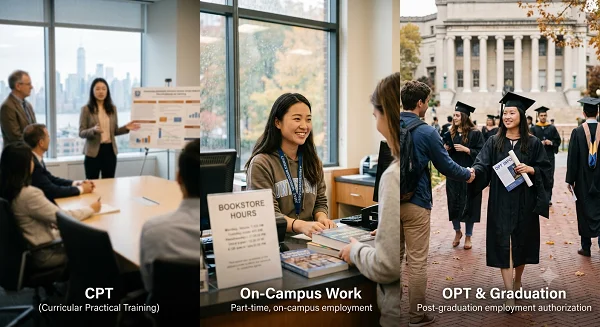

By the midpoint of your first semester, you’re sitting in the library on campus, and two opportunities fall into your email inbox for the same week: unpaid research assistant position with a professor and paid job in the campus bookstore. The first thought that occurs to you isn’t which one to choose but whether either of the three—the on-campus work, CPT or OPT—is even available for you at all right now? And for most students in the first semester in F-1 status, the answer is on-campus work. As a rule, CPT becomes relevant much later for an internship when the conditions of your university’s eligibility become applicable; and OPT is used for pre-completion and post-completion work authorization. The understanding of the differences will allow you to accept the proper opportunity and avoid any problems with immigration authorities.
Eligible on-campus employment includes positions that:
- Library assistant
- Campus bookstore employee
- Cafeteria or dining hall worker
- Research assistant
- Teaching assistant (if eligible for your academic program)
| Work Type | When it applies | Need an employer offer? | offer?
On or off campus? |
| On-campus work | While enrolled, including your first academic year | Yes | On campus |
| CPT | Before graduation for an eligible degree-related internship or practical training | Yes | Usually off campus |
| OPT | Before or after graduation for work related to your major | No | Usually off campus |
On-Campus Work: What F-1 Students Can Do From Day One
Having an F1 visa does not mean you can accept any job offer. Your work options depend on your school type, academic level, immigration status, and whether your Designated School Official has approved the process, as needed. On-Campus work is the only work option that you can do with the F-1 visa, and is rule-bound. on-Campus work usually opens 30 days after the program start date. It is capped at 20 hours/week during the academic term, and can go full-time during official school breaks. Students must still report the job to their school’s international office (DSO).
| Rule | Detail |
| Start date | students can begin on-campus employment 30 days after your program start date if you are entering the U.S. inF-1 status and have been authorized to enroll. Most students start once classes begin and after completing their school’s hiring process. |
| Hours per term-time | 20 hours per week while school is in session. |
| Hours during breaks | 40 hours a week (full-time) during summer and university breaks. |
| Reporting requirement | Report your on-campus employment to your Designated School Official (DSO) or international student office as required by your school, and complete all employment and payroll paperwork before starting work. |
Curricular Practical Training (CPT): Working While Still Enrolled
Curricular Practical Training (CPT) offers an opportunity to F-1 visa holders to gain practical experience during their studies. Contrary to on-campus employment, curricular practical training is applicable when the training is related to your field and an essential part of the curriculum. This includes a required internship, cooperative education (co-op) program, practicum, or another work experience that is required for your degree or earns academic credit. No matter whether the job is on-campus or off-campus, you have to get the permission of the DSO prior to starting work.
The following criteria need to be satisfied in order to qualify for CPT:
- Enrollment for at least one year on a full-time basis
- Training must be curriculum-required
- Must have an employer offer letter
- DSO must authorize it before starting
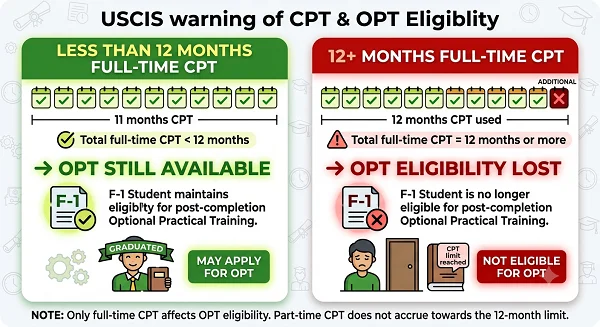
- Working 12+ months of full-time CPT eliminates eligibility for OPT
Optional Practical Training (OPT): Work Authorization Before or After Graduation
Optional Practical Training, or OPT lets F1 students work in a job related to their field of study.
OPT provides up to 12 months of work authorization exactly related to the student’s field of study, usable before completion (pre-completion OPT, part-time while enrolled) or after (post-completion OPT, full-time). Pre-completion OPT is typically part-time while you are enrolled in classes, whereas post-completion OPT is generally full-time after you complete your degree requirements.
Unlike CPT, OPT does not require a job offer at the time of application and allows employer changes as long as the new role stays within the same field.
Apply for OPT by completing the following steps:
During the standard 12-month OPT period, you may not accumulate more than 90 days of unemployment. Exceeding this limit can place your F-1 status at risk, so it is important to keep your employment records and report any required updates to your DSO.
- Request a recommendation from the DSO
- Receive updated I-20
- File Form I-765 with USCIS
- Wait for EAD card
- Begin work only after EAD approval
| Step | Who handles it | What happens |
| Request a recommendation from the DSO
|
Student and DSO | The student requests OPT, and the DSO verifies eligibility and recommends OPT in SEVIS. |
| Receive an updated Form I-20 | DSO | The DSO issues a new Form I-20 showing the approved OPT recommendation. |
| File Form I-765 | Student | The student submits Form I-765 and supporting documents to USCIS. |
| Receive the EAD card | USCIS | USCIS reviews the application and, if approved, issues an Employment Authorization Document (EAD). |
| Begin authorized employment | Student and employer | The student may begin work only after receiving the EAD card and reaching the approved OPT start date. |
The STEM OPT Extension: An Extra 24 Months for Eligible Graduates
The STEM OPT Extension is an essential opportunity for international students on an F1 visa to extend their work authorization in the United States. the program continues to offer a 24-month extension, but with stricter compliance rules and documentation requirements. This increases the maximum OPT-related work authorization to 36 months. However, the extension is not available to every STEM-related major.
During the STEM OPT extension, students receive an additional 60 days of allowable unemployment, bringing the combined maximum for the initial 12-month OPT period and the 24-month STEM extension to around 150 days in total. Because immigration policies may change, verify the current unemployment limits on the latest USCIS guidance before relying on this figure.
To be eligible for a STEM OPT extension, you must meet the following requirements:
- Degree must be listed under STEM CIP code list
- Job directly related to your field of study
- Employer must be enrolled in E-Verify
- Employer must complete Form I-983 (Training Plan)
- The student must complete required evaluations: Submit evaluations at 12 and 24 months
- Degree from an SEVP-approved institution
| Requirements | Why It Matters |
| CIP code | It helps to show your degree qualifies for the 24-month STEM OPT extension, always verify the CIP code on your Form I-20 against the current DHS list. |
| E-Verify | STEM OPT employment is only permitted with employers participating in the federal E-Verify program. |
| Form I-983 | It helps to documents your learning objectives, training plan, and employer responsibilities throughout the STEM OPT period. |
| evaluations | Students must complete periodic self-evaluations (commonly at the 12- and 24-month marks) to demonstrate progress and maintain compliance with STEM OPT requirements. |
CPT vs. OPT vs. On-Campus Work: Full Comparison
If you’re looking to decide between on-campus work, Curricular Practical Training (CPT), and Optional Practical Training (OPT), the biggest differences are when you can use each option, who authorizes it, and what type of work it allows.
- On-campus work: It is available when you are enrolled in school, including your first academic year. It is authorized by your school, does not require USCIS approval, and is generally limited to 20 hours per week during the academic term. Jobs do not have to be related to your major.
- Curricular Practical Training (CPT): CPT is for internships or other training that is directly related to your major and forms part of your curriculum. It requires a job offer and DSO authorization before you start working. If you complete 12 months or more of full-time CPT, you become ineligible for OPT at the same degree level.
- Optional Practical Training (OPT): OPT will provide up to 12 months of work authorization before or after graduation for jobs related to your field of study. Unlike CPT, you do not need a job offer to apply, but you must receive USCIS approval and an Employment Authorization Document (EAD) before beginning work.
The below table compares the differences between on-campus work, CPT, and OPT to help you quickly identify which option matches your situation.
| Timing | Authorization Source | Employer Offer Required? | Duration | Key Risk | |
| On-Campus Work | The first academic year While enrolled | School/DSO | Yes | Up to 20 hours/week during the academic term; full-time during official school breaks | Working off campus without proper authorization or exceeding hour limits |
| CPT | Before graduation | School/DSO | Yes | Part-time or full-time, depending on your program and authorization | 12+ months of full-time CPT eliminates OPT eligibility |
| OPT | Before or after graduation | USCIS (with DSO recommendation) | No | Up to 12 months | Exceeding the unemployment limit or working without an EAD |
| STEM OPT Extension | After post-completion OPT | USCIS (with DSO recommendation) | Yes | 24-month extension (up to 36 months total OPT); standard processing typically takes 2–5 months, and timely applicants may continue working for up to 180 days while the extension is pending | Failing to meet STEM reporting requirements or employer eligibility (E-Verify/Form I-983) |
Common Mistakes That Put F-1 Status at Risk
- Unauthorized work before approval: F-1 students must have prior authorization (e.g., CPT/OPT authorization in SEVIS) before starting any off-campus employment. Working without it is considered unauthorized employment under SEVP rules.
- Exceeding 20-hour on-campus limit during term: SEVP guidance allows up to 20 hours/week while school is in session; exceeding this can be treated as a status violation depending on institutional reporting and SEVIS compliance.
- 12+ months full-time CPT affecting OPT eligibility: This is a well-known SEVP rule: 12 months or more of full-time CPT at the same education level eliminates eligibility for OPT.
- 90-day unemployment (or 150-day STEM total): These limits come directly from DHS regulations for post-completion OPT and STEM OPT extensions.
- Failure to report employer changes to DSO: SEVP requires timely reporting of employment information updates through the DSO and SEVIS; failure can lead to compliance issues or termination of SEVIS record.
Frequently Asked Questions (FAQ)
What is the difference between CPT and OPT?
CPT stands for Curricular Practical Training which is connected with your study curriculum and should be approved beforehand before starting an internship. In turn, OPT is Occupational Practical Training that provides a broader authorization of working in your area of specialization either before or after the graduation. CPT is school-based, while OPT is authorized by USCIS and doesn’t require getting a job offer.
Is it possible to work on-campus for F-1 students without USCIS approval?
Yes, it is possible for the F-1 visa holder to work on campus without obtaining USCIS authorization; however, the job should be authorized and accounted for by your school DSO.
How many hours a week can international students work on campus?
Foreign students on F-1 visas are allowed to work on campus up to 20 hours per week and full-time during vacations. Any extra amount of work on campus may be considered unauthorized employment and negatively impact your future chances of getting any work authorization benefits like CPT and OPT.
Does CPT influence my OPT?
Yes, it influences OPT if you have completed 12 months or more of full-time CPT at the same degree level; it would remove eligibility for OPT. Part-time CPT usually does not affect OPT, but excessive full-time use can permanently limit future post-graduation work authorization options.
What is the STEM OPT extension and who qualifies?
The STEM OPT is a two-year extension for students to complete additional work experience after graduation from an eligible institution with an eligible STEM degree, working for an E-Verified employer in a relevant job. To apply for a STEM extension, a Form I-983 training plan must be submitted, along with ongoing reports to maintain compliance with the STEM OPT requirements.
How many days of unemployment are allowed during OPT?
F-1 students may have up to 90 days of unemployment during their 12-month period of post-completion OPT. Students in a physical science-related field will also be granted an additional 60 days of unemployment during their two-year extension. Exceeding a total of 150 days of unemployment will result in termination of your SEVIS record and your F-1 status, which will have a negative impact on your ability to immigrate and work in the future.
Do I need a job offer to apply for OPT?
No, you do not need a job offer to apply for OPT. Students can apply during the authorized filing window before or after program completion. However, once approved, employment must begin within the OPT period, and all job details must be reported to your DSO.

ScholarLink AI
Your Ultimate Admission Co-Pilot
- 🎓 Professors Database: World’s largest supervisor directory
- 📡 Live Positions: Real-time faculty openings & vacancies
- 👥 Students Database: Connect with successful applicants
- 🎯 Smart Matching: AI-driven professor recommendation
- 💰 Funding Analysis: Real-time lab & research funding data
- 📝 Apply Management: Track applications & cold emails