
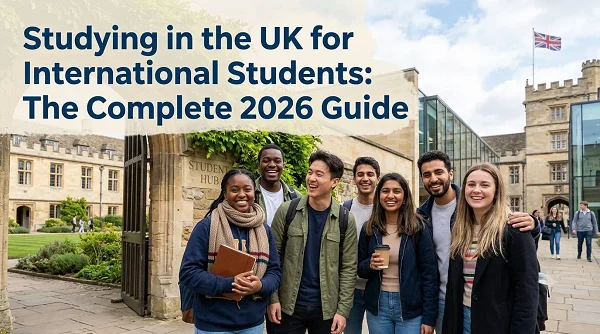
For decades, the United Kingdom has been more than just a place to earn a degree — it is a globally recognized academic ecosystem that attracts over 700,000 international students every year. When students decide where to study, they are not only comparing tuition fees or visa policies; they are weighing long-term outcomes: career mobility, research exposure, and academic credibility. On all of these measures, the UK consistently stands out.
This guide brings together everything an international student needs in one place: why the UK is worth it, how the education system and study programs work, what it costs, how to fund it, which universities to consider, the 2026 student visa rules, your right to work, and a step-by-step application walkthrough.
Why Study in the UK as an International Student?
Globally recognized degrees
Completing a degree at a UK university — whether Oxford, Cambridge, or another Russell Group institution — deepens your knowledge and sharpens your skills in your field, and it carries a reputation that is respected worldwide. A UK degree strengthens your CV when you start applying for jobs, and it earns recognition whether you work for a multinational, a government, or the private sector.
That reputation is not just marketing. UK institutions operate within frameworks like the Research Excellence Framework (REF), which systematically evaluates research quality across the country. In practice, this means students learn from up-to-date material and often work alongside principal investigators who actively publish in top-tier journals rather than teaching from outdated notes.
Shorter, more focused degrees
UK degrees are typically shorter than their equivalents elsewhere: three years for a bachelor’s and one year for a master’s, compared with four-year bachelor’s and two-year master’s programs common in other countries. This compressed structure reduces both tuition and living costs and gets you into the job market — or onto a PhD — faster. For students who think in terms of return on investment, this is often the deciding factor.
Specialized, flexible programs
UK universities offer highly specialized programs, especially at postgraduate level. Instead of broad degrees, students can choose niche fields such as an MSc in Artificial Intelligence Ethics or an MA in Global Development Policy. This specialization is closely tied to industry needs and research funding, which supports employability, and the modular system lets students tailor parts of their curriculum toward their career goals.
A multicultural environment
The UK hosts students from more than 180 countries, creating a genuinely global academic community. Living and studying in such a diverse environment builds the cross-cultural skills employers increasingly value. Universities actively support this diversity through international offices, student unions, mental-health support, visa guidance, and academic writing centers — infrastructure that makes the transition abroad significantly smoother.
Post-graduation work opportunities
Graduating in the UK does not mean leaving immediately. Under the Graduate Route, students can stay and work for up to 2 years after a bachelor’s or master’s degree, and up to 3 years after a PhD — time that helps graduates gain experience and build strong professional networks.
The UK Education System Explained
Understanding how UK higher education is organized makes the application process much easier. The UK is made up of four nations — England, Scotland, Wales, and Northern Ireland — and while the higher education system is broadly similar across all of them, there are a few important differences.
Universities in all four nations offer high-quality education. The main difference for international students is the length of an undergraduate degree: in England, Wales, and Northern Ireland a bachelor’s degree usually takes 3 years, while in Scotland most bachelor’s degrees take 4 years, giving students more time to explore different subjects before graduating.
Education in the UK is divided into two main levels:
- Undergraduate degree — your first university degree after secondary school. The most common is the bachelor’s degree, which usually takes 3 to 4 years. Students choose a subject such as business, engineering, medicine, law, or computer science.
- Postgraduate degree — for students who have already completed a bachelor’s. There are two main types: taught postgraduate degrees and research postgraduate degrees.
Study Programs and Courses in the UK
The real advantage of the UK is not just variety — it is structure. Compared with the United States, Canada, or Australia, UK degrees tend to move faster and demand earlier focus, meaning less time on broad electives and more time developing expertise. For a student who already knows their direction, that is a major advantage; for someone still undecided, it calls for careful planning before applying.
Undergraduate degrees
A UK bachelor’s degree usually takes three years in England, Wales, and Northern Ireland, and four years in most of Scotland. What makes UK undergraduate study distinctive is early specialization — a student applying for Mechanical Engineering, for example, enters that subject directly rather than spending a year or two on general education requirements.
Popular undergraduate fields include Business and Management, Computer Science, Engineering, Medicine and Health Sciences, Law, Economics, Psychology, and Media and Communication.
Many programs lead to an honours degree — a BA (Hons), BSc (Hons), or similar — which signals a more advanced level of achievement and matters later when applying for master’s or PhD programs in competitive fields.
Master’s degrees
Master’s study is one of the strongest reasons the UK is so popular. Most taught master’s degrees — MSc, MA, LLM, or MBA — are completed in one year full-time. Compared with two-year models elsewhere, this significantly reduces both living expenses and time away from the labor market.
The one-year format is intense: students move quickly through lectures, seminars, assessments, and a final dissertation or project. A Data Science MSc, for instance, may pack advanced coursework, an applied capstone, and career preparation into 12 months.
Popular master’s subjects include Artificial Intelligence and Data Science, Finance and Accounting, International Business, Public Health, Education, International Relations, Architecture, and Biotechnology.
The UK also offers research master’s degrees such as the MRes and, at some universities, the MPhil. A taught MSc builds knowledge and practical skills; an MRes places more emphasis on research design, literature review, and independent investigation — an important distinction for students who plan to progress to a PhD.
Doctoral and PhD programs
A UK PhD typically takes three to four years full-time — often shorter than doctoral programs elsewhere, because candidates begin independent research early rather than spending years on coursework first. This suits applicants who already have a defined research interest and a degree of academic maturity.
Common doctoral routes include:
- Traditional PhD — an original research project under a supervisor or supervisory team.
- Integrated PhD — combines master’s-level training with doctoral research.
- Professional doctorates — such as the EdD, DBA, or EngD, for practice-oriented advanced study.
Choosing the right PhD is rarely just about the project title. The UK doctoral system is closely tied to research groups, laboratories, doctoral training partnerships (DTPs), and funding councils — so supervisor fit, departmental strength, and funding access all matter together.
What makes UK programs distinctive
Across all levels, UK study programs share a few defining characteristics: shorter duration (better return on investment), earlier specialization, high academic intensity, strong research integration, and global recognition that supports international career mobility.
Entry Routes to UK Universities
International students can be admitted to a UK university through more than one route, depending on their previous qualifications and whether they meet the university’s requirements.
Students who do not yet meet the entry requirements — because of academic qualifications or English proficiency — can often take a Foundation Year (also called Year Zero) or a Pathway Program. This is a one-year preparatory course taken before starting a bachelor’s degree.
Students who already have sufficient academic documents apply through UCAS. Instead of submitting separate applications to each university, UCAS lets you complete a single application and apply to several universities at the same time (for undergraduate study). Postgraduate applications are usually made directly on each university’s website.
UK Student Visa Requirements (2026 Update)
Every student applying for a UK Student Visa needs a valid passport or travel document and a Confirmation of Acceptance for Studies (CAS) issued by their institution. Applicants must also be at least 16 years old.
The UK immigration system is points-based: Student Visa applicants must score 70 points, awarded for holding a valid CAS and meeting the English-language and financial requirements. In 2026, the rules were updated to emphasize that CEFR standards are mandatory for visa applications, with the exact level depending on the course.
Students must also provide evidence that they can support themselves during their studies. The required maintenance funds differ depending on whether the institution is in London or outside London.
Visa policies, fees, and requirements can change from year to year, so always check the official UK Visas and Immigration guidance on GOV.UK before applying.
| Visa requirement | What it means |
|---|---|
| CAS | A confirmation issued by your UK university or college that you have been accepted onto a course and are sponsored by that institution. |
| Financial proof | Evidence that you have enough funds to pay your tuition fees and living costs. |
| English test | A document proving your English proficiency. Most degree-level courses require CEFR B2. |
| Age requirement | You must be at least 16 years old to apply for a UK Student Visa. |
| ATAS | An ATAS certificate is required for some international students on sensitive subjects before they can apply for a visa. |
Cost of Studying in the UK: Tuition & Living Expenses
Cost is one of the most important factors for international students. Budgeting your monthly expenses in advance helps you avoid problems once you arrive.
Tuition fees by level of study
Tuition varies widely between universities and courses. In general, courses that involve laboratory work, clinical practice, or specialization cost more than humanities and social science courses.
- Bachelor’s degree: £11,400 – £38,000 per year
- Master’s degree: £9,000 – £30,000 per year
- Doctoral / research degree: £15,000 – £35,000+ per year
- Medicine / Dentistry: £35,000 – £60,000+ per year
Prestigious universities and specialized courses can charge above these ranges, so always confirm the exact fee on the course page.
Living costs: London vs. outside London
Living costs depend heavily on location. London is the most expensive city, while cities such as Manchester, Birmingham, Leeds, Cardiff, and Liverpool are considerably more affordable.
| Expense | London (per month) | Outside London (per month) |
|---|---|---|
| Rent & accommodation | £1,200 – £1,500 | £600 – £1,000 |
| Food & groceries | £300 – £600 | £150 – £300 |
| Transport | £70 – £150 | £30 – £100 |
| Utilities & internet | £100 – £200 | £60 – £120 |
| Leisure & personal | £100 – £300 | £80 – £200 |
| Approximate total | £1,770 – £2,750 | £920 – £1,720 |
As a rough guide, most international students spend somewhere between £920 and £2,750 per month in 2026, depending on the city and their lifestyle.
Scholarships and Funding for Studying in the UK
For many international students, the decision to study in the UK is limited not by academic fit but by financing. The good news is that the UK has a layered funding landscape — university scholarships, government-backed awards, and private or external sources. The challenge is understanding which category fits your profile and timeline. (See UKCISA, the UK’s specialist charity for international student advice, for guidance on scholarships, funding, and work.)
The pattern is consistent: students who build a funding strategy months ahead — shortlisting scholarship types and tailoring their personal statement — are far more competitive than those who wait for an offer and then search at random. Scholarship success in the UK depends on positioning, timing, and fit.
University scholarships
University scholarships are usually the most accessible starting point. Offered directly by institutions, they range from small tuition discounts to substantial merit-based support. Some are automatic; many require a separate application, especially at postgraduate level. Universities allocate funding based on academic excellence, leadership potential, subject area, nationality, or widening-participation goals.
A common, preventable mistake is writing one generic scholarship essay and reusing it everywhere. Universities are evaluating fit — they want to see why their program, faculty, and research environment matter to you, not just that you need funding.
Government scholarships
Government-funded scholarships are among the most visible and most competitive options:
- Chevening — the UK government’s flagship scholarship for one-year master’s degrees, aimed at emerging leaders. Eligibility typically includes citizenship of an eligible country, a return-home requirement, and prior work experience. (Chevening)
- Commonwealth Scholarships — offered through the Commonwealth Scholarship Commission for citizens of low- and middle-income Commonwealth countries, linked to sustainable-development goals, with around 800 awards each year across postgraduate study and professional development. (Commonwealth Scholarship Commission)
- GREAT Scholarships — promoted via the British Council’s Study UK platform. For 2026–27, GREAT Scholarships offer £10,000 toward tuition for a range of one-year taught postgraduate courses, with more than 140 scholarships from over 60 universities for students from 18 countries. (Study UK)
These awards carry more than financial value — they strengthen your profile and network — but they require sharper storytelling: a Chevening applicant, for example, is assessed on leadership trajectory and clarity of purpose, not grades alone.
Private and external funding
Private funding is more fragmented but still important: charitable foundations, corporate sponsorships, professional associations, employer support, and country-specific education funds. Because these sources are less centralized, they are often overlooked — yet they can be the difference between partial funding and a realistic plan. Many students combine a university tuition discount, family contribution, part-time work allowance, and a smaller external grant into a workable blended model.
In short:
- University scholarships are tied to one institution.
- Government scholarships are tied to national programs and policy goals.
- Private / external funding is tied to independent organizations, professions, employers, or foundations.
Tips for a successful scholarship application
- Start early — many students miss deadlines or supporting-document requirements.
- Match the scholarship to its purpose — leadership, research, and hardship awards need different narratives.
- Show academic direction — be specific about your course, field, and long-term goals.
- Demonstrate fit — explain why this university, department, or the UK is right for your future.
- Write with evidence, not slogans — “I am passionate” is weak; concrete experience is strong.
- Prepare your referees properly — a rushed reference can weaken an otherwise strong application.
- Treat funding as a parallel process — don’t wait for admission decisions before working on scholarships.
Not every student wins a fully funded place, and that is worth saying plainly. But affordability in the UK is not all-or-nothing: a one-year master’s already lowers the total cost, and pairing a shorter degree with even a modest scholarship — and choosing a lower-cost city — can make UK study far more manageable than applicants first expect.
Best UK Universities for International Students
There is no single best university for everyone. The right choice depends on your academic goals, your field, and your budget. Rather than fixating on overall rankings, evaluate universities on the factors that actually affect your outcome.
How to choose
- Course accreditation — focus on the specific course, not just the university’s overall reputation. For regulated fields (engineering, accounting, architecture, medicine, psychology), verify that the course is accredited by the relevant professional body.
- Location and cost of living — London offers access to business centers and networks but costs more; cities like Manchester, Birmingham, Leeds, Cardiff, and Newcastle have much lower living costs. Check rent, transport, and the availability of part-time work.
- International student support — look for international advisers, academic-skills workshops, and career guidance, which are especially valuable in your first year.
- Graduate employability — compare graduate employment rates, industry partnerships, internship and placement opportunities, career services, and alumni networks.
| Factor to consider | Question to ask yourself |
|---|---|
| Course quality | Is this course right for my field? |
| Cost | Can I afford the tuition and living expenses? |
| Location | Do I prefer big cities or smaller towns? |
| Student support | Does the university have support programs? |
| Employability | What is the employment status of graduates? |
| Reputation | Is the university recognized by employers and industry? |
Russell Group universities
The Russell Group is a network of 24 research-intensive UK universities known for academic reputation, research output, and industry connections. Being in the Russell Group does not automatically make a university the best choice for you, but many international applicants treat it as a useful indicator of research quality and global recognition.
Leading UK universities (QS World University Rankings 2026)
The following institutions consistently attract international students. Global ranks below are from the QS World University Rankings 2026.
University of Oxford (Global rank: 4) Strengths: Humanities, Medical Sciences, Law, Philosophy, AI research. Oxford’s college-based structure places students in smaller academic communities within the larger university, creating a close supervisor–student dynamic that is especially valuable at PhD level.
University of Cambridge (Global rank: 6) Strengths: Engineering, Mathematics, Natural Sciences, Economics. Cambridge emphasizes fundamental research and innovation ecosystems such as Cambridge Science Park, making it attractive to students working at the intersection of academia and industry.
Imperial College London (Global rank: 2 — the UK’s highest-ranked university) Strengths: Engineering, Medicine, Data Science, Business Analytics. Imperial is STEM-focused with strong government and private research funding and direct industry links — often the top choice for students targeting tech, biotech, or finance.
University College London (UCL) (Global rank: 9) Strengths: Architecture, Education, Psychology, Medicine. UCL has an interdisciplinary research culture and one of the most internationally diverse campuses in Europe — it was among the first UK universities to admit students regardless of religion or background.
King’s College London (KCL) (Global rank: 31) Strengths: Health Sciences, Law, International Affairs. Close ties to major hospitals and policy institutions give KCL a strong blend of academic rigor and real-world exposure, especially in healthcare and public policy.
University of Edinburgh (Global rank: 34) Strengths: Informatics, Medicine, Humanities, AI research. Edinburgh combines academic prestige with a vibrant student life and is particularly well known for AI and informatics.
University of Manchester (Global rank: 35) Strengths: Engineering, Business, Life Sciences. A Russell Group university with strong industry partnerships, often chosen by students seeking a balance of research excellence and affordability.
London School of Economics and Political Science (LSE) (a global leader in the social sciences) Strengths: Economics, Politics, International Relations, Finance. LSE’s policy-driven research and central-London location give students strong access to internships and global institutions — ideal for careers in policy, consulting, or international organizations.
University of Warwick Strengths: Business, Economics, Mathematics. Warwick is known for innovation and strong employer connections, producing highly employable graduates in finance and consulting.
University of Bristol Strengths: Engineering, Social Sciences, Law. Research-intensive with a strong international outlook and excellent facilities — often underrated, and especially appealing for postgraduate research students.
Working While Studying & Post-Study Career Options
One of the biggest benefits of studying in the UK is the chance to gain work experience during your studies and after graduation. Compared with many competing education systems, the UK is relatively generous with work rights for international students.
Most students on a Student Visa can work up to 20 hours per week during term time, and full-time during official university vacations.
After graduation, the Graduate Route lets students stay in the UK to gain professional experience without needing employer sponsorship — about 2 years after a bachelor’s or master’s, and 3 years after a PhD. This is a valuable window to build networks and secure a longer-term role.
Life in the UK as an International Student
Moving abroad to study is a major life decision, but UK universities provide extensive support to make the experience rewarding.
Living options
- University halls of residence — convenient, safe, and a great way to meet people. Rent usually includes electricity, internet, and access to university facilities. Popular with first-year and international students.
- Private accommodation — a more independent option often preferred by mature and postgraduate students. You’ll be responsible for bills, the tenancy contract, and any household issues.
Weather — expect everything from sunshine to rain and cold. Pack layers, a waterproof coat, and appropriate footwear.
British culture — politeness and punctuality are highly valued. Tea and casual small talk (often about the weather) are a friendly, everyday way to connect with people.
Making friends and building connections
- Student societies and clubs — universities run hundreds of societies across sports, culture, music, volunteering, and academic interests; joining one is the easiest way to meet like-minded people.
- Buddy and mentoring programs — many universities pair new students with experienced ones through Global Buddy or International Buddy schemes, offering practical support and early friendships.
- Settling in — feeling homesick at first is completely normal. With time and involvement in campus life, most international students quickly build friendships, confidence, and a sense of belonging.
How to Apply: Step-by-Step
- Research courses and universities. Identify courses that fit your academic goals, career objectives, and budget. Compare course content, tuition, location, and ranking.
- Apply to universities. Use UCAS for undergraduate degrees; apply directly on the university website for postgraduate programs.
- Review your offer. If successful, you’ll receive a conditional or unconditional offer. Check all conditions, deadlines, and entry requirements carefully.
- Confirm your choice and pay a deposit. Accepting your preferred university and paying any deposit secures your place.
- Get your CAS. Once you meet all admission conditions, the university issues your Confirmation of Acceptance for Studies (CAS).
- Apply for a UK Student Visa. With your CAS, prepare your documents and complete the visa application.
- Arrange accommodation. Book university halls or private housing as early as possible.
- Prepare to travel. Once your visa is granted, book flights, organize your documents, and check your university’s arrival information.
- Arrive and begin your journey. Complete your university registration and start your new life in the UK.
Frequently Asked Questions
How much does it cost to study in the UK as an international student? Tuition fees generally range from £11,400 to £38,000 per year, depending on the course and level. Living costs are roughly £920–£1,720 per month outside London and £1,770–£2,750 per month in London.
What are the UK student visa requirements in 2026? You need a valid CAS, proof of financial ability, evidence of English-language proficiency (usually CEFR B2), and a total of 70 points under the points-based system. You must also be at least 16 years old.
Can international students work while studying in the UK? Yes. Most students can work up to 20 hours per week during term time and full-time during official university vacations.
What documents do I need for a UK student visa? Requirements vary, but most applicants need a valid passport, a Confirmation of Acceptance for Studies (CAS), proof of financial support, evidence of English-language ability, and — for some subjects — an ATAS certificate.
How long can I stay in the UK after graduation? Under the Graduate Route, you can usually stay about 2 years after a bachelor’s or master’s degree, and up to 3 years after a PhD.
Is the UK a good place to study for international students? Yes. The UK is home to some of the world’s most respected universities, offers internationally recognized degrees, and provides strong work and career opportunities during and after study.
Conclusion — Why Choose the UK for Your Studies
Choosing where to study is a strategic decision: it’s not just about the next one to four years, but about where those years take you. Seen through that lens, the UK offers a rare combination of academic excellence, efficiency, global recognition, and structured opportunity — world-class universities embedded in a broader ecosystem of research councils, industry partnerships, and international collaboration.
That foundation becomes even more powerful because of how UK education is structured: shorter, more specialized, academically intense degrees that let you gain advanced skills and re-enter the job market — or move into a PhD — faster than in many other countries. Add a multicultural, well-supported environment and a layered funding landscape, and it’s clear why the UK remains a top study destination.
If you’re serious about studying in the UK, the next step isn’t just choosing a country or a university — it’s finding the right academic fit. Platforms like ScholarLink.ai can help you identify relevant programs, connect with potential supervisors, and navigate the application process with more clarity — so you approach your application strategically, based on fit, opportunity, and long-term goals.