

If you’ve just finished a degree, you know the routine. Forty browser tabs, a dozen university job boards, and one academic vacancy after another that almost fits your background but doesn’t. If you run a research group, you know the other side: an inbox full of applications, most of them from people who never read what your lab works on.
Both problems have the same root. The right graduate and the right professor are out there, and they can’t find each other. ScholarLink uses AI to match them on research fit, so neither side has to rely on luck and keyword searches.
Why the academic search fails on both sides
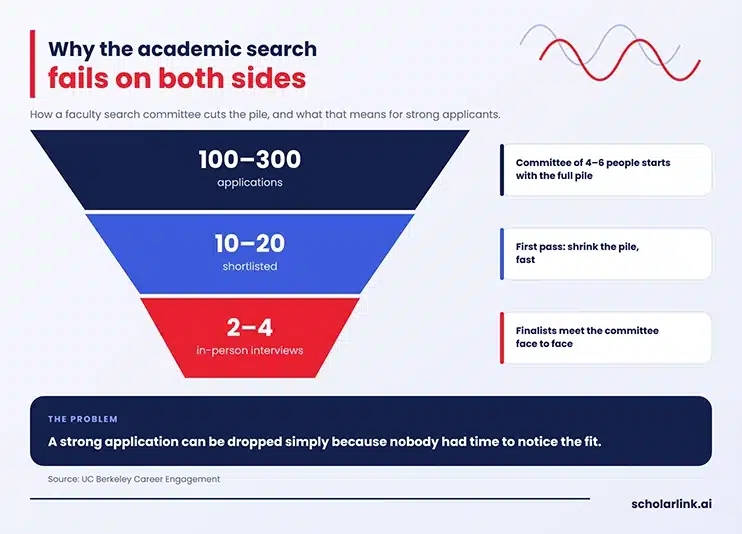
UC Berkeley’s Career Engagement office has a candid guide to the hiring process from the other side. In a typical faculty search, it explains, a committee of four to six people starts with 100 to 300 applications and has to cut them down to a shortlist of ten to twenty. The first pass is about shrinking the pile, fast.
“At this stage of the game, few are looking for attractive candidates.”
— UC Berkeley Career Engagement
That is how a strong application gets dropped: nobody had the time to notice the fit. Meanwhile, the graduate who sent it is already writing the next one, with no idea whether it stands a better chance.
How ScholarLink’s AI matching works
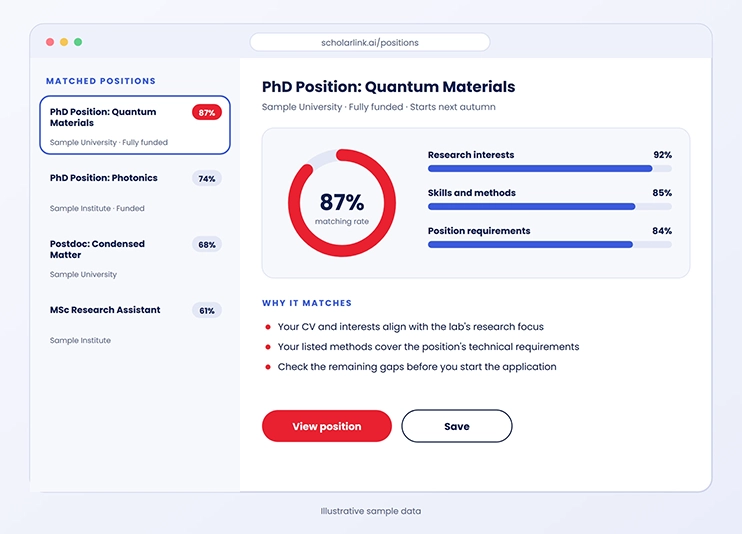
Keyword search only finds what you already know how to ask for. ScholarLink reads your CV and research interests, then compares them with what professors are working on and what their open positions require.
The pool is large. ScholarLink lists more than 500,000 professors, 100,000 open positions and 50,000 active students worldwide. Each position comes with a matching rate, so you can see how well your background lines up before you spend an evening on the application.
For graduates: apply where you fit
You spent years building a specific set of skills. A generic application sent to a hundred labs hides them.
ScholarLink shows your profile to professors who are looking for your background, and shows you the positions that match it. The hours you used to spend searching go into a sharper application and better interview preparation.
For professors: a shortlist worth reading
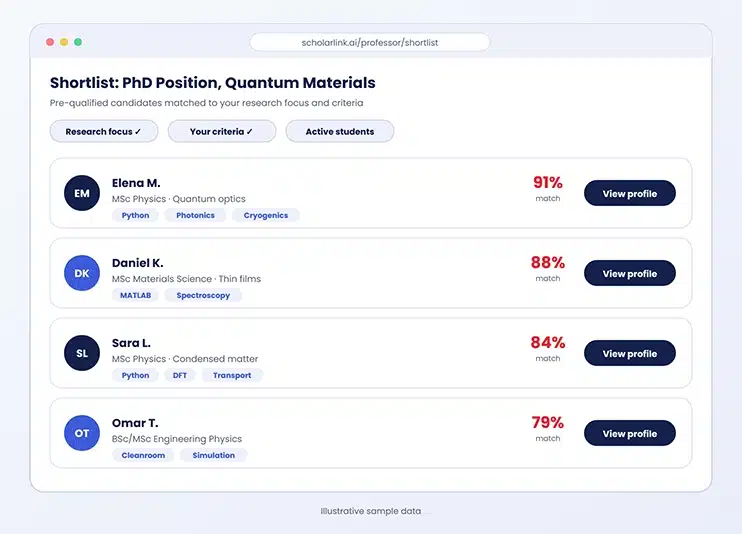
Screening is slow because most of what arrives is irrelevant. ScholarLink searches its candidate pool for people whose background fits your research focus and your own criteria, and gives you a shortlist of pre-qualified candidates. You read fewer applications, and the ones you read are from people who want to do your kind of work.
Traditional academic search vs. ScholarLink
| The usual way | With ScholarLink | |
|---|---|---|
| Finding positions (graduates) | Checking job boards and department pages one by one | Positions matched to your CV and research interests |
| Judging your chances | Guesswork | A matching rate for each position |
| Finding candidates (professors) | Whoever happens to email or apply | A pool of 50,000+ active students, filtered by fit |
| Screening | Reading every application to find the relevant few | A shortlist of pre-qualified candidates |
| Where your time goes | Searching and sorting | Research, teaching and strong applications |
Frequently asked questions
What is AI academic matching?
It is a way of pairing graduates with professors and open positions based on research fit. The AI compares a candidate’s CV and interests with a professor’s research area and requirements, then ranks the closest matches.
Who is ScholarLink for?
Graduates looking for research, master’s, PhD or postdoc positions, and professors or universities looking for candidates who fit their work.
Do I still need to write my own application?
Yes. ScholarLink finds the right match. Your application and interview still have to make the case, and now they are aimed at the right person.
Stop settling for a mismatch
A good academic fit shapes years of your work, whether you are joining a lab or building one. Let ScholarLink’s AI do the searching. Sign up today and see who you match with.