
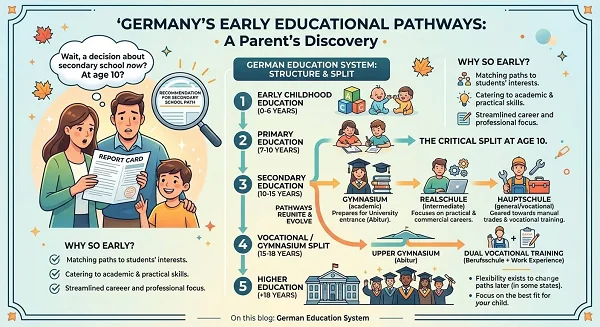
A parent is reading their 10-year-old’s school report card and suddenly notices something unusual: The document could affect their child’s secondary education, a decision that most countries don’t make so soon. In Germany, students are often guided into different educational paths at the end of primary school earlier than in other countries. You might be wondering how the German education system is structured and why it categorizes students from a relatively young age? The answer lies in a system designed to match educational paths to students’ academic, career and professional interests from a relatively young age.
| Stage | Age |
| Early childhood education | 0 to 6 years |
| Primary education | 7 to 10 |
| Secondary education | 10 to 15 |
| Vocational/Gymnasium split | 15 to 18 |
| Higher Education | +18 |
Germany is one of the countries that channels students into different educational pathways very soon after primary school.
Early Childhood and Primary Education
Before school begins, most children go to Kindergarden between ages 3 and 6. Although not compulsory, it is widely effective and has an impact on social development, communication skills, creativity, and preparing children for going to school.
Compulsory education starts at age 6 with Grundschule (primary school). In most German states, primary education lasts from grades 1 to 4, after that students go to different secondary school pathways. Berlin and Brandenburg are exceptions because they keep on primary education through grade 6 before students go to secondary school.
Secondary Education: Gymnasium, Realschule, and Hauptschule
Education in Germany is based on a class system where all students around age 10 years are divided into different level:
- Gymnasium: Gymnasium is a school that prepares students for a university education and is targeted towards more academically gifted students and its suitable for those who plan to go to university.
- Realschule: for students who plan to work blue-collar jobs, or learn a trade often led to vocational training or further study
- Hauptschule: It is more suitable for students who want to learn a trade or pursue an apprenticeship.
- Gesamtschule: comprehensive option actually a mixture of the 3 types of school.
| School Type | Grade | Leads To |
| Gymnasium | 5–12 | university entrance certificate that allows entry to universities and higher education programs. |
| Realschule | 5–10 | Leads to vocational training, upper-secondary schools, or further academic study |
| Hauptschule | 5–9 | Typically lead to apprenticeships |
| Gesamtschule | 5–10 | A combination of all three states. |
The Abitur: Germany’s University Entrance Qualification
Abitur is a degree earned by students who successfully pass their final exams at the end of their secondary education, at the end of Gymnasium or after extending studies via Gesamtschule, actually Once students get to the end of year 12 or 13, they can either leave with a Hauptschulabschlus diploma or stay on for another 3 years to take the Abitur and get a place at university.
Abitur is considered as the general entry qualification for German universities that allow students to apply to universities in Germany and get a different degree program. It’s really important and often considered the key factor for students want to go to higher education.
To obtain the Abitur, students study an academic curriculum that includes main subjects like Languages, Literature, and Arts, Social Sciences, Mathematics, Natural Sciences, and Technology.
The Abitur is designed to demonstrate that a student has achieved the academic level needed for university study so has a central role in Germany’s education system and is widely recognized as a strong preparation for higher education.
Vocational Education and the Dual System (Ausbildung)
Vocational training known as “Ausbildung” in Germany. German vocational education Ausbildung dual system is a program that combines practical and theoretical education to prepare young students for specific professions or job. This combination of theory and practice equips trainees to enter the job market immediately after graduation.
This system is a respected common path that is often highlighted internationally as an advantage of the German system. This system is an attractive alternative for those who wish to study in Germany, it offers the opportunity to learn in an advanced educational environment with a strong emphasis on hands-on application.
Higher Education: Universities vs. Universities of Applied Sciences
Germany’s higher education system offers two main types of institutions: Universities (Universitäten) and Universities of Applied Sciences (Fachhochschulen or HAWs). Both award internationally recognized degrees, but they vary in their focus and teaching approach.
Universities (Universitäten)
Universities place an emphasis on theoretical knowledge and research. The students have more freedom regarding their course selection and study schedules. This type of education is well suited for individuals who are interested in doing research, who want to go into academia or doctoral studies.
Universities of Applied Sciences (Fachhochschulen)
Universities of Applied Sciences are geared towards hands-on learning and connections to businesses. They often feature obligatory internships, projects carried out by companies, and guest lecturers with experience in business outside of academia.
Degree Structure and ECTS Credits
Germany standard degrees across Europe follows the Bologna Process:
- Bachelor’s Degree: usually 3 years (180 ECTS credits)
- Master’s Degree: usually 1–2 years (90–120 ECTS credits)
- PhD (Doctorate): advanced research degree completed after a master’s degree
The European Credit Transfer and Accumulation System (ECTS) allows qualifications and study achievements to be recognized and compared across European countries to make international study easier.
| Institution Type | Main Focus | Class style | Degree |
| universities (Universität) | Academic theory and research | Independent study, lectures, research projects | BA, MA, MSc – equivalent to university degrees |
| Universities of Applied Sciences (Fachhochschule) | Practical education | Small classes, structured schedules, industry projects, and internships | BA, BSc, MA, MSc … – wider range of academic degrees |
How Foreign Qualifications Are Recognized: The Anabin Database
For international students, one of the most important steps before apply to a German university is to check their school-leaving certificate or previous degree reputation in Germany , this process done through Anabin, the official database maintained by the Central Office for Foreign Education (Zentralstelle für ausländisches Bildungswesen ZAB).
When student check a qualification in Anabin will face one of three options:
- Full recognition: This degree is considered equivalent to a German university entrance degree and allows direct application to degree programs. Full recognition: This degree is considered equivalent to a German university entrance degree and allows direct application to degree programs.
- Partial or case-by-case recognition: This degree will be recognized only under certain conditions like finishing additional coursework, obtaining specific grade requirements, or undergoing an individual evaluation.
- Non-recognition: This kind of degree does not provide access to German higher education and students need to complete a Studienkolleg (preparatory foundation year) and maybe pass the evaluating examination (Feststellungsprüfung), or obtain an individual evaluation from the ZAB.
Because recognition rules vary significantly by country, qualification type, graduation year, and education system, students should always check their certificate in Anabin instead of depending on another person’s experience. Recognition factors will update periodically so qualification that provides direct university access in one country may require additional preparation in another.
| Anabin Status | Meaning | Next Step |
| Recognized | Your qualification is considered equivalent to a German higher education | You can go to a German university program, subject to language and specific program requirements. |
| Partially Recognized | Your qualification provides only limited or conditional access to higher education in Germany. | You need additional coursework, pass exams, or an individual assessment before applying. |
| Not Recognized | Your qualification does not have access to German higher education. | You should complete Studienkolleg (preparatory foundation program) and pass theFeststellungsprüfung, or obtain evaluation from the ZAB. |
Frequently Asked Questions
What is the structure of the German education system?
The German education system consists of five main stages: early childhood education, primary education (Grundschule), secondary education, higher education, and continuing education. Compulsory schooling begins at age six, and students later follow different academic or vocational pathways depending on performance and career goals.
What is a Gymnasium in Germany?
A Gymnasium is the academic secondary-school track in Germany. Students usually enter around age 10 and continue until grades 12 or 13, depending on the state. It prepares students for higher education and culminates in the Abitur, the qualification required for university admission.
What is the Abitur and why does it matter?
The Abitur is Germany’s general university entrance degree that will be earned after completing Gymnasium or an equivalent pathway. It demonstrates advanced academic achievement and allows students to apply to universities in Germany.
What is the difference between a university and a university of applied sciences in Germany?
Universities (Universitäten) emphasize academic theory, research, and doctoral studies. Universities of Applied Sciences (Fachhochschulen) focus on practical learning, industry collaboration, smaller class sizes, and work placements.
How do I know if my foreign degree is recognized in Germany?
You should check your qualification in the Anabin database. Anabin’s base gives you data about your certificate. The result of checking your degree will be fully recognized, partially recognized, or not recognized for university admission.

ScholarLink AI
Your Ultimate Admission Co-Pilot
- 🎓 Professors Database: World’s largest supervisor directory
- 📡 Live Positions: Real-time faculty openings & vacancies
- 👥 Students Database: Connect with successful applicants
- 🎯 Smart Matching: AI-driven professor recommendation
- 💰 Funding Analysis: Real-time lab & research funding data
- 📝 Apply Management: Track applications & cold emails