
A PhD research proposal is a short document that explains what you want to study, why it matters, and how you plan to do it. It shows a selection committee or potential supervisor that you can identify a worthwhile problem, place it in existing research, and design a realistic plan to investigate it. This guide explains what a strong proposal contains, walks through the writing process step by step, and includes an annotated example and a reusable template.
Requirements differ between universities, funders, and disciplines, so treat this guide as a framework and always follow the official instructions of your target programme.
In this guide
- What is a PhD research proposal?
- What makes a strong proposal?
- How to write a PhD research proposal step by step
- Proposal structure and format
- A PhD research proposal example
- A PhD research proposal template
- Common mistakes to avoid
- Final checklist and FAQs
What Is a PhD Research Proposal?
A PhD research proposal presents a planned study. It describes the research problem, the existing work it builds on, the questions you want to answer, the methods you will use, the contribution you expect to make, and a timeline for completing the work. It is a plan, not a promise: the committee knows your project will change as you learn more.
Research Proposal vs. Dissertation
A proposal presents a planned study, while a dissertation (or thesis) reports completed research and its findings. The proposal argues that the project is worth doing and can be done. The dissertation, written years later, shows what was actually found. You are not expected to deliver a dissertation-level literature review or any results at the proposal stage.
When Do You Need a PhD Research Proposal?
It depends on how the programme recruits. If you apply with your own project idea, as is common in many UK, European, and Australian programmes, you usually submit a proposal. If you apply to an advertised doctoral position with a predefined research plan, you may only need a cover letter or motivation letter, sometimes with a short outline of how you would approach the project. Some programmes admit students first and ask for a proposal after the first year. Check the programme page, and if it is unclear, ask the admissions contact.
The table below shows how the proposal differs from related documents. Terminology varies across universities, so confirm what your target programme means by each term.
Table 1: Research Proposal vs. Dissertation vs. Research Statement
| Document | Purpose | Timing | Typical content | Expected outcome |
| Research proposal | Argue that a planned study is worthwhile and feasible | Before or at the start of the PhD | Problem, gap, questions, methods, contribution, timeline | A credible plan that may evolve |
| Dissertation / thesis | Report completed research | At the end of the PhD | Full literature review, methods, results, discussion, conclusions | New knowledge, examined and defended |
| Research statement | Describe your research interests and direction | At application or later career stages | Past work, current interests, future directions | A picture of your research identity |
What Makes a Strong PhD Research Proposal?
Committees read many proposals. The strongest ones are rarely the most ambitious. They are the clearest, most focused, and most believable. Most readers look for the following:
- A meaningful research problem: a real question that matters to a field, community, or practice.
- A clear research gap: a specific thing that existing research has not resolved.
- Focused research questions: questions narrow enough to answer within a PhD.
- A suitable and feasible methodology: methods that can actually answer your questions with the data, access, and time you have.
- An original contribution: a plausible addition to knowledge, not a claim to revolutionise the field.
- A realistic timeline: phases and milestones that fit the programme’s duration.
- Alignment with the programme and supervisor: a project the department can actually support.
A strong proposal does not promise answers; it presents a credible plan for finding them.
Notice what is not on the list: certainty. Reviewers expect you to acknowledge risks, such as limited data access or a method that might not work, and to explain how you would respond.
How to Write a PhD Research Proposal Step by Step
1. Choose a Focused Research Topic
Start with a broad area you care about, then narrow it by population, place, time period, method, or theoretical angle until it is something one person can investigate in a few years. A useful test is whether you could describe the project in two sentences.
- Weak: “Climate change and agriculture.”
- Stronger: “How smallholder maize farmers in a specific region adapt planting dates to changing rainfall patterns.”
The stronger version names who, where, and what, which makes the next steps possible.
2. Identify the Research Problem and Gap
Move from the general subject to something unresolved. Read recent reviews, journal articles, and the work of potential supervisors. Look for conflicting findings, understudied groups or contexts, outdated evidence, or methods that have not been applied to your problem. A gap is not simply “no one has studied this.” It is a limitation that matters.
A short worked example shows the progression:
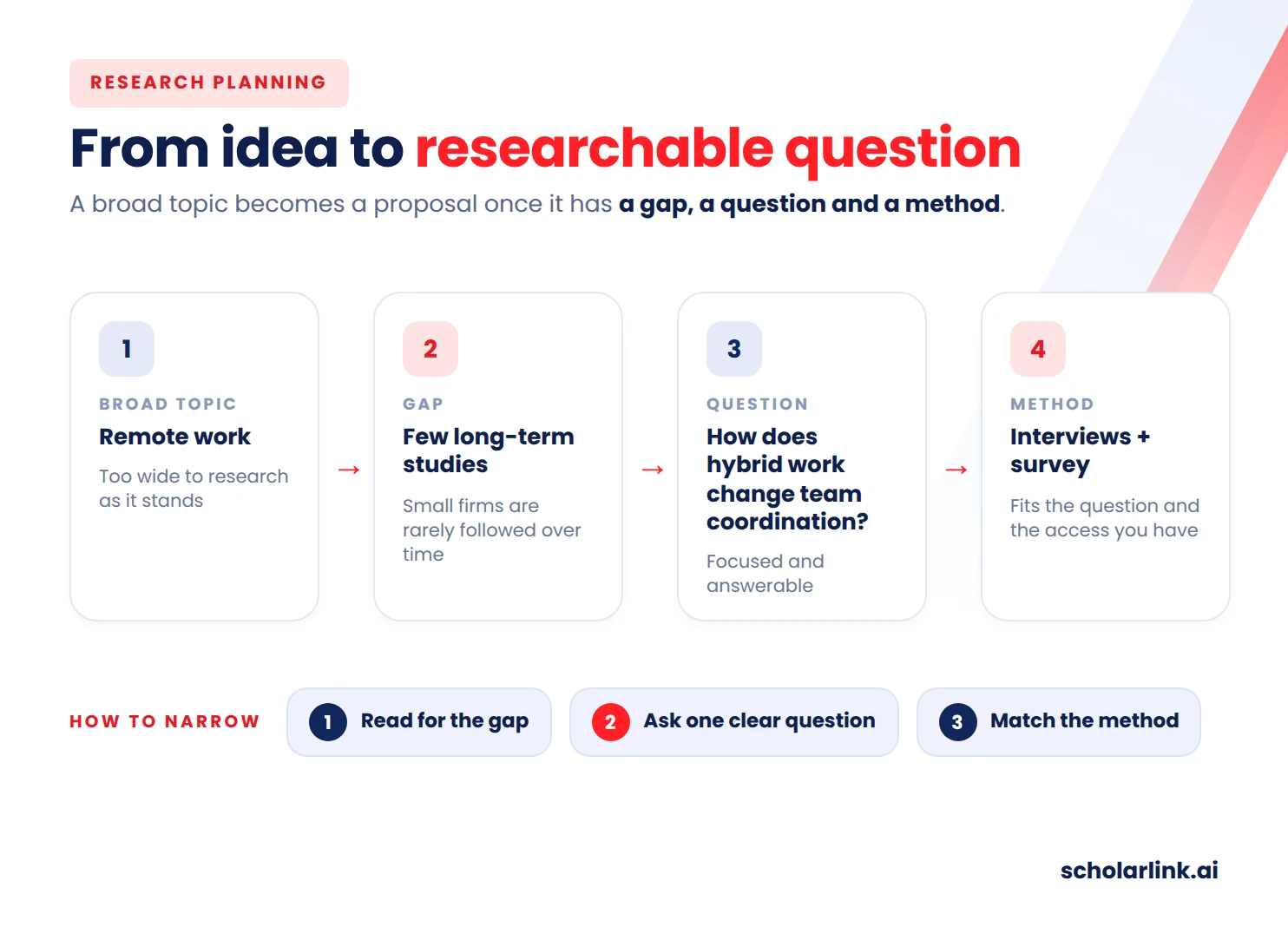
- Topic: remote work.
- Gap: most studies focus on large companies and short time periods; few follow small firms over several years.
- Research question: how does hybrid work change team coordination in firms with fewer than 50 staff over two years?
A research gap matters only when it leads to a clear, answerable question.
3. Review the Existing Literature
The literature review in a proposal is shorter and more targeted than in a dissertation. Its purpose is to show that you understand the main debates, can compare studies critically, and have found a real gap. Group sources by theme or argument instead of summarising them one by one, and point out limitations in earlier work. You are not expected to review everything, only enough to justify your project.
4. Develop Research Questions and Objectives
Start with one central question, then add two or three sub-questions that break it into manageable parts. Objectives translate the questions into actions, for example “to compare coordination practices before and after adopting hybrid work.” In quantitative or experimental work, you may also state hypotheses. Check that every question can be answered with the methods you plan to use; if not, revise one or the other.
5. Choose an Appropriate Methodology
Explain your research design (for example qualitative, quantitative, mixed-methods, archival, computational, or experimental), what data or source material you will use, how you will collect and analyse it, and how you will address access, ethics, and limitations. Justify each choice by linking it to your question. Methods vary widely between disciplines: a historian may describe archives and sources, a biologist an experimental protocol, a social scientist sampling and analysis.
The best methodology is not the most complicated one; it is the one that answers the research question.
6. Explain the Expected Contribution
Say what your project could add to knowledge, theory, method, or practice, and who might benefit. Distinguish a plausible contribution (“the study will provide the first longitudinal evidence on…”) from a promise of specific results (“the study will prove that…”). Honest, modest claims are more convincing than bold ones.
7. Prepare a Research Timeline
Break the project into phases such as literature review and design, data collection, analysis, and writing, and place milestones within them. The overall duration must follow the programme’s rules: full-time PhDs are commonly three to four years, but this varies by country and part-time study. Include time for ethics approval, access to participants or data, and revision.
8. Tailor the Proposal to the Programme
Read about the research groups, facilities, and current projects. Explain why your project fits the department and which supervisor’s expertise it connects to, and show that the necessary resources exist there. Send the same proposal to many places and it will read like it. A short, specific paragraph on fit is usually enough.
The table below shows how to turn broad ideas into researchable questions in different disciplines.
Table 2: From Research Idea to Researchable Question
| Broad topic | Refined topic | Identified gap | Research question | Possible method |
| Education technology | Use of AI tutoring tools in secondary maths | Little evidence on long-term learning effects | Does sustained use of AI tutoring change maths attainment over one school year? | Quasi-experimental study with pre- and post-tests |
| Environmental science | Microplastics in lowland rivers | Limited data on transport under variable flow | How does flow variability affect microplastic transport in lowland streams? | Field sampling and numerical modelling |
| Public health | Loneliness among older adults in rural areas | Few studies on community-led interventions | How do community-led programmes affect reported loneliness among older rural residents? | Mixed methods: survey and interviews |
| Computer science | Bias in language models | Few evaluations across low-resource languages | How does measured bias differ across languages with limited training data? | Benchmark design and statistical analysis |
PhD Research Proposal Structure and Format
There is no universal format that applies to every doctoral programme. Some ask for two or three pages, others for five to ten or more, and some provide their own template or headings. Always prioritise the target university’s instructions over any general structure, including the one below.
Essential Sections of a Research Proposal
Most proposals include these sections, though names and order vary:
- Title
- Introduction and background
- Problem statement and research gap
- Literature review or state of the art
- Research questions and objectives
- Methodology and research design
- Expected contribution
- Timeline or work plan
- References
Depending on the discipline and institution, you may also need an abstract, hypotheses, ethical considerations, a description of resources, or a provisional chapter outline.
Table 3: PhD Research Proposal Structure Template
| Section | Purpose | Questions to answer | Suggested content |
| Title | Signal the topic and approach | What is the project about? | A clear, specific working title |
| Introduction and background | Set the context | Why does this topic matter now? | Brief background, scope, relevance |
| Problem and research gap | Define what is unresolved | What is missing in current knowledge? | Problem statement, gap, justification |
| Literature review | Show command of the field | What do we know, and where is it limited? | Key themes, debates, limitations |
| Questions and objectives | State what you will do | What exactly will you investigate? | Central question, sub-questions, aims |
| Methodology | Show how you will answer | Which design, data, and analysis, and why? | Design, sources, analysis, ethics, risks |
| Expected contribution | Explain significance | What might this add, and for whom? | Plausible contribution to knowledge or practice |
| Timeline | Show feasibility | What happens when? | Phases, milestones, resources |
| References | Support your claims | Which sources underpin the proposal? | Consistent citation list |
Formatting, Length, and Referencing
Page limits, word counts, citation styles, fonts, spacing, and required sections vary. For example, some graduate schools set limits of a few pages, while others accept longer proposals; those limits apply to their own programmes, not to PhD applications in general. Read the official application guidance, follow it exactly, and ask the admissions office if anything is unclear. Within the limits, use clear headings, short paragraphs, and a consistent referencing style such as APA, Harvard, or Chicago, depending on your field.
Keep the language precise and readable. Reviewers from neighbouring disciplines may read your proposal, so define specialist terms and avoid unnecessary jargon. Proofread carefully, because errors suggest carelessness about the work itself.
Once you know the sections and format, the clearest way to learn what good writing looks like is to examine an example, which the next section provides.
PhD Research Proposal Example
The example below is original and illustrative. It is not an accepted or successful application, and the project is invented. Use it to see how a broad topic becomes a focused, researchable proposal, then write your own from your own interests and sources.
Example of a PhD Research Proposal Topic
Broad topic: remote work and organisations.
Focused topic: hybrid work and team coordination in small firms (fewer than 50 employees) over two years.
The focused topic specifies the practice (hybrid work), the outcome (team coordination), the setting (small firms), and the period (two years).
Example of a Research Problem and Research Question
| Remote work is widely discussed in organisational research. However, most studies examine large companies and short observation periods, and few follow small firms over several years. As a result, little is known about how everyday coordination in small teams changes once hybrid arrangements become permanent.
This project therefore asks: How does hybrid work change team coordination in firms with fewer than 50 staff over a two-year period? |
This passage works because it moves from a recognised area to a specific limitation, then to one question. The question is bounded by firm size and time, which keeps it researchable. The relevance is clear: small firms make up a large share of employers, and their practices may differ from those of large companies.
Example of a Methodology Section
| The study will use a two-year mixed-methods design. In the first phase, I will recruit eight small firms through professional networks and conduct semi-structured interviews with managers and staff. In the second phase, a short survey on coordination practices will be repeated at six-month intervals. Interview data will be analysed thematically, and survey data will be analysed using descriptive statistics and mixed-effects models. Ethical approval will be sought before data collection, and participants will be anonymised. If recruiting eight firms proves difficult, the sample will be reduced and the analysis will focus on within-firm change. |
The method follows from the question: interviews capture how coordination works in practice, and repeated surveys track change over time. The passage also addresses feasibility by naming recruitment, ethics, and a fallback. A real proposal would add detail on sampling, survey instruments, and analysis, as your discipline expects.
Table 4: Annotated Proposal Example
| Example passage | Purpose | What works | What to adapt |
| “Few studies follow small firms over several years.” | State the gap | Specific and tied to existing research | Cite the studies that show the gap |
| “How does hybrid work change team coordination in firms with fewer than 50 staff?” | State the research question | Focused, answerable, bounded | Adjust scope to your resources |
| “A two-year mixed-methods design combining interviews and repeated surveys.” | Show how the question will be answered | Method matches the question | Justify your own choices in detail |
| “If recruiting eight firms proves difficult, the sample will be reduced.” | Address feasibility | Honest about risk and fallback | Replace with your real constraints |
When you study an example like this, ask of every sentence what job it does in the argument. If you cannot answer, the sentence probably needs revising in your own draft too.
PhD Research Proposal Template
A template can give your draft a starting shape. Use the outline below as a general starting point, not a universal submission format. Replace each bracket with your own content, and adapt headings and length to the programme’s instructions.
| 1. Working title: [A specific title that signals topic, context, and approach]
2. Research background: [Why this topic matters; key context in 1–2 paragraphs] 3. Problem statement and research gap: [What is unresolved? What do existing studies not explain?] 4. Main research question and objectives: [One central question; 2–3 sub-questions or objectives] 5. Brief literature overview: [Main themes, debates, and limitations that lead to your gap] 6. Proposed methodology: [Design; data or sources; collection; analysis; ethics; access; risks] 7. Expected contribution: [What the study could add to knowledge or practice, and for whom] 8. Timeline and resources: [Phases and milestones; equipment, access, training needed] 9. References: [Key sources in the required citation style] |
A template can organize your thinking, but it cannot replace your own research rationale.
After filling in the template, read each section and ask whether it answers the question “so what?” A proposal that only completes headings, without a clear argument connecting them, will feel generic. The strongest drafts make each section lead naturally into the next: the gap motivates the question, the question determines the method, and the method shapes the timeline.
Common PhD Proposal Mistakes to Avoid
- Choosing a topic that is too broad: “social media and society” cannot be a PhD project without narrowing.
- Failing to establish a research gap: describing a topic is not the same as showing what is missing.
- Writing questions that the method cannot answer: for example, asking about causes while planning only descriptive data.
- Listing sources instead of synthesising them: a literature review should compare and critique, not summarise one paper after another.
- Overstating novelty or expected results: claiming that no one has ever studied a topic, or promising a specific outcome.
- Ignoring data access, ethics, or practical constraints: a brilliant design is useless if you cannot get the data.
- Using the same proposal everywhere: adapt it to each programme and supervisor.
- Ignoring official length and formatting requirements: exceeding page limits or omitting required sections can count against you.
Final PhD Research Proposal Checklist
Use the table below before you contact a supervisor or submit your application. For each criterion, answer the review question honestly, and mark it as complete or in need of work.
Table 5: Proposal Readiness Checklist
| Criterion | Review question | Status |
| Clarity | Can I explain the project in two sentences? | ☐ Done ☐ Needs work |
| Research gap | Have I shown what is missing in existing research, with sources? | ☐ Done ☐ Needs work |
| Questions | Are my questions focused, and can my methods answer them? | ☐ Done ☐ Needs work |
| Methods | Have I explained design, data, analysis, and ethics? | ☐ Done ☐ Needs work |
| Feasibility | Do I have access, time, skills, and resources? | ☐ Done ☐ Needs work |
| Contribution | Is my claimed contribution plausible and honest? | ☐ Done ☐ Needs work |
| References | Are sources current, relevant, and consistently cited? | ☐ Done ☐ Needs work |
| Formatting | Do length, structure, and style follow the instructions? | ☐ Done ☐ Needs work |
| Programme fit | Have I explained why this department and supervisor? | ☐ Done ☐ Needs work |
Before you finish, read the proposal aloud and ask a supervisor, tutor, or peer to review it. A reader who does not know your topic will quickly show you where the argument is unclear. Revise, proofread once more, and submit only when the proposal matches the programme’s requirements. No structure or length guarantees admission, but a clear and honest proposal gives your application its best chance.
Frequently Asked Questions
How do you write a PhD research proposal?
Choose a focused topic, identify a research gap, review the literature, formulate questions, plan a methodology, explain the contribution, and set a realistic timeline. Then adapt the proposal to the programme and proofread it.
How long should a PhD research proposal be?
It varies by programme. Some ask for a few pages, others for considerably more, and some set a word count. Follow the official instructions rather than a general rule.
What is the standard PhD proposal format?
There is no single standard. Most proposals include a title, introduction, research gap, literature review, questions, methodology, expected contribution, timeline, and references, but names, order, and extra sections differ by institution.
Where can I find a PhD research proposal sample?
Check university websites, graduate school guidance, and funding bodies, which sometimes publish guidance or examples. The example in this guide is illustrative only. Do not copy any sample; use it to understand structure and tone.
Can I use a PhD proposal template?
Yes, as a starting point. Use the template to organise your thinking, but adapt it to the programme’s format and make sure the content reflects your own research rationale.
Do all PhD programmes require a research proposal?
No. Programmes with advertised, predefined projects may ask for a cover letter or motivation letter instead, and some ask for a proposal only after admission. Check each programme.
Should I contact a supervisor before writing the proposal?
Often it helps, particularly where supervisors are matched to projects. A short, specific email describing your idea and why it fits their work can give you useful feedback. Check whether the programme encourages or requires it.
How detailed should the methodology be?
Detailed enough to show that your methods can answer your questions and that the project is feasible, but not a full research protocol. Cover design, data or sources, analysis, ethics, and risks, at the level your discipline and the programme expect.
Production Notes (not part of the article)
SEO metadata
- Meta title: How to Write a PhD Research Proposal: Examples & Template
- Meta description: Learn how to write a PhD research proposal with a clear structure, practical examples, a research proposal template, and a step-by-step checklist.
- URL: /guides/how-to-write-phd-research-proposal/
Images: placement and alt text (files sent separately as WebP)
| Image | File | Placement | Alt text |
| 1 (featured) | phd-research-proposal-featured.webp | Below the H1, above the introduction | Writing a PhD research proposal in an academic study space |
| 2 | phd-research-proposal-planning-research-question.webp | After the step-by-step section and its transition paragraph (after the sentence leading into Table 2 and the table) | Planning the research question and methodology for a PhD proposal |
| 3 | phd-research-proposal-structure.webp | After “Formatting, Length, and Referencing” | Organizing the sections of a PhD research proposal |
| 4 | phd-research-proposal-annotated-example.webp | After the annotated example section (after Table 4 and the paragraph following it) | Reviewing and annotating a PhD research proposal example |
| 5 | phd-research-proposal-timeline-phases.webp | After the template section and the paragraph that follows it | Planning research milestones for a doctoral research project |
| 6 | phd-research-proposal-final-checklist.webp | After the checklist section and its closing paragraph (below Table 5) | Checking a PhD research proposal before submission |
Internal links to add (use existing site URLs)
- PhD application guide
- research proposal guide (if separate)
- academic CV for PhD applications
- how to contact a potential PhD supervisor
- PhD scholarships and funding
- research methodology guide
External links (optional)
- FindAPhD: Writing a PhD research proposal
- DAAD: How to write a research proposal (PDF)
- University of Hamburg: proposal guideline (four-page limit applies to that programme only)
- University of Münster: guidelines for writing a research proposal (five to seven pages applies to that graduate school only)
- EQUALFIN: How to write a proposal
Before publishing
- Table of contents: the “In this guide” list near the top is plain text. Replace it with your CMS’s automatic table of contents or add anchor links.
- The example proposal is invented. The three-to-four-year full-time duration and the citation styles mentioned are general statements; adjust them if your audience is concentrated in particular countries.
- Table 5 status column uses checkbox characters (☐). If they do not render in your CMS, replace them with “Yes / No”.
- Pull quotes are editorial suggestions. Style them with your blockquote component rather than attributing them to anyone.