
For many applicants, the PhD interview is the decisive moment in the doctoral admission process. By the time you reach this stage, your academic record already meets the formal requirements. What the interview evaluates is something deeper: how you think, how you communicate your research ideas, and whether you are a strong intellectual and personal fit for the program, the supervisor, and the research environment. In practice, this conversation often weighs as much as, sometimes more than, your CV or written proposal.
Preparing for a PhD interview is therefore not about memorizing perfect answers. It is about understanding what interviewers are really trying to assess: your research maturity, your motivation for doctoral study, and your ability to work independently within a structured academic system. Applicants who treat the interview casually often underperform, while those who prepare strategically can significantly improve their chances, especially in competitive systems such as Canada, the USA, the UK, Australia, and Germany. That context matters, because once you understand why the PhD interview exists, you can prepare for it with intention rather than anxiety.
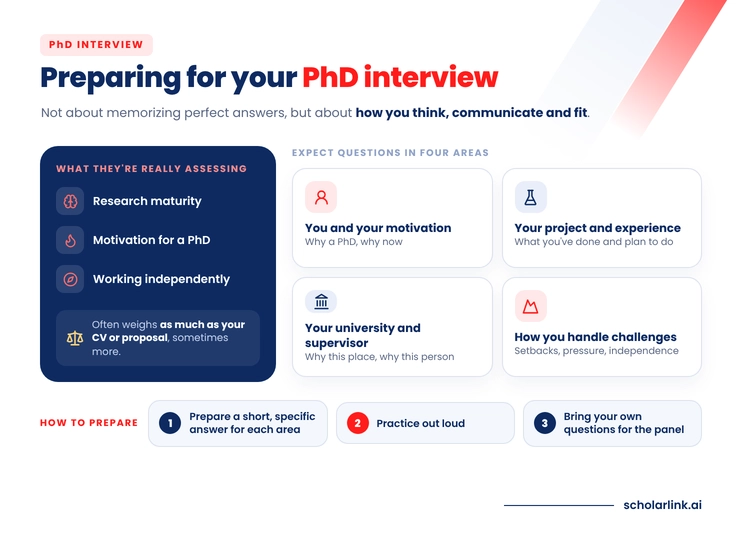
Quick answer: Expect questions in four areas: you and your motivation, your project and experience, your choice of university and supervisor, and how you handle challenges. Prepare a short, specific answer for each, practice out loud, and bring your own questions for the panel.
Key Takeaways
- Interviewers assess capability, commitment, and fit, not memorized speeches.
- Know your project, supervisor, and research group in depth, including recent publications.
- Use specific examples (ideally in a clear structure like STAR) instead of vague claims.
- Be honest about gaps; a PhD is training, not a three-year exam.
- Prepare 4-5 questions to ask the panel.
- Send a short thank-you email afterwards.
What Is a PhD Interview?
A PhD interview is a structured academic conversation designed to evaluate whether you are ready for doctoral-level research and whether you are a good fit for a specific program, project, or supervisor. Unlike job interviews, it focuses less on past titles and more on how you think, how you approach problems, and how clearly you can articulate your research interests and goals. In most cases, the interview assesses three core areas: your research skills and academic thinking, your motivation for pursuing a PhD, and your alignment with the proposed project, supervisor, and research environment. That combination (capability, commitment, and fit) is what ultimately shapes admission decisions.
| What they assess | What it means | Questions that test it |
|---|---|---|
| Capability | Your research skills and academic thinking | Methods, previous research, challenges of the project |
| Commitment | Your motivation for pursuing a PhD | Why a PhD, why now, long-term goals, resilience |
| Fit | Alignment with the project, supervisor, and environment | Why this university, why this supervisor, how you fit the group |
What to Expect: Format and Logistics
Formats vary by university and country, so check your invitation email. These are the common patterns:
| Detail | What to expect |
|---|---|
| Format | In person, video call, or panel |
| Length | Often between 30 minutes and an hour; longer if a presentation is included |
| Who attends | Usually your prospective supervisor, another academic from the department, and sometimes a postgraduate coordinator |
| Presentation | Some interviews ask for a short talk on your proposed project or past research |
| Project type | For an advertised project, expect questions on that exact project; if you proposed your own, expect to expand on your research proposal |
| Decision | Universities often reply within a few weeks |
Sources: FindAPhD, DiscoverPhDs, Proteintech.
Why Preparing for a PhD Interview Can Make or Break Your Admission
Preparation before a PhD interview is not optional. It is often the factor that separates strong candidates from those who look promising only on paper. Admissions committees and supervisors assume that serious applicants understand their research direction, can defend their choices, and have taken time to reflect on why this specific PhD opportunity fits their goals. From experience, even highly qualified candidates can lose credibility if they appear vague, unstructured, or unfamiliar with the project or supervisor during the interview. To prepare effectively for a PhD interview, focus on a few high-impact actions:
| Action | Why it matters |
|---|---|
| Practice answering questions out loud, ideally with friends, mentors, or academics who can challenge your thinking | Rehearsing in your head is not the same as speaking; you spot unclear explanations |
| Research the project, supervisor, and research group in depth, including recent publications and methodological approaches | Your answers will show real familiarity |
| Refine your CV and research proposal, making sure you can clearly explain every line and decision | Anything on paper can be questioned |
| Review common PhD interview questions and answers, especially those related to motivation, research methods, and long-term goals | You avoid being caught off guard |
| Prepare concise examples that demonstrate independence, problem-solving, and resilience in research | Specific examples make answers credible |
| Plan thoughtful questions to ask the interviewer, showing curiosity and genuine engagement | It turns the interview into a two-way conversation |
Once these basics are in place, you’re ready to move from general readiness to mastering the specific questions that almost every PhD applicant faces.
Common PhD Interview Questions and Model Answers You Should Prepare For
In this section, we move from general advice to concrete preparation. Below are real, commonly asked PhD interview questions, the kind repeatedly reported by applicants across academic forums, university guidelines, and supervisor interviews, grouped by theme and paired with guidance on how to answer them effectively. Use these examples to structure your own responses, not to memorize them word for word.
The most common PhD interview questions at a glance:
| Theme | Questions |
|---|---|
| You and your motivation | Tell us about yourself; why a PhD; why now; long-term goals; what keeps you going; what makes you a good fit; strengths and weaknesses |
| Your project and experience | Previous research; methods; how your background prepares you; adapting if the project changes; main challenges; expected impact; recent publications in your field |
| University and supervisor | Why this university; why this supervisor; how you fit the group; contacting supervisors; what you expect from supervision |
| Challenges and practicalities | A time you overcame a setback; handling criticism; managing time and workload; funding |
Questions About You and Your Motivation
Tell us about yourself
What they are really asking: This is usually an icebreaker. They want a short overview of your academic background and what led you to apply.
How to answer: Cover three things in about two minutes: your academic path, your research interests, and why you want a PhD. Keep it relevant to the project, and avoid a life story.
Model answer (adapt to your own story): “I completed my [degree] in [field] at [university], where my [thesis/project] on [topic] got me interested in [research area]. During my [master’s/work experience], I [specific research task]. That is why I applied for this PhD: it lets me continue working on [specific question] with a team that [specific strength].”
Why do you want to pursue a PhD?
A strong answer explains your intellectual motivation, not just career ambition. Interviewers want to hear about curiosity, unanswered questions, or research problems that genuinely drive you. Avoid framing the PhD as a default step or a way to delay career decisions.
Model answer: “While working on [project], I realized the part I enjoyed most was [investigating an open question]. A PhD gives me the time and structure to do that in depth, and it is the training I need for [your goal].”
Why is this the right time for you to start a PhD?
This question tests maturity and readiness. Effective answers link your current skills, academic background, or professional experience to a clear readiness for independent research.
What are your long-term career goals after completing a PhD?
There is no single “correct” path. Whether you aim for academia, industry, or policy, the key is realism and alignment. Interviewers look for coherence between your goals and what the PhD actually prepares you for.
What motivates you to continue when research becomes difficult?
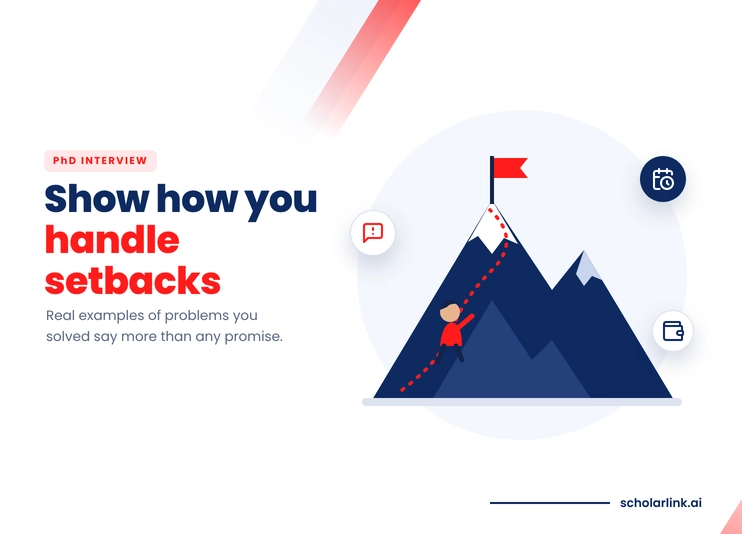
This is about resilience. Good answers draw on past experiences (failed experiments, rejected papers, or complex projects) and explain how you handled uncertainty and setbacks.
What makes you a good fit for doctoral research?
Here, highlight traits such as independence, persistence, critical thinking, and self-direction. Avoid generic adjectives; brief examples make your answer credible.
What are your strengths and weaknesses?
What they are really asking: Whether you can assess yourself honestly and act on it.
How to answer: For strengths, choose qualities relevant to the PhD and back them with a brief example. For weaknesses, pick something real but not critical to the project, and explain how you are working on it (for example, through training offered in the program).
Model answer: “My main strength is [skill], for example when I [specific situation]. Something I am still developing is [real area], so I have started [concrete step], and I would like to use [training/course] in my first year.”
Once your motivation is clear, interviewers usually pivot to whether you can actually do the research.
Questions About the Project and Your Academic Experience
Can you briefly explain your previous research experience?
Focus on your role, not just the topic. Interviewers want to know what you did, how you designed or executed the work, and what you learned from it.
What research methods are you most comfortable with?
Be honest. It’s better to show depth in a few methods and openness to learning than to claim broad expertise without substance.
How does your background prepare you for this PhD project?
Strong answers connect past coursework, theses, or professional research directly to the proposed project’s methods or questions.
If this project changes direction, how would you adapt?
This tests flexibility. Supervisors want candidates who can handle evolving research questions without losing momentum or motivation.
What do you see as the main challenges of this research area?
A good response shows awareness of limitations, gaps, or debates in the field, without sounding pessimistic. This demonstrates critical thinking rather than blind enthusiasm. Name a challenge, then say how you would address it.
Model answer: “One challenge will be [specific difficulty, e.g., access to data or participants]. I would address it by [concrete plan], and I would discuss the approach with my supervisor early.”
What would you like the impact of this project to be?
They want to see that you think beyond the thesis. Mention who could use the results (the field, industry, policy, or the public), and how you would share them (publications, conferences, public engagement).
What are some recent publications in your field?
This checks that you read around your topic. Prepare to summarize two or three recent papers in a sentence or two each, and say how they relate to the project.
At this point, most interviews move beyond competence and into the question of fit.
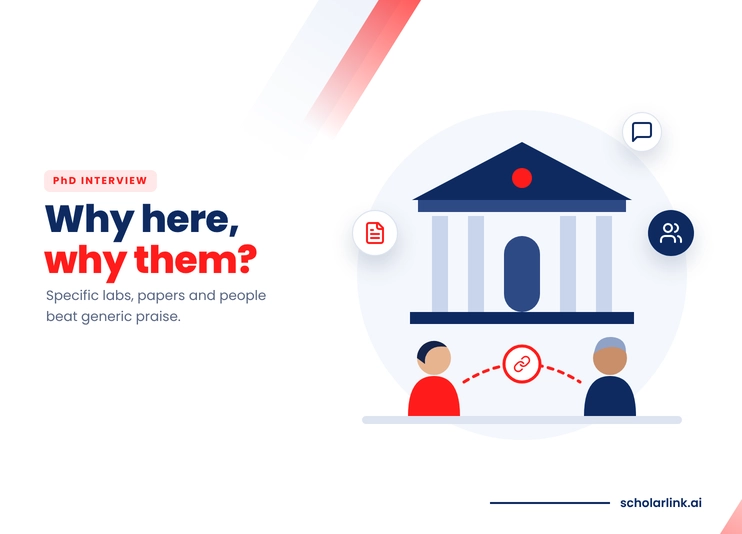
Questions About the University and the Supervisor
Why did you apply to this university or department?
Generic answers are a red flag. Strong responses reference specific research strengths, labs, centers, or academic culture relevant to your interests.
Why do you want to work with this supervisor?
This is crucial. Interviewers expect familiarity with the supervisor’s research themes, not flattery. Mention alignment in methods, topics, or mentoring style if known.
Model answer: “I read your recent paper on [topic], and the [method/approach] you used connects directly to my work on [your background]. I would like to contribute to [specific line of research] in your group.”
How do you see your work fitting into the supervisor’s research group?
This question assesses collaboration. Good answers balance independence with an understanding of teamwork and contribution to a broader research agenda.
Have you contacted potential supervisors before applying?
Answer honestly. If yes, briefly explain the outcome. If no, explain your reasoning professionally; this is not automatically negative.
What do you expect from a supervisor during your PhD?
This reveals expectations. Thoughtful answers show you understand supervision as a professional relationship involving guidance, feedback, and increasing independence over time. For more on supervision styles, read [Types of PhD Supervisors: Roles, Styles, and How to Choose the Right One].
Questions About Challenges and Practicalities
Describe a time you overcame a setback or solved a difficult problem
How to answer: Use the STAR structure (see the table below). Choose an academic or professional example, such as a failed experiment, unavailable data, or a rejected draft, and end with what you learned.
Model answer: “In my [project], [situation/problem]. My task was [responsibility]. I [action: what you changed or tried], and as a result [outcome]. Next time I would [what you learned].”
How do you handle criticism of your work?
Feedback is a core part of the PhD. Give a specific example of critical feedback you received and how you responded constructively. Show that you treat feedback as a chance to improve, not as a personal attack.
How do you manage your time and workload?
A PhD requires sustained independent work. Describe the tools or routines you use (weekly planning, regular progress reviews) and give an example of managing competing deadlines.
How will you fund your PhD?
If the position is funded, confirm that you understand the terms. If not, explain your plan clearly (applications, part-time work) and make clear that research stays your priority. For funding options, see [How to Get Funding for a PhD].
How to Answer PhD Interview Questions Effectively (and Avoid Common Pitfalls)
Answering PhD interview questions is less about giving perfect responses and more about showing structured thinking, self-awareness, and academic maturity. Strong answers are clear, specific, and grounded in your real experience. In practice, interviewers listen for how you explain your reasoning, justify your choices, and connect your background to the proposed research, not for rehearsed or overly polished speeches. Common mistakes in PhD interview answers include:
| Common mistake | What to do instead |
|---|---|
| Being vague or abstract, using broad statements without concrete examples or explanations | Give one specific example for each claim |
| Overclaiming expertise, especially in methods or topics you cannot comfortably defend if questioned | Show depth in a few methods and openness to learn the rest |
| Memorizing scripted answers, which often sound unnatural and collapse under follow-up questions | Know your key points, not your exact words |
| Focusing only on achievements, while ignoring challenges, failures, or learning moments | Include one setback and what you learned |
| Showing weak project or supervisor awareness, suggesting poor preparation or generic applications | Reference specific papers, methods, or lab strengths |
| Avoiding uncertainty, instead of acknowledging gaps and showing willingness to learn | Say what you don’t know and how you would learn it |
Avoiding these pitfalls helps your answers sound authentic, confident, and academically credible, exactly what interviewers are trying to identify.
The STAR Method for Experience Questions
For questions that start with “Tell us about a time…”, structure your answer like this:
| Letter | Stands for | What to say |
|---|---|---|
| S | Situation | The context: your project, the problem |
| T | Task | Your responsibility |
| A | Action | What you did, step by step |
| R | Result | The outcome, and what you learned |
Smart Questions to Ask in a PhD Interview (What They Reveal About You)
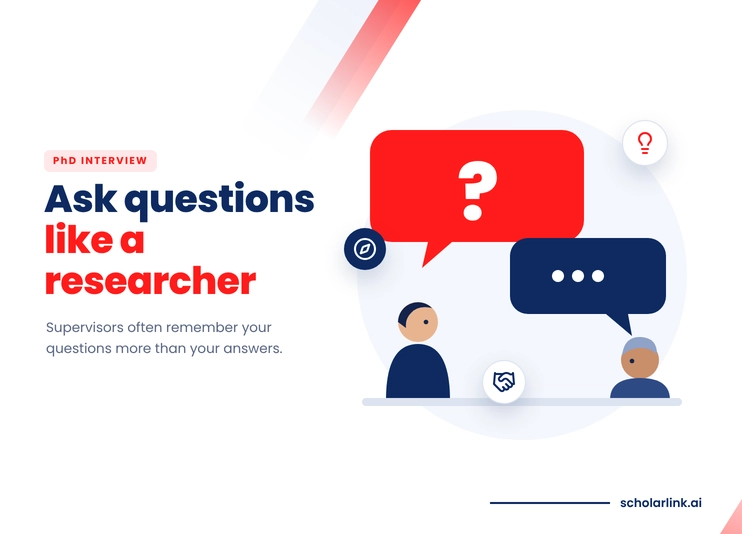
A PhD interview is not a one-way examination where you simply respond to questions. It is a professional academic conversation. When you ask thoughtful, well-timed questions, you signal several positive traits at once: intellectual curiosity, strategic thinking, and a serious understanding of what doctoral research actually involves. From experience, supervisors often remember candidates not for flawless answers, but for the quality of questions they asked. Asking your own questions shows that you:
- Think like a researcher, not just an applicant waiting for approval.
- Understand the realities of doctoral study, including supervision style, expectations, and long-term outcomes.
- Care about fit and sustainability, rather than treating the PhD as a generic credential.
- Can engage in academic dialogue, which is essential for a healthy supervisor-student relationship.
Once that mindset is clear, the key is choosing questions that are practical, relevant, and respectful of the interviewer’s role.
Examples of Good Questions to Ask in a PhD Interview
| Topic | Question |
|---|---|
| Supervision | How do you typically guide PhD students during the first year of their research? |
| Independence | What level of independence do you expect from your PhD students at different stages? |
| Training | Are there opportunities for training, workshops, or interdisciplinary collaboration within the department? |
| Publishing | How do you support students in publishing papers during the PhD? |
| Funding and conferences | What funding or conference participation opportunities are usually available to PhD students in this group? |
| Group culture | How does the research group handle feedback, authorship, and collaboration? |
| Outcomes | How many PhD students has this supervisor seen through to completion, and what did they do afterwards? |
| Teaching | Will I have opportunities to teach, present, or publish? |
These questions help you gather critical information while demonstrating maturity, preparation, and genuine engagement, qualities that interviewers consistently value.
Tip: Prepare four or five questions in advance, because some will be answered during the interview. Avoid asking about things already covered in the project description or the university’s website, and skip trivial topics.
Interview Day Checklist and After the Interview
| Stage | What to do |
|---|---|
| Before | Re-read your application, proposal, and project description; research your interviewers’ recent publications; confirm the format, length, and who will attend; bring copies of your proposal and CV; for video interviews, test your technology the day before |
| During | Pause before answering (silence beats rushing); ask for clarification if you don’t understand; be honest when you don’t know something; show enthusiasm without overdoing it; speak clearly |
| After | Send a brief thank-you email to the lead interviewer; note any follow-up information you were asked to provide; reflect on what went well and what to improve |
Sources: DiscoverPhDs, FindAPhD.
FAQ
What are the most common PhD interview questions?
The most common questions cover your motivation (why a PhD, why now, long-term goals), your project and experience (methods, previous research, challenges), your fit with the university and supervisor, and practical topics like handling setbacks, criticism, time management, and funding.
How should I prepare for a PhD interview?
Research the project, supervisor, and group; practice your answers out loud; know every line of your CV and proposal; prepare specific examples; and plan four or five questions to ask the panel.
How long does a PhD interview last?
Many last between 30 minutes and an hour, and some run longer if they include a presentation or a detailed discussion of your proposal.
Will I need to give a presentation?
Some interviews include a short presentation on your proposed project or past research. Check your invitation email, and prepare a clear version of your research story either way.
Should I bring my research proposal to the interview?
Yes. Even if the panel has read it, a copy shows preparation and is a handy reference during the discussion.
Is it normal to be interviewed by more than one person?
Yes. Panels often include your prospective supervisor, another academic, and sometimes a postgraduate coordinator.
What if I don’t know the answer to a question?
Say so honestly, then explain how you would find out or approach the problem. Interviewers value honesty and learning ability more than bluffing.
How soon will I hear back after a PhD interview?
Universities often reply within a few weeks. If you haven’t heard back after that, a polite follow-up to the admissions office is acceptable.
Final Thoughts: Key Takeaways for Succeeding in Your PhD Interview
The PhD interview is not a test of memorization. It is an evaluation of readiness, fit, and research mindset. As we explored throughout this guide, success comes from understanding why interviewers ask certain questions and responding with clarity, honesty, and structure. Strong candidates prepare in advance, reflect deeply on their motivation, know their research direction, and can clearly explain how their background aligns with the project, the supervisor, and the academic environment. Just as importantly, they treat the interview as a two-way conversation, asking thoughtful questions that demonstrate curiosity, maturity, and long-term thinking.
If there is one core principle to remember, it is this: preparation turns uncertainty into confidence. Reviewing common PhD interview questions and answers, refining your research narrative, understanding your supervisor’s work, and practicing how you communicate your ideas can dramatically improve your performance. The interview is where your application becomes human. Make sure it reflects both your academic ability and your readiness for doctoral research.
If you want support beyond interview preparation, such as identifying the right PhD programs, finding aligned supervisors, or improving overall application fit, ScholarLink.ai helps international PhD applicants navigate the process more strategically. By focusing on clarity, alignment, and informed choices, you can approach the PhD journey with confidence rather than guesswork.