

A Statement of Purpose (SOP) for Mechanical Engineering is an essay that introduces your academic background, technical skills, practical experience, and career ambitions to an admissions committee. It connects what you’ve already done with what you want to do next, and shows a university why you’re a strong fit for its engineering program. Whether you’re applying for an undergraduate program or a graduate degree, a well-crafted mechanical engineering statement of purpose can noticeably strengthen your application. If you’re applying in other disciplines, check our SOP for Economics guide for a tailored walkthrough.
This guide walks you through the entire writing process: structural requirements, level-specific strategies for bachelor’s and master’s degrees, complete samples, an analysis of what makes them work, and the common mistakes to avoid.
What Is an SOP for Mechanical Engineering?
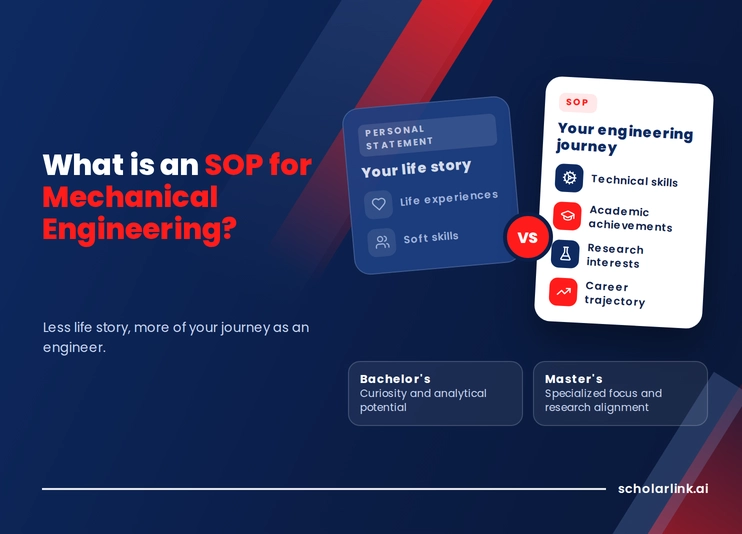
A Statement of Purpose for mechanical engineering is a focused narrative about your journey as an engineer or prospective engineering student. A standard personal statement often emphasizes life experiences and soft skills. An SOP is different: it focuses on your technical competencies, academic achievements, research interests, and career trajectory.
Admissions committees at top institutions, such as the University of Michigan or UCLA, read your SOP to judge whether you have the intellectual foundation and practical drive to succeed in a demanding academic environment. They look for specific signals: your grasp of core principles in fluid mechanics, thermodynamics, or robotics; your involvement in design projects or internships; and a clear vision of how their faculty, laboratories, and specialized tracks will help you reach your long-term goals. For bachelor’s applicants, the SOP should reflect curiosity and analytical potential. For graduate applicants, it must show a specialized focus and clear research alignment.
What Should You Include in a Mechanical Engineering SOP?
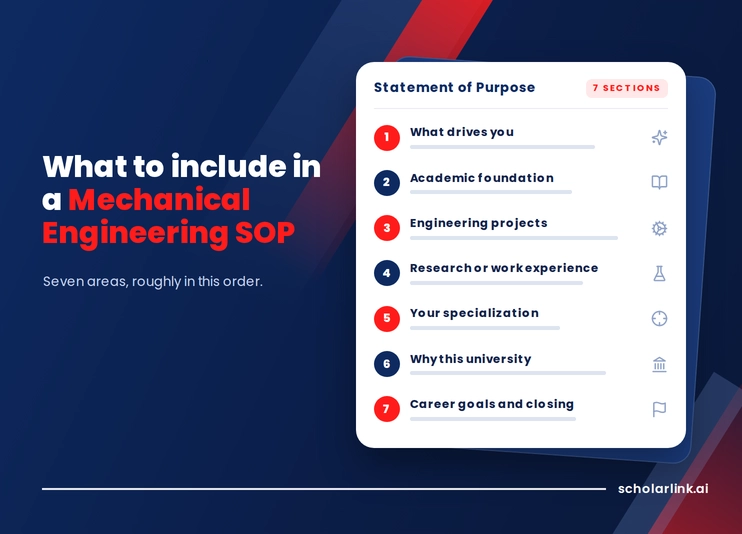
A persuasive SOP covers seven areas of your academic and professional life, roughly in this order.
Start with a focused introduction that explains what drives you to study mechanical engineering. Avoid vague statements about a childhood fascination with toys. Instead, point to a specific engineering problem, technology, or domain that sparked your interest.
Next, outline your academic foundation. Discuss relevant coursework, academic distinctions, and core competencies without repeating your transcript. Show how courses like advanced mathematics, materials science, or heat transfer gave you real analytical tools.
Your engineering projects come after that. Explain your design methodology, the tools you used (such as CAD software, ANSYS, or MATLAB), and the outcomes of your work. Talk about the problems you ran into during prototyping or simulation and how you solved them.
Then bring in your research or professional experience: internships, laboratory work, co-op positions, or published papers. Focus on your direct contributions, whether you optimized a manufacturing process, improved thermal efficiency, or developed control algorithms for automated systems.
The fifth area is your research interest or specialization. Graduate applicants in particular should avoid talking about mechanical engineering in broad terms. Name specific subfields like biomechatronics, sustainable energy systems, computational fluid dynamics, or additive manufacturing.
After that, explain why you chose this particular university. Mention faculty members whose research aligns with your goals, specific research groups or laboratories, unique courses, or specialized facilities. If you’re targeting Canadian institutions, read our detailed guide on navigating master’s and PhD programs in Canada to better understand supervisor outreach, university selection, and study permit strategies.
Finally, outline your short-term and long-term career goals, and close with a confident summary of why your background and the program are a strong match.
How to Write an SOP for Mechanical Engineering
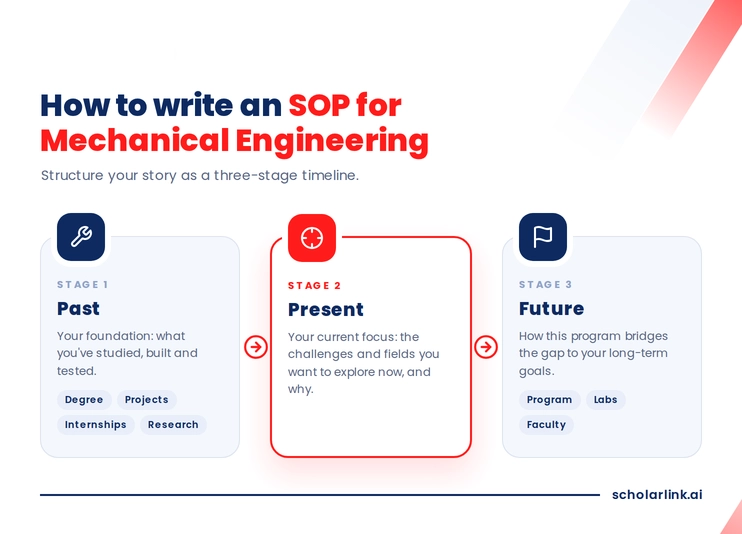
A simple way to structure your writing is a three-stage timeline: Past, Present, and Future.
The Past establishes your foundation. Here you reflect on what you have studied, built, and tested. Discuss your undergraduate degree, key technical projects, internships, and research experience to show that you already have a solid engineering baseline.
The Present covers your current focus. Explain the specific mechanical engineering challenges or technical fields you want to explore more deeply right now, and why.
The Future connects that path to the target institution. Explain why this university’s program, laboratories, and faculty are what you need to bridge the gap between your current skills and your long-term career goals.
Craft Your Mechanical Engineering SOP
Ready to write your application essay? Use ScholarLink's AI SOP Builder to tailor a strong, compelling Statement of Purpose for your Mechanical Engineering program.
Sample SOP for Mechanical Engineering
Sample SOP for Master’s in Mechanical Engineering
The sample below is written for a master’s applicant in thermal-fluid sciences. The laboratory and faculty references are kept general on purpose. In your own SOP, name the actual professor and research group you want to work with.
During my undergraduate studies in Mechanical Engineering, my primary goal was to bridge theoretical fluid dynamics with practical energy conversion systems. With data centers and high-power electronics running hotter every year, efficient thermal management has become a real engineering bottleneck. My academic projects and research assistantship have strengthened my determination to pursue advanced study in thermal-fluid sciences, specifically microchannel heat exchangers for electronic cooling applications.
At my home university, I built a strong foundation in thermodynamics, heat transfer, fluid mechanics, and numerical analysis. To put theory into practice, I led a four-person team for our senior capstone project, designing a closed-loop microchannel cooling system for high-power-density electronics. I ran computational fluid dynamics (CFD) simulations in ANSYS Fluent to analyze pressure drop and heat dissipation across different channel geometries. I then fabricated a physical prototype using precision micro-machining and verified our numerical models experimentally. Our optimized channel design increased heat dissipation efficiency by 18 percent compared to standard heat sinks and earned our team the department’s Best Senior Design Award.
Beyond academic projects, I completed a six-month engineering internship at an industrial turbomachinery firm. There, I worked alongside senior design engineers to evaluate thermal stresses in high-temperature turbine blades using finite element analysis (FEA). The experience showed me how design compromises are made in high-stakes manufacturing environments, and why advanced computational tools need to be part of product design from the earliest stages.
In graduate school, I intend to focus my research on multiphase flow phenomena and microscale heat transfer. The Master of Science in Mechanical Engineering program at your institution is the ideal platform for this. I am particularly drawn to your department’s thermal management laboratory and its work on phase-change heat transfer, which aligns directly with my interest in ultra-compact cooling solutions for next-generation computing hardware. Access to your flow visualization facilities and thermal analysis laboratories would allow me to contribute meaningfully to ongoing research while expanding my technical capabilities.
After completing my degree, I plan to work as a Senior Thermal R&D Engineer in the semiconductor or aerospace industry, designing advanced thermal control architectures for high-performance systems. In the long term, I aim to lead engineering teams that drive sustainable thermal innovation in high-tech manufacturing. Your program offers the combination of rigorous curriculum, advanced lab infrastructure, and industry collaboration I need to reach these goals.
Why This Mechanical Engineering SOP Works
This sample succeeds because it follows a clear logical structure. Paragraph one introduces a specific engineering motivation without relying on clichés. Paragraph two proves academic strength through a concrete senior project, naming specific tools like ANSYS Fluent and a clear quantitative result (an 18 percent efficiency increase). Paragraph three shows real-world application through an internship and signals industry readiness. Paragraph four establishes direct fit with the university by pointing to a specific laboratory, research topic, and set of facilities; your own version should also name the professor. Paragraph five links the master’s program to clear short- and long-term career outcomes.
SOP for Mechanical Engineering Bachelor’s
An SOP for a bachelor’s program is quite different from a master’s essay. High school students usually don’t have research experience or exposure to advanced engineering software, so the focus shifts to foundational aptitude, a problem-solving mindset, and curiosity.
In an undergraduate SOP, highlight your performance in mathematics, physics, and chemistry. Mention relevant extracurricular activities such as robotics clubs, Science Olympiads, coding competitions, or hands-on maker projects. Explain what sparked your curiosity about physical systems and how the university’s curriculum will turn your raw problem-solving skills into professional engineering expertise.
Mechanical Engineering Statement of Purpose Example for Bachelor’s Applicants
My interest in mechanical engineering grew from analyzing the mechanical advantages of simple mechanisms in high school physics labs to designing custom chassis for our school’s competitive robotics team. As the mechanical lead, I applied principles of static equilibrium and torque calculation to build a lightweight aluminum frame that improved our robot’s maneuverability. My goal in enrolling in the Bachelor of Science in Mechanical Engineering program is to gain a deep theoretical foundation in dynamics, solid mechanics, and CAD modeling, allowing me to turn my passion for hands-on problem solving into a career in automated systems engineering.
Outside the robotics lab, physics and calculus have been my strongest subjects, and competing with my school’s Science Olympiad team taught me to break unfamiliar problems into pieces I could actually solve. Teaching myself basic CAD to model our robot’s frame also showed me how much I still have to learn about designing parts that can be manufactured reliably. Your program’s hands-on first-year design course and student engineering teams are exactly the environment where I want to close that gap.
SOP for Master’s in Mechanical Engineering
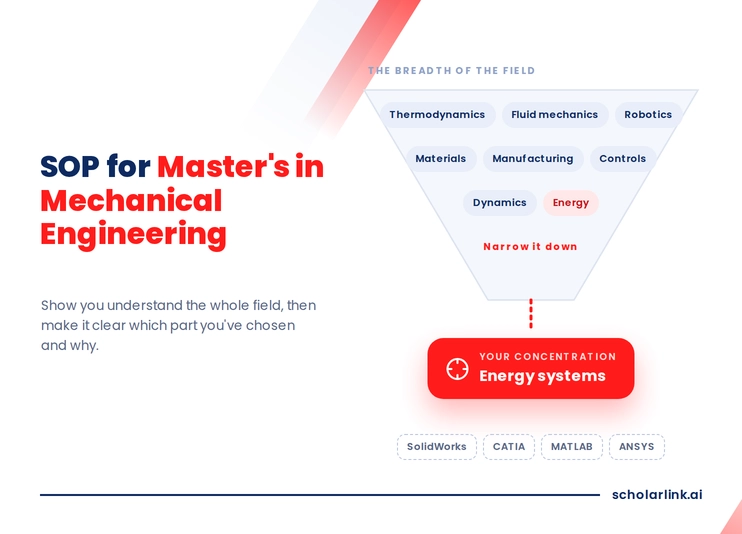
A master’s SOP must show academic maturity and a clear specialization. Universities reviewing graduate applicants want to see that you understand the breadth of mechanical engineering and have deliberately chosen a specific subfield.
When writing for a master’s program, emphasize advanced coursework, capstone design projects, technical certifications, industrial internships, and lab research. Describe how you’ve used engineering software such as SolidWorks, CATIA, MATLAB, or ANSYS. State your target concentration clearly, whether it’s energy systems, dynamics and controls, manufacturing processes, or materials engineering, and explain why advanced education is necessary for your technical career. Top programs expect applicants to articulate clear graduate goals and show both self-direction and strong academic preparation. If your long-term goal involves doctoral research, explore our breakdown of fully funded doctoral programs worldwide to align your statement with institutional funding expectations.
Mechanical Engineering Statement of Purpose Example Scenarios
Depending on your background, your statement of purpose should emphasize different strengths.
If you’re a fresh graduate with little industrial experience, focus on academic excellence, course projects, laboratory assignments, capstone work, and software proficiency. Show how your theoretical preparation and academic projects demonstrate research readiness.
If you have professional work experience, emphasize your industry achievements, technical responsibilities, and practical problem-solving. Explain how working in the field revealed specific knowledge gaps that only a targeted graduate program can fill. For example:
Three years of designing HVAC ductwork for commercial buildings taught me to size systems quickly and reliably using standard correlations. It also showed me where those correlations stop working. On two projects, our installed systems underperformed their design airflow by more than 10 percent, and none of our tools could explain why. I want to study computational fluid dynamics at the graduate level so I can model those cases properly instead of adding safety factors and hoping for the best.
If you’re a research-focused applicant, emphasize published papers, research assistantships, methodology design, data analysis, and literature reviews, and make your alignment with specific faculty labs clear. If you’re planning to pursue a doctoral degree, read our comprehensive guide on how to apply for a STEM PhD for detailed advice on funding, requirements, and contacting prospective supervisors.
Mechanical Engineering SOP Format
A standard format keeps your SOP readable and professional for any admissions committee:
| Section | What it covers |
|---|---|
| Introduction | Your academic background and your specialized area of interest within mechanical engineering |
| Academic & Technical Background | Relevant coursework, engineering software proficiency, and core analytical abilities |
| Projects & Professional Experience | Capstone projects, lab work, internships, or job roles, with your methodology and quantitative results |
| Specialization & Research Focus | Your subfield of interest, such as robotics, thermal systems, or fluid dynamics |
| Program Fit & University Selection | Specific professors, research groups, laboratories, and courses at the target university |
| Career Goals & Conclusion | Your short- and long-term professional goals and a brief statement on your readiness for the program |
If you are relying on external funding to support your studies, explore our comprehensive guide on fully funded government scholarships to identify merit-based opportunities that cover tuition, living expenses, and travel.
How Long Should a Mechanical Engineering SOP Be?
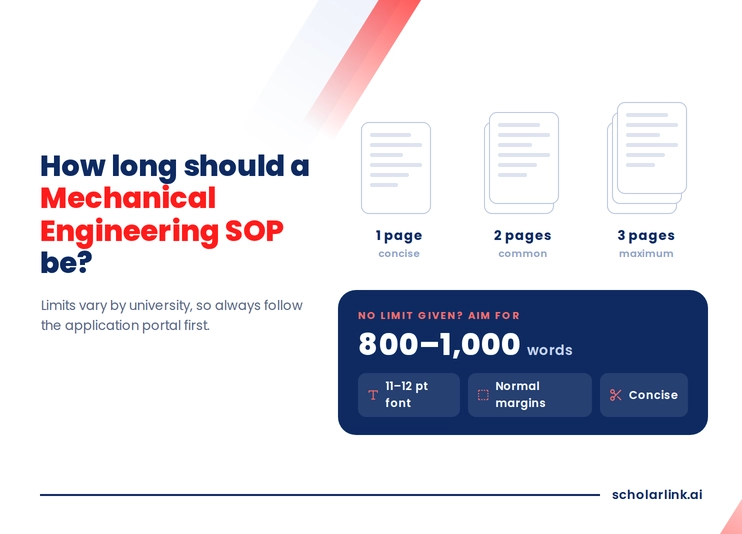
Word counts and page limits vary between universities, so always follow the instructions in the application portal.
Some programs allow up to three pages, others suggest two, and some prefer a concise single page. When no limit is given, aim for about 800 to 1,000 words in a standard 11- or 12-point font with normal margins. Staying concise while delivering real technical substance is itself a sign of strong professional communication.
Common Mistakes to Avoid in a Mechanical Engineering SOP
- Avoiding a few standard errors will make your submission much stronger.
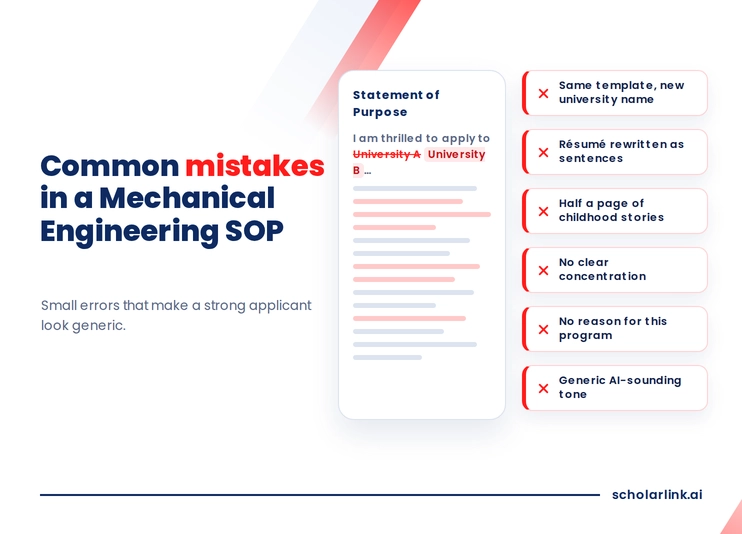
- The biggest red flag is a generic template where only the university name changes. Admissions committees can easily spot recycled essays that lack institution-specific details.
- Don’t simply turn your résumé into full sentences, either. Your SOP should explain the technical challenges, decisions, and problem-solving behind the items listed on your résumé.
- Keep childhood anecdotes short. Spending half a page on childhood building toys wastes space that belongs to your academic work and technical projects.
- Avoid talking about mechanical engineering too broadly. Without a stated concentration, your application looks unfocused next to candidates who have clear research interests.
- Don’t overlook program fit. If you don’t explain why a specific university, professor, or curriculum is right for you, your application will look generic.
- Finally, avoid relying on generic AI-generated content. Overused phrases and a flat, generic tone weaken both the authenticity and the technical credibility of your application.
How to Make Your Mechanical Engineering SOP Stand Out
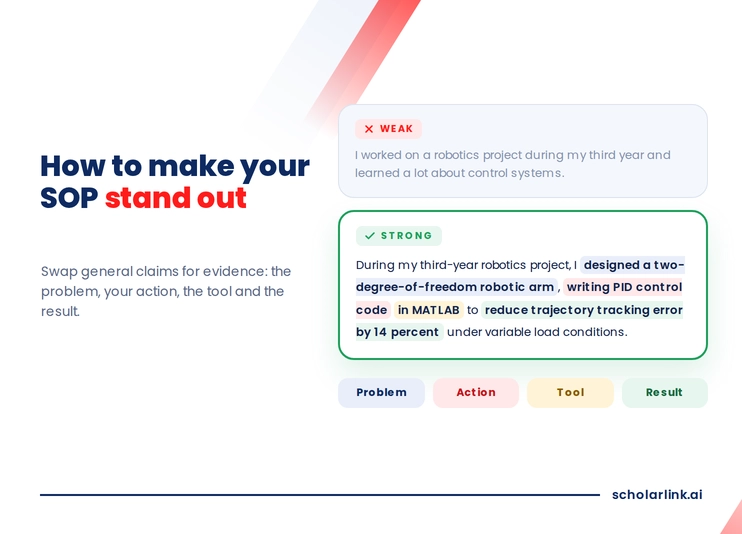
To stand out, move from general claims to detailed, evidence-based descriptions. Instead of writing that you worked on a robotics project, describe the specific challenge, your actions, and the result:
Weak: I worked on a robotics project during my third year and learned a lot about control systems.
Strong: During my third-year robotics project, I designed a two-degree-of-freedom robotic arm, writing PID control code in MATLAB to reduce trajectory tracking error by 14 percent under variable load conditions.
Framing your achievements this way (Problem, Action, Technical Tool, Result) proves your practical ability as an engineer.
Mechanical Engineering SOP Checklist
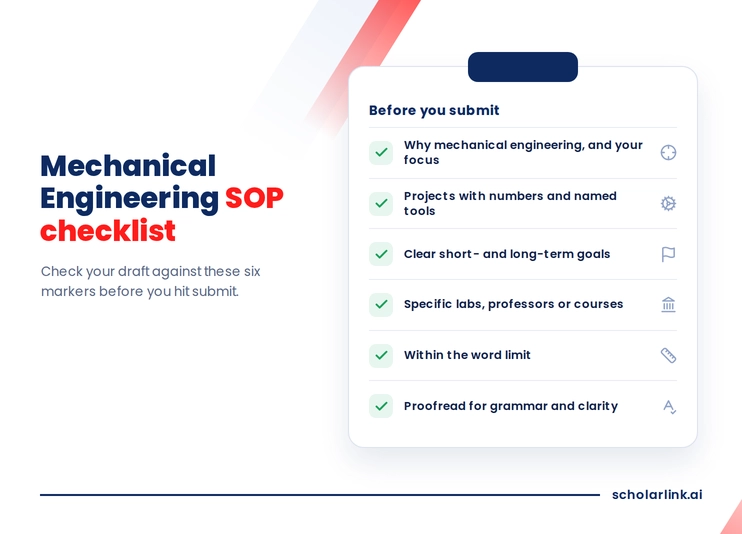
Before submitting your essay, review your draft against these quality markers:
- Your statement clearly explains why you chose mechanical engineering and highlights your technical area of focus.
- Your academic background, senior capstone, or key projects are explained with quantitative results and the specific software tools you used.
- Your short-term and long-term career goals are clearly stated and logically tied to the degree.
- You’ve named specific laboratories, professors, or courses at the university to show strong program fit.
- You’ve followed the word count requirements and cut unnecessary personal history.
- You’ve proofread the whole essay for grammar and clarity.
Frequently Asked Questions
What is an SOP for Mechanical Engineering?
It’s a formal application essay explaining your academic background, technical skills, engineering projects, career goals, and your reasons for applying to a specific university program.
How do I write an SOP for Mechanical Engineering?
Structure your essay around your past accomplishments, current technical interests, and future goals. Highlight specific engineering projects, software tools, practical experience, and program-specific fit.
How long should a Mechanical Engineering SOP be?
Unless the university specifies otherwise, aim for 800 to 1,000 words, typically one to two single-spaced pages.
Can I use the same SOP for different universities?
No. Your academic background and project details can stay consistent, but the sections on research interests, university labs, professors, and program fit must be customized for each institution.
What should I include in an SOP for Master’s in Mechanical Engineering?
Include your undergraduate degree, senior capstone project, technical skills, internships, desired concentration, specific research interests, and clear reasons for choosing the university.
Do Bachelor’s applicants need an SOP for Mechanical Engineering?
Yes. Many international universities require a personal statement or SOP for undergraduate admissions to assess your interest in engineering, academic preparation, and motivation.
Should I mention professors in my Mechanical Engineering SOP?
Yes, especially for graduate applications. Referencing specific professors and their research laboratories shows that you’ve researched the program and understand how it fits your academic goals.
What is the difference between an SOP and a Personal Statement?
An SOP focuses primarily on your academic qualifications, technical skills, research interests, and professional trajectory. A Personal Statement usually focuses more on personal challenges, life experiences, and soft skills.

ScholarLink AI
Your Ultimate Admission Co-Pilot
- 🎓 Professors Database: World’s largest supervisor directory
- 📡 Live Positions: Real-time faculty openings & vacancies
- 👥 Students Database: Connect with successful applicants
- 🎯 Smart Matching: AI-driven professor recommendation
- 💰 Funding Analysis: Real-time lab & research funding data
- 📝 Apply Management: Track applications & cold emails