

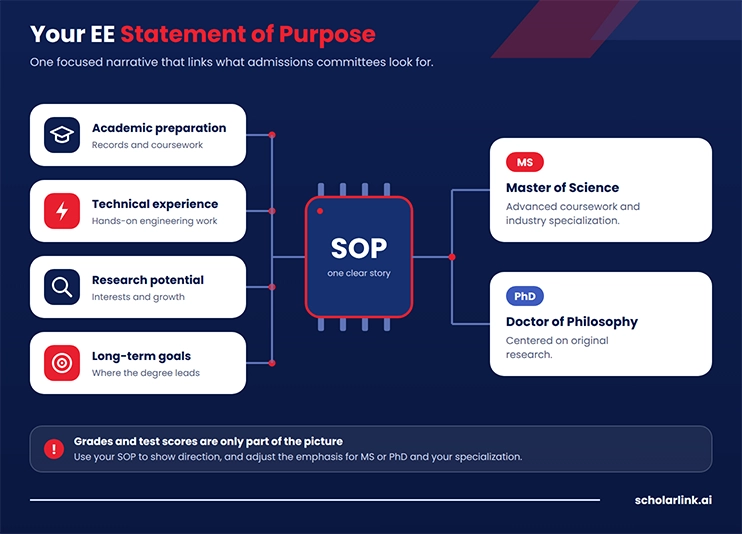
Securing admission to a competitive graduate program in electrical engineering requires more than strong academic records and competitive test scores. Admissions committees evaluate applicants based on a combination of academic preparation, technical experience, research potential, and long-term goals. In this process, your Statement of Purpose (SOP) provides an opportunity to connect your academic achievements and engineering experience into a clear, focused narrative. An effective SOP for electrical engineering demonstrates your technical capabilities, intellectual development, research interests, and readiness for advanced study.
Whether you are pursuing a Master of Science (MS) focused on advanced coursework and industry specialization or a Doctor of Philosophy (PhD) centered on original research, your statement should communicate a clear academic and engineering direction. This guide explains how to structure an effective statement, provides tailored sample SOPs for Master’s and PhD applications, compares their key requirements, and explores approaches for different electrical engineering specializations.
What Is an SOP for Electrical Engineering?
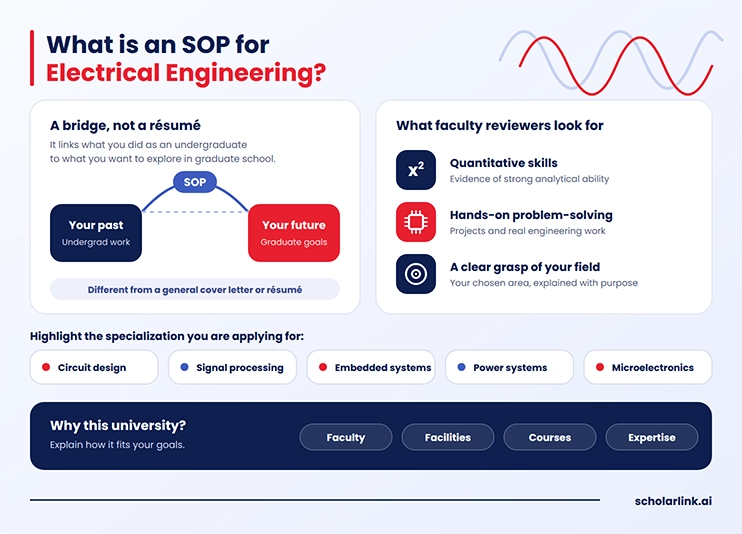
An SOP for Electrical Engineering is an academic essay submitted to graduate admission committees that explains your academic background, technical interests, research or project experience, and future goals. Unlike a general cover letter or resume, an engineering statement of purpose focuses on the experiences and interests that have prepared you for advanced study. It connects what you have accomplished during your undergraduate education with what you hope to explore or achieve in graduate school.
In a technical field like electrical engineering, faculty reviewers look for evidence of quantitative skills, hands-on problem-solving, and a clear understanding of the applicant’s chosen field. Your SOP for electrical engineering should highlight relevant areas such as circuit design, signal processing, embedded systems, power systems, or microelectronics based on your specialization. It should also explain why the specific university, including its faculty, research facilities, courses, or areas of expertise, aligns with your academic and professional goals.
What Should an Electrical Engineering SOP Include?
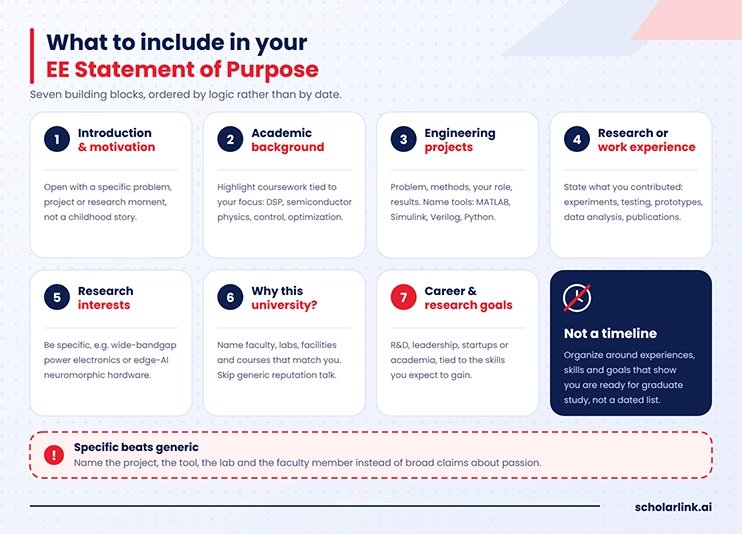
A strong electrical engineering statement of purpose follows a clear and logical structure. Instead of presenting your accomplishments as a chronological list, organize the SOP around the experiences, skills, and goals that demonstrate your preparation for graduate study.
1. Introduction and Motivation
Your opening paragraph should establish your academic or technical focus early. Avoid broad, familiar stories about childhood curiosity or a lifelong fascination with electronics. Instead, start with a specific engineering problem, project, research experience, or technological development that shaped your interest in advanced study.
2. Academic Background
Describe your academic preparation in electrical engineering or a closely related field. Rather than repeating your transcript, highlight coursework that directly supports your intended specialization, such as digital signal processing, semiconductor physics, control systems, or optimization. Explain how your academic training and quantitative skills prepared you for graduate-level study.
3. Electrical Engineering Projects
Highlight major engineering projects, capstone designs, or technical competitions that demonstrate your ability to apply theoretical knowledge. For each significant project, explain the problem you addressed, the methods and tools you used, your individual contribution, and the results you achieved. Relevant tools may include MATLAB, Simulink, Verilog, Cadence Virtuoso, Python, or other discipline-specific software.
4. Research or Work Experience
Discuss relevant research internships, university laboratory work, or professional engineering experience. Focus on what you actually contributed, such as designing experiments, testing systems, developing prototypes, analyzing data, or contributing to technical publications. Mention relevant laboratory equipment, simulation environments, or engineering methods when they strengthen your application.
5. Research Interests
Define your research interests as specifically as possible rather than simply stating that you are interested in electrical engineering. For example, you might focus on high-efficiency power electronics using wide-bandgap semiconductors, neuromorphic hardware for edge AI, or another clearly defined area within your specialization. Your interests should also connect naturally to your previous academic or project experience.
6. Why This University?
Explain why the specific university is a good fit for your academic and research goals. Mention relevant faculty members, research groups, laboratories, specialized facilities, or courses that connect directly to your interests. Avoid generic statements about the university’s reputation and focus instead on the resources and research opportunities that are relevant to your goals.
Identifying relevant advisors and research labs can take time. Tools such as ScholarLink’s academic matching platform can help applicants explore potential supervisors and research opportunities.
7. Career and Research Goals
Conclude by explaining what you plan to do after graduate school. Depending on your path, this could include industrial R&D, engineering leadership, technology development, entrepreneurship, or academic research. Connect these goals to the skills, knowledge, and research experience you expect to gain from the program.
How to Write an SOP for Electrical Engineering
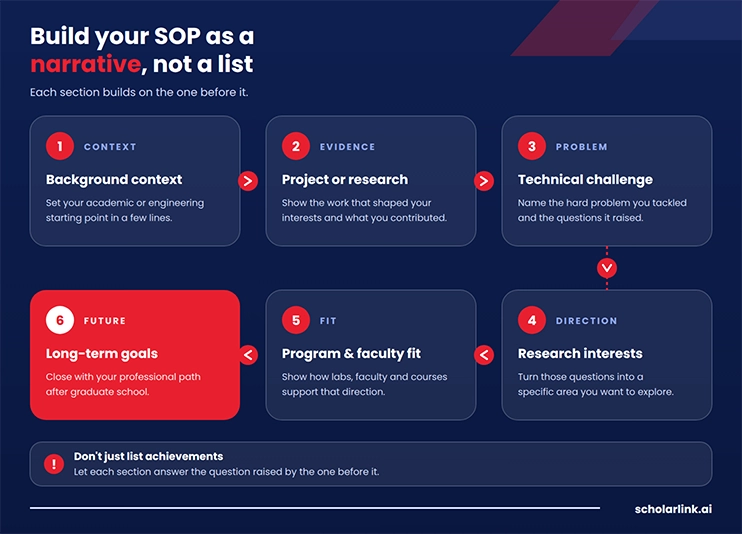
Writing an effective electrical engineering statement of purpose requires a clear narrative rather than a simple list of academic and professional achievements. A useful structure is to connect your past experience with your technical interests, program fit, and future goals.
Engineering Narrative Framework:
Background Context → Project or Research Experience → Technical Challenge → Research Interests → Program & Faculty Fit → Long-Term Goals
This structure helps each section build naturally on the previous one. Start by establishing your academic or engineering context, then explain the projects or research that shaped your interests. Connect those experiences to the technical questions you want to explore, explain how the target program can support those goals, and conclude with your long-term professional direction.
Sample SOP for Electrical Engineering
Below is a full-length sample SOP for electrical engineering that demonstrates how to connect academic preparation, technical projects, research experience, and future goals in a cohesive graduate application. The details and results are illustrative and should be replaced with your own experiences and achievements.
Full-Length Sample SOP for Electrical Engineering
The rapid integration of renewable energy into modern power grids presents a significant engineering challenge: maintaining grid stability under increasingly dynamic and intermittent generation conditions. During my undergraduate studies in Electrical Engineering, I became particularly interested in how conventional control approaches perform in microgrids dominated by inverter-based resources. This interest led me to focus on power electronics and smart grid control and motivated me to pursue graduate study in Electrical Engineering, with the goal of developing adaptive control methods for next-generation power distribution systems.
My academic background has provided me with a strong foundation in both electrical engineering theory and practical design. During my undergraduate studies at National Institute of Technology, I focused on linear control systems, power electronics, power system analysis, and signal processing, graduating in the top 5% of my class. Coursework in advanced power electronics introduced me to wide-bandgap (SiC and GaN) semiconductor devices, while dynamic system modeling strengthened my ability to analyze nonlinear systems. I also developed proficiency in MATLAB/Simulink, PSCAD, and C++ for embedded real-time control.
To apply these concepts to a practical engineering problem, I completed a senior capstone project on a high-efficiency bidirectional DC-DC converter for battery energy storage in residential microgrids. As the lead control engineer on a four-person team, I implemented a sliding-mode control strategy to manage rapid load fluctuations and source variations. I modeled the converter in Simulink, designed PCB layouts using Altium Designer, and programmed a Texas Instruments C2000 microcontroller for real-time PWM generation. Experimental testing achieved a peak conversion efficiency of 96.4% and reduced transient recovery time by 30% compared with a conventional PI control scheme. The project strengthened my understanding of converter topologies and microcontroller-based control while giving me practical experience debugging hardware-in-the-loop systems.
I further developed my research experience through a six-month internship at the Clean Energy Research Laboratory, where I investigated the effects of distributed photovoltaic penetration on voltage stability in low-voltage distribution networks. My primary responsibility was to develop a localized reactive power compensation algorithm to mitigate voltage rise along radial feeders. By combining smart-inverter telemetry with secondary control loops, I developed a decentralized voltage regulation model that reduced voltage deviation by 18% under maximum solar irradiation conditions. This work resulted in a co-authored conference paper presented at a regional IEEE Power & Energy Society student conference and strengthened my interest in research-driven approaches to modern power systems.
These experiences have given me a strong foundation, but I now want to deepen my understanding of robust control, smart grid cybersecurity, and wide-area monitoring. The Master of Science in Electrical Engineering at [Target University] would allow me to build this expertise while continuing to explore modern grid architectures. I am particularly interested in the work of Dr. [Professor’s Last Name] at the Smart Grid Innovation Center, whose research on microgrid resilience under high renewable penetration closely matches my interests. Courses such as Advanced Power Semiconductor Devices and Microgrid Autonomous Control would further strengthen my technical background and prepare me to investigate emerging challenges in power electronics and grid control.
After completing my degree, I intend to work as a Power Electronics R&D Engineer in the renewable energy sector, focusing on intelligent grid-forming inverters. In the long term, I hope to contribute to large-scale microgrid integration and resilient power infrastructure. I believe that the combination of my technical background, project experience, and research interests will allow me to contribute to the Electrical Engineering community at [Target University].
Why This SOP Works
This sample demonstrates how an effective statement can connect technical experience with a clear area of specialization. Rather than making broad claims about electrical engineering, the applicant focuses on power electronics and microgrid control and supports this focus with specific coursework, projects, tools, research experience, and measurable results. The final sections also connect the applicant’s previous work with specific program resources, faculty research, and future career goals.
Statement of Purpose for Master’s in Electrical Engineering
A statement of purpose for masters in electrical engineering should emphasize technical preparation, project experience, practical problem-solving, and professional goals. For Master’s programs, applicants should demonstrate that their undergraduate education and engineering experience have prepared them for advanced coursework and specialized technical training.
What to Include in a Master’s SOP
When drafting your Master’s statement, focus on the experiences that demonstrate your preparation for graduate-level engineering study. Highlight relevant undergraduate coursework, capstone projects, internships, technical skills, and career objectives. Explain how the Master’s program will build on your existing knowledge and help you develop the expertise required for your intended engineering career.
Find Electrical Engineering Supervisors
Connect with prospective EE professors and lab principal investigators globally using ScholarLink’s supervisor directory.
Sample SOP for Master’s in Electrical Engineering
Dedicated Master’s SOP Sample
The continuous miniaturization of semiconductor devices and growing demand for low-power edge computing have created new challenges in integrated circuit (IC) design. My decision to pursue a Master of Science in Electrical Engineering, specializing in VLSI and Analog Integrated Circuit Design, is driven by my interest in developing high-performance, energy-efficient microelectronic systems for next-generation computing and autonomous hardware.
During my undergraduate studies in Electrical and Electronics Engineering at [University Name], I developed a strong foundation in semiconductor physics, digital logic design, electronics, and signal processing. My interest in IC design grew during a course in CMOS Analog Circuit Design. To deepen my understanding, I completed a project focused on designing a low-voltage, low-power operational transconductance amplifier (OTA) using a 180nm CMOS technology node. Using Cadence Spectre, I performed DC, AC, and transient analyses to optimize gain, bandwidth, phase margin, and power consumption. The design achieved a 68dB DC gain with power consumption below 120uW, reinforcing my understanding of transistor sizing and bias circuit design.
I also gained practical industry experience through a summer internship at [Semiconductor Company], where I worked with the physical design team. My responsibilities included running static timing analysis (STA) and resolving setup and hold timing violations across digital block layouts using Synopsys PrimeTime. Working alongside industry engineers introduced me to tape-out workflows, deep sub-micron design considerations, and modern EDA toolchains. This experience showed me how advanced theoretical knowledge and practical EDA skills work together in real-world semiconductor development.
The MS in Electrical Engineering program at [Target University] offers the combination of advanced coursework and practical opportunities I seek. I am particularly interested in the VLSI Design Lab and courses such as Advanced Analog IC Design, RF Microelectronics, and Mixed-Signal Circuit Architecture. The opportunity to work with Professor [Name], whose research focuses on low-power circuit architectures, would allow me to further develop my interests in energy-efficient IC design.
After graduation, I aim to work as an Analog/Mixed-Signal IC Design Engineer in the semiconductor industry, focusing on low-power sensor interfaces for wearable technologies. The technical training and research opportunities available at [Target University] would help me build the specialized expertise required to pursue this career path.
SOP for Master’s in Electrical Engineering
Master’s SOP Template
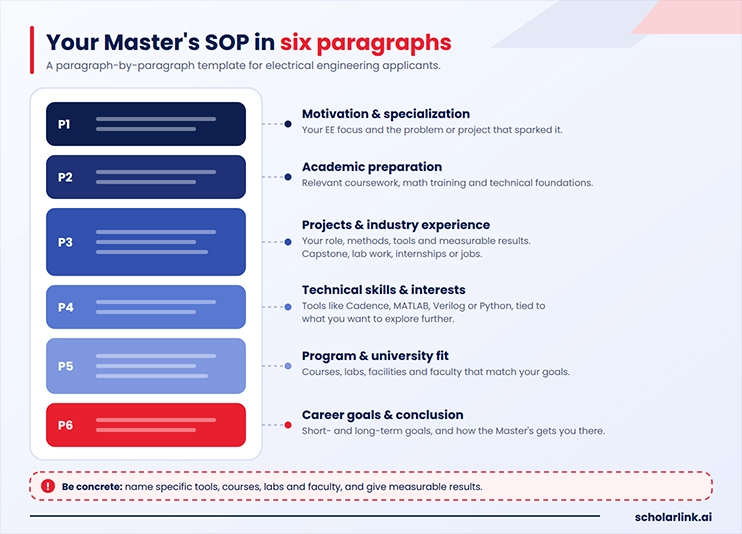
Use the following six-paragraph structure to organize your sop for masters in electrical engineering:
- Paragraph 1: Motivation & Specialization
Introduce your intended electrical engineering specialization and the technical problem, project, or experience that motivated your interest in graduate study. - Paragraph 2: Academic Preparation
Highlight relevant undergraduate coursework, mathematical training, academic achievements, and technical foundations that prepare you for advanced study. - Paragraph 3: Engineering Projects & Industry Experience
Discuss relevant capstone projects, laboratory work, internships, or professional experience. Explain your individual contribution, methods, tools, and measurable results. - Paragraph 4: Technical Skills & Specialized Interests
Describe the technical skills and software tools relevant to your specialization, such as Cadence, MATLAB, Verilog, Python, or other discipline-specific platforms. Connect these skills to the areas you want to explore further. - Paragraph 5: Program & University Fit
Explain why the specific program matches your goals. Reference relevant courses, laboratories, facilities, research opportunities, and faculty members where appropriate. - Paragraph 6: Career Goals & Conclusion
Summarize your short-term and long-term career goals and explain how the Master’s program will help you develop the knowledge and expertise needed to achieve them.
Statement of Purpose for Electrical Engineering PhD
A statement of purpose electrical engineering phd requires a different focus and structure from a Master’s SOP. Because a PhD is primarily a research degree, the admissions committee looks closely at your research experience, ability to formulate research questions, methodological skills, and potential to contribute to ongoing academic work.
Research assistantships and departmental funding can also depend on the fit between an applicant’s research interests and available projects or faculty research areas. For broader strategies on financial support, explore our guide on how to get a funded PhD.
What Makes a PhD SOP Different?
While a Master’s SOP often emphasizes academic preparation, technical skills, and career development, a PhD SOP places greater emphasis on research experience, methodological expertise, academic publications, and alignment with potential faculty advisors. The focus shifts from demonstrating readiness to learn established concepts to showing your ability to investigate research questions and contribute to existing knowledge.
What to Include in an Electrical Engineering PhD SOP
An Electrical Engineering PhD SOP should describe your previous research contributions, thesis or dissertation work, peer-reviewed publications or conference presentations, technical methods, and the research questions you want to pursue. It should also demonstrate a clear understanding of the faculty, laboratories, and research groups relevant to your interests. Referring to specific faculty publications or ongoing research projects can help demonstrate that your proposed research direction is informed by the work being conducted at the target institution.
Sample SOP for Electrical Engineering PhD
Dedicated PhD SOP Sample
The advancement of real-time autonomous systems depends on the ability to execute complex computer vision and signal processing algorithms under strict power and thermal constraints at the network edge. General-purpose computing architectures can face significant energy-efficiency challenges when processing high-throughput sensor streams. My research objective is to develop hardware-software co-designed neuromorphic architectures that use event-based sensing and sparse neural networks to improve processing efficiency for edge applications. Pursuing a PhD in Electrical Engineering at [Target University] under the guidance of Professor [Faculty Name] would allow me to further develop this research direction within a specialized academic environment.
My research training began during my Bachelor of Science in Electrical Engineering at [University Name], where I focused on embedded computing and digital system architecture. As an undergraduate research assistant in the Embedded Systems Laboratory under Dr. [Advisor Name], I spent two years investigating hardware acceleration strategies for deep neural networks on FPGA platforms. My primary contribution involved designing a customized systolic array architecture in SystemVerilog for quantized convolutional layers. By implementing dynamic precision scaling based on feature map activation sparsity, I reduced dynamic power consumption by 24% on a Xilinx Zynq-7000 SoC without degrading classification accuracy on standard benchmark datasets. This work resulted in a first-author paper titled “[Paper Title]” presented at the [IEEE International Conference Name].
Building on this work during my Master’s thesis, I shifted my focus toward event-based vision processing using neuromorphic engineering principles. I developed an asynchronous spike-based feature extraction algorithm designed to interface directly with dynamic vision sensors (DVS). To evaluate its hardware implementation feasibility, I constructed an end-to-end simulation framework in Python and C++ that modeled asynchronous neural dynamics and interconnect traffic. My research demonstrated that asynchronous spike event routing reduced data throughput requirements by 3.5x compared with frame-based image processing pipelines during high-speed tracking scenarios. This effort resulted in a manuscript currently under review in the IEEE Transactions on Very Large Scale Integration (VLSI) Systems.
These experiences have strengthened my ability to formulate research questions, design experimental validation protocols, and communicate research findings through academic publication. I now want to investigate the scaling challenges of edge intelligence by exploring non-Von Neumann and compute-in-memory architectures. At [Target University], I am particularly interested in Professor [Faculty Name]’s research on resistive RAM (RRAM)-based neuromorphic chips, which closely relates to my research interests. I would be especially interested in contributing to Dr. [Faculty Name]’s work on heterogeneous edge intelligence, with a focus on mitigating device non-idealities in analog in-memory computing arrays through noise-tolerant learning algorithms.
Access to advanced nanofabrication facilities and an interdisciplinary research environment at [Target University] would allow me to explore the connection between device-level physics and system-level architecture. Following my PhD, I intend to pursue an academic career focused on energy-efficient computing hardware and lead research on autonomous and edge-computing systems. I hope to contribute my research experience in hardware acceleration, neuromorphic computing, and system design to the Electrical Engineering community at [Target University].
Master’s vs PhD Electrical Engineering SOP
Understanding the differences between a Master’s and PhD statement of purpose can help you present the type of preparation and goals expected for each degree. While both should demonstrate a clear academic direction, their emphasis differs in several important areas:
| Area | Master’s SOP | PhD SOP |
|---|---|---|
| Primary Orientation | Focuses on advanced coursework, technical training, practical skills, and professional development. | Focuses on research experience, research questions, and potential contributions to the field. |
| Technical Depth | Highlights relevant coursework, engineering projects, laboratory work, and practical technical skills. | Highlights research methodology, thesis work, publications, conference presentations, and independent research experience. |
| Institutional Alignment | Emphasizes relevant courses, specializations, laboratories, facilities, and professional opportunities. | Focuses more specifically on faculty research, laboratories, research groups, and ongoing projects that match the applicant’s interests. |
| Future Goals | Often describes goals in engineering, industry R&D, product development, or technical leadership. | Often describes goals in academic research, industrial research, or other research-intensive careers. |
In short, a Master’s SOP should demonstrate that your academic and technical background has prepared you for advanced study and practical specialization. A PhD SOP should provide stronger evidence of research experience, independent thinking, and a clearly defined research direction.
Electrical Engineering SOP Format
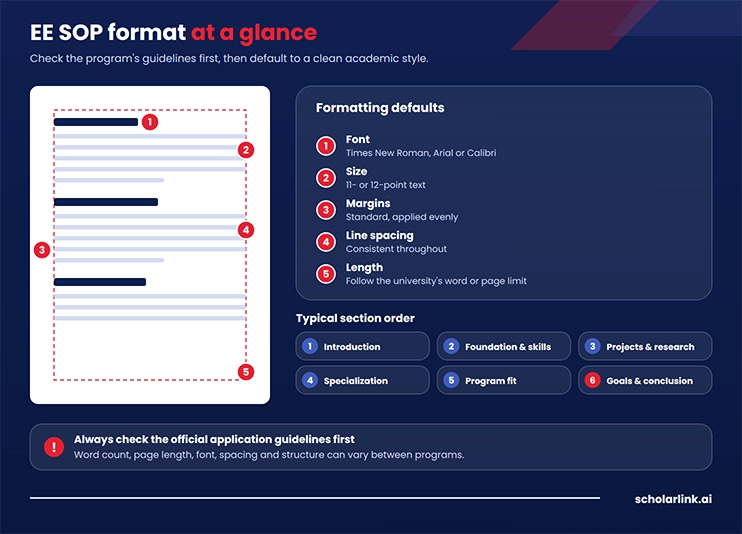
A clear format makes your Electrical Engineering SOP easier to read and helps ensure that it follows the application requirements of your target university. Always check the program’s official application guidelines first, as requirements for word count, page length, font, spacing, and document structure can vary.
Unless the university provides different instructions, use a clean and consistent academic format. A readable font such as Times New Roman, Arial, or Calibri in 11- or 12-point size, standard margins, and consistent line spacing are generally appropriate. Keep the statement focused and concise, and follow the university’s specified word or page limit whenever one is provided.
A typical Electrical Engineering SOP format can follow this structure:
- Introduction and Motivation
Introduce your academic focus, intended specialization, and the experiences that motivated you to pursue graduate study. - Academic Foundation & Technical Skills
Highlight relevant coursework, quantitative preparation, technical skills, and academic experiences that support your intended field. - Engineering Projects & Research Experience
Discuss significant projects, laboratory work, internships, thesis research, or publications. Focus on your contribution, methods, and outcomes. - Specialization & Research Interests
Explain the specific area of electrical engineering you want to study and, particularly for PhD applications, the research questions or problems you want to explore. - Program & University Fit
Connect your interests with relevant faculty, laboratories, courses, research groups, facilities, or other program resources. - Career Goals & Conclusion
Summarize your short-term and long-term goals and explain how the target program fits into your academic or professional development.
Electrical Engineering SOP Examples by Specialization
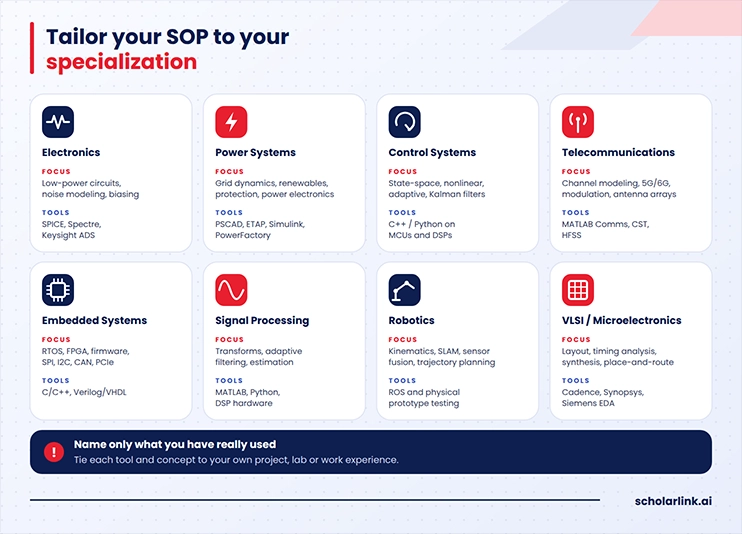
With its wide range of sub-disciplines, this field requires applicants to tailor their SOP to the technical area they intend to pursue. Your statement should reflect the concepts, tools, and research problems relevant to your specialization while connecting them to your own academic or project experience.
Electronics Engineering SOP
Focus on areas such as dynamic circuit design, continuous-time signal processing, noise modeling, semiconductor biasing, and low-power circuit design. Detail your experience with simulation tools such as SPICE, Cadence Spectre, or Keysight ADS, and emphasize physical layout techniques or silicon testing strategies when relevant to your background.
Power Systems SOP
Highlight grid dynamics, renewable energy integration, high-voltage equipment, protection systems, smart grid communications, and power electronics topologies. Mention software packages such as PSCAD, ETAP, MATLAB/Simulink, or DigSILENT PowerFactory when you have practical experience with them, and connect your interests to challenges such as decarbonization, grid resilience, or voltage stability.
Control Systems SOP
Emphasize mathematical feedback systems, state-space representations, nonlinear control, optimal filtering such as Kalman filters, adaptive control, and real-time execution. Discuss applications in autonomous systems, industrial automation, or robotics, highlighting relevant C++ or Python implementations on microcontrollers or DSPs.
Telecommunications SOP
Discuss wireless signal transmission, information theory, digital modulation, channel modeling, 5G/6G protocols, and antenna array design. Reference tools such as MATLAB Communications Toolbox, CST Studio, or HFSS when applicable, and connect your experience to challenges involving capacity, dynamic spectrum sharing, or communication latency.
Embedded Systems SOP
Center your statement on microcontrollers, RTOS architecture, FPGA synthesis, firmware optimization, hardware-software co-design, and bus interfaces such as SPI, I2C, CAN, or PCIe. Highlight projects involving low-level C/C++ programming, Verilog/VHDL logic design, real-time operating systems, or edge computing.
Signal Processing SOP
Relevant topics include Fourier, Wavelet, and Z-transforms, adaptive filtering, image or audio reconstruction, and statistical signal estimation. Discuss applications in biomedical instrumentation, audio processing, or computer vision, supported by experience with MATLAB, Python, or dedicated DSP architectures.
Robotics SOP
Cover areas such as kinematics, trajectory planning, sensor fusion, SLAM (Simultaneous Localization and Mapping), actuator dynamics, and ROS (Robot Operating System). Highlight integrated hardware-software projects, multi-sensor systems, and physical prototype testing in dynamic environments.
VLSI / Microelectronics SOP
Emphasize physical layout design, static timing analysis, synthesis, place-and-route workflows, semiconductor physics, and advanced-node design considerations. Detail your experience with EDA platforms from Cadence, Synopsys, or Siemens EDA, and discuss relevant interests such as compute-in-memory architectures or chiplet integration.
Common Mistakes in an Electrical Engineering SOP
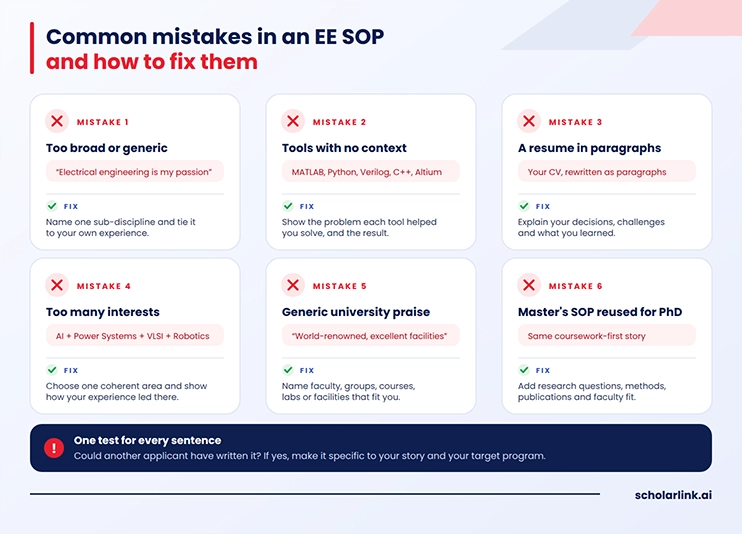
Avoiding common structural and content issues can make your statement clearer, more focused, and more relevant to the expectations of graduate admissions committees. Watch for these common mistakes:
- Being Too Broad or Generic: Vague statements such as “Electrical engineering is my passion” do little to explain your academic direction. Narrow your narrative to a specific sub-discipline, technical interest, or research area that connects to your experience and goals.
- Listing Tools Without Context: Avoid simply listing software programs and programming languages such as MATLAB, Python, Verilog, C++, or Altium. Explain how you used these tools to solve an engineering problem, complete a project, conduct research, or develop a technical solution.
- Turning the SOP Into a Written Resume: An SOP should not simply repeat your CV in paragraph form. Use it to explain the experiences behind your achievements, the technical decisions you made, the problems you encountered, and what you learned from them.
- Listing Too Many Research Interests: Presenting equal interest in unrelated areas such as Artificial Intelligence, Power Systems, VLSI, and Robotics can make your research direction difficult to understand. Focus on a coherent area of interest and explain how your previous experiences led you there.
- Using Generic University Alignment: Statements such as “Your university is world-renowned and has excellent facilities” provide little evidence of program fit. Instead, identify specific faculty members, research groups, courses, laboratories, or facilities that connect directly to your academic goals.
- Reusing a Master’s SOP for a PhD Application: A Master’s SOP typically emphasizes coursework, technical preparation, and professional development, while a PhD SOP requires greater emphasis on research experience, research questions, methodology, publications, and faculty alignment. Adapt the statement to the expectations of the specific degree rather than reusing the same narrative.
How to Make Your Electrical Engineering SOP Stand Out
A strong Electrical Engineering SOP does more than list projects and technical skills. When describing an engineering experience, show how you identified a problem, approached it, contributed to the solution, and connected the outcome to your broader academic interests.
Engineering Narrative Formula:
Engineering Problem → Technical Approach & Tools → Individual Contribution → Results → Research or Academic Insight
Instead of writing:
“I completed an undergraduate project on solar power optimization using MATLAB.”
Make the description more specific:
“To address power conversion efficiency losses in partially shaded solar arrays, I designed a dynamic maximum power point tracking (MPPT) algorithm in MATLAB/Simulink. By implementing a modified perturb-and-observe approach, I improved power extraction efficiency by 14% under simulated dynamic shading conditions, which strengthened my interest in adaptive renewable power interfaces.”
This approach gives the reader a clearer understanding of your engineering process rather than simply stating what you completed. Where possible, use measurable results to demonstrate the outcome of your work, and explain how the experience influenced your technical interests, research direction, or graduate study goals.
Note: The technical details and results in the example above are illustrative. Replace them with accurate results from your own projects or research.
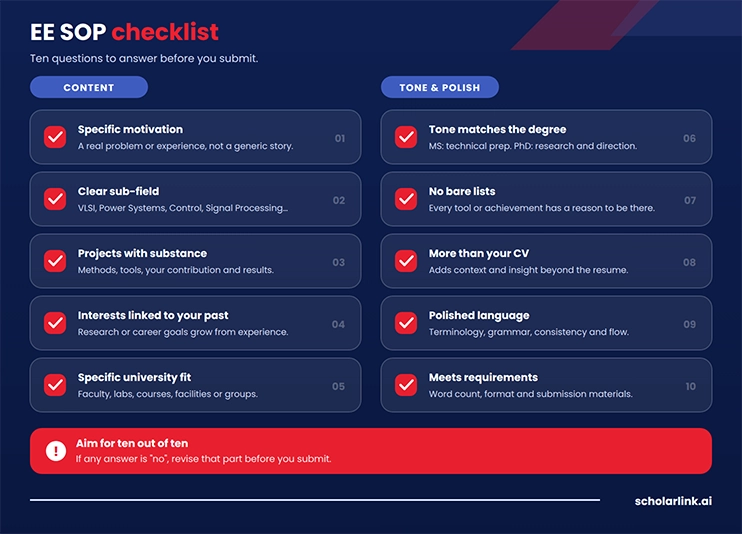
Electrical Engineering SOP Checklist
Before submitting your Electrical Engineering SOP, use this checklist to review the content, structure, and overall fit of your statement:
- Is your motivation clearly connected to a specific engineering problem, academic interest, or experience rather than a generic personal story?
- Does the essay clearly identify your intended electrical engineering sub-field, such as VLSI, Power Systems, Control Systems, or Signal Processing?
- Are your technical projects or research experiences explained through specific methods, tools, your individual contribution, and relevant results?
- Have you clearly explained your research interests or professional goals and connected them to your previous experience?
- Is your university fit specific, with relevant faculty members, research labs, courses, facilities, or research groups?
- Does the tone match your target degree, with greater emphasis on technical preparation for an MS and research experience and direction for a PhD?
- Have you avoided simply listing tools, technologies, or achievements without explaining their relevance?
- Does the SOP add context and insight beyond what is already stated in your resume or CV?
- Have you checked the statement for accurate technical terminology, grammar, consistency, and overall flow?
- Does the final draft follow the target university’s requirements for word count, format, and submission materials?
Frequently Asked Questions (FAQ)
What is an SOP for Electrical Engineering?
An SOP (Statement of Purpose) for Electrical Engineering is an academic essay that explains your technical background, research or project experience, academic interests, and career goals. It helps the admissions committee understand your preparation for graduate study and why the specific program fits your academic direction.
How long should an Electrical Engineering SOP be?
The ideal length depends on the target university. Some programs specify a word count or page limit, while others provide general guidelines. Always follow the official application requirements rather than relying on a standard length.
What should I include in a Master’s SOP for Electrical Engineering?
A Master’s SOP should typically highlight relevant undergraduate coursework, engineering projects, internships, technical skills, and professional or academic goals. Explain how these experiences have prepared you for advanced coursework and specialized training.
How is a PhD SOP in Electrical Engineering different from a Master’s SOP?
A PhD SOP places greater emphasis on research experience, research questions, publications or thesis work, methodological expertise, and alignment with potential faculty advisors or research groups. A Master’s SOP generally gives more attention to academic preparation, technical projects, and professional development.
Should I mention professors in my Electrical Engineering SOP?
For PhD and thesis-based Master’s applications, mentioning relevant professors can strengthen your explanation of program fit. Choose faculty whose current research genuinely connects with your interests and experience, and briefly explain that connection rather than simply listing names.
Should I include my research interests in an Electrical Engineering SOP?
Yes. Define your interests as specifically as your experience allows. Instead of stating that you are interested in electrical engineering generally, identify a relevant area such as wide-bandgap power electronics, neuromorphic hardware, control systems, or physical-layer wireless communication.
Can I use the same SOP for multiple universities?
You can maintain a core draft covering your academic background, projects, and goals, but customize each application. In particular, revise the program-fit section to reflect the target university’s faculty, research groups, courses, facilities, and other relevant opportunities.

ScholarLink AI
Your Ultimate Admission Co-Pilot
- 🎓 Professors Database: World’s largest supervisor directory
- 📡 Live Positions: Real-time faculty openings & vacancies
- 👥 Students Database: Connect with successful applicants
- 🎯 Smart Matching: AI-driven professor recommendation
- 💰 Funding Analysis: Real-time lab & research funding data
- 📝 Apply Management: Track applications & cold emails