
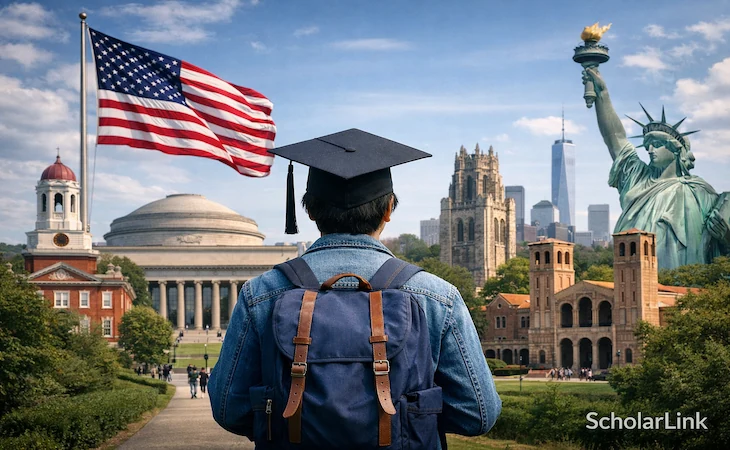
Studying in the USA remains one of the most attractive academic paths for international students because the country offers something that few destinations can match at the same scale: range. The United States is home to a vast mix of universities and colleges, including public research universities, private institutions, liberal arts colleges, community colleges, and specialized graduate schools. That diversity matters. It means a student is not choosing only a country; the student is choosing an academic ecosystem with multiple entry points, funding models, teaching styles, and career pathways.
For many families and applicants, the idea of studying in the USA is tied to prestige. That is part of the picture, but not the full story. In practice, the real advantage is flexibility. A student interested in engineering may find a large research-intensive university with strong laboratories and industry ties. Another student may prefer a smaller college with closer faculty interaction and more personalized academic support. A PhD applicant may be looking less at rankings and more at supervisor fit, research funding, publication culture, and access to facilities. The American higher education system can serve all of these different priorities, which is one reason it continues to attract students from around the world.
A useful way to understand the appeal is to imagine two applicants. One is a high-achieving undergraduate student looking for broad campus life, internships, and long-term career options. The other is a future doctoral researcher comparing labs, principal investigators, and funding packages in a narrow field such as biomedical engineering or education policy. Both are looking at the same country, but they are really evaluating different versions of it. That is often overlooked. “Universities and colleges in the USA” is not a single category. It is a layered landscape, and the right choice depends on academic level, field, budget, and long-term goals.
That is why this guide matters: the headline opportunity is clear, but the real decisions sit underneath it.
One of the strongest reasons students choose the United States is academic opportunity. American universities are deeply connected to research, innovation, and interdisciplinary learning. At the graduate level, especially in master’s and PhD programs, students often work within structured research environments that include faculty supervisors, labs, research centers, teaching assistantships, and grant-funded projects. In many fields, this creates a direct link between academic study and professional development. Students are not only attending classes. They may also be publishing papers, presenting at conferences, joining collaborative research teams, or building relationships that shape future academic and industry careers.
Beyond the classroom, the student experience is another major factor. A serious international student guide for studying in the USA must go beyond admissions and mention daily life: housing decisions, campus services, student clubs, cultural adaptation, transportation, healthcare, part-time work rules, and social integration. Student life and accommodation in the USA can vary dramatically between a dense urban campus in New York or Boston and a college town in the Midwest. From experience, this is where expectations often need adjustment. A university may be excellent academically, but the surrounding environment, cost of living, and support system also shape whether a student succeeds there.
Then there is the long-term value question. Many students and parents ask whether American education still justifies the cost. That is the right question. Tuition fees and scholarships in American universities can vary enormously, and no serious applicant should treat the USA as a uniform market. Still, for many students, the return comes from a combination of academic quality, international reputation, practical exposure, alumni networks, and career mobility. Employers, research institutions, and doctoral admissions committees around the world are familiar with the structure and credibility of strong US programs. That recognition can matter long after graduation.
Next, we’ll move from the big picture to the structure underneath it—so the American system becomes easier to evaluate, not just admire.
This article is designed to help readers make sense of that structure. Whether you are an international applicant, a parent trying to compare options, or a professor advising prospective students, the goal is not simply to praise American education. The goal is to explain how it works, where the real opportunities are, where the trade-offs sit, and how to make better decisions at each stage. Later in this guide, we will connect universities, admissions, funding, visas, accommodation, and career outcomes into one practical roadmap. That way, studying in the USA becomes less of an abstract dream and more of a clear, manageable process.
Why Choose the USA for Higher Education?
For many international students, choosing the United States is not just about studying abroad. It is about entering one of the most developed higher education systems in the world. American universities have built a global reputation not only because of rankings, but because of the depth of their academic infrastructure: experienced faculty, research laboratories, interdisciplinary programs, industry partnerships, academic libraries, and strong alumni networks. When students think about studying in the USA, they are often responding to that wider ecosystem, not simply to a university name.
One of the clearest advantages is academic quality across different types of institutions. The United States is not defined only by a handful of famous universities. It includes thousands of institutions with different strengths, missions, and teaching models. A student interested in computer science may find excellent opportunities at a public research university. Another student focused on liberal arts, education, business, or health sciences may thrive at a smaller private college with close faculty support. This range is one reason universities and colleges in the USA appeal to such a broad international audience. Students can match their goals to the institution instead of forcing their ambitions into one rigid model.
That variety becomes even more valuable when a student is still refining academic direction.
Another major reason to choose the USA for higher education is the diversity of fields and the flexibility of study pathways. In some countries, students must commit early to a narrow academic track. In the United States, especially at the undergraduate level, students often have more room to explore disciplines, combine majors and minors, or shift focus after gaining exposure to new subjects. At the graduate level, flexibility appears in a different way: students can move across departments, work on interdisciplinary research, or combine theory with applied training. That matters in modern fields where boundaries are increasingly blurred, such as data science with public health, engineering with business, or education with technology.
Consider a realistic example. An international applicant arrives with a strong interest in environmental science but becomes increasingly drawn to policy, sustainability management, and urban systems. In a rigid system, that student may feel locked into the original path. In the American system, the same student may find room to reshape the academic plan through electives, cross-department collaboration, or a research project supervised by faculty from multiple areas. In practice, this flexibility can make the difference between finishing a degree and building a career that actually fits.
Research opportunity is another central advantage, especially for master’s and PhD applicants. Many American universities place research at the core of their identity. This means students may gain access to laboratories, fieldwork, grant-funded projects, faculty-led teams, teaching assistantships, and publication opportunities. For doctoral students, the relationship between a principal investigator, supervisor, department, and funding source is often one of the most important factors in the application process. A strong program is not only a place to earn a credential. It is a place to contribute to knowledge, develop a research profile, and build credibility within a field.
This is where the decision becomes strategic rather than symbolic.
International networking is also a serious advantage of studying in the USA. American campuses often bring together students, professors, postdoctoral researchers, and professionals from many countries. That diversity creates everyday exposure to different academic traditions, communication styles, and professional expectations. For some students, the classroom is only part of the value. The larger gain comes from joining a network that extends into research collaborations, conference participation, internships, startup ecosystems, and future job opportunities. From experience, this network effect is often underestimated at the beginning and appreciated only later, when students realize how much their peers, faculty contacts, and alumni connections shape future options.
The cultural dimension matters too, and not only in a lifestyle sense. Student life and accommodation in the USA expose international students to a new social environment that often develops independence, adaptability, and confidence. Students learn how to communicate across cultures, manage practical responsibilities, and navigate unfamiliar systems, from housing and healthcare to academic integrity rules and office hours. That adjustment can be challenging, yes, but it is also part of the educational value. A student who learns how to live, study, and collaborate in a multicultural environment often graduates with more than a degree. The student leaves with sharper judgment, broader perspective, and stronger personal resilience.
This broader development helps explain why the choice is often seen as a long-term investment.
For many readers, the smartest reason to choose the United States is that it combines academic opportunity with future flexibility. A degree from a strong American institution can support several paths at once: academic progression, professional specialization, international mobility, and career repositioning. That does not mean every university offers the same return, and it certainly does not mean every student should choose the USA automatically. Tuition fees and scholarships in American universities vary widely, and the right decision always depends on field, budget, academic profile, and long-term goals. But when the match is right, the United States offers a powerful combination of quality, choice, research depth, global exposure, and personal growth.
That is the core reason many students continue to see studying in the USA as a smart and forward-looking decision.
Universities and Colleges in the USA
Understanding the structure of American higher education is one of the most important steps for any international applicant. Many students use the words college and university as if they mean the same thing, but in the United States, they often point to different kinds of institutions. A college usually refers to a smaller institution that focuses primarily on undergraduate education, although some colleges also offer graduate degrees. A university, by contrast, is typically larger and includes multiple schools or faculties, such as engineering, business, medicine, law, or education, along with master’s and doctoral programs. Universities are also more likely to have extensive research facilities, larger faculty teams, and broader academic infrastructure.
That said, the difference is not always absolute. Some institutions with “college” in the name are academically strong and highly respected. Some universities may feel smaller and more teaching-focused than their size suggests. This is why students should not judge an institution only by its title. In practice, what matters more is the academic level offered, the strength of the department, the learning environment, and whether the institution fits the student’s goals. A future PhD applicant, for example, may prioritize laboratories, faculty publications, and funding opportunities. An undergraduate student may care more about teaching quality, campus support, and flexibility in choosing majors.
This is where structure starts to matter more than branding.
The American system also includes several categories beyond the basic college-university distinction. Community colleges, for instance, usually offer two-year associate degrees and can serve as a transfer pathway into a four-year university. Liberal arts colleges focus on broad-based undergraduate education in the humanities, social sciences, and natural sciences. Research universities, especially those offering PhD programs, place greater emphasis on graduate education, external funding, and original scholarship. For an international student guide for studying in the USA, this point is essential: American higher education is not one model repeated many times. It is a layered system with different missions, price points, admissions standards, and student outcomes.
Imagine a student who says, “I want to study at a top American university.” That sounds clear, but it is actually incomplete. Does the student want a large campus with Division I sports and thousands of research staff? A smaller environment with close professor access? A lower-cost route through a community college transfer? A PhD-focused institution where the supervisor and lab matter more than the overall university brand? These are different decisions hidden inside one sentence. Understanding universities and colleges in the USA helps applicants ask better questions before they apply, not after.
Public vs Private Universities
One of the biggest distinctions in the United States is between public and private universities. Public universities are funded in part by state governments. Because of that structure, they often have lower tuition for students who live in that state and higher tuition for out-of-state and international students. Many public universities are large, academically strong, and research-intensive. They may have broad program offerings, major sports culture, large student populations, and strong links to state industries and public institutions. Flagship public universities such as the University of Michigan, University of California system campuses, or the University of Texas system often combine global research reputation with wide academic choice.
Private universities operate differently. They rely more heavily on tuition revenue, endowments, private donations, and research funding rather than direct state support. Private institutions can be large or small, but they often market themselves through lower student-to-faculty ratios, distinct campus cultures, specialized resources, or strong institutional branding. Some of the most globally recognized American institutions are private, including Harvard, Stanford, MIT, and Yale. For international students, one important detail is that private universities sometimes appear more expensive at first glance, but they may also offer generous institutional aid in some cases, especially at the undergraduate level.
The comparison becomes more useful when students move past assumptions and look at outcomes.
From a teaching and quality perspective, there is no simple rule that private automatically means better or public means more affordable in every real case. Some public universities outperform many private institutions in engineering, business, medicine, agriculture, computer science, and scientific research. Some private universities offer stronger mentoring, smaller classes, or greater prestige in global academic circles. Research opportunities can be excellent in both settings, especially at institutions with strong faculty funding and active graduate programs. What changes is often the scale, culture, and funding model rather than the academic seriousness.
A realistic example helps here. A student admitted to a major public research university may gain access to world-class labs, large alumni networks, and wide course selection, but may also experience larger class sizes in the early years. A student at a private university may benefit from closer advising and smaller seminars, but the overall experience could be more expensive if aid is limited. For graduate and PhD applicants, the picture shifts again. A public university with a well-funded lab and strong supervisor fit may be far more valuable than a private university with a famous name but weaker alignment in the student’s research area.
So the smart comparison is not public versus private as a label. It is public versus private in relation to field, funding, scale, mentoring, and long-term goals.
Ivy League and Top-ranked Universities
The Ivy League is one of the most recognized groups in American higher education, but it is also one of the most misunderstood. Officially, the Ivy League is an athletic conference made up of eight private institutions in the northeastern United States: Harvard, Yale, Princeton, Columbia, University of Pennsylvania, Brown, Dartmouth, and Cornell. Over time, the term has become shorthand for academic prestige, selective admissions, strong alumni influence, and social status. For international families, the phrase often carries symbolic power. But academically, it should be understood as one prestigious group within a much wider landscape of top-ranked universities in the USA.
Many outstanding American universities are not part of the Ivy League at all. Stanford, MIT, the University of Chicago, Duke, Caltech, Johns Hopkins, Northwestern, UC Berkeley, and the University of Michigan are just a few examples of institutions with extraordinary reputations in specific disciplines or across multiple fields. This matters because applicants sometimes narrow their view too early. They may assume that only Ivy League universities represent excellence, when in reality the best option may be another institution with stronger faculty alignment, better funding, a more suitable location, or superior departmental reputation.
That distinction often changes how strong applicants build their list.
Top-ranked universities in the United States usually offer several advantages: internationally recognized degrees, access to leading researchers, high-impact publications, strong employer and alumni networks, advanced facilities, and competitive funding ecosystems. For undergraduates, these universities may provide exceptional academic challenge, brand value, and career access. For graduate students and PhD candidates, the deeper advantage often lies in the research environment itself: mentorship quality, grant activity, lab culture, interdisciplinary collaboration, and conference visibility. From experience, applicants who focus only on the overall university name sometimes miss the more important question, which is whether the department and faculty are the right fit.
There is also a trade-off worth naming clearly. Highly ranked universities can offer significant opportunities, but they are also highly competitive, demanding, and not always the best personal or financial fit. A student may thrive more at a university that is slightly less famous but offers better supervision, more realistic funding, a healthier environment, or stronger support for international students. In other words, rankings can inform a decision, but they should not control it. Rankings are tools, not verdicts.
International Student Guide for Studying in the USA
For international applicants, the American admissions process can look complicated at first because it is not controlled by one single national system. Each university sets its own requirements, deadlines, review criteria, and submission process. That is the first thing to understand. Studying in the USA is not one application repeated many times. It is a portfolio process. Students usually compare programs, review eligibility, prepare documents, contact departments or professors where appropriate, and submit separate applications through university portals or centralized systems depending on the academic level and field.
A smart approach begins with sequence. First, identify the right type of institution and program. Then review the admissions criteria carefully. Then prepare documents early, especially if transcripts, test scores, passport renewal, or recommendation letters may take time. From experience, strong applicants rarely fail because they are weak on paper. They often fail because they start too late, misunderstand what the university is really asking for, or treat every application as if it should be identical. A good international student guide for studying in the USA must therefore explain not only the documents, but the logic behind the process.
That logic is simple: universities are trying to assess readiness, fit, credibility, and intent.
Imagine a prospective applicant from outside the United States who wants to apply for a master’s in public health and also a PhD in a related policy field. The applicant may need to show academic preparation, English language ability, a clear academic purpose, strong references, and, for some programs, evidence of research potential. If the applicant is targeting a PhD, the case must often go further. The university may want proof that the student’s research interests align with faculty expertise, departmental priorities, and available supervision. That is why generic applications tend to underperform. Admissions committees and faculty reviewers are not only asking, “Is this student qualified?” They are also asking, “Is this the right student for this program right now?”
This is where document quality and communication start to shape outcomes.
Application Requirements
Most American universities ask international applicants for a core group of documents. The exact list varies by institution and degree level, but the most common requirements include:
- completed application form
- academic transcripts and, when required, degree certificates or diplomas
- passport identification page
- proof of English proficiency, often through tests such as TOEFL or IELTS, depending on university policy
- statement of purpose or personal statement
- letters of recommendation
- résumé or CV
- writing sample, portfolio, or research proposal for some fields
- standardized test scores if the program still requires them
- application fee, unless waived
For graduate applicants, the statement of purpose is one of the most important parts of the file. A strong SOP does not sound dramatic or overly promotional. It explains the applicant’s academic path, current interests, future direction, and reason for choosing that specific program. It should answer a practical question: why this field, why this university, and why now? In practice, the best statements are specific without becoming overly long. They show intellectual direction, not just ambition. A weak SOP often lists achievements. A strong SOP connects experience to purpose.
Recommendation letters are equally strategic. Students should not choose recommenders only because they hold senior titles. The better choice is usually a professor, supervisor, or research mentor who knows the student’s work well and can comment with detail on academic ability, independence, writing, problem-solving, or research potential. This is often overlooked. A short, vague letter from a famous person is usually less persuasive than a detailed letter from someone who has directly supervised the student’s work. For PhD applicants in particular, letters should reinforce research readiness, discipline, and the ability to contribute to a scholarly environment.
The same principle applies to English proficiency. Universities do not treat language scores as a formality. They use them as evidence that the student can participate in seminars, read complex material, write assignments, communicate with faculty, and function in a demanding academic environment. Some applicants meet the minimum score and assume the issue is finished. But in reality, stronger language ability improves the whole application, including the SOP, interviews, email communication, and later classroom performance.
That brings us to one of the most misunderstood parts of the process: contacting professors.
For many research-based master’s and PhD programs, especially in STEM and some social science fields, reaching out to a professor can be useful or even essential. But the purpose of that message is not to ask for admission directly. The purpose is to show alignment. A good email is brief, respectful, and informed. It usually includes a short introduction, the applicant’s academic background, current research interest, a sentence showing familiarity with the professor’s work, and a clear reason for making contact. The tone should be professional and focused. Not flattering. Not desperate. Not copied and pasted to twenty people.
A realistic scenario makes the difference clear. One applicant sends a generic message: “I want to study in your prestigious university. Please accept me in your lab.” Another applicant writes: “I am applying for the PhD program in educational technology and have been reading your recent work on adaptive learning systems. My current thesis examines student engagement in AI-assisted learning environments, and I believe there is a strong fit between my background and your lab’s focus.” The second message shows preparation, fit, and seriousness. That is what faculty members respond to, when they respond at all.
Once the admission side is in motion, the immigration side becomes the next major step.
Student Visa and Immigration
For academic study in the United States, most international students use the F-1 visa. The visa process begins only after a student has been accepted by a U.S. school that is authorized to enroll international students. After admission, the school issues Form I-20, which is the Certificate of Eligibility for Nonimmigrant Student Status. The student then pays the required visa-related fees, completes the DS-160 online nonimmigrant visa application, and follows the U.S. embassy or consulate instructions to schedule a visa interview where required. Official U.S. guidance also states that new F-1 visas may be issued up to 365 days before the program start date, but entry to the United States is generally not allowed more than 30 days before the start date on the program record.
Before the interview, students should prepare the standard documents carefully. These commonly include:
- valid passport
- DS-160 confirmation page
- visa fee payment receipt, where applicable
- visa photo if required by local instructions
- signed Form I-20
- evidence of academic preparation, such as transcripts, diplomas, or test scores
- evidence of financial ability to cover tuition, living, and travel costs
- documents that support the applicant’s study plan and intent to return after the program, where relevant
The U.S. Department of State notes that consular officers may ask for additional documentation about academic preparation, finances, and the applicant’s intent after study. This matters because the visa interview is not only a document check. It is an eligibility assessment. The officer is trying to understand whether the student is a genuine applicant with a credible academic plan, a real institution, and a realistic ability to fund the stay.
This is why consistency matters so much.
For example, if a student says they plan to pursue a highly specialized master’s degree but cannot explain why they chose the program, how it connects to their background, or how they will afford the first year, the case may appear weak even if the student holds an admission letter. By contrast, a student who can clearly explain the academic goal, the university choice, the funding source, and the post-study plan usually presents a more coherent case. In practice, visa preparation is partly administrative and partly narrative. Your documents must support the same story that your application already told.
The DS-160 itself should be completed carefully and truthfully. The Department of State explains that applicants need the DS-160 confirmation page for the interview, and students are typically asked for details such as the SEVIS ID and school information listed on the I-20. After visa approval, students can make final travel plans, but a visa does not guarantee admission at the airport or land border. Entry is ultimately decided by U.S. Customs and Border Protection at the port of entry, and students should carry key documents in their hand luggage, not in checked baggage.
Once in the United States, maintaining status becomes just as important as obtaining the visa. F-1 students must follow the terms of their program, remain properly enrolled, and comply with the rules attached to their student status. The official guidance also notes that students in F status generally receive a 60-day grace period after the program end date on the I-20 before departure, assuming they remain in status. So the immigration process is not a one-time event. It continues throughout the student journey.
Tuition Fees and Scholarships in American Universities
Cost is one of the biggest factors in any decision about studying in the USA, and it should be approached with realism rather than assumptions. In 2026, the most useful benchmark is the 2025–26 academic-year pricing data, because that is the latest full nationwide tuition cycle published by the College Board. Those figures show a wide gap between sectors: average published tuition and fees were $11,950 at public four-year institutions for in-state students, $31,880 for out-of-state students at public four-year institutions, and $45,000 at private nonprofit four-year institutions. In other words, the average private nonprofit tuition price was about 3.8 times the average in-state public four-year tuition price.
For international students, the practical comparison is usually not public in-state versus private, but public out-of-state versus private, because most international students are charged out-of-state or nonresident tuition at public universities. That changes the picture immediately. A public university may still be cheaper than a private one, but often by a smaller margin than families expect. Using the 2025–26 averages, the gap between public out-of-state tuition and private nonprofit tuition is $13,120 per year, not the much larger gap people imagine when they compare only in-state public prices to private ones.
A realistic applicant should also separate tuition from total annual cost. Published tuition is only one layer. Housing, food, health insurance, books, transportation, and personal expenses can materially change the budget. For 2025–26, average housing and food alone were about $13,900 at public four-year institutions and $15,920 at private nonprofit four-year institutions, which means the full published cost of attendance can rise much faster than the tuition number suggests.
That is why good financial planning starts with structure, not hope.
Average Tuition Fees
For undergraduate study, the average 2025–26 price points provide a useful national map, but students should not treat them as fixed quotes. Public university prices vary by state and campus, and private universities vary even more. College Board’s 2025–26 data show that average in-state tuition and fees at public four-year institutions ranged from $6,360 in Florida and $7,430 in Wyoming to $18,000 in New Hampshire and $18,090 in Vermont. At the flagship level, out-of-state tuition and fees ranged from $13,300 at the University of South Dakota to $63,960 at the University of Michigan. That spread is enormous, and it explains why “American university cost” is never one number.
A simple 2026-style comparison makes the point clearer. An international undergraduate choosing between a public university charging around the national public out-of-state average ($31,880) and a private nonprofit university at the national average ($45,000) is looking at a tuition difference of $13,120 per year. Over a four-year bachelor’s degree, that becomes $52,480, before counting annual cost increases, housing, food, insurance, or travel. If room and board are added using the national averages, the annual published totals move to roughly $45,780 at a public four-year institution and $60,920 at a private nonprofit institution.
At graduate level, the situation becomes more field-dependent. Professional master’s programs in business, engineering, public policy, data science, and health-related areas can be expensive and are often only partially funded or not funded at all. Research-focused PhD programs are different. In many U.S. doctoral programs, especially in STEM fields and some social sciences and humanities departments, the more relevant question is not sticker tuition but whether the student is fully funded through a fellowship, teaching assistantship, or research assistantship. Official graduate-school policies at universities such as Cornell, Rice, Stanford, Northwestern, and the University of Maryland show that doctoral funding packages commonly include some combination of stipend, tuition coverage or remission, fees, and sometimes health insurance.
This is the key distinction: for many bachelor’s and taught master’s students, cost is something to reduce; for many PhD students, funding is something to secure before enrollment.
Scholarships and Financial Aid
International students usually fund U.S. study through a mix of institutional scholarships, departmental awards, assistantships, external fellowships, home-country sponsorship, and family or personal funds. U.S. federal student aid is generally not available to most foreign citizens, and the Department of Homeland Security also notes that international students must show financial ability for study when pursuing F-1 status. That means applicants should assume that their main aid sources will be the university itself, external scholarship programs, or their own sponsors. (Federal Student Aid)
For undergraduates, the most common types of aid are merit scholarships and, at some institutions, need-aware or need-based institutional grants. These awards can range from modest discounts to substantial annual packages. EducationUSA’s scholarship listings show real 2025–26 examples such as awards of $12,000 to $18,000 per year at Concordia College and a scholarship covering 50% of standard tuition, housing, and meals at Roger Williams University for admitted international applicants. These examples are not national averages, but they show how institutional aid often works in practice: scholarships reduce cost, but they do not always make the degree cheap unless the original price and renewal conditions are carefully reviewed.
For graduate students, the funding landscape is more strategic. The main categories are:
- Fully funded PhD packages: often include full or partial tuition coverage, a living stipend, and sometimes health insurance.
- Teaching Assistantships (TA): students support teaching, grading, labs, or discussion sections in exchange for salary or stipend and often tuition support.
- Research Assistantships (RA): students work on faculty-led or grant-funded research and are typically paid while also receiving tuition support in many programs.
- Fellowships: competitive awards that often provide stipend support without requiring teaching or research service in return.
- External scholarships: awards from governments, foundations, or research bodies outside the university.
These are not theoretical categories. University graduate-school guidance explicitly states that assistantships commonly provide a stipend plus tuition remission or tuition reimbursement, and fellowships may also include tuition support.
A strong example of how external fellowships work is the NSF Graduate Research Fellowship Program. For the current cycle, NSF states that each fellowship year provides a $37,000 stipend plus a $16,000 cost-of-education allowance paid to the institution. That is not a universal PhD funding level across the country, but it shows the scale of competitive doctoral funding in the U.S. research system. (NSF – U.S. National Science Foundation)
The smartest way to reduce cost depends on degree level. An undergraduate applicant can lower expenses by targeting universities with automatic merit awards, applying early where scholarship consideration is tied to admission timing, comparing total cost rather than tuition alone, and considering lower-cost public or regional institutions instead of chasing prestige blindly. A graduate applicant should focus on departments with a real funding culture, contact potential supervisors where appropriate, ask direct questions about assistantships and duration of support, and distinguish clearly between an admission offer and a funded offer. This is often overlooked, and it matters enormously. Being accepted into a program is not the same as being financially able to attend it.
Consider one simple scenario. Student A receives admission to a private master’s program with annual tuition of about $45,000 and a scholarship of $15,000. Student B receives admission to a public university charging roughly the public out-of-state average of $31,880 with no scholarship. On tuition alone, Student A still pays about $30,000, which is slightly lower than Student B. But once housing, fees, insurance, and location-based living costs are added, either option could end up being more expensive. That is why applicants should compare net annual cost, not the headline scholarship amount.
That financial lens changes the decision from “Which university sounds better?” to “Which offer is sustainable and strategically worth it?”
In practice, the most financially successful international students are not always those admitted to the most famous institution. They are often the ones who understand funding models early, apply broadly but selectively, build strong scholarship-ready applications, and treat cost as part of academic fit rather than an afterthought. Later in this guide, that same logic becomes even more important when we connect finances to student life, housing, and long-term career planning.
Student Life and Accommodation in the USA
For many international students, the biggest adjustment is not the classroom. It is everyday life. Studying in the USA usually means learning how to manage time, money, housing, friendships, academic expectations, and independence all at once. That is why student life should be treated as part of the educational experience, not as a side issue. A university may look excellent on paper, but daily life on campus or in the surrounding city will strongly affect well-being, focus, and long-term success.
The American student experience can feel very different depending on where a student studies. A large public university may offer a busy campus, major events, strong sports culture, hundreds of organizations, and a more self-directed environment. A smaller private college may offer a tighter community, easier professor access, and a more residential atmosphere. EducationUSA notes that students often need to think carefully about whether they want an urban, suburban, or rural setting, whether they want to live on campus or off campus, and whether clubs, sports, and local activities matter to them. (EducationUSA)
This matters because student life in the USA is never one standard experience.
A realistic example makes that clear. One student may choose a university in a major city such as Boston or Chicago and enjoy access to internships, public transit, cultural diversity, and off-campus networking. Another may choose a college town and benefit from a quieter academic rhythm, lower daily distractions, and a more concentrated campus community. Neither option is automatically better. The right choice depends on personality, budget, academic workload, and how much structure the student needs outside the classroom.
Campus Life and Activities
Campus life in the United States usually extends far beyond lectures and exams. EducationUSA describes U.S. campuses as places where students take part not only in academic work, but also in research, part-time jobs, clubs, events, sports, and a wide range of extracurricular experiences. It also notes that academic, cultural, athletic, and special-interest clubs help students socialize, explore shared interests, and form a community within the campus environment.
For international students, these activities are more important than they first appear. A club fair, student association, volunteering event, graduate student society, entrepreneurship group, or departmental seminar can become the place where friendships begin and professional connections form. In practice, many students build their first real support system through campus organizations rather than through formal orientation alone. This is especially true in the first semester, when routine and belonging have not yet fully developed.
That social layer also supports academic and career development.
A student who joins a research group, debate society, coding club, international student association, or discipline-specific organization often gains more than just recreation. These spaces can improve communication skills, introduce leadership opportunities, and create informal networking with peers, faculty, alumni, and employers. EducationUSA also highlights that employers often connect with student groups and extracurricular activities, which helps explain why involvement outside class can have career value as well as social value. (EducationUSA)
There is also a cultural side that should not be underestimated. American campus culture often encourages students to speak up, attend office hours, participate in discussions, and manage their schedules independently. For some international students, this feels exciting. For others, it feels unfamiliar at first. From experience, the transition becomes easier when students actively join campus life instead of waiting passively to “settle in.” The more a student engages with the environment, the faster the university starts to feel usable rather than overwhelming.
Accommodation Options
Housing is one of the most important practical decisions in the entire student journey. In the USA, the most common options are on-campus residence halls or dormitories, university-managed apartments, off-campus apartments, shared houses, co-ops, and in some cases host-family arrangements. EducationUSA materials specifically note on-campus and off-campus housing as major choices, and also mention co-ops and host-family living as additional possibilities in some situations.
On-campus housing is often the easiest option for first-year students or anyone arriving in the U.S. for the first time. It usually simplifies the first months because students live close to classes, campus services, dining halls, and student activities. Dorm life can also make it easier to meet people quickly. The trade-off is that residence halls may offer less privacy, more rules, and limited flexibility compared with private renting. Off-campus housing, by contrast, may provide more independence and sometimes better value per square foot, but it usually requires more effort: lease review, deposits, utility setup, commuting, furniture, and sometimes a guarantor or credit history.
This is where cost planning becomes very real.
For 2025–26, College Board reported average housing and food charges of about $13,900 at public four-year institutions and $15,920 at private nonprofit four-year institutions. Those are national averages, not guaranteed bills, but they are useful 2026 benchmarks because they show that living costs are a major part of the student budget even before transportation, books, health insurance, and personal expenses are added. The difference between those two averages is $2,020 per year.
A simple comparison helps. If Student A lives in a campus residence hall at a public university near the national average for housing and food, and Student B lives in housing priced near the private nonprofit average, Student B may spend about 14.5% more on that part of the budget alone. That does not mean private-campus housing is always overpriced or that off-campus living is always cheaper. In some expensive cities, a shared off-campus apartment can cost more than a dorm once transportation, utilities, and furnishing are included. The right comparison is always total monthly living cost, not rent in isolation.
Students should therefore evaluate housing with a practical checklist:
- distance to classes, labs, or campus shuttle routes
- lease length and move-in timing
- whether utilities and internet are included
- meal plan requirements
- safety and neighborhood environment
- furnishing status
- roommate expectations and noise level
- total monthly cost, not just advertised rent
EducationUSA also notes that living with an American host family can be enriching and may be less expensive than some other off-campus options, though availability depends on the institution.
The most useful mindset is this: housing is not only about where you sleep. It shapes commute time, stress level, social life, academic routine, and spending discipline. A student who chooses a slightly less glamorous but more stable living arrangement often performs better than a student who chooses housing based only on appearance or impulse. Later in the guide, that same principle connects directly to budgeting, adaptation, and long-term success in the United States.
Career Opportunities After Graduation
One reason studying in the USA remains attractive is that the value of the degree does not end at graduation. For many international students, the real question is what comes next: Can I work in the United States? Can I gain professional experience? Is there a path from study to longer-term immigration or global career mobility? These are practical questions, and they matter because the return on education is shaped not only by the classroom, but by what a student can do with the degree afterward.
The first major pathway for many F-1 students is Optional Practical Training, usually called OPT. U.S. Citizenship and Immigration Services explains that practical training is employment directly related to a student’s major area of study, and post-completion OPT takes place after the program end date. For many graduates, this is the bridge between academic study and professional experience. It allows students to work in roles connected to what they studied rather than leaving the United States immediately after graduation.
For STEM graduates, the opportunity can extend further. USCIS states that certain F-1 students with eligible science, technology, engineering, and mathematics degrees may apply for a 24-month STEM OPT extension beyond standard post-completion OPT. That makes STEM fields especially significant in career planning, because the graduate may have more time to build U.S. experience, strengthen an employer relationship, and prepare for the next immigration step. (USCIS)
That is where graduation starts to look less like an ending and more like a transition point.
A realistic scenario helps. Imagine an international student who completes a master’s in data analytics. During the program, the student joins a faculty-led project, attends industry networking events, and secures a summer internship. After graduation, the student uses post-completion OPT to work in a data-focused role. If the degree is STEM-designated and the employer meets the requirements, the student may later seek the 24-month STEM OPT extension. That sequence matters because employers often prefer candidates who can begin working quickly and who already understand the U.S. workplace. In practice, the strongest post-study outcomes usually begin before graduation, not after it.
Beyond OPT, students should understand that “working in America after graduation” is not one single path. It is a chain of decisions. The graduate may pursue short-term professional experience through OPT, transition to an employer-sponsored status if eligible, continue into another academic program, or use the U.S. degree to compete for opportunities in Canada, Europe, the Middle East, or the home country. This is often overlooked. The value of studying in the USA is not only local. A strong American degree can also improve international employability because employers and institutions worldwide recognize the training environment, academic standards, and practical exposure associated with well-regarded U.S. programs.
That broader perspective becomes especially important when immigration is part of the conversation.
Students should be careful here, because immigration rules are not static and they can change. USCIS policy materials make clear that F-1 status is temporary and tied to academic study, while employment after graduation depends on specific legal pathways such as OPT and other authorized categories. (USCIS) Some graduates later explore employer-sponsored routes, and others may decide that the smarter move is to gain one to three years of U.S. experience and then relocate strategically. From experience, the best long-term decisions usually come from matching immigration options to field, employer demand, degree type, and personal goals rather than assuming there is one universal route for everyone.
For students who want a strong professional start, a few habits matter a lot:
- build career preparation before the final semester
- use career services, alumni networks, and faculty contacts actively
- look for internships, campus jobs, or research roles that strengthen the résumé
- understand whether the degree is STEM-designated
- track immigration deadlines carefully and rely on official guidance for status-related decisions
The most successful graduates are usually the ones who treat career planning as part of the degree itself. They do not wait until graduation week to think about work, visas, or networking. They build toward those outcomes from the first year or first semester. That is one of the clearest ways to turn studying in the USA into a smart long-term investment.
Conclusion
Studying in the USA can offer international students far more than a classroom education. As this guide has shown, the real value comes from the combination of academic choice, institutional diversity, research access, global networking, cultural development, and post-graduation opportunity. But the system is also complex. Universities and colleges in the USA differ widely in structure, cost, funding, student life, and career outcomes. The smartest applicants are not simply the most ambitious. They are the ones who understand how these pieces fit together and make decisions with clarity.
That brings the article back to its central point: the United States can be an excellent destination for higher education, but only when students choose strategically. The right university is not always the most famous one. The right offer is not always the one that sounds impressive at first glance. The right path is the one that aligns academic goals, finances, supervision, lifestyle, and future plans in a way that is actually sustainable.
If you want help making that path clearer, ScholarLink.ai can support the next step by helping international students identify relevant programs, find potential professors or supervisors, and approach the application process with stronger fit and direction. When the search becomes more targeted, the whole journey usually becomes more manageable too.