

Do university rankings really matter when choosing where to study? Every year, millions of prospective undergraduate and graduate students use global university rankings to compare institutions and decide where to invest their time, money, and education.
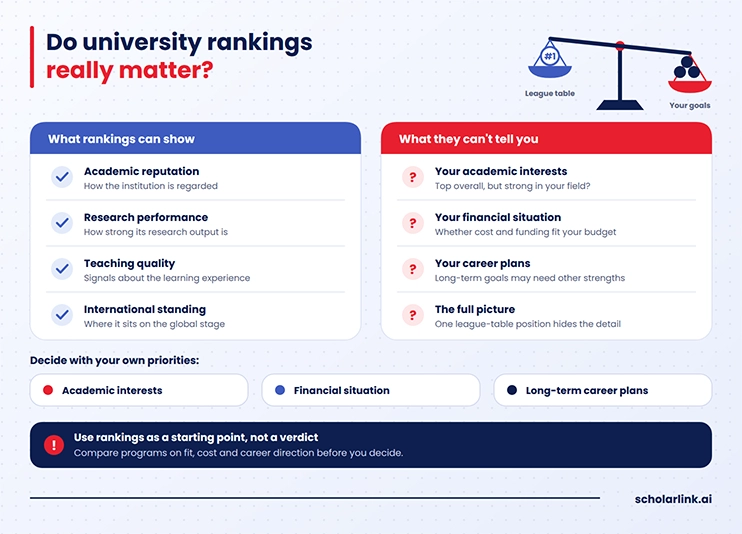
Rankings can provide useful insights into factors such as academic reputation, research performance, teaching quality, and international standing. However, an overall ranking does not tell the full story. Focusing too heavily on a university’s position in a league table can cause students to overlook factors that may be more relevant to their goals.
Understanding why university rankings are important, as well as their limitations, can help you make a more informed decision based on your academic interests, financial situation, and long-term career plans.
Why Are University Rankings Important?
University rankings provide a common framework for comparing higher education institutions across countries. They bring together different types of institutional data and turn them into indicators that students, universities, and policymakers can use when evaluating academic institutions.
However, rankings do not measure every aspect of the student experience. Understanding what these metrics represent—and what they leave out—can help prospective students interpret ranking results more effectively.
What University Rankings Measure
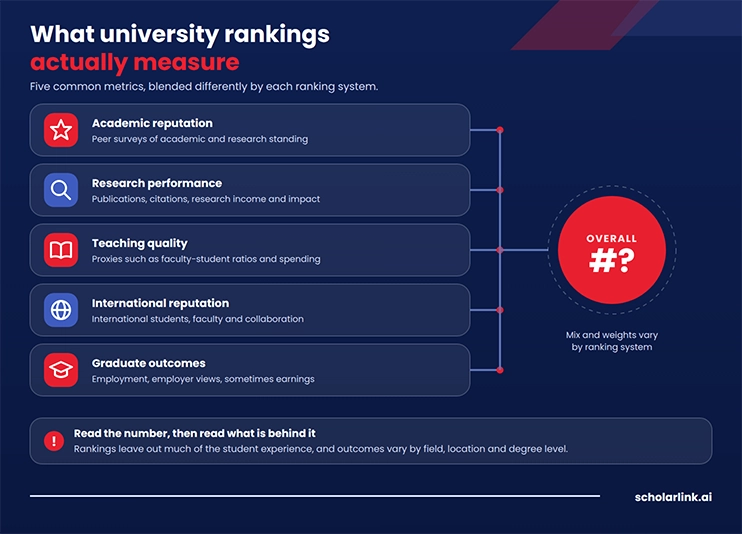
Different ranking systems use a mix of quantitative data, surveys, and other indicators to assess universities. The specific methodology varies by ranking, but common metrics include academic reputation, research performance, teaching-related indicators, international outlook, and graduate outcomes.
| Ranking Metric | What It Typically Measures |
|---|---|
| Academic Reputation | Peer assessments of a university’s academic and research reputation within the higher education community. |
| Research Performance | Research publications, citations, research income, and other measures of research activity and impact. |
| Teaching Quality | Indicators related to teaching resources and the learning environment, such as faculty-to-student ratios or institutional spending. |
| International Reputation | Measures of international students and faculty, as well as international research collaboration and global engagement. |
| Graduate Outcomes | Indicators such as graduate employment, employer perceptions, and, in some rankings, earnings or starting salaries. |
Academic Reputation
Academic reputation is commonly assessed through surveys of academics who evaluate institutions based on their perceived academic and research strength. Because reputation reflects peer recognition and an institution’s established standing, it can be an important component of some overall ranking systems.
Research Performance
Research performance may be evaluated using indicators such as publication volume, citation impact, research income, and contributions to high-impact journals. For research-oriented students, these measures can provide useful context about an institution’s research activity and academic environment.
Teaching Quality
Teaching quality is more difficult to measure consistently than some research indicators. Ranking systems may therefore use proxy measures such as faculty-to-student ratios, spending per student, or the qualifications of academic staff. These indicators can offer some insight into teaching resources, but they do not fully capture classroom experience or instructional quality.
International Reputation
International outlook can include the proportion of international students and faculty, cross-border research collaborations, and other measures of global engagement. This can be particularly relevant for students who value an internationally diverse academic environment.
Graduate Outcomes
Some ranking systems assess graduate outcomes using measures such as employment rates, employer surveys, and graduate earnings. These indicators can provide context about how graduates perform after completing their studies, although outcomes may also vary significantly by field, location, degree level, and individual career path.
How Do University Rankings Affect Students’ Choices?
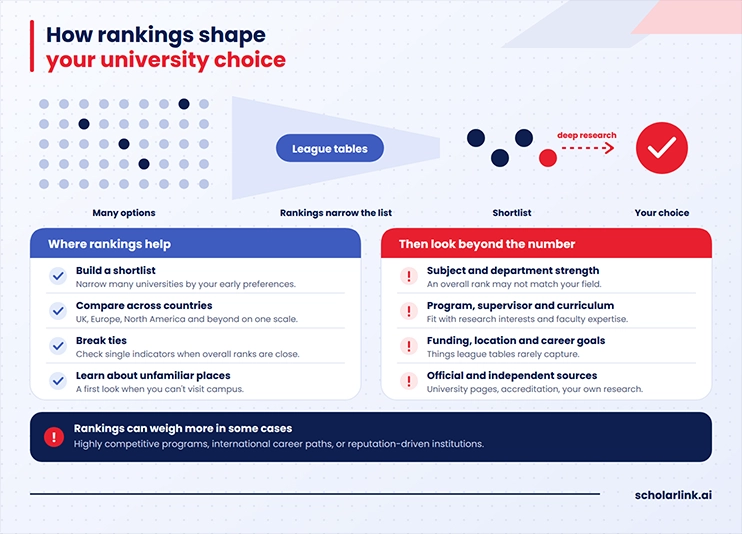
University rankings can influence graduate study choices by helping students narrow down a large number of potential institutions. For many applicants, rankings are most useful during the early stages of university research, when they need a practical way to compare institutions and build a shortlist.
Rankings as a Starting Point for University Research
League tables can provide a useful starting point for university research. Instead of investigating every institution individually, students can use rankings to identify universities that match their initial academic, geographic, or career preferences and then research those options in greater detail.
Comparing Universities and Programs
Rankings offer a standardized framework for comparing universities across different countries. This can help applicants compare institutions in the United Kingdom with alternatives in Europe, North America, or other regions.
However, overall rankings should be treated as a starting point rather than a complete comparison. Subject rankings, program structure, research opportunities, and department-level reputation can provide more relevant information for a specific field of study.
Choosing Between Similar Universities
When applicants are considering universities with similar overall rankings, they can look at individual ranking indicators to identify differences in areas such as research performance, international outlook, or faculty resources.
These comparisons can help narrow the options, but students should also consider factors that rankings may not capture, such as supervisor fit, curriculum, funding, location, and career goals.
Rankings and International Students
For international students who cannot visit campuses before applying, rankings can provide one source of information about an unfamiliar institution’s academic reputation and international profile.
Still, rankings should be considered alongside official university information, program details, accreditation where relevant, and independent research. A university’s overall position does not necessarily reflect the quality or suitability of every program it offers.
When Rankings Can Influence Graduate Study Choices
Rankings may carry more weight when students are comparing highly competitive programs, considering international career paths, or looking at institutions where academic reputation is particularly relevant.
At the same time, an important distinction is needed: a strong overall university ranking does not necessarily mean that the university has an equally strong program or department in your specific field. For graduate applicants, subject ranking, research strength, faculty expertise, and program fit can sometimes provide more relevant information than the overall position.
Top-Ranked Universities and Academic Reputation
The reputation of highly ranked universities is shaped by years of academic, research, and institutional achievements. However, a university’s overall reputation does not necessarily reflect the strength of every department or program it offers.
Why Academic Reputation Matters
Academic reputation can influence how a university is perceived by academics, researchers, and employers. For students, it can provide useful context about an institution’s established standing within higher education and research.
However, reputation is only one factor to consider. Its relevance depends on the student’s field, degree level, career goals, and the specific program they are considering.
How University Reputation Is Built
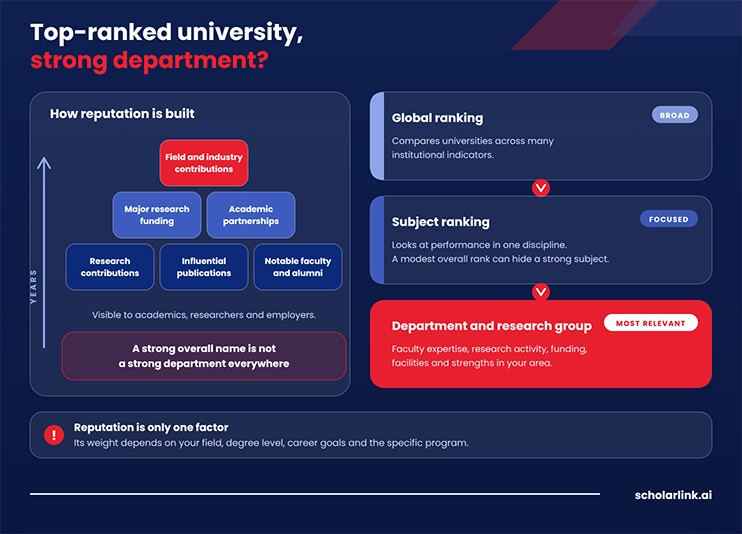
University reputation develops over time through factors such as research contributions, influential publications, notable faculty and alumni, major research funding, academic partnerships, and broader contributions to a field or industry.
These factors can contribute to an institution’s visibility and recognition, but a strong overall reputation does not automatically mean that every academic department has the same level of strength.
Global Rankings vs Subject Rankings
Global rankings assess universities across a broad range of institutional indicators, while subject rankings focus on performance within specific academic disciplines.
This distinction matters when choosing a specialized program. A university with a relatively modest overall ranking may have a strong position in a particular subject, making its subject ranking more relevant to an applicant in that field.
University Ranking vs Department Reputation
For specialized graduate study, department-level reputation can provide more relevant information than an institution’s overall ranking. Applicants should consider factors such as faculty expertise, research activity, available funding, facilities, and the department’s strengths in their intended area of study.
A university’s overall position in a global ranking does not necessarily indicate how strong a particular department or research group will be for a student’s goals.
Why Research Reputation Matters for PhD Students
For PhD applicants, research environment is an important consideration. Doctoral study is closely connected to the department, research group, and prospective supervisor, as well as the resources available for the student’s research.
An influential researcher, active research group, strong laboratory infrastructure, or relevant funding opportunities may therefore be more directly relevant to a PhD applicant than the university’s overall international ranking.
How University Rankings Influence Career Opportunities
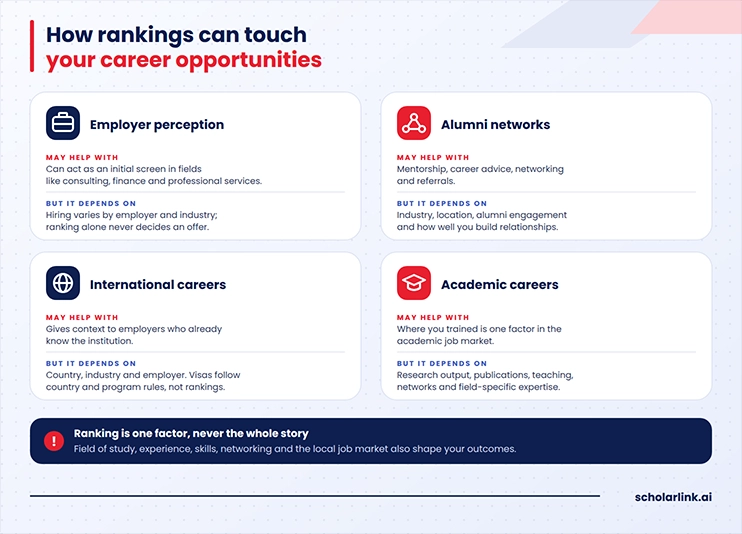
University rankings can play a role in how employers, academic institutions, and prospective students perceive a university’s reputation. However, the relationship between university ranking and career outcomes is not straightforward. The value of a degree also depends on factors such as field of study, professional experience, skills, networking, and the local job market.
Employer Perception
Some employers may consider university reputation when reviewing applications, particularly in industries where academic background is commonly used as an initial screening factor. This can be relevant in fields such as management consulting, finance, and some professional services.
However, hiring practices vary significantly between employers and industries. A university’s ranking is only one potential factor in an application and does not determine whether a candidate will receive an offer.
Alumni Networks
Universities with large and established alumni communities may provide students with access to broader professional networks. Alumni connections can support activities such as mentorship, career advice, networking, and referrals.
The usefulness of an alumni network depends on factors such as the industry, geographic location, level of alumni engagement, and the student’s ability to build professional relationships.
International Career Opportunities
For students planning to work internationally, a university’s reputation may provide some context for employers who are familiar with the institution. However, the importance of university reputation varies by country, industry, and employer.
Immigration and post-study work opportunities should also be evaluated separately. Visa eligibility is determined by the rules of the relevant country and program, and should not be assumed to depend solely on a university’s ranking.
Academic Careers and Research Positions
For students pursuing academic careers, the reputation of the institution where they complete their graduate training can be one factor in the academic job market. Research output, publications, teaching experience, academic networks, field-specific expertise, and the strength of a candidate’s research profile can also be important.
The relative importance of these factors varies across disciplines, institutions, and academic job markets.
Does a Higher University Ranking Guarantee a Better Career?
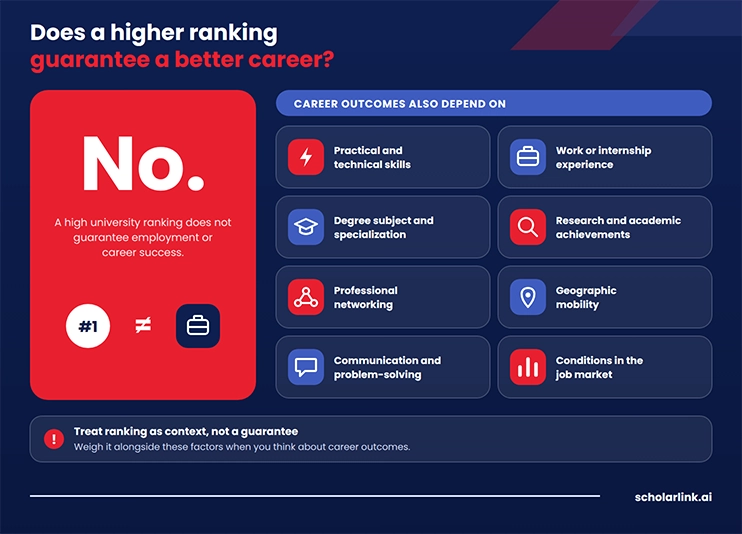
No. A high university ranking does not guarantee employment or career success.
Career outcomes can depend on a combination of factors, including:
- Practical and technical skills
- Relevant work or internship experience
- Degree subject and specialization
- Research and academic achievements
- Professional networking
- Geographic mobility
- Communication and problem-solving skills
- Conditions in the relevant job market
University ranking can provide useful context, but it should be considered alongside these factors rather than treated as a guarantee of career outcomes.
Do University Rankings Really Matter?
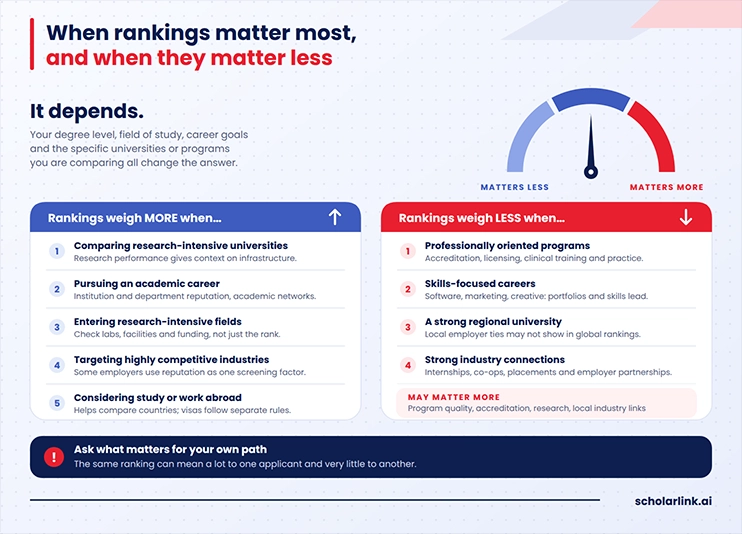
How much university rankings matter depends on factors such as your degree level, field of study, career goals, and the specific universities or programs you are comparing. For some students, rankings can provide useful context. For others, program quality, professional accreditation, research opportunities, or local industry connections may be more relevant.
When University Rankings Matter Most
University rankings may carry more weight when:
- Comparing research-intensive universities: Overall research performance can provide useful context for students looking for extensive research infrastructure and resources.
- Pursuing an academic career: Institutional and department-level reputation may be relevant when evaluating research environments and academic networks.
- Entering research-intensive fields: Fields that depend on specialized laboratories, major research facilities, or substantial research funding may require closer attention to research strength than to ranking alone.
- Targeting highly competitive industries: Some employers may consider university reputation as one factor when screening candidates, particularly in industries with highly selective recruitment processes.
- Considering international study or employment: A university’s international reputation can provide useful context when comparing institutions across countries, although work authorization and visa eligibility are governed by separate rules.
When University Rankings Matter Less
Rankings may be less informative when:
- Choosing professionally oriented programs: Factors such as professional accreditation, licensing requirements, clinical training, or practical experience may be more relevant than overall ranking.
- Building skills-focused careers: In fields such as software development, digital marketing, and some creative industries, demonstrable skills, portfolios, and work experience can be particularly important.
- Studying at a strong regional university: A university with established relationships with local employers may offer valuable opportunities that are not reflected fully in global rankings.
- Choosing programs with strong industry connections: Internships, cooperative education, work placements, and direct employer partnerships can have significant value for students focused on entering the workforce.
University Ranking vs Program Quality
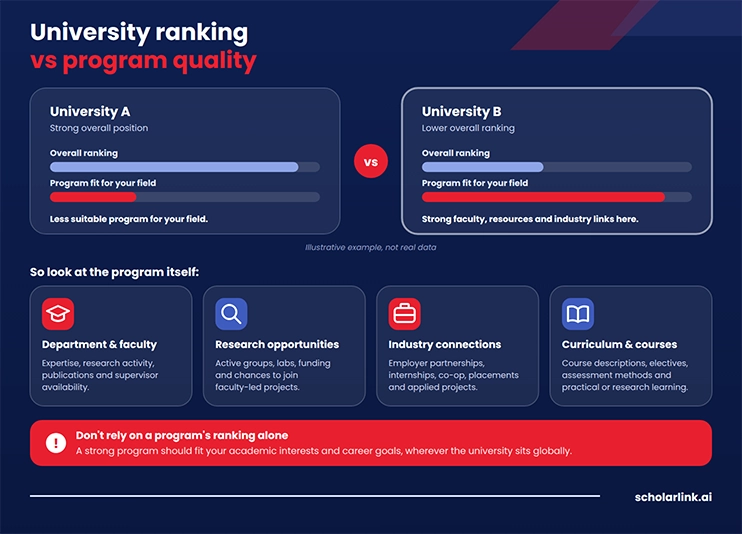
Looking at a university’s overall ranking alone does not always provide a clear picture of the quality of a specific program. A university may have a strong overall position but offer a less suitable program for a particular field, while another institution with a lower overall ranking may have strong resources, faculty, or industry connections in that discipline.
Why Program Ranking Can Matter More
For students choosing a specific field, subject and program-level information can sometimes be more useful than an overall university ranking. Program rankings may consider factors related to a particular discipline, including research performance, faculty reputation, and academic resources.
However, applicants should also review the program itself rather than relying on its ranking alone.
Department and Faculty Reputation
Department-level reputation can provide important context about the academic environment students will join. Faculty expertise, research activity, publications, and the availability of supervisors can be particularly relevant for graduate students.
For research-focused applicants, the strength of the department and the work of individual faculty members may therefore deserve close attention alongside the university’s overall ranking.
Research Opportunities
Research opportunities can vary significantly between universities and departments, regardless of overall ranking. Students should look at active research groups, available laboratories, research funding, publications, and opportunities to participate in faculty-led projects.
A smaller or less highly ranked university may offer strong opportunities in a particular research area, while a highly ranked institution may have greater resources in other fields.
Industry Connections
Industry connections can be especially valuable for students seeking practical experience or employment after graduation. Relevant factors include employer partnerships, internships, cooperative education, work placements, applied research projects, and the strength of a department’s professional network.
These opportunities may be influenced by the university’s location and relationships with local industries and employers.
Curriculum and Course Content
Program quality also depends on what students actually study. Review the curriculum, course descriptions, elective options, assessment methods, and opportunities for practical or research-based learning.
A strong program should provide coursework that is relevant to the student’s academic interests and career goals, regardless of where the university appears in a global ranking.
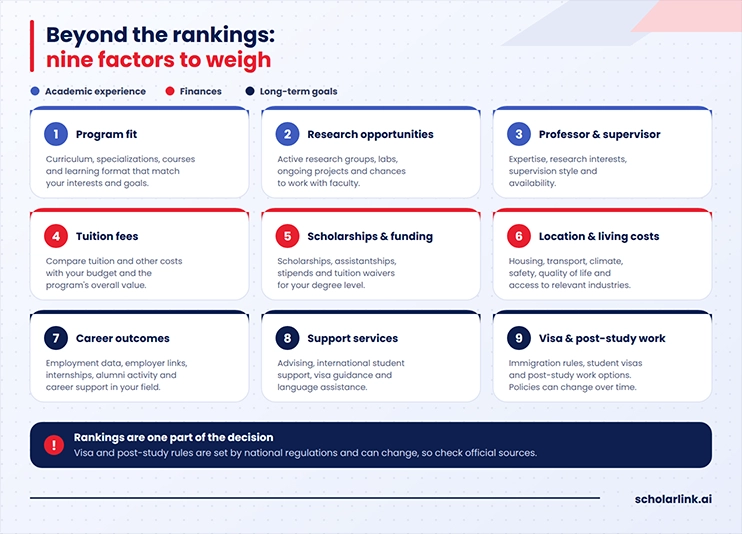
What Should You Consider Besides University Rankings?
University rankings are only one part of the decision-making process. Before choosing a university, prospective students should also evaluate factors that directly affect their academic experience, finances, and long-term goals.
- Program Fit: Consider whether the curriculum, specialization options, courses, and learning format align with your academic interests and career goals.
- Research Opportunities: Look for active research groups, laboratories, ongoing projects, and opportunities to work with faculty or contribute to research.
- Professor and Supervisor Fit: For research-based graduate programs, consider faculty expertise, research interests, supervision style, and availability when evaluating potential supervisors.
- Tuition Fees: Compare tuition and other university-related costs with your available budget and the overall value of the program.
- Scholarships and Funding: Check the availability of scholarships, assistantships, stipends, tuition waivers, and other funding opportunities for your degree level and program.
- Location and Cost of Living: Consider housing costs, transportation, climate, safety, quality of life, and access to relevant industries or professional opportunities.
- Career Outcomes: Review employment data where available, employer connections, internship opportunities, alumni activity, and career support relevant to your field.
- Student Support and International Community: Evaluate services such as academic advising, international student support, visa guidance, language assistance, and other resources available to students.
- Visa and Post-Study Opportunities: Research the immigration rules, student visa conditions, post-study work options, and other pathways available in the country. These policies are determined by national regulations and can change over time.
How to Choose a University Using Rankings
Using university rankings effectively requires more than checking an overall score. A structured research process can help you use rankings as a starting point while evaluating the factors that matter most to your academic and career goals.
| Step | Action | What to Check |
|---|---|---|
| Step 1 | Check Overall Ranking | Use the overall ranking to understand the university’s broad international standing. |
| Step 2 | Check Subject Ranking | Compare the university’s position in your specific field or discipline. |
| Step 3 | Compare the Department | Review departmental research activity, faculty expertise, funding, and available facilities. |
| Step 4 | Research Faculty Members | Identify professors whose research interests and recent work align with your goals. |
| Step 5 | Review Research Opportunities | Look for active research projects, laboratories, assistantships, and relevant funding opportunities. |
| Step 6 | Compare Costs and Funding | Estimate total study and living costs and compare them with available scholarships, stipends, and tuition support. |
| Step 7 | Check Career Outcomes | Review available employment data, industry connections, alumni networks, internships, and career services. |
| Step 8 | Evaluate Overall Fit | Consider location, lifestyle, student support, program structure, and relevant post-study work rules. |
Which University Ranking Should You Trust?
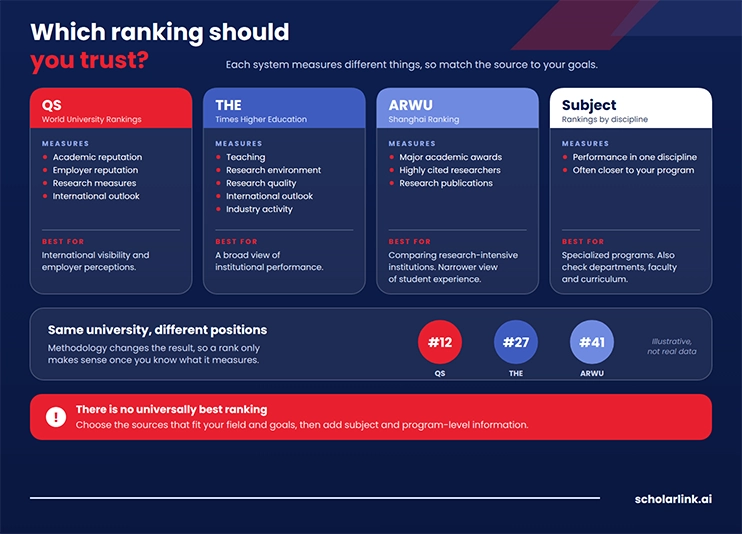
Different university ranking systems use different methodologies, indicators, and data sources. As a result, the same university can receive very different positions across ranking tables.
Rather than asking which ranking is universally the most reliable, applicants should understand what each system measures and choose the sources that are most relevant to their field and goals.
QS World University Rankings
The QS World University Rankings use a combination of indicators that include academic reputation, employer reputation, research-related measures, international outlook, and other institutional data.
For students interested in international visibility or employer perceptions, QS can provide useful context. However, its overall ranking should still be considered alongside subject rankings and program-specific information.
Times Higher Education Rankings
The Times Higher Education (THE) World University Rankings use indicators covering areas such as teaching, research environment, research quality, international outlook, and industry-related activity.
Its methodology can provide a broad view of institutional performance, but applicants should still examine the specific indicators that are most relevant to their degree and field.
Academic Ranking of World Universities (ARWU)
The Academic Ranking of World Universities, commonly known as the Shanghai Ranking, places substantial emphasis on research-related indicators. These include measures involving major academic awards, highly cited researchers, research publications, and other research performance metrics.
Because ARWU has a strong research focus, it may be particularly informative for students comparing research-intensive institutions. However, it provides a narrower picture of the overall student experience than a ranking that incorporates a broader range of indicators.
Subject-Specific Rankings
Subject rankings evaluate universities within particular academic disciplines. For applicants choosing a specialized program, these rankings can provide more relevant information than an overall institutional ranking.
However, applicants should also review department-level research, faculty expertise, curriculum, facilities, and program outcomes rather than relying on a subject ranking alone.
Why Ranking Methodology Matters
No single ranking system captures every aspect of university quality. Differences in methodology can produce significantly different results for the same institution.
For example, one ranking may place greater emphasis on reputation and international outlook, while another may give more weight to research performance and academic awards. Understanding these differences helps applicants interpret ranking positions in context rather than treating them as universal measures of quality.
What Master’s Students Should Look For
For taught Master’s programs, applicants may want to consider overall university reputation alongside program quality, curriculum, career services, employer connections, internships, and graduate outcomes.
The relative importance of each factor depends on the student’s field and career goals. A professional Master’s applicant may have different priorities from someone pursuing a research-oriented degree.
What PhD Students Should Look For
For PhD applicants, university-wide rankings are only one part of the evaluation. Research alignment, potential supervisors, research groups, funding, publications, laboratory facilities, and departmental expertise can be particularly relevant.
Applicants should investigate the specific research environment they would join rather than assuming that an institution’s overall ranking represents the quality of every research group.
Why PhD Students Should Look Beyond Overall Rankings
A highly ranked university does not automatically provide the strongest research environment for every doctoral applicant. The suitability of a PhD depends on factors such as supervisor expertise, research alignment, funding, research facilities, departmental activity, and opportunities to publish or collaborate.
When comparing PhD programs, evaluate these factors individually and consider how well the research environment supports your specific academic goals. Overall university ranking can provide useful context, but it should not replace program- and research-level evaluation.
Common Mistakes When Using University Rankings
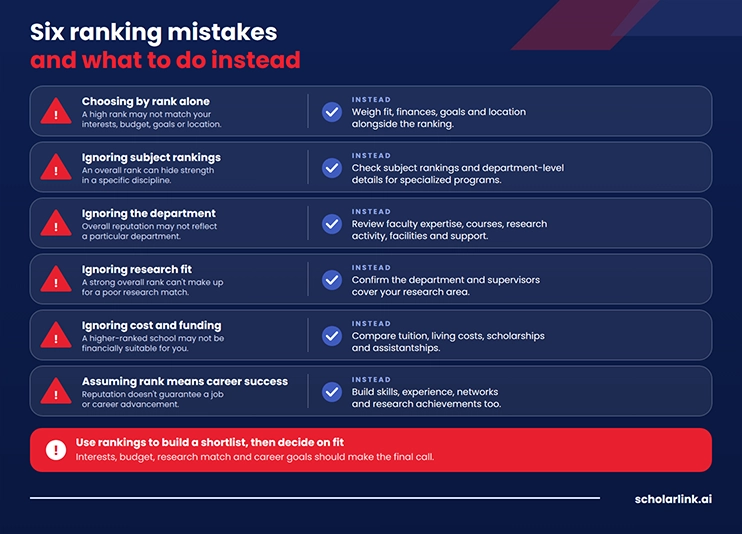
University rankings can be useful for comparing institutions, but relying on them too heavily can lead to an incomplete assessment. Avoid these common mistakes when using ranking data:
- Choosing a University Only Because of Its Ranking: A high overall ranking does not necessarily mean that a university is the right fit for your academic interests, budget, career goals, or preferred location.
- Ignoring Subject Rankings: An overall ranking may overlook strong performance in a specific discipline. Check subject rankings and department-level information when evaluating a specialized program.
- Ignoring the Department: A university’s overall reputation does not necessarily reflect the quality of a particular department. Review faculty expertise, course offerings, research activity, facilities, and available support.
- Ignoring Research Fit: For research degrees, make sure the department and potential supervisors have relevant expertise in your intended research area. A strong overall ranking cannot compensate for a poor research match.
- Ignoring Cost and Funding: Compare tuition, living expenses, scholarships, assistantships, and other funding options before making a decision. A higher-ranked institution may not be the most financially suitable option for your circumstances.
- Assuming Ranking Guarantees Career Success: A university’s reputation does not guarantee employment or career advancement. Skills, relevant experience, networking, research achievements, and performance during the recruitment process also contribute to career outcomes.
FAQ About University Rankings
Why do university rankings matter?
University rankings can help students compare institutions using standardized indicators such as academic reputation, research performance, international outlook, and graduate outcomes. They are most useful as a starting point rather than a complete measure of university quality.
How important are university rankings when choosing a university?
Their importance depends on your degree level, field of study, and career goals. Rankings can help with initial comparisons, but factors such as program fit, tuition costs, faculty expertise, research opportunities, location, and career outcomes should also be considered.
Do university rankings affect career opportunities?
University reputation may influence how some employers perceive a candidate or may provide access to established alumni and professional networks. However, career outcomes also depend on skills, relevant experience, networking, field of study, and the local job market. University ranking does not guarantee employment or career success.
Should I choose a university based on its ranking?
No. An overall ranking should be one factor in your decision, not the only one. Compare the university’s program quality, academic fit, costs, funding opportunities, research environment, location, and career opportunities with your personal goals.
Are subject rankings more important than overall rankings?
For students choosing a specific field, subject rankings can provide more relevant information than overall rankings. However, they should still be considered alongside department reputation, faculty expertise, curriculum, research opportunities, and other program-level factors.
Does university ranking matter for PhD applications?
University ranking can provide useful context, but PhD applicants should also examine research alignment, potential supervisors, department expertise, funding, research facilities, and publication opportunities. The relevance of each factor depends on the student’s research area and goals.
Which university ranking is the most reliable?
No single ranking is universally reliable for every purpose. QS, Times Higher Education (THE), and ARWU use different methodologies and emphasize different aspects of university performance. The most useful ranking depends on what you want to evaluate, so applicants should review the methodology and compare relevant subject- and program-level information as well.