Applying for a PhD involves more than finding a suitable research project, contacting potential supervisors, and preparing academic documents. If your target university teaches and conducts research in English, you may also need to demonstrate that you can use the language effectively in an academic environment.
Universities use English proficiency tests to assess applicants’ ability to understand academic material, communicate research ideas, and complete written work. However, the accepted tests and minimum scores differ across institutions, departments, and doctoral programs. Some universities also offer exemptions or accept alternative forms of proof.
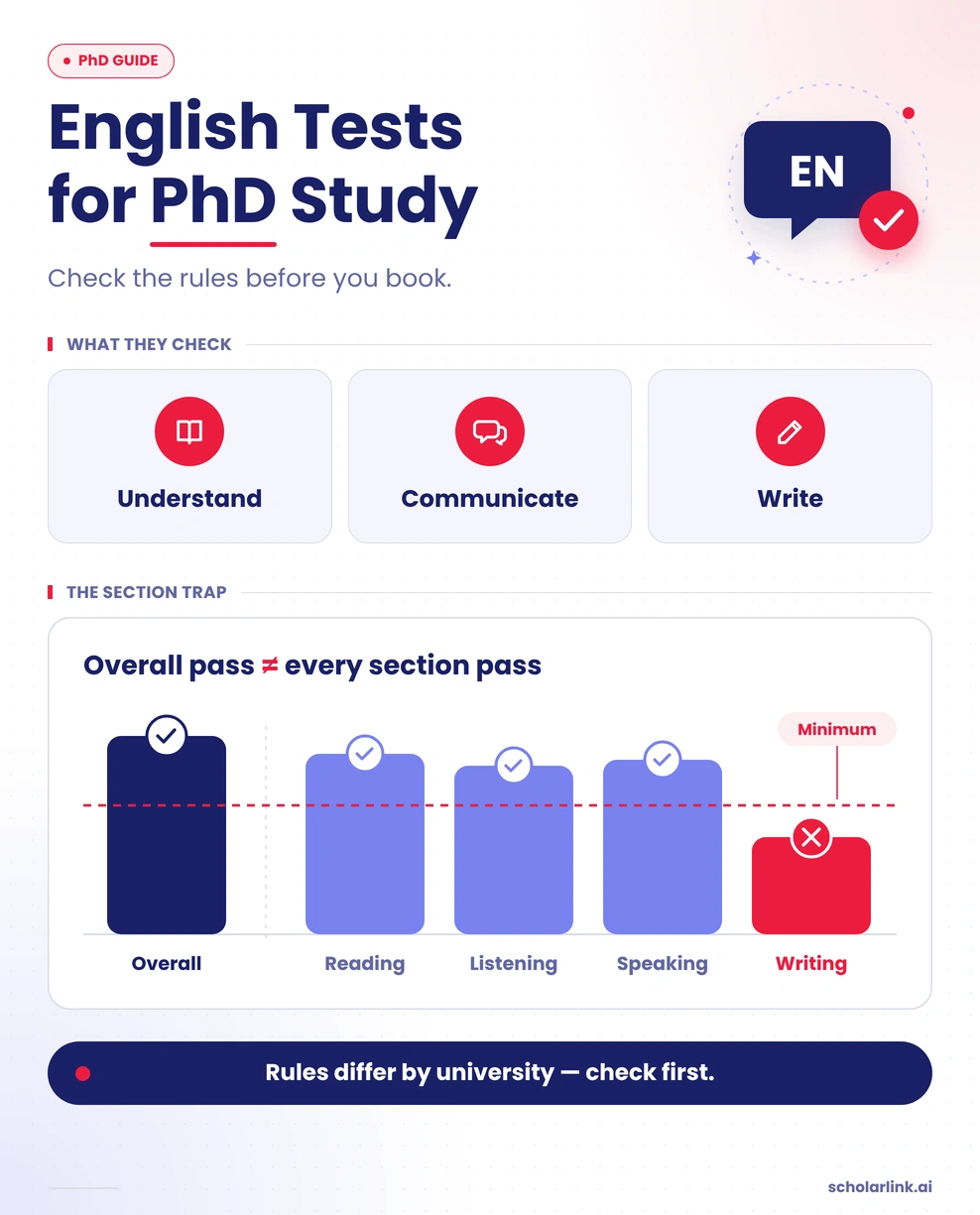
Choosing an exam before checking these requirements can cost you time and money. A test accepted by one university may not be accepted by another, and meeting an overall score requirement does not always mean you have met the minimum for every section.
This guide explains which English language tests are commonly accepted for PhD study, how to interpret score requirements, when you may qualify for a waiver, and how to prepare for the exam that best fits your application plans.
Why English Language Tests Matter for PhD Study
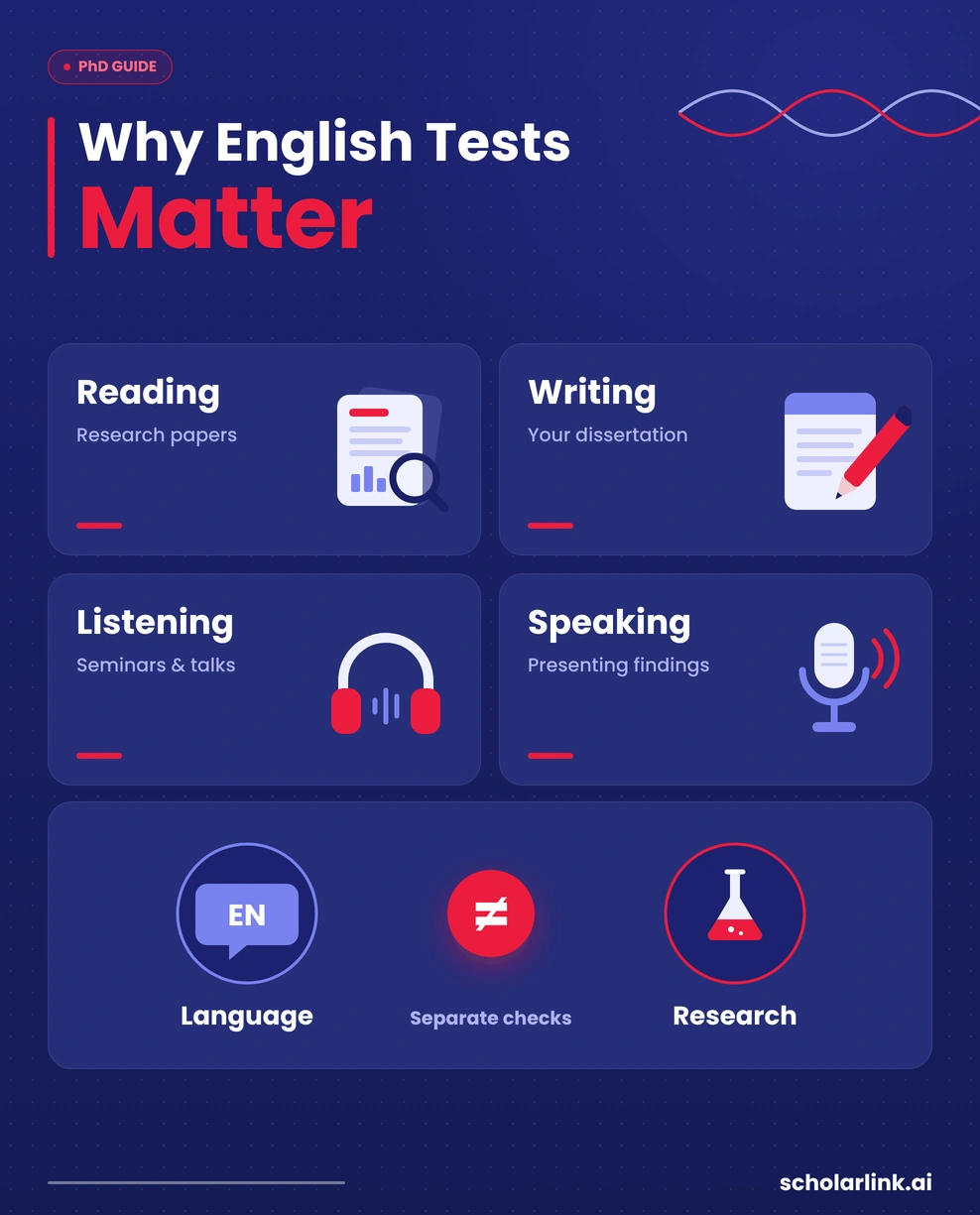
Doctoral research requires sustained academic communication. Throughout a PhD, you may need to read research papers, review previous studies, write a dissertation, prepare manuscripts for publication, present findings, and discuss your work with supervisors and research teams.
When English is the working language of a university or research group, applicants need to demonstrate that they can participate in these activities. An English proficiency test provides universities with a standardized way to assess language ability across applicants from different educational backgrounds.
The four main language skills are particularly relevant to doctoral study:
- Reading: Understanding academic articles, research methods, theoretical arguments, and technical vocabulary.
- Writing: Organizing arguments, explaining findings, preparing research documents, and communicating ideas clearly.
- Listening: Following lectures, seminars, research discussions, and academic presentations.
- Speaking: Explaining your research, participating in meetings, presenting findings, and answering questions.
An English test does not measure your research potential, subject knowledge, or ability to produce original academic work. It measures language proficiency against the requirements established by the institution.
That distinction matters: a strong research profile does not automatically replace a required language certificate, just as a high language score does not guarantee PhD admission.
Who Needs to Meet English Language Requirements for PhD Admission?
Whether you need to take an English test depends on the admission policy of your target university and doctoral program.
Universities may require proof of English proficiency if:
- Your previous degree was taught in a language other than English.
- You completed your education in a country or institution that does not meet the university’s exemption criteria.
- You cannot provide accepted documentation confirming that your previous degree was taught entirely in English.
- Your program has additional language requirements beyond the university-wide minimum.
- You do not hold another English qualification recognized by the institution.
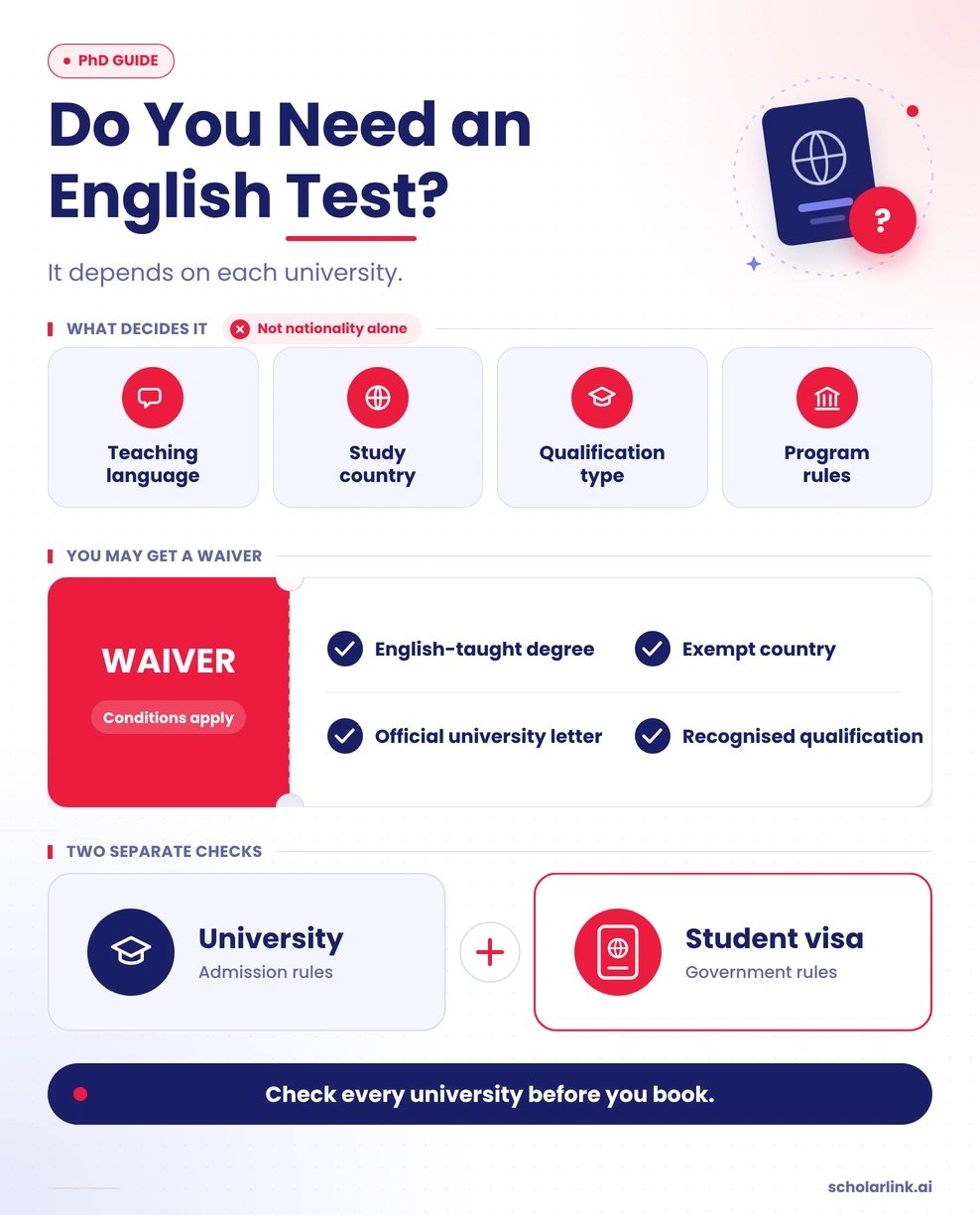
Your nationality alone does not always determine whether you need a test. Some universities assess the language of instruction of your previous degree, while others consider the country where you studied, the type of qualification you hold, or a combination of these factors.
For example, an applicant who completed a master’s degree entirely in English may qualify for an exemption at one university but still need to submit IELTS or TOEFL scores to another. The policies are institution-specific, so applicants should not assume that an English-taught degree automatically removes the requirement.
Can You Get an English Language Test Waiver?
Some universities allow applicants to apply for an English language test waiver. A waiver means that the university accepts other evidence of English proficiency instead of requiring a new test result.
Depending on the institution, possible waiver conditions may include:
- Completing a previous degree at an institution where English was the official language of instruction.
- Holding a degree from a country or university included in the institution’s exemption policy.
- Providing an official letter from your previous university confirming that the entire degree was taught and assessed in English.
- Holding another English qualification that the university recognizes.
However, waiver policies can contain additional conditions. A university may require your previous degree to have been completed within a certain period, for example, or may accept only qualifications from specific institutions.
Before requesting a waiver, check the graduate school’s policy and the requirements of your individual department. If the policy is unclear, contact the admissions office and provide details of your previous degree, institution, country of study, and language of instruction.
Important: Do not book an English test—or assume that you are exempt—until you have checked the official requirements of every university on your shortlist.
University Admission Requirements vs. Student Visa Requirements
University admission and immigration are separate processes. A university determines which English qualifications it accepts for academic admission, while immigration authorities may apply their own language requirements for particular visa categories.
A test accepted by a university is not automatically accepted for every visa purpose. Likewise, receiving a language waiver from a university does not necessarily remove any separate immigration requirement.
If you are applying internationally, check both:
- The English language requirements published by the university and doctoral department.
- The current language requirements for the relevant student visa or immigration route.
Use the official government website for the country where you plan to study. Visa rules can change, and the requirements may depend on the type of application.
Which English Language Tests Are Accepted for PhD Study?
Universities commonly accept one or more standardized English proficiency tests. The most frequently encountered options include IELTS Academic, TOEFL iBT, PTE Academic, Cambridge English qualifications, and the Duolingo English Test.
They assess similar language skills, but their formats, scoring systems, delivery methods, and institutional acceptance policies are different.
| Test | Format | Score reporting | Important consideration |
|---|---|---|---|
| IELTS Academic | Computer or paper-based options, depending on location and availability | Band scores from 0 to 9 | Check overall and individual band requirements |
| TOEFL iBT | Computer-based, with adaptive elements in the updated test | New 1–6 scale from January 2026 | Check whether the university has updated its score policy |
| PTE Academic | Computer-based | Overall and skill scores from 10 to 90 | Acceptance must be checked at program level |
| Cambridge C1 Advanced / C2 Proficiency | Examination-based | Cambridge English scoring and qualification grades | Institutions may impose their own certificate-recency rules |
| Duolingo English Test | Online, computer-adaptive | Scores from 10 to 160 | Not accepted by every PhD program |
The table provides a general comparison, not a guarantee that a particular university accepts every exam. Always use the official admissions page of your target program as the final reference.
IELTS Academic
The International English Language Testing System (IELTS) is one of the most widely recognized English proficiency exams for higher education. For university admission, applicants are generally asked to take IELTS Academic, rather than assuming that IELTS General Training will be accepted.
IELTS Academic assesses four language skills:
- Listening: Understanding conversations and spoken information.
- Reading: Interpreting academic texts and identifying arguments, details, and supporting evidence.
- Writing: Producing structured written responses and explaining information or arguments.
- Speaking: Discussing familiar and academic topics in an assessed speaking interview.
The test takes approximately two hours and 45 minutes. Its Speaking section lasts around 11–14 minutes. IELTS reports an overall band score and a separate score for each of the four skills.
Universities may require both an overall score and minimum scores in individual sections. For example, a program might require an overall IELTS score of 7.0 with no individual band below 6.5. This is an illustrative requirement, not a universal PhD standard.
IELTS Academic may be suitable if you prefer its test format and want an exam recognized by the universities on your shortlist. Before booking, check whether your target programs accept the particular IELTS delivery option available in your location.
Official information: IELTS Academic test format.
TOEFL iBT
The Test of English as a Foreign Language (TOEFL) is administered by Educational Testing Service (ETS). TOEFL iBT is used by universities worldwide to assess academic English proficiency.
The test covers:
- Reading
- Listening
- Speaking
- Writing
The TOEFL iBT format changed on January 21, 2026. The updated test includes adaptive elements and uses a new score scale designed to align more directly with the Common European Framework of Reference for Languages (CEFR).
Under the updated system:
- Each section receives a score from 1 to 6, in half-point increments.
- The overall score is also reported on a 1–6 scale.
- For a two-year transition period following the January 2026 change, test takers also receive a comparable overall score on the previous 0–120 scale.
This change is particularly important for applicants who are comparing older TOEFL results with requirements written before 2026. Universities may still publish requirements using the previous 0–120 scale, so check whether the institution has provided updated guidance or an official equivalency.
Do not convert a score yourself using an unofficial table. Use the comparison information published by ETS and follow the university’s instructions.
Official information: TOEFL iBT test content and structure and the updated TOEFL score scale.
PTE Academic
The Pearson Test of English (PTE) Academic is a computer-based English proficiency test developed by Pearson. It assesses speaking, writing, reading, and listening through a combination of question types, including tasks that integrate more than one language skill.
PTE Academic reports:
- An overall score from 10 to 90.
- Individual scores for listening, reading, speaking, and writing.
- Additional information about performance in different skill areas.
The current test takes approximately two hours. Pearson states that results are typically available within two days, although applicants should allow for possible processing or administrative delays.
PTE Academic may be a practical option if your target universities accept it and you prefer a computer-based test. However, acceptance can vary between institutions and even between departments within the same university.
Do not assume that a university accepting PTE for undergraduate or master’s programs also accepts it for PhD admission. Check the doctoral program’s language policy before registering.
Official information: PTE Academic test format and PTE Academic scoring.
Cambridge English: C1 Advanced and C2 Proficiency
Cambridge English offers qualifications that can be used to demonstrate advanced English proficiency. Two qualifications applicants may encounter are:
- C1 Advanced (CAE): A qualification demonstrating advanced English proficiency.
- C2 Proficiency (CPE): A qualification demonstrating a very high level of English proficiency.
Some universities accept these qualifications as alternatives to IELTS or TOEFL. However, acceptance depends on the institution, the specific qualification, the score or grade achieved, and sometimes the date on which the exam was taken.
Cambridge English certificates are valid indefinitely as qualifications. This does not mean every university must accept an older certificate. Individual institutions can set their own rules about how recent the result must be.
If you already hold a Cambridge qualification, check whether your target PhD programs accept it and whether they require a minimum Cambridge English Scale score or a particular grade.
Official information: Cambridge English qualifications and Cambridge guidance on certificate validity.
Duolingo English Test
The Duolingo English Test (DET) is an online, computer-adaptive English proficiency test that applicants can take remotely, subject to its technical and testing-environment requirements.
The test assesses reading, writing, listening, and speaking. Its score reports include an overall score on a scale from 10 to 160, along with additional information about individual and integrated language skills.
The test takes approximately one hour, and Duolingo states that certified results are typically available within two days.
Its online format and relatively quick result delivery can make it convenient for applicants working with tight deadlines. However, convenience should not determine your choice on its own.
Some universities accept the Duolingo English Test for graduate admission, while others do not accept it for doctoral programs or accept it only for certain departments or admission cycles.
Before relying on DET, confirm all of the following:
- The university accepts the test for graduate admission.
- The specific PhD department accepts it.
- The required overall and subscore thresholds are achievable.
- The institution accepts the test format and result date for your application cycle.
Official information: Duolingo English Test.
What English Test Score Do You Need for a PhD?
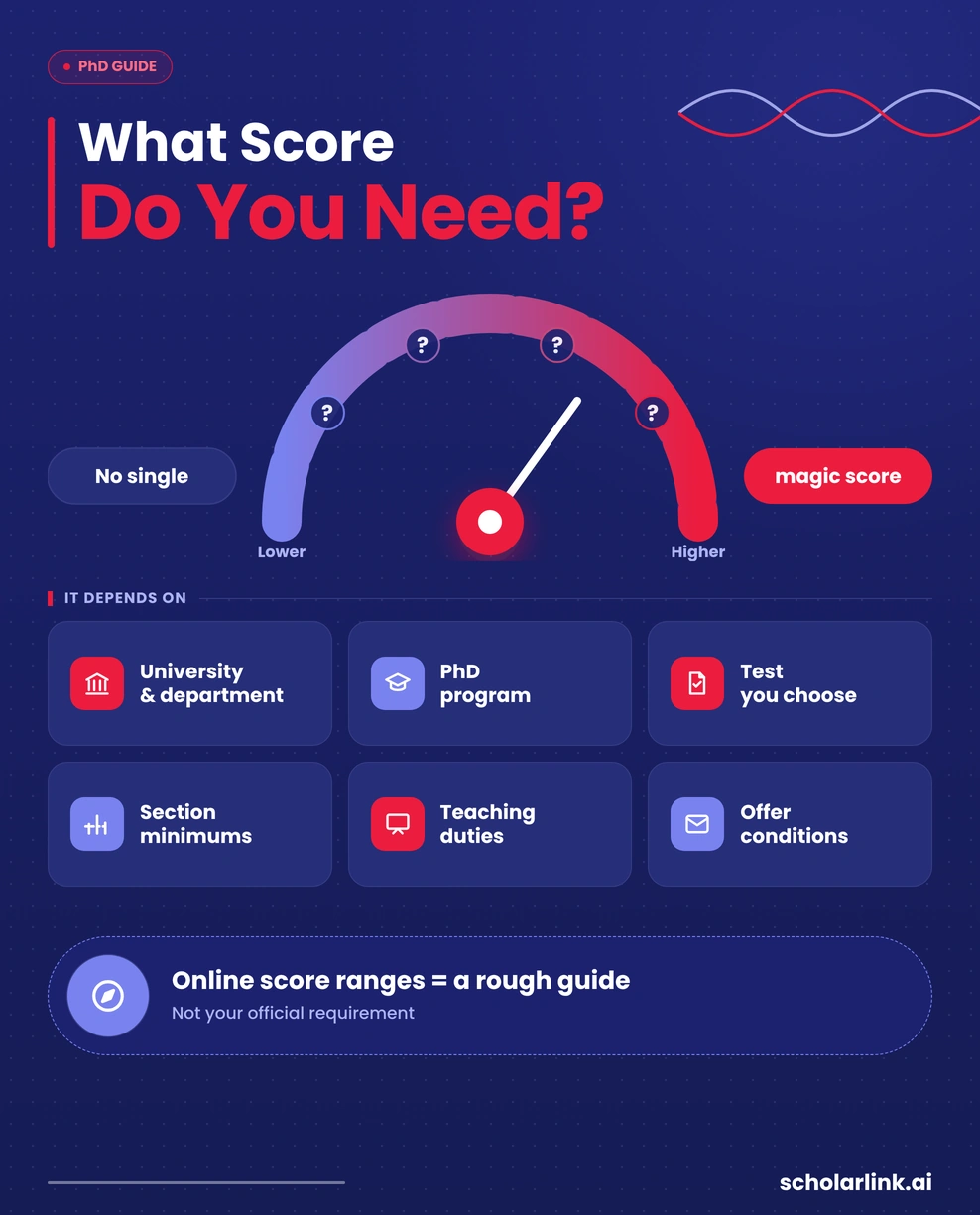
There is no single English test score that guarantees eligibility for every PhD program. Each university establishes its own minimum requirements, and some departments apply stricter standards than the institution-wide graduate school.
The required score may depend on:
- The university and department.
- The doctoral program and its academic requirements.
- The test you choose.
- Minimum scores for individual skills.
- Whether the program includes teaching responsibilities.
- Any additional language conditions attached to the offer.
For this reason, general score ranges found online should be treated as preliminary guidance rather than admission requirements.
Overall Scores vs. Section Scores
Most English proficiency tests report an overall score as well as individual scores for the skills assessed.
A university may require applicants to meet both conditions. For example, a program could ask for:
| Requirement | Illustrative IELTS result |
|---|---|
| Minimum overall score | 7.0 |
| Minimum Listening score | 6.5 |
| Minimum Reading score | 6.5 |
| Minimum Writing score | 6.5 |
| Minimum Speaking score | 6.5 |
This is only an example of how a university might publish its requirements. It does not represent a standard IELTS requirement for PhD admission.
Consider an applicant who receives an overall IELTS score of 7.0 but obtains 6.0 in Writing. If the program requires at least 6.5 in every section, the applicant has not met the language requirement, even though the overall score is sufficient.
The same principle applies to TOEFL, PTE, Duolingo, and other accepted examinations. Always compare both the overall result and the individual skill scores with the program’s published requirements.
Minimum Score vs. a More Competitive Application
A minimum language score is an eligibility threshold. It indicates the level an applicant must reach to satisfy the university’s formal language requirement.
A higher score does not automatically guarantee admission, a scholarship, or a funded PhD position. Universities assess applicants using different criteria, including academic qualifications, research experience, supervisor or project fit, references, and available funding.
A higher score may be relevant when:
- The program explicitly sets a higher threshold.
- A department requires additional spoken-English proficiency for teaching.
- The applicant wants to demonstrate stronger language ability for a particular academic role.
- The published selection criteria specifically consider language performance.
Unless the university states otherwise, do not assume that exceeding the minimum language score will compensate for a weak research proposal or improve funding eligibility.
IELTS vs. TOEFL: Which Is Better for Your PhD Application?
IELTS and TOEFL are both widely recognized, but neither is automatically the better choice for every applicant. The right option depends on the universities you are applying to, the requirements of your programs, and the test format in which you can perform most effectively.
Use the following checklist before choosing:
- Check university acceptance. Confirm that every target program accepts the test you plan to take.
- Compare score requirements. Look at overall scores and individual section minimums.
- Review the test format. Consider whether you are more comfortable with the IELTS speaking interview or the computer-based TOEFL format.
- Check the score reporting system. In particular, understand the updated TOEFL 1–6 scale if you plan to take the exam in 2026 or later.
- Consider the application deadline. Make sure the result will be available and can be sent before the university’s deadline.
- Check alternative tests. PTE, Cambridge English, and Duolingo may be suitable if all your target programs accept them.
A useful way to make the decision is to create a shortlist of universities and compare their policies directly.
| University | Accepted tests | Overall requirement | Section requirements | Test deadline |
|---|---|---|---|---|
| University A | IELTS, TOEFL | Check program page | Check program page | Check application deadline |
| University B | IELTS, PTE | Check program page | Check program page | Check application deadline |
| University C | IELTS, TOEFL, DET | Check program page | Check program page | Check application deadline |
This comparison prevents a common mistake: choosing a test based on convenience and discovering later that one of your preferred doctoral programs does not accept it.
How to Prepare for English Language Tests for PhD Study
Preparing for an English proficiency test requires more than general language practice. You need to understand the exam format, identify your weakest skills, and work toward the specific score required by your target programs.
A structured preparation plan can help you avoid spending too much time on skills you have already mastered while neglecting the sections that may prevent you from meeting the minimum requirement.
1. Check Your Target Score Before You Start
First, identify the exact English language requirements of your target universities.
Record:
- The accepted tests.
- The required overall scores.
- Minimum scores for individual sections.
- The date by which official results must be submitted.
- Any available waiver or conditional admission policy.
This gives you a clear target. Preparing for a general IELTS or TOEFL score without knowing the actual requirements may lead you to spend time pursuing a score that is either insufficient or unnecessarily high.
2. Take a Diagnostic Test
Before committing to a preparation schedule, complete an official practice test or a reliable timed assessment.
Use the results to identify:
- Your current overall proficiency.
- The skills in which you perform least effectively.
- Whether you struggle with time management.
- Whether you understand the question types and scoring criteria.
- How far your current performance is from your target score.
A diagnostic test also helps you estimate how much preparation you may need. Applicants who are already close to the required score may need focused test practice, while those with larger skill gaps may need a longer period of language development.
3. Build a Preparation Schedule Around Your Weakest Skills
Your preparation plan should reflect your diagnostic results and the requirements of your target programs.
A practical weekly plan may include:
| Skill | Suggested practice | Objective |
|---|---|---|
| Reading | Timed passages and academic texts | Improve comprehension, accuracy, and speed |
| Writing | Structured essays and written responses | Improve organization, clarity, grammar, and argument development |
| Listening | Lectures, discussions, and test recordings | Improve understanding of key information and detail |
| Speaking | Timed responses and recorded practice | Improve fluency, pronunciation, and clarity |
You do not need to divide your study time equally between all four skills. If your university requires a higher Writing score and your diagnostic result shows that Writing is your weakest area, allocate more preparation time to it.
4. Strengthen Academic Reading and Writing
Academic reading and writing are especially relevant to doctoral study.
To improve your reading ability:
- Read research articles in your academic field.
- Identify each paper’s research question and main argument.
- Summarize the methods and findings in your own words.
- Practice identifying limitations and supporting evidence.
- Work with timed reading exercises from your chosen test.
To improve your writing:
- Practice organizing essays around a clear central argument.
- Use paragraphs with logical transitions.
- Support claims with relevant explanations and examples.
- Prioritize clarity and accuracy over unnecessarily complex vocabulary.
- Review your work against the official scoring criteria.
- Seek feedback from someone familiar with the test format.
Reading academic papers can help you become more comfortable with scholarly language, but it should not replace test-specific practice. IELTS, TOEFL, PTE, and DET use different tasks and scoring systems, so preparation should match the exam you intend to take.
5. Practice Speaking and Listening
Speaking and listening are important not only for language test performance but also for participating in a research environment.
Useful speaking exercises include:
- Explaining your research interests in two or three minutes.
- Summarizing an academic article aloud.
- Describing a research problem and its possible solution.
- Recording your answers and reviewing them for clarity.
- Practicing responses under the time limits of your chosen test.
For listening practice, use academic lectures, research presentations, and official test recordings. Focus on identifying the speaker’s main point, supporting arguments, examples, and changes in topic.
Avoid memorizing entire answers. Instead, practice expressing ideas clearly and organizing your responses quickly.
6. Use Official Preparation Resources
Start with materials published by the organization that administers your chosen test.
| Test | Official preparation resource |
|---|---|
| IELTS Academic | IELTS preparation and test information |
| TOEFL iBT | ETS TOEFL preparation |
| PTE Academic | Pearson PTE preparation |
| Cambridge English | Cambridge English preparation |
| Duolingo English Test | Duolingo English Test practice and information |
Official practice materials are particularly useful because they reflect the test’s actual question types, timing, and assessment approach.
You can supplement them with academic articles, online lectures, writing exercises, and structured English courses. However, avoid using too many unrelated resources at once. A smaller set of reliable materials, used consistently, is usually easier to manage.
7. Schedule the Test With Enough Time for a Retake
Do not wait until the final application deadline to take your first official test.
Your schedule should leave room for:
- Completing your preparation.
- Booking an available test date.
- Receiving the result.
- Reviewing your performance.
- Retaking the test if necessary.
- Sending official results to the university.
The right preparation period depends on your current proficiency and target score. There is no universal rule that every PhD applicant needs the same number of weeks or months.
If you are applying to several universities with different deadlines, plan around the earliest relevant deadline and check how each institution receives official scores.
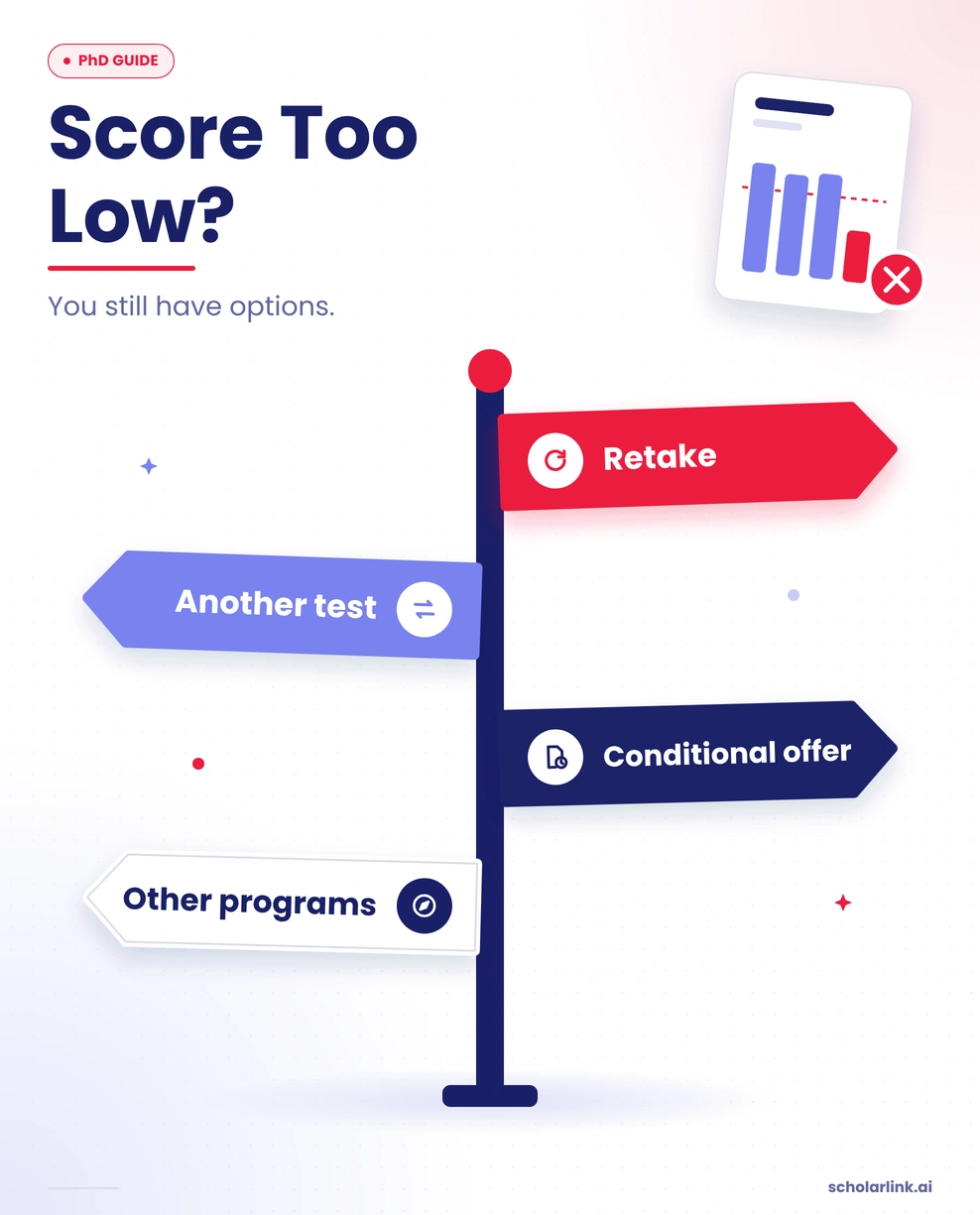
What If You Do Not Meet the Minimum English Score?
Receiving a score below the required threshold does not always mean that you must abandon your PhD application. Your available options depend on the university’s policy, the application deadline, and how far your result is from the required score.
Consider the following steps:
Retake the Test
If you are close to the required score, identify the section that lowered your result and focus your preparation on that area.
For example, if your overall score meets the university’s minimum but your Writing score does not, repeating general English exercises may be less useful than targeted writing practice and feedback based on the test’s scoring criteria.
Before booking another attempt, check the test provider’s retake rules and whether your university accepts the result from the new test date.
Consider Another Accepted Test
Some universities accept multiple English proficiency tests. If you are more comfortable with another format, you may be able to take an alternative exam.
However, make sure the alternative is accepted by the specific doctoral program. A university’s general acceptance of a test does not always mean that every department accepts it.
Ask About Conditional Admission
Some universities may issue a conditional offer to an applicant who meets the academic requirements but has not yet satisfied the English language requirement.
Depending on the institution, the applicant may be allowed to:
- Submit an updated English test result before enrollment.
- Complete an approved English for Academic Purposes (EAP) course.
- Meet another specified language condition before starting the program.
Conditional admission is not guaranteed. Some doctoral programs require applicants to meet the language requirement before issuing a final offer, confirming funding, or allowing enrollment.
Contact the graduate admissions office to ask whether this option exists and whether it applies to funded PhD positions.
Review Other Programs and Deadlines
If your current score does not meet the required threshold, you may also consider doctoral programs with different language requirements.
Compare their accepted tests, minimum scores, waiver policies, and deadlines before submitting applications. Do not choose a program based on a lower language requirement alone; research fit, supervision, funding, and academic suitability remain essential.
Do English Test Scores Affect PhD Funding and Teaching Assistantships?
English language requirements for admission and language requirements for funded academic roles are not always the same.
A student may meet the university’s minimum English requirement for PhD admission but still need to demonstrate additional spoken-English proficiency before taking on a teaching role.
This is particularly relevant to positions such as:
- Teaching Assistant (TA)
- Graduate Teaching Assistant (GTA)
- Teaching Fellow
- Other roles involving direct communication with students
Some universities assess spoken English separately through an additional test, interview, course, or institutional assessment.
Research Assistant (RA) responsibilities may follow different requirements, depending on the role and institution.
It is also important not to assume that a higher IELTS or TOEFL score automatically increases your chances of receiving a scholarship or funded PhD position. Funding decisions may depend on academic performance, research experience, supervisor or project fit, references, and the availability of funding.
Before accepting an offer, review the requirements for both admission and any teaching or funding responsibilities attached to the position.
Final Checklist Before Booking an English Test
Before registering for an exam, use this checklist to make sure you have the information needed to make the right choice.
I have shortlisted the universities and PhD programs I want to apply to.
I have checked which English tests each program accepts.
I know the required overall score for each university.
I have checked the minimum score for every individual section.
I have checked whether I qualify for an English language waiver.
I have confirmed whether the test format and delivery option are accepted.
I have checked the score validity and result submission rules.
I have allowed enough time for a possible retake.
I have reviewed any separate language requirements for teaching roles or visa applications.
Planning these details early can prevent avoidable delays and help you focus on the most important parts of your doctoral application.
Frequently Asked Questions About English Language Tests for PhD Study
What English test do I need for a PhD?
The required test depends on the university and doctoral program. IELTS Academic and TOEFL iBT are commonly accepted, while some institutions also accept PTE Academic, Cambridge English qualifications, or the Duolingo English Test. Always check the official language requirements of your target program.
Is IELTS Academic or IELTS General Training required for PhD admission?
Universities commonly request IELTS Academic for higher education admission. Do not assume that IELTS General Training is accepted as a substitute. Check the specific requirements of your graduate school and department before booking.
Can I apply for a PhD without an English language test?
Yes, in some cases. A university may grant an exemption if your previous degree meets its English-language education criteria or if you hold another recognized qualification. However, exemptions are institution-specific and may require official documentation.
What is the minimum IELTS score for PhD admission?
There is no universal IELTS minimum for all doctoral programs. Requirements vary by university, department, and field. Some programs require an overall score as well as a minimum band in each skill, so applicants should check both.
What is the TOEFL score scale in 2026?
Starting January 21, 2026, TOEFL iBT reports scores on a new 1–6 scale in half-point increments. During the two-year transition period, test takers also receive a comparable overall score on the previous 0–120 scale. Applicants should follow the score policy published by their target university.
Do universities accept the Duolingo English Test for PhD admission?
Some universities accept the Duolingo English Test for graduate programs, but acceptance is not universal. A university may accept DET for certain degrees while requiring IELTS or TOEFL for particular doctoral departments. Check the policy for your specific program.
How long are English test results valid?
Validity depends on the test provider and the institution receiving your result. IELTS partners recommend that results be treated as evidence of English proficiency for two years. Cambridge English certificates are valid indefinitely as qualifications, but universities may impose their own recency requirements. Always check the rules of your target institution.
Can I receive a conditional PhD offer without meeting the English requirement?
Some universities issue conditional offers that allow applicants to submit a qualifying test result later or complete an approved English for Academic Purposes course. This option is not available everywhere, and some funded doctoral positions require the language condition to be satisfied before enrollment.
Does a higher English test score improve my chances of getting a PhD scholarship?
Not necessarily. A higher score may help demonstrate language proficiency, but it does not automatically improve scholarship eligibility. Funding decisions usually depend on the university’s selection criteria, academic record, research fit, supervisor or project availability, and other application materials.
Can I use one English test result for multiple universities?
Often, yes, provided that each university accepts the test, the result is still valid under its policy, and you meet its minimum overall and section requirements. You may need to arrange official score delivery separately for each institution.
Final Thoughts
English proficiency is an important part of doctoral admission, but choosing the right test requires more than comparing exam formats or looking for a general minimum score.
Start by identifying the universities and programs that match your research interests. Then compare their accepted tests, overall requirements, section minimums, waiver policies, and deadlines. Once you have this information, choose the exam that satisfies your target programs and fits your strengths.
A well-planned language test can make the application process more predictable, reduce the risk of missed deadlines, and help you focus on the academic work that matters most: finding the right PhD opportunity and preparing a strong research application.