Almost every doctoral program asks applicants to show that they can read, write, speak, and listen in English at an academic level. For many international applicants, that means taking an English language test. The details, however, are far less uniform than most guides suggest. Accepted tests, minimum scores, waivers, and even the way scores are submitted can differ from one university to the next, and sometimes from one department to the next.
This guide covers which tests are commonly accepted, how score requirements work, when exemptions may apply, how IELTS and TOEFL compare, and how to plan your preparation. It also gives you a step-by-step method for checking the rules of each program on your shortlist. It is general orientation, not a substitute for the official admissions policy of the university you are applying to. If you are still mapping out your applications, see our guide to the PhD application process.
Quick answer
- There is no universal PhD English requirement. Each university, and often each department, sets its own accepted tests, scores, and exemptions.
- Check both the overall score and every section score. Many programs require a minimum in each skill, not just a total.
- Check which tests are accepted before you book. Some universities accept only IELTS and TOEFL; others also accept PTE, Cambridge English, or Duolingo.
- TOEFL iBT changed its scoring scale on January 21, 2026. Always confirm how the university states its requirement for your test date.
- Admission, teaching, and visa requirements are separate. Meeting one does not automatically meet the others.
Do You Need an English Language Test for PhD Admission?
Most universities require evidence of English proficiency from applicants whose previous education was not taught in English. What counts as acceptable evidence depends on the institution. First language, nationality, country of previous study, and the language of instruction of your earlier degrees can all matter, but each university weighs them differently.
A previous degree taught in English also does not guarantee an exemption everywhere. The University of British Columbia’s Pharmaceutical Sciences PhD program, for example, states that applicants with a degree from an English-instruction university outside its list of exempt countries must still meet its test requirement. Other universities treat the same situation as grounds for a waiver. For the wider picture of what programs ask for, see our overview of PhD admission requirements.
Who Usually Needs to Submit an English Test?
You are more likely to be asked for a test if:
- your previous degrees were not taught in English;
- you are applying to an English-taught doctoral program and cannot show qualifying previous study or a recognized language background;
- your previous qualifications do not meet the university’s specific exemption criteria, such as the country where you studied, the length of study, or how recently you completed the degree.
Can You Be Exempt From the English Test?
Exemptions exist, but they are defined by each institution. Common routes include a qualifying degree taught in English, a period of full-time study or work in an English-speaking country, or a recognized first-language background. Documentation is often required.
Here is how much the rules vary:
- Cornell University offers standing exemptions, for example for applicants who speak English as a first language and are citizens or permanent residents of a country where English is an official language, or who will have earned a bachelor’s degree from an accredited U.S. institution. It also considers special exemptions in exceptional cases.
- The University of Washington’s HCDE PhD program waives its test requirement for applicants holding a bachelor’s, master’s, or doctoral degree from a regionally accredited institution where all instruction is in English.
- The University of Oxford allows applicants to request a waiver, for instance based on a degree of at least nine months taught in English and completed within the previous two academic years. The department decides whether to approve it.
An English test waiver is a university policy decision, not an automatic benefit of studying in English.
University Admission vs. Visa Requirements
A university’s English requirement and a country’s immigration rules are two separate systems. Meeting one does not automatically satisfy the other, and immigration requirements depend on the destination and visa category. For visa questions, use official government guidance, such as GOV.UK, the U.S. Department of State, Immigration, Refugees and Citizenship Canada, or the Australian Department of Home Affairs. Your university’s international office can also explain how its decisions relate to your visa application.
Which English Tests Are Accepted for PhD Programs?
No single list of accepted tests applies everywhere. Three universities show how much the lists differ:
- Cornell accepts only IELTS Academic and TOEFL iBT for admission, and states that it does not accept other exams such as Pearson or Duolingo.
- The UW HCDE PhD accepts TOEFL iBT, IELTS, and the Duolingo English Test.
- Oxford accepts IELTS Academic, Cambridge C1 Advanced and C2 Proficiency, and the Oxford Test of English Advanced. It accepts TOEFL iBT only if taken before January 21, 2026.
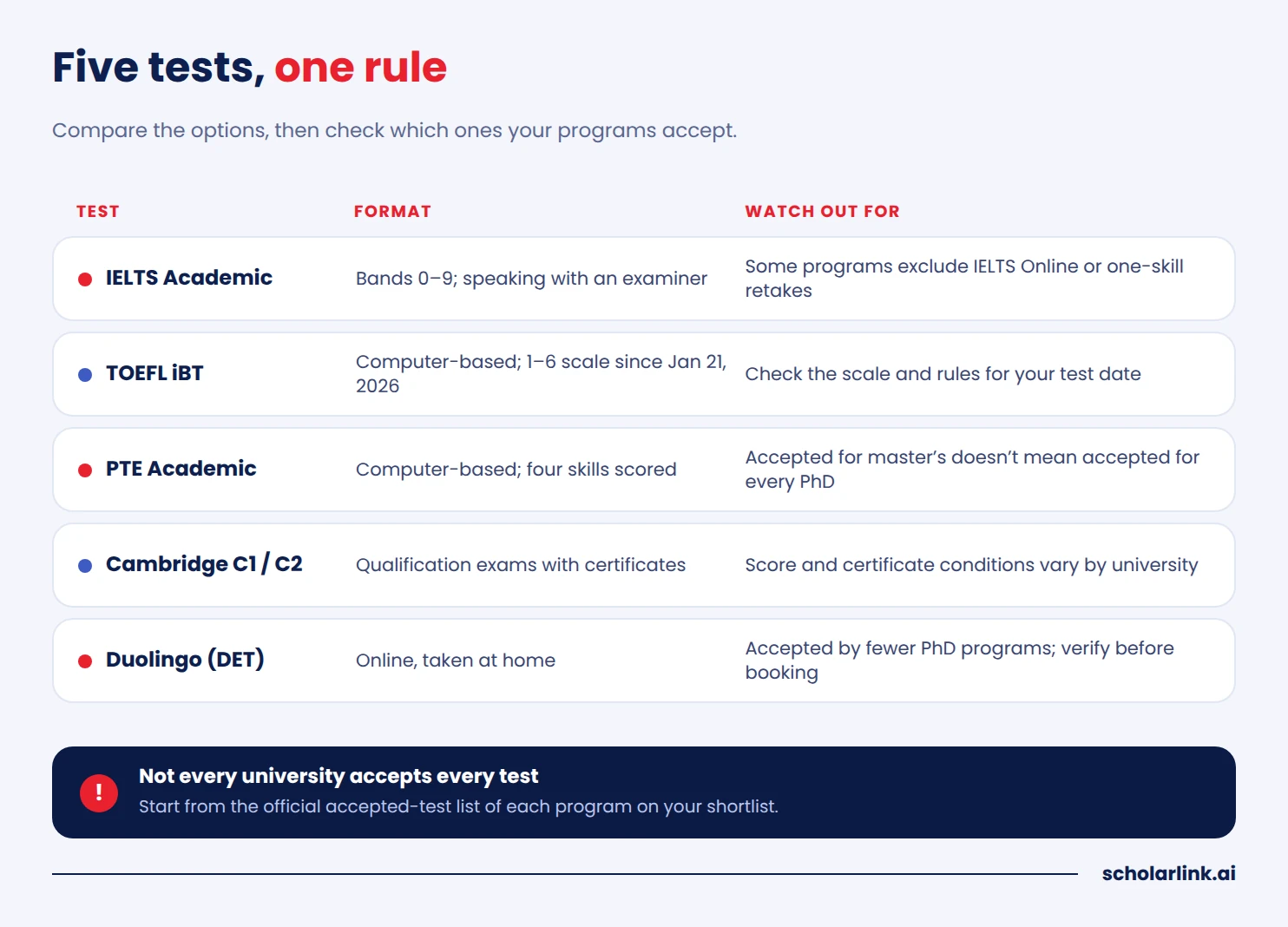
Table 1 gives a quick overview of the main options. Treat it as a starting point and then check your own shortlist.
Table 1: English tests commonly considered for PhD admission
| Test | Format | Skills assessed | Acceptance considerations | Official link |
| IELTS Academic | Paper or computer-delivered; speaking with an examiner | Listening, Reading, Writing, Speaking | Widely accepted, but check whether the university accepts the specific version (some exclude IELTS Online) | ielts.org |
| TOEFL iBT | Computer-based, at a test center or at home | Reading, Listening, Speaking, Writing | Widely accepted; check the scoring scale and your test date | ets.org/toefl |
| PTE Academic | Computer-based | Speaking, Writing, Reading, Listening | Accepted by some universities; not by all PhD programs | pearsonpte.com |
| Cambridge C1 Advanced / C2 Proficiency | Qualification exams | Reading, Writing, Listening, Speaking | Accepted by some universities; check score and certificate conditions | cambridgeenglish.org |
| Duolingo English Test | Online, at home | Adaptive, integrated tasks | Accepted by fewer PhD programs; verify before booking | englishtest.duolingo.com |
IELTS Academic for PhD Admission
For doctoral applications, choose the Academic version, not General Training. IELTS assesses Listening, Reading, Writing, and Speaking, each reported in bands, with an overall band score. The Speaking test is a conversation with an examiner. Universities usually state a required overall band and a minimum band per skill, and some name which IELTS versions they accept. Oxford, for instance, does not accept IELTS Online or the One Skill Retake feature, and requires the scores to come from a single test.
TOEFL iBT for PhD Applications
TOEFL iBT is an academic English test that assesses Reading, Listening, Speaking, and Writing. Since January 21, 2026, results are reported on a 1–6 scale in half-point steps. The overall score is the average of the four sections, rounded to the nearest half band. For a two-year transition period, score reports also include a comparable overall score on the older 0–120 scale. ETS aligns the new scale with the CEFR, where a section score of 5 corresponds to C1 and 6 to C2.
Universities handle this transition in different ways. Cornell lists separate requirements for exams taken before and after January 2026. The UW HCDE PhD program gives a total of 4.5 for the new scale and 92 for earlier tests. Oxford, as noted above, currently accepts only TOEFL results from before the change. Whatever you read online, use the university’s current statement for your test date.
Some universities also do not accept TOEFL MyBest scores, which combine your best section results from different tests. Both Oxford and the UW HCDE program require scores from a single sitting, while Cornell’s Graduate School accepts them but notes that individual fields may not.
PTE Academic for PhD Admission
PTE Academic is a computer-based test that reports scores for the four skills. Some universities accept it, but acceptance for undergraduate or master’s study does not mean it is accepted for every PhD program. Cornell, for example, does not accept it. Confirm the policy of each program before you register.
Cambridge English Qualifications
C1 Advanced and C2 Proficiency can be useful if your target university accepts them. Oxford, for example, accepts both and publishes minimum scores for each. Because acceptance and score or certificate conditions vary, verify them on the university’s own page.
Duolingo English Test for PhD Admission
The Duolingo English Test is convenient because it is taken online, but acceptance differs sharply by institution. The UW HCDE PhD program accepts it, while Cornell does not. UBC’s graduate school has stated that it will accept the test for May and September 2027 admissions, though individual programs may set their own rules. Do not book it until you have confirmed the policy of each program you are applying to.
Other Accepted Tests and Alternatives
Some institutions accept additional tests or approved alternatives, such as the Oxford Test of English Advanced at Oxford, or LanguageCert and other tests at some Australian universities. Keep the university’s own list as your only reference.
Minimum English Score for PhD Admission
Score requirements are not standardized internationally. They vary by university, discipline, and department, and sometimes by the specific program within a department.
Typical Score Ranges Across English Tests
Rather than publish a conversion table that could mislead you, here are examples of how real PhD programs state their requirements. These are illustrations, not standards.
- Oxford (per course page): IELTS 7.0 overall with 6.5 in each component at the standard level, or 7.5 overall with 7.0 in each component at the higher level.
- UW HCDE PhD: IELTS total 7, TOEFL total 4.5 (92 for tests taken before January 21, 2026), Duolingo total 130.
- UBC Pharmaceutical Sciences PhD: IELTS 7.0 overall with 6.5 in each component, or TOEFL iBT 100 overall with 22 in each section (published on the older 0–120 scale).
Even in this small sample, the same test can be asked for at different levels, and TOEFL requirements are expressed on two different scales. Equivalent-looking scores across tests are not necessarily interchangeable, and universities may apply their own conversion rules.
English Test Requirements by Country
Country-level generalizations are useful only as a rough orientation. What matters is the individual institution and program.
- United Kingdom: Universities typically set requirements by course, often in tiers. Oxford, for example, labels courses as “standard” or “higher” level.
- United States: Policies are usually set by the graduate school, with departments or fields adding their own conditions. Cornell and the University of Washington both follow this pattern.
- Canada: Graduate schools publish a baseline, and programs may set higher requirements. UBC’s Pharmaceutical Sciences program says its requirements are higher than the faculty minimum.
- Australia: Universities publish accepted tests and course-specific scores. The University of Melbourne, for example, directs applicants to the requirements for their faculty or school.
Table 3: Examples of university and program requirements (checked October 22, 2026; these are examples, not national standards)
| Country | University / program | Accepted tests | Overall minimum | Section minimums | Waiver policy | Source |
| UK | Oxford (graduate courses) | IELTS Academic, Cambridge C1/C2, Oxford Test of English Advanced; TOEFL only if taken before Jan 21, 2026 | IELTS 7.0 (standard) or 7.5 (higher), set per course | IELTS 6.5 (standard) or 7.0 (higher) | Requestable; department decides | Oxford |
| US | Cornell (research degrees) | IELTS Academic, TOEFL iBT | IELTS 7.0 | TOEFL section minimums; IELTS Speaking 8.0 for the top tier | Standing and special exemptions | Cornell |
| US | University of Washington, HCDE PhD | TOEFL iBT, IELTS, Duolingo | TOEFL 4.5 (92 before Jan 21, 2026); IELTS 7; Duolingo 130 | Not listed for admission | Waived with a degree from a regionally accredited institution with all-English instruction | UW HCDE |
| Canada | UBC, Pharmaceutical Sciences PhD | TOEFL iBT, IELTS Academic | TOEFL 100; IELTS 7.0 | TOEFL 22 each; IELTS 6.5 each | Exempt if degree is from a listed English-speaking country | UBC Pharm Sci |
| Australia | University of Melbourne (graduate degrees) | TOEFL iBT, IELTS Academic, PTE, Cambridge C1 Advanced | Course-specific | Course-specific | Other routes exist; see policy | Melbourne |
Overall Score vs. Section Minimums
Meeting an overall threshold is not the same as meeting every requirement. Many programs also set a minimum in each skill.
Here is a hypothetical example. A program requires IELTS 7.0 overall with at least 6.5 in each skill. An applicant scores 7.5 in Listening, 7.5 in Reading, 7.0 in Speaking, and 6.0 in Writing. The overall band is 7.0, which meets the threshold, but Writing is below 6.5, so the applicant does not meet the requirement.
Meeting the minimum score does not automatically mean you meet every requirement.
Table 4: Minimum score vs. section requirements
| Requirement type | What it means | What applicants should check |
| Overall score | Minimum combined or overall result | Does the result meet the published threshold? |
| Section score | Minimum in an individual language skill | Does every skill meet the required minimum? |
| Score validity | How recently the test must have been taken | Is the score valid at the relevant deadline or enrollment date? |
| Test acceptance | Which exams and formats are recognized | Is this specific test accepted by the intended PhD program? |
Minimum Score vs. Competitive Score
A published minimum is usually an eligibility threshold, not a promise of admission. Doctoral admission also depends on research fit, supervisor availability, references, and the strength of the application. Some universities say explicitly that the language score is not part of the academic assessment. Oxford, for example, states that meeting its English requirement is not a criterion in the academic assessment of an application. Unless the institution’s policy says otherwise, do not assume a higher score improves your chances of admission or funding. Your research proposal and contact with a potential supervisor matter far more; see our guides to writing a PhD research proposal and contacting a potential PhD supervisor.
Do Requirements Differ by Discipline?
Sometimes, but the differences come from the institution rather than from the field in general. Oxford assigns “standard” or “higher” levels course by course. UBC’s Pharmaceutical Sciences program sets requirements above the faculty baseline. Cornell notes that some graduate fields require higher scores or an interview. Programs with substantial teaching duties may add spoken-English conditions. Treat any pattern across humanities, social sciences, or STEM as something to verify, not a rule.
IELTS vs. TOEFL for PhD: Which Test Should You Choose?
Differences in Test Format and Assessment
Both tests assess the four skills, but they feel different:
- Speaking: IELTS Speaking is a conversation with an examiner, while TOEFL Speaking is completed on a computer.
- Scoring: IELTS reports bands from 0 to 9 with half-band steps, while TOEFL iBT now reports on a 1–6 scale in half-point steps, with a comparable 0–120 score shown during the transition period.
- Delivery: Both are available at test centers, and both have at-home options in many regions. Some universities restrict certain versions, so check this too.
- Test design: Since January 2026, TOEFL iBT’s Reading and Listening sections are adaptive, adjusting to your performance. Test formats change, so confirm the current structure and availability on the official IELTS and ETS websites before you choose.
Which Test Is Best for Your Target Universities?
Start with the accepted-test list of every university on your shortlist, then compare formats and requirements. Cornell accepts only IELTS and TOEFL, Oxford currently excludes new-format TOEFL results, and the UW HCDE program accepts Duolingo as well. The best test is the one every, or nearly every, program accepts at the scores you need.
Check your university shortlist before booking an English test.
Table 5: Test-selection checklist
| Decision factor | Questions to ask | Action |
| University acceptance | Is the test accepted by every target program? | Check official program pages |
| Score requirements | Are there section minimums? | Compare each skill requirement |
| Test format | Which format can you prepare for effectively? | Complete official sample tests |
| Timing | Will results arrive before the deadline? | Work backward from submission |
| Validity | Will the score remain valid? | Verify the institution’s policy |
How to Choose Based on Your Strengths
Once acceptance is settled, format can guide the final choice. If you speak more naturally with a person than to a microphone, IELTS may suit you. If you are comfortable with timed computer-based tasks, TOEFL may suit you. These are preferences, not predictions of your score. The most reliable approach is to take the official sample or practice tests for both and compare how you do.
What If You Are Applying to Multiple Countries?
Build your shortlist first, then choose a test accepted by all or most programs. If no single test covers everything, you may need to sit more than one, so find that out early. Our studying abroad application guide can help you organize a multi-country shortlist.
How to Check English Language Requirements for a PhD Program
This is the most important step in your planning, because the right answer always comes from the university itself.
A Step-by-Step Verification Checklist
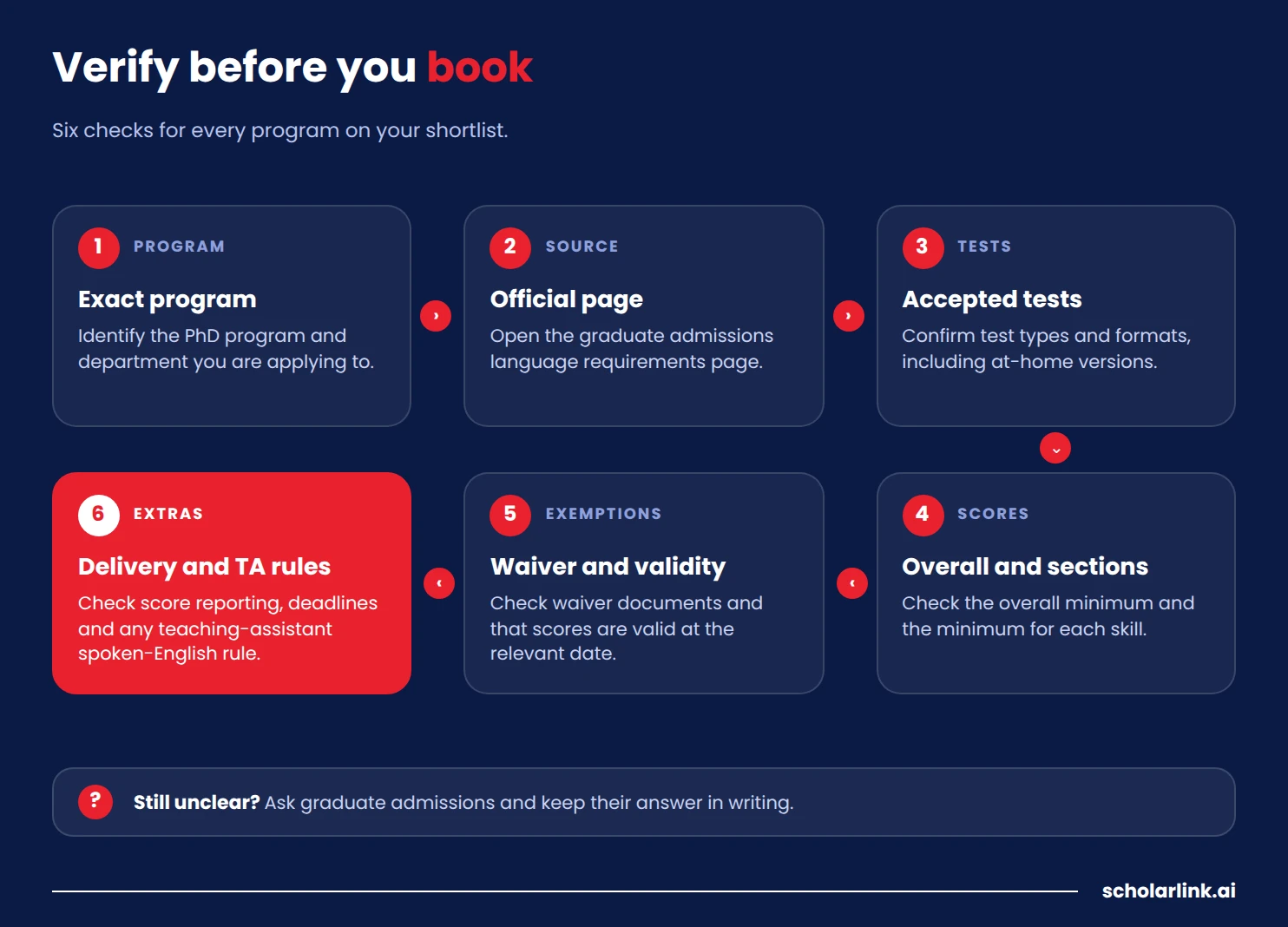
- Identify the exact PhD program and department.
- Open the official graduate admissions language requirements page.
- Confirm accepted test types and formats.
- Check the overall minimum and each section minimum.
- Check exemptions and the documents needed to claim one.
- Confirm score validity at the application deadline or enrollment date, as applicable.
- Check official score-reporting procedures and delivery deadlines.
- Review additional requirements for teaching assistantships or funded positions.
- Contact graduate admissions if a policy is ambiguous.
Pay close attention to how validity is measured. Cornell and the UW HCDE program both require scores valid for two years, Cornell as of the application deadline. Oxford requires the test to have been taken less than two years before the course start date. UBC’s Pharmaceutical Sciences program and the University of Melbourne look at the 24 months before you apply.
What to Do When University Pages Conflict
A department may add requirements on top of the central graduate school’s policy. UBC’s Pharmaceutical Sciences program, for example, notes that its requirements are higher than the faculty minimum. When pages disagree, follow the hierarchy of policies the institution states. If it is not clear, ask for written clarification and keep a copy.
Questions to Ask Graduate Admissions
- Is my test accepted for this program, including the version I plan to take?
- Do I qualify for a waiver, and what documents do I need?
- How long is a score valid, and on which date is validity checked?
- Are there minimum scores per section?
- When must scores be received, and can I submit self-reported scores first?
- Can I receive a conditional offer if I do not yet meet the requirement?
English Test Waivers, Conditional Offers, and Missing Scores
How to Request an English Test Waiver
Check your eligibility under the university’s criteria, gather transcripts or official proof of the language of instruction, and follow the stated application process. Do not assume a waiver has been granted until the university confirms it. Cornell says it does not pre-approve exemption requests by email, and instead asks applicants to attest to a standing exemption in the application itself.
Can You Apply Before Receiving Your Test Results?
It depends on the university. Oxford allows you to submit an application without test scores, and the department may later set a deadline for scores as a condition of an offer. The UW HCDE program asks applicants to enter self-reported scores while official scores are matched to the application, which can take two weeks or more. Submitting an application is not the same as having a complete application ready for review, so check what each university means by “complete.”
What Happens If Your Score Is Below the Requirement?
You have several options, and which ones exist depends on the university:
- retake the test, focusing on your weakest skill;
- ask whether another accepted test might suit you better;
- ask whether a conditional offer is possible;
- ask whether a pre-sessional English course can satisfy the condition.
Oxford, for example, allows its online pre-sessional course to meet the language condition for applicants whose recent results fall only slightly below the requirement, within limits it publishes.
Do English Test Scores Expire?
Many institutions apply a validity window, commonly two years, but the length and the date on which validity is assessed differ, as shown above. Confirm both with the university.
How to Prepare for English Language Tests for PhD Study
When Should You Take Your English Test?
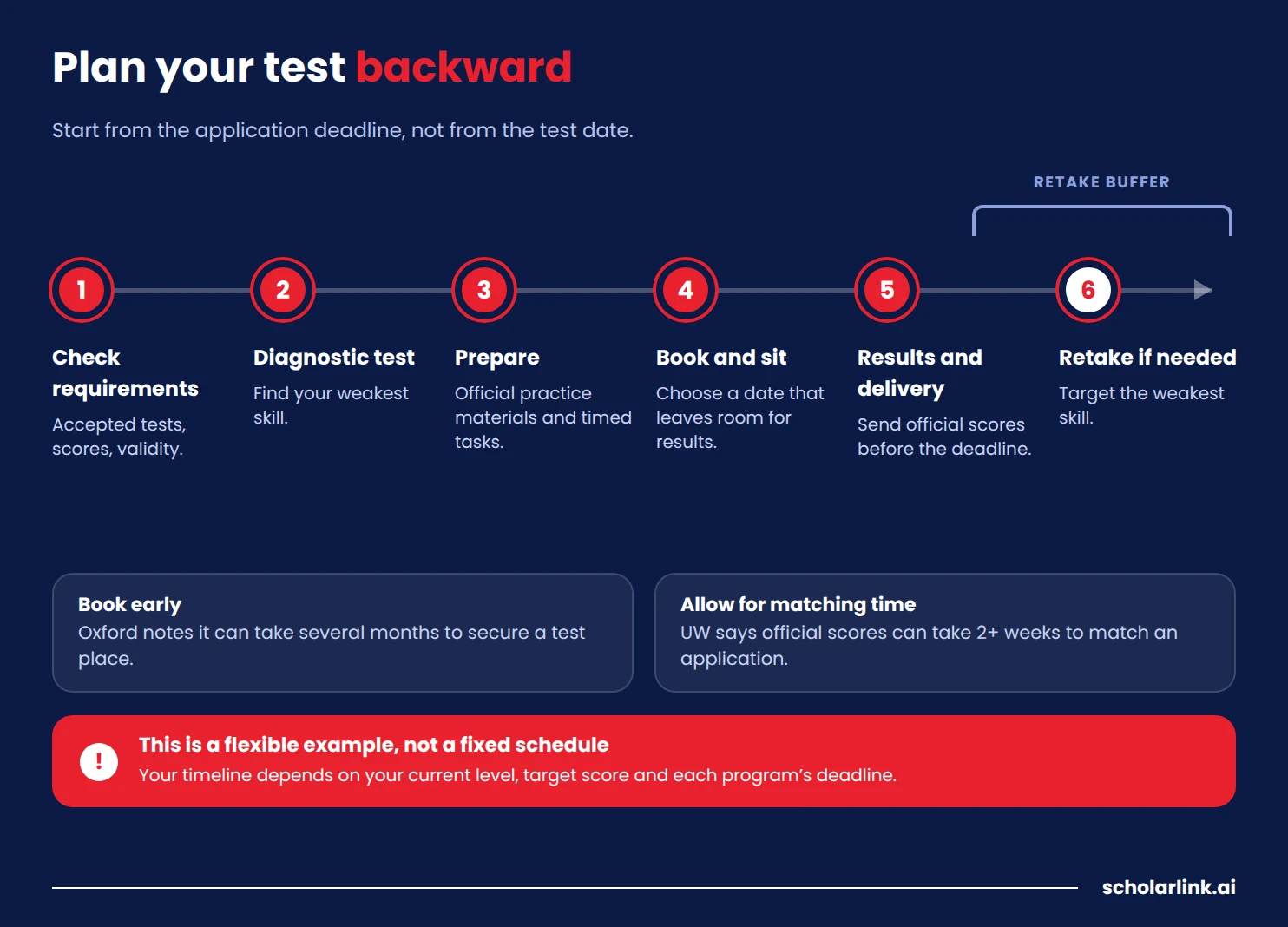
Plan backward from the application deadline. As a planning example, not a rule: confirm the requirements, take a diagnostic test, prepare, sit the exam early enough to receive and send results, and leave time for a possible retake. Oxford notes that it can take several months to secure a test place, and UW notes that official scores can take weeks to match to an application, so build in a buffer.
How Much Preparation Time Do You Need?
It depends on your current level, your target score, your weakest skill, and your familiarity with the test. A diagnostic test under real conditions is the best way to estimate your gap. Any timeline you read online is a planning example only.
How to Improve Academic Reading and Writing
- Read research papers in your field and summarize each argument in a few sentences.
- Practice organizing short essays with a clear thesis and supporting points.
- Do timed writing tasks that match the format of your chosen test.
- Review your writing against the official scoring criteria.
How to Improve Speaking and Listening
- Practice explaining your research topic clearly and concisely.
- Listen to lectures and academic talks, then summarize them aloud.
- Practice with the specific speaking format of your chosen test.
Official Practice Materials and Mock Tests
Start with materials from the test providers themselves: IELTS, ETS TOEFL, Pearson PTE, Cambridge English, and the Duolingo English Test. Our IELTS preparation guide and TOEFL preparation guide can supplement them, but official practice tests give the most accurate picture of the exam.
Do English Test Scores Affect PhD Funding and Teaching Assistantships?
Admission, scholarship decisions, and teaching eligibility may follow different criteria. Teaching roles in particular often carry a separate spoken-English requirement.
- Cornell: Doctoral students appointed as teaching assistants must demonstrate a higher level of English proficiency. Research-degree applicants in Score Tier A are automatically approved to serve as a TA, while those in Tier B need an English Language Assessment and may be supported through Cornell’s International Teaching Assistant Program.
- University of Washington: Non-native speakers must meet an additional spoken-English requirement before a teaching appointment. They can do so through qualifying degrees, a test score (for example, TOEFL Speaking 5 on the new scale or IELTS Speaking 7.0), a one-time assessment, or a course.
Admission requirements and teaching-assistant language requirements may be different.
These examples show that a student can meet the admission requirement and still need to satisfy an additional standard before teaching. They do not show that a higher score improves your chances of a scholarship. Funding decisions depend on each program’s own criteria, so check them directly. If you are exploring funding, our guides to fully funded PhD programs and PhD scholarships are a good next step.
Frequently Asked Questions About English Language Tests for PhD Study
What English test do I need for a PhD?
It depends on the university and program. IELTS Academic and TOEFL iBT are the most commonly requested, but some programs also accept PTE Academic, Cambridge English, or Duolingo. Check the program’s official page.
What IELTS score is required for a PhD?
There is no universal score. The examples above range from 7.0 to 7.5 overall, often with section minimums of 6.5 or 7.0, but your target program may differ.
What TOEFL score do I need for PhD admission?
It varies, and the scale matters. Tests from January 21, 2026 onward use a 1–6 scale, and earlier tests use 0–120. Use the university’s current requirement for your test date.
Can I apply for a PhD without IELTS?
Possibly. You may qualify for an exemption, or the program may accept another test. Some universities also let you apply before you have a score, as Oxford does. Confirm with the university.
Is IELTS or TOEFL better for PhD applications?
Neither is better in general. Choose the test accepted by all your target programs, then pick the format you can prepare for most effectively.
Do all universities accept the Duolingo English Test?
No. Some PhD programs accept it, and others, such as Cornell, do not.
Can a previous English-taught degree exempt me from a language test?
Sometimes. Each institution sets its own criteria, such as the country of study, length of study, and how recently you finished.
Do PhD programs require higher English scores than master’s programs?
Not always. Some do, and some set the same requirement. Compare the specific programs.
Can I submit my English test score after the application deadline?
It depends. Some universities accept scores later or as a condition of an offer, and others require them by the deadline.
How long are IELTS and TOEFL scores valid?
Many universities require a test taken within two years, but the date on which validity is checked differs. Confirm it with each university.
Can I receive a conditional PhD offer if I do not meet the English requirement?
Some universities make conditional offers, sometimes with a pre-sessional course option. Ask admissions.
Are English proficiency requirements different for teaching assistantships?
Often, yes. Cornell and the University of Washington both set additional spoken-English requirements for TAs.
Final Checklist Before Booking Your English Test
- Confirm your exact target programs.
- Verify accepted tests.
- Check overall and section minimums.
- Confirm exemptions and supporting documents.
- Check score validity and result-delivery timing.
- Review teaching-assistant requirements if relevant.
- Book a test only after confirming that the result will meet your application timeline.
Choosing among English language tests for PhD study comes down to verification. Start from your shortlist, confirm each program’s policy on its own page, and plan your test date backward from the deadline. When you are ready to build your list, you can browse PhD programs and review the full PhD application process.