A strong SOP for Data Science does one thing well: it turns your academic background, technical skills, and projects into a convincing story about why you’re ready for a graduate Data Science programme — and why this one. It isn’t a list of tools you’ve touched or a declaration that data is the future; it’s a focused argument, built from real work you’ve done. This guide covers what a Data Science statement of purpose should communicate, how to structure it, how to present projects and technical skills convincingly, how to handle tricky situations like a career switch or a low GPA, a complete illustrative sample, and a revision checklist. The SOP is one important piece of your application, not a guarantee of admission — so the aim here is a clear, honest, specific essay.
What Is an SOP for Data Science?
A Statement of Purpose for a graduate Data Science application is a short, structured essay explaining your academic motivation, technical preparation, relevant experience, and future goals — and arguing that a specific MS programme is the right fit. Admissions committees use it to understand who you are beyond your transcript: why you want to study Data Science, whether you’re prepared for its mix of statistics, programming, and machine learning, and where you’re heading.
It’s easy to confuse the SOP with two neighbouring documents. Your resume or CV lists what you’ve done; the SOP explains what it meant. A personal statement, where a university asks for one, leans more on personal background and motivation. The table makes the split clear:
| Feature | SOP | Resume / CV | Personal statement |
|---|---|---|---|
| Main purpose | Explain academic motivation and program fit | Summarise qualifications and experience | Present personal experiences and motivations |
| Format | Structured essay | Sections and bullet points | Usually a narrative essay |
| Main focus | Why this field and this program | What you’ve accomplished | Personal background and development |
| Content | Academic interests, projects, goals | Education, skills, work experience | Personal experiences and motivations |
Universities don’t always use these names the same way — some use “SOP” and “personal statement” interchangeably, others ask for both. Always follow the specific instructions for the programme you’re applying to.
What Should an SOP for Data Science Include?
A complete Data Science SOP touches a handful of elements — each answering a question the committee is quietly asking.
| Element | What to include |
|---|---|
| Academic background | Relevant degrees, coursework, and preparation |
| Motivation | Why you want to study Data Science |
| Technical skills | Programming, statistics, and analytical tools |
| Projects and research | Academic, professional, or personal projects |
| Work experience | Internships, employment, practical exposure |
| University fit | Relevant courses, faculty, research areas, facilities |
| Career goals | Short-term and long-term objectives |
The single most common failure is treating the technical-skills element as a keyword list — “Python, R, SQL, TensorFlow.” A committee can’t tell a beginner from an expert from a list. Instead, demonstrate each skill through a concrete example: where you used it, what you built, and what it produced. A tool named inside a real project is evidence; a tool named in a list is noise.
How to Write an SOP for Data Science: Step by Step
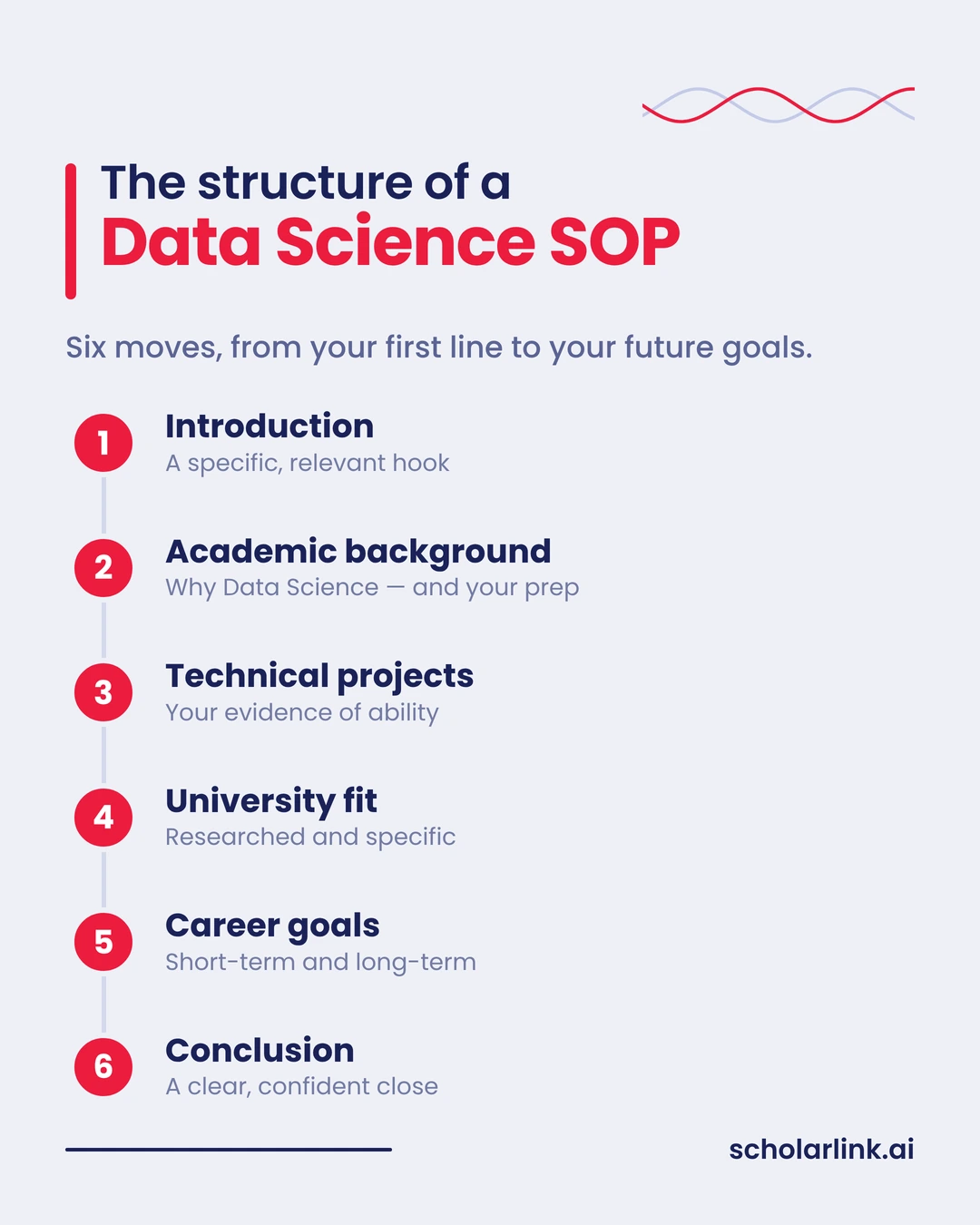
A good SOP follows a clear arc: what drew you in, what prepared you, what you’ve done, why this programme, and where you’re going. Here’s each stage, made specific to Data Science.
1. Introduction — Start With a Relevant Hook
Open with something concrete: a technical problem you hit, a dataset that surprised you, a project that pulled you toward data work. Avoid empty openings like “I am passionate about Data Science because it is the future.” Compare:
- Weak: “I have always been passionate about data and technology.”
- Stronger: “While analysing survey data for my undergraduate thesis, I realised a flawed sampling method had skewed years of published results — and I wanted the tools to catch that kind of error systematically.”
2. Academic Background and Motivation — Why Data Science?
Connect your prior education to Data Science. Point to the subjects that prepared you — mathematics, statistics and probability, computer science, linear algebra, programming, database management, machine learning — and show how they lead naturally to this step. If your background is in another field, this is where you show the bridge: additional coursework, certifications, independent learning, and projects that prove you’ve built the quantitative and computational foundation.
3. Technical Skills and Projects — Demonstrate Your Experience
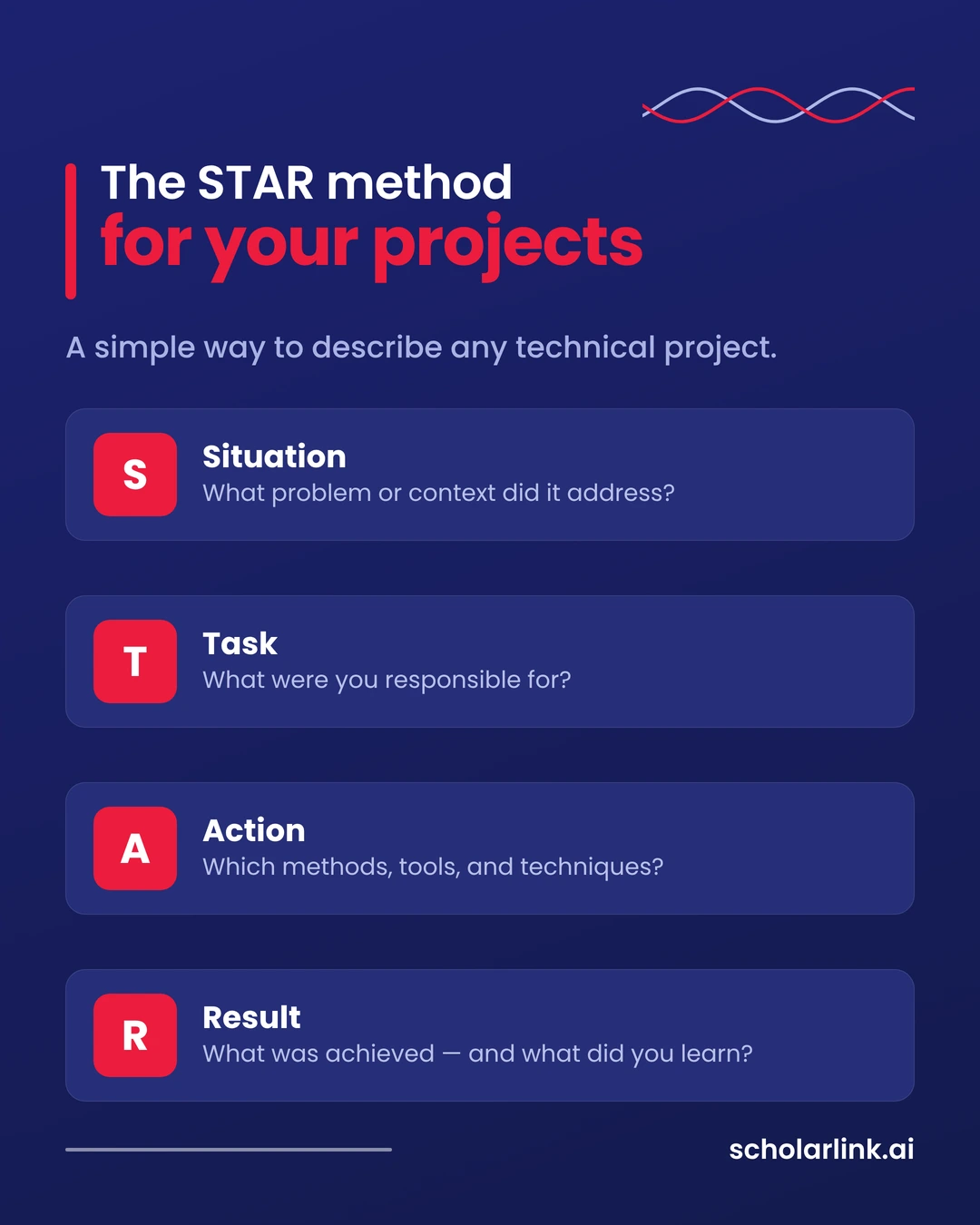
This is the heart of the essay, so give it the most space. Draw on academic projects, an undergraduate thesis, research, internships, professional or personal projects, and practical competitions like Kaggle where relevant. Name tools (Python, R, SQL, Pandas, NumPy, Scikit-learn, TensorFlow, PyTorch, Tableau, Power BI) only inside the work where you actually used them. The STAR framework is a useful way to organise each project:
| Component | Explanation |
|---|---|
| Situation | What problem or context did the project address? |
| Task | What were you responsible for? |
| Action | What methods, tools, and techniques did you use? |
| Result | What was achieved, and what did you learn? |
For example, turn “I built a churn prediction model in Python” into: “A subscription business was losing customers without warning (situation); I was tasked with predicting churn from usage logs (task); I engineered features from activity data and trained a gradient-boosted model in Python, validating it against a holdout set (action); it flagged at-risk users well enough that the team built a retention test around it, and I learned how much feature engineering mattered over model choice (result).” Keep every claim truthful — never invent metrics or inflate results.
4. Why This University and Program?
Show genuine fit. Point to specific professors whose research interests overlap with yours, relevant courses and specialisations, research labs or centres, capstone projects, and any industry partnerships — but mention only faculty, courses, and facilities you’ve verified on the university’s official pages. A generic “your university has an excellent program” is wasted space; a researched, specific paragraph is persuasive. This is the section you rewrite for every application.
5. Career Goals — Explain Your Future Direction
Connect the degree to a realistic direction: roles like data scientist, machine learning engineer, data analyst, research scientist, business intelligence analyst, or AI researcher. Separate your short-term goal (the first role or research area after graduation) from your longer-term ambition, and explain how this specific programme gets you there.
6. Conclusion — End With a Clear Purpose
Close by reinforcing your motivation, summarising why you fit the programme, and linking your background to your goals. Keep it short and confident — don’t restate the whole essay.
Weak vs. Strong SOP Writing
The difference between a forgettable SOP and a compelling one is almost always specificity. Here are three of the highest-impact spots, shown before and after.
Example 1: The Introduction
- Weak: “I am passionate about Data Science because it is transforming the world.”
- Strong: “Cleaning a messy 2-million-row sales dataset for a student club taught me that most of the insight lives in the preparation, not the model — and I wanted to get seriously good at both.”
Example 2: Describing a Technical Project
- Weak: “I used Python, Pandas, and Scikit-learn to build a machine learning model for predictions.”
- Strong: “To predict late deliveries for a logistics project, I built features from historical shipment data and compared logistic regression against a random forest in Scikit-learn; the random forest cut false negatives noticeably, and the exercise taught me how much class imbalance shaped the result.”
Example 3: Explaining University Fit
- Weak: “Your university has an excellent Data Science program and world-class faculty.”
- Strong: “[Professor]’s work on interpretable machine learning speaks directly to my interest in models people can trust, and the [specific course] on large-scale data systems would fill the engineering gap my projects have exposed.”
Notice the pattern: each “strong” version names something real — a dataset, a method, a result, a specific course — that the weak version only gestures at.
Full Sample SOP for MS in Data Science
The sample below is fictional and illustrative — the applicant, projects, and details are invented to show how the pieces fit together. Do not copy it. Replace every detail and bracketed placeholder with your own truthful information, and verify any real university name, course, or faculty member on official sources before using it. A sample never guarantees admission; it’s a model of structure, not content.
My interest in Data Science started with a frustration. Volunteering for a campus NGO, I watched the team make outreach decisions on gut feeling while a spreadsheet of three years of donor data sat unused. I built a simple churn model from it, and the response rate to our next campaign rose enough that the team never went back to guessing. I’m applying to the MS in Data Science at [University] to turn that instinct into rigorous skill.
My undergraduate degree in [field] gave me the quantitative core this field runs on — probability, linear algebra, and two programming courses — and I filled the gaps with an online specialisation in machine learning and steady work on real datasets. I learned to code the way I learn best: by building things that had to work.
The donor project grew into my most serious work. The problem was predicting which first-time donors would lapse; my contribution was the full pipeline, from cleaning inconsistent records to engineering features from giving history. I compared logistic regression with a gradient-boosted model in Python, validated against a holdout set, and chose the simpler model when its performance held up — a decision that taught me more about judgement than any single algorithm did.
A summer internship at [Company] added scale and discipline. Rebuilding a reporting dashboard in SQL and Tableau, I learned how much of real data work is making results trustworthy and legible to people who won’t read the code.
[University]’s programme fits where I want to go. [Professor]’s research on [research area] connects to my interest in [interest], and the [specific course] would give me the systems foundation my projects have only touched. In the short term I want to work as a data scientist on applied problems; longer term, I want to specialise in the modelling challenges that sit between research and production.
Why it works, paragraph by paragraph:
- The opening starts with a concrete situation and a real outcome, not a slogan — the reader immediately sees a person who uses data to change decisions.
- The academic paragraph proves preparation and, crucially, addresses a non-ideal background by showing how the gaps were filled.
- The project paragraph follows problem → contribution → method → result, and the honest reflection on choosing a simpler model reads as maturity.
- The internship paragraph adds scale and a lesson about communication, not just tools.
- The fit-and-goals paragraph names a specific professor, course, and realistic direction — and it’s the part you rewrite for each school.
Writing Your SOP for Different Situations
Not every applicant arrives with a research record and a perfect transcript. Here’s how to write a strong SOP from a less-than-ideal starting point.
No Work Experience
You don’t need a job title to show ability. Academic projects, undergraduate research, personal projects, relevant coursework, online certifications, and independent technical learning all count as evidence. What matters is demonstrating you can do the work — a well-described personal project that solved a real problem can be more convincing than a vague internship.
A Non-Technical Background
Applicants coming from biology, economics, business, psychology, or similar fields can make a strong case by showing the bridge. Highlight transferable analytical skills, relevant quantitative subjects you studied, technical courses and certifications you’ve added, and projects that prove computational ability — then explain clearly why the move into Data Science makes academic and professional sense. A focused narrative beats an apology for your background. If your background is specifically in computer science, our SOP for Computer Science guide covers that path in more depth and pairs well with this one.
A Low GPA or Academic Gap
Address it briefly and honestly — one or two sentences, not a paragraph of excuses. Acknowledge the difficulty, then pivot to evidence of improvement: stronger recent grades, relevant projects, professional experience, or independent learning that shows where you are now. Committees respond far better to constructive framing (“after a difficult second year, I rebuilt my foundation through…”) than to silence or over-explanation.
No Research Experience
Research isn’t the only way to show readiness, especially for professional or coursework-oriented master’s programmes. Practical projects, technical internships, professional experience, and independent or exploratory projects all demonstrate preparation. Keep in mind that research-oriented programmes will weigh research experience and clear academic interests more heavily, so match your emphasis to the kind of programme you’re targeting.
SOP Format for Data Science: Length, Structure, and Presentation
There’s no single correct length. Different programmes and guides suggest different ranges — commonly somewhere between 500 and 1,200 words — but the only number that matters is the one in your target programme’s official instructions. When a limit is given, respect it exactly; when none is, aim for concise and complete over long.
Beyond length, a few presentation basics keep the essay readable:
- Length matches the official word/page limit
- Clear paragraph structure, one idea per paragraph
- A clean, standard font and comfortable spacing
- The exact file format and upload instructions followed
- A professional, direct writing style — no jargon for its own sake
- Proofread for grammar, spelling, and flow
How to Customize Your SOP for Different Universities
Don’t send the same SOP to every programme. Your academic story stays largely the same, but the fit section — and sometimes your framing of goals — should change for each school. Forget rigid rules like “keep 80%, change 20%”; how much you adjust depends on how different each programme is and what its instructions ask for.
To tailor each application:
- Read the programme curriculum and specialisations
- Identify professors and research areas that match your interests
- Understand the programme’s academic focus (applied vs. research-heavy)
- Connect your specific interests to named programme opportunities
- Adjust your stated goals to reflect the programme’s strengths
- Verify every faculty name, course, and lab on official pages
Common Mistakes to Avoid in a Data Science SOP
| Common mistake | Why it hurts | How to improve |
|---|---|---|
| Listing technologies without context | Doesn’t show real ability | Explain how you used each tool in a project |
| Using generic motivations | Makes you blend in | Tie motivation to a real experience |
| Repeating the resume | Adds nothing new | Explain the meaning and impact of experiences |
| Ignoring university fit | Reads as mass-produced | Research programme-specific opportunities |
| Exaggerating achievements | Damages credibility | Use accurate, verifiable claims |
| Unrealistic career goals | Weakens your narrative | Present clear, achievable goals |
| Copying online samples | Kills originality | Use samples only for structure |
| Ignoring application instructions | Risks a non-compliant submission | Follow each university’s exact requirements |
SOP for Data Science Checklist Before Submission
Run through this before you submit each application:
- The introduction explains what genuinely motivated me to study Data Science
- I’ve connected my academic background to the field
- I’ve shown technical skills through concrete examples, not lists
- I’ve explained my own contribution to key projects
- I’ve said why I chose this specific university, with verified details
- My career goals are clear and realistic
- The SOP follows the programme’s word limit and formatting rules
- The content is original and factually accurate
- I’ve proofread for grammar, spelling, and paragraph flow
Frequently Asked Questions
What is the ideal word count for an SOP for Data Science?
There’s no universal number — it varies by university and programme, often somewhere between 500 and 1,200 words. Always follow the official instructions for your target programme.
How do I start an SOP for Data Science?
Open with a specific academic, professional, or personal experience that shows genuine motivation — a problem you tackled or a project that pulled you in — rather than a generic statement about loving data.
What technical skills should I mention?
Programming (Python, R, SQL), statistics and probability, data analysis, databases, and machine learning — but mention them inside real examples that show how you used them, not as a keyword list.
Can I write an SOP for Data Science without work experience?
Yes. Academic projects, undergraduate research, personal projects, relevant coursework, and online certifications can all demonstrate your preparation and ability.
Can students from non-CS backgrounds apply for an MS in Data Science?
Often, yes — it depends on each programme’s prerequisites. Show your quantitative and computational readiness through relevant subjects, added coursework or certifications, and projects.
Should I mention Python, SQL, and machine learning projects?
Yes, when they’re relevant — and explain your actual contribution and what each project demonstrated, not just the tools you touched.
Can I use the same SOP for multiple universities?
Keep the core, but rewrite the program-fit section for each school and follow each university’s specific requirements. A copy-pasted fit paragraph is easy to spot.
Is research experience necessary for an MS in Data Science?
Not always. Professional and coursework-based programmes value practical projects and experience; research-oriented programmes weigh research experience and academic interests more heavily.
Find Your Next Data Science Program
The fit section of your SOP is only as strong as the research behind it — so start by finding programmes whose faculty and courses genuinely match your interests. ScholarLink AI helps you discover Data Science master’s programmes, potential supervisors, and scholarships, so you can target the right schools before you write a word. Once you’ve shortlisted, tailor your SOP to each one.
Related guides: SOP for Computer Science for CS applicants, plus our general statement of purpose and letter of recommendation guides for the rest of your application.