How much money do you actually need to live in Australia while you study? Most international students spend roughly A$450–750 per week, which works out to about A$23,000–39,000 a year, but your own number depends on your city, your accommodation and your lifestyle. This guide to the cost of living in Australia for international students covers rent, food, transport, bills and health cover, compares five major cities, and explains how living costs differ from tuition fees. It also separates the government’s student visa financial requirement from what you will really spend, so you can build a realistic budget before committing to a course. Every figure here is an indicative planning estimate, and we note sources and dates throughout.
In this guide
- How much does it cost to live in Australia as an international student?
- Average weekly and monthly living expenses
- Cost of living by city
- Tuition fees and total study costs
- How much money you need for an Australian student visa
- How to budget and save money
- Frequently asked questions
How Much Does It Cost to Live in Australia as an International Student?
Excluding tuition, a single international student should plan for roughly A$450–750 per week. That range matches a January 2026 estimate from student accommodation provider Scape, which also notes that Sydney and Melbourne are usually the most expensive cities and Adelaide and Brisbane tend to be more budget-friendly. University guidance points the same way: Monash University, for example, tells international students to expect about A$30,000–45,000 a year for living expenses.
The table below turns that range into three planning scenarios.
| Budget level | Weekly estimate | Monthly estimate | Annual estimate |
| Budget-conscious | A$450 | A$1,950 | A$23,400 |
| Moderate | A$600 | A$2,600 | A$31,200 |
| Higher-cost lifestyle | A$750 | A$3,250 | A$39,000 |
Assumptions behind each scenario
- Budget-conscious: a shared room in a lower-cost city such as Adelaide, Brisbane or Perth, mostly cooking at home, and limited social spending.
- Moderate: shared housing or on-campus accommodation in a larger city, with a mix of home cooking and eating out.
- Higher-cost lifestyle: a studio or one-bedroom apartment, often in Sydney or Melbourne, with regular eating out and activities.
Methodology: monthly figures are weekly figures × 52 ÷ 12; annual figures are weekly figures × 52. Weekly bands are editorial planning estimates based on the Scape range above and university cost guides.
These are planning estimates, not guaranteed costs or visa eligibility thresholds. Note that the budget-conscious scenario sits below the visa financial requirement discussed later in this article.
Average Weekly and Monthly Living Expenses in Australia
The table below shows how a moderate weekly budget of A$600 can break down. Use it as a template and adjust each line to your own city and housing.
| Expense category | Weekly cost (AUD) | Monthly cost (AUD) |
| Accommodation (shared rental) | A$300 | A$1,300 |
| Groceries and food | A$120 | A$520 |
| Public transport | A$35 | A$152 |
| Utilities and internet | A$35 | A$152 |
| Mobile phone | A$10 | A$43 |
| Personal and social expenses | A$100 | A$433 |
| Total living expenses | A$600 | A$2,600 |
Methodology: monthly = weekly × 52 ÷ 12, rounded to the nearest dollar. Overseas Student Health Cover (OSHC) is excluded because it is usually paid upfront for the whole visa period; get a current quote from an approved provider. If your accommodation includes bills, remove the utilities line so you don’t count it twice.
Budgeting takeaway: Your actual student budget depends on where you live, how you travel and whether your accommodation includes essential bills.
Accommodation Costs
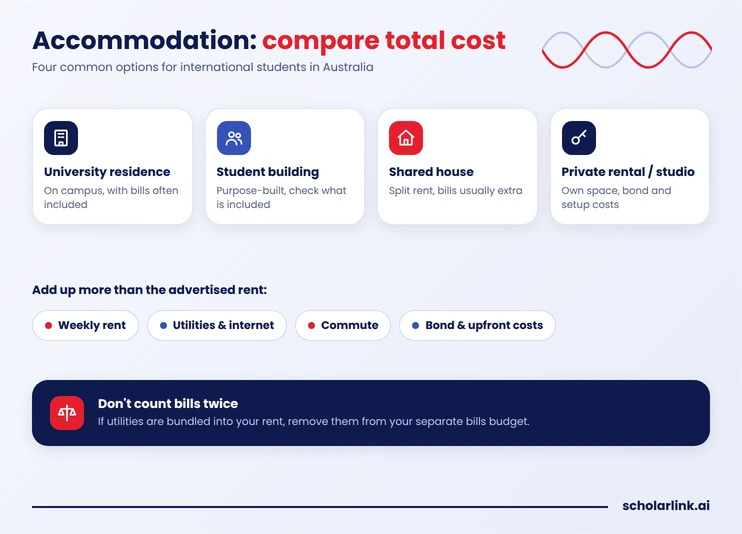
Housing is usually the biggest expense. Typical options include:
- University residences and purpose-built student accommodation: convenient and often all-inclusive. Monash lists on-campus rooms at about A$350–450 per week.
- Shared houses: the most common choice. Monash’s Clayton-area shared rentals run about A$275–380 per week, and UTS gives about A$350 per week as an example for shared accommodation near its Sydney campus.
- Private rentals and studios: more privacy at a higher price. Monash lists A$500–750 per week in the Clayton area.
- Homestay: a host family provides a room and often meals, around A$275–430 per week at Monash.
Location matters a great deal. Queensland’s student guidance, for example, lists off-campus accommodation from about A$180 to A$450 per week, well below the Sydney and Melbourne examples above.
Budget for upfront costs too. Most private landlords ask for a rental bond, commonly equal to about four weeks’ rent, plus rent in advance. UTS has estimated start-up costs of around A$5,200 in Sydney once you add linen and basic furniture, though that figure dates from 2023.
Housing takeaway: Compare the total cost of accommodation, including utilities, transport and upfront rental expenses, not just the weekly rent.
Food and Grocery Costs
Cooking at home is the single biggest lever on your food budget. The University of Sydney puts a typical weekly grocery bill for one person at A$80–280, depending on where you shop and what you buy, and other student guides cite A$70–100 per week for careful shoppers. Supermarkets such as Coles, Woolworths and Aldi are the usual money-savers. Regular takeaway or food delivery can double your food spending, so decide in advance how many meals out fit your plan.
Public Transport Costs
Fares and student concessions vary by state, and international students are not always eligible for the same discounts as local students. According to the University of Sydney, international students in Sydney are currently not eligible for concession tickets on the Opal network. Scape reports that Victoria offers an International Student Travel Pass (the iUSEpass) with 50% off fares, and that Brisbane’s go card fares are currently heavily discounted. Rules change, so check your state’s transport authority before you budget. As a rough guide, one student guide puts an average monthly pass at around A$142.
Utilities, Internet and Mobile Phone Plans
In a shared house, you’ll typically split electricity, gas (where applicable), water and internet. Monash lists gas, water and electricity at A$40–80 per week and phone plus internet at A$20–46 per week, while Queensland’s guidance puts electricity and gas lower, at A$10–20 per week. In all-inclusive student accommodation, these bills are bundled into the rent.
Health Insurance and Other Personal Expenses
Overseas Student Health Cover (OSHC) is compulsory for most international students on a student visa, so treat it as a fixed cost rather than an optional extra. Prices depend on the provider, level of cover and length of stay. Beyond OSHC, budget for study materials (textbooks, lab equipment), clothing, personal care and entertainment. Your course outline will list essential items.
Cost of Living in Australia by City
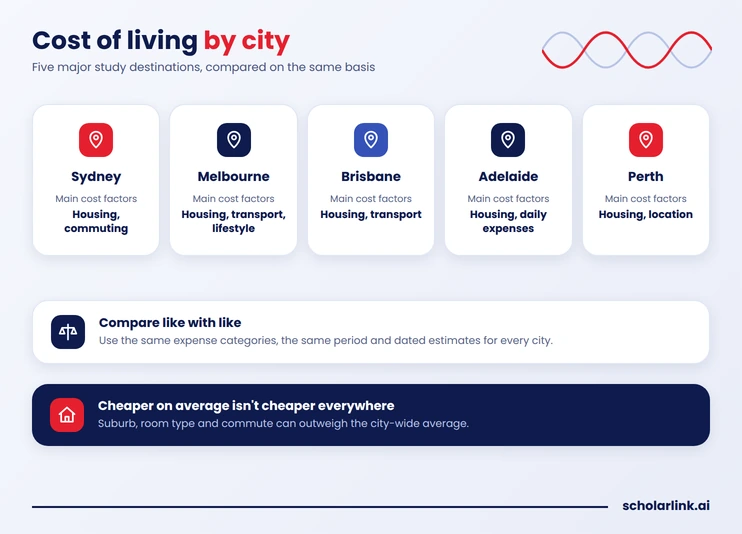
City costs differ mainly because of rent and commuting. Published city-level estimates are not standardised, so the table uses one consistent set of annual ranges for shared housing, divided by 12 for monthly figures.
| City | Estimated monthly living costs | Main cost considerations |
| Sydney | A$2,300–3,750+ | Housing and commuting |
| Melbourne | A$2,300–3,750+ | Housing, transport and lifestyle |
| Brisbane | A$2,000–3,150 | Housing and transport |
| Adelaide | A$2,000–3,150 | Housing and daily expenses |
| Perth | A$2,000–3,150 | Housing and location |
Methodology: indicative 2026 ranges (Sydney/Melbourne about A$28,000–45,000 a year; Brisbane, Adelaide and Perth about A$24,000–38,000 a year, shared housing, excluding tuition and OSHC), divided by 12. Other sources report lower figures for Adelaide in particular, so treat every number as a range and check city-specific university guidance.
Cost of Living in Sydney
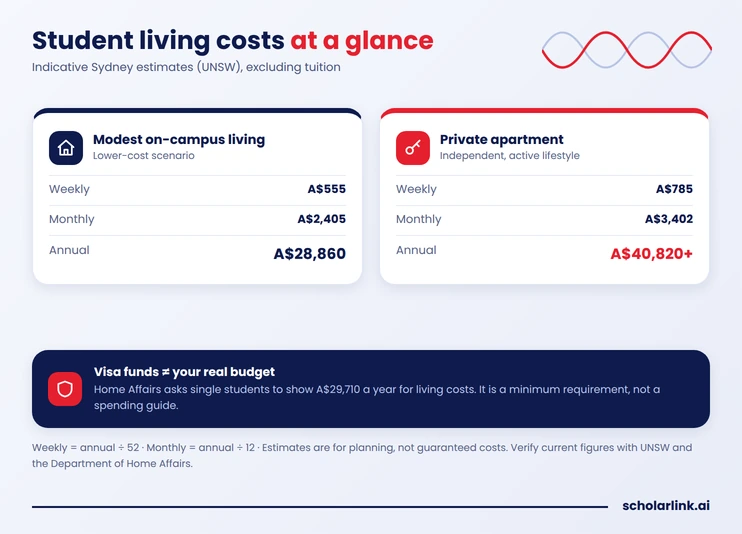
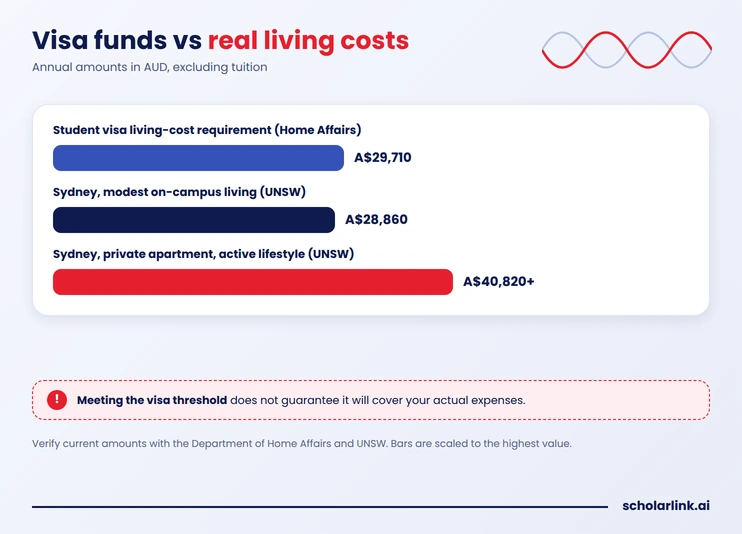
UNSW is a useful Sydney-specific reference. Its published estimates range from about A$28,860 a year for modest on-campus living to A$40,820 or more for a private apartment and a more active lifestyle. These are Sydney figures, not a national average. Living close to campus, sharing a room or house, and choosing on-campus housing all pull the budget down, while a private one-bedroom apartment pushes it up sharply. Since international students pay adult public transport fares in Sydney, living near campus can save real money on commuting.
Cost of Living in Melbourne
Melbourne’s costs are shaped by where you live and how you travel. Rent varies considerably by suburb (Monash’s Clayton shared-house and private-rental ranges above are one example), and a student travel pass can halve fares for eligible international students. Without comparable data from the same source and period, we don’t claim Melbourne is cheaper or more expensive than Sydney beyond the shared “higher-cost” tier both cities fall into.
Affordable Cities for International Students
Adelaide, Brisbane and Perth generally sit in a lower cost tier than Sydney and Melbourne, mostly because of cheaper housing. That is an average, though. A central apartment in Brisbane can cost more than a shared house in outer Sydney, and on-campus rooms are priced similarly in many cities. Compare the specific suburb and accommodation type, not just the city name.
Tuition Fees and Total Study Costs in Australia
The cost of living is only part of the picture. Your total study cost adds tuition, which is paid to your university or college, plus insurance, visa and arrival expenses. Keep recurring costs (tuition and living) separate from one-off costs (visa, flights, setup), so you don’t blur the two.
Average Tuition Fees for International Students
Study Australia indicates that international students usually pay about A$20,000–45,000 per year for a bachelor’s degree. Postgraduate coursework and specialist programs such as medicine can cost more. Fees vary by institution, course and year of entry, so always check the fee page of the course you’re considering.
Additional Study and Arrival Expenses
First-year costs often include the visa application charge (A$2,500 for the main applicant from 1 July 2026, up from A$2,000), OSHC for your visa period, flights, a rental bond, initial accommodation and essential setup items like bedding and kitchenware.
| Cost type | Frequency | Amount |
| Tuition fees | Annual | Typically A$20,000–45,000 (undergraduate); verify by course |
| Living expenses | Annual | A$23,400–39,000 (see budget table above) |
| OSHC | Policy-dependent | Obtain a current quote |
| Visa application | One-off | A$2,500 (main applicant, from 1 July 2026) |
| Flights and initial setup | One-off | Depends on origin and circumstances |
Estimate your first-year total with this formula:
Formula: Tuition + (weekly living budget × 52) + OSHC + visa fee + flights + bond and setup costs + emergency buffer
Illustration only: assuming A$30,000 tuition, a moderate living budget of A$31,200 and the A$2,500 visa fee, the subtotal is A$63,700 before OSHC, flights, setup and a buffer.
How Much Money Do You Need for an Australian Student Visa?
When you apply for a Student visa (subclass 500), the Department of Home Affairs may ask you to show that you can pay for your living costs, travel and tuition, plus costs for any accompanying family members. The living-cost component for a single student is currently A$29,710 per year, with separate amounts for a partner (A$10,394) and for each school-age child (A$13,502 a year). Always confirm the current figures on the Department of Home Affairs student visa page before you plan, because thresholds can change.
Visa takeaway: The minimum financial-capacity requirement for a student visa is not necessarily the amount you will actually spend while living in Australia.
Visa Financial Requirements vs. Actual Living Costs
| Item | Annual (AUD) | Weekly equivalent |
| Visa living-cost evidence (single student) | A$29,710 | A$571 |
| Budget-conscious scenario | A$23,400 | A$450 |
| Moderate scenario | A$31,200 | A$600 |
| Higher-cost scenario | A$39,000 | A$750 |
| UNSW: modest on-campus living (Sydney) | A$28,860 | A$555 |
| UNSW: private apartment, active lifestyle (Sydney) | A$40,820+ | A$785+ |
Methodology: weekly equivalent = annual ÷ 52. Visa figure per Home Affairs; verify before relying on it.
Meeting the visa threshold does not guarantee that the budget will cover your actual expenses. Students who plan around the minimum in Sydney or Melbourne often find costs run higher, especially in the first months.
Can You Rely on Part-Time Work to Cover Living Costs?
Student visa holders can generally work up to 48 hours per fortnight during study periods and without that cap during official course breaks, but conditions can change and apply to your individual visa, so check the current rules on the Home Affairs website. Work is never guaranteed: jobs take time to find, hours can be irregular, and income should not be the only basis of your financial plan. Treat part-time earnings as a buffer, not the foundation of your budget.
How to Budget and Save Money as an International Student in Australia
Choose Accommodation Carefully
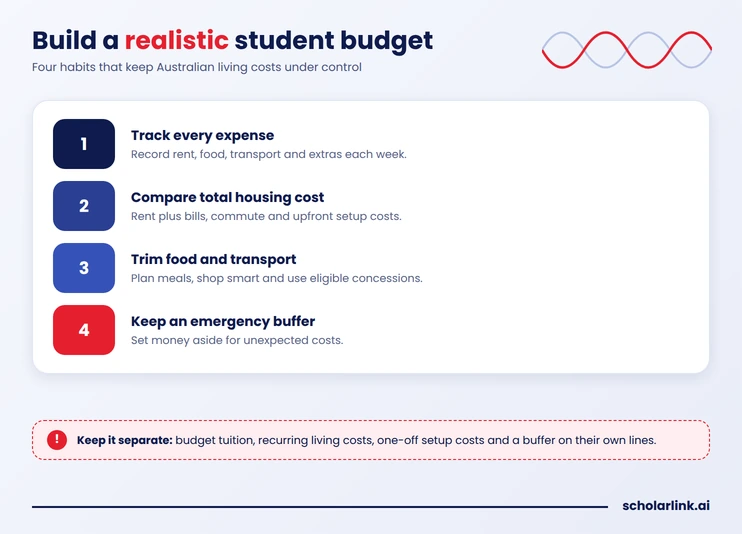
Compare total monthly cost, not just advertised rent. A cheaper room far from campus can cost more once you add commuting time and fares, and all-inclusive housing may beat a lower rent with separate bills. Factor in the bond and any advance rent too.
Reduce Food and Transport Expenses
Plan meals for the week, shop at discount supermarkets and split bulk groceries with housemates. Apply for any transport concession you are eligible for, and walk or cycle where it’s practical.
Use Student Discounts and University Resources
Use your campus library and free study spaces, join free campus events, and look for second-hand furniture through student groups and community marketplaces. Many universities also offer student support services and some scholarships for international students.
Create a Realistic Monthly Budget
Track your spending for the first two months, then adjust each category. Keep an emergency fund, ideally covering at least a few weeks of living costs, for surprise expenses such as medical visits or a sudden rent increase.
Frequently Asked Questions About Living Costs in Australia
Is Australia expensive for international students?
It can be, mainly because of housing. Sydney and Melbourne are generally the costliest cities, while Adelaide, Brisbane and Perth tend to be cheaper. Your accommodation type and lifestyle matter as much as the city, so a careful budget can keep costs manageable.
How much money does an international student need per month in Australia?
Most students spend roughly A$1,950–3,250 per month on living costs, excluding tuition and OSHC. The low end suits shared housing in a lower-cost city, while the high end suits private apartments in Sydney or Melbourne.
Which Australian city is most affordable for students?
Adelaide, Brisbane and Perth usually cost less than Sydney and Melbourne, mainly due to rent. But published figures vary between sources, so compare the actual suburb, accommodation type and transport costs rather than relying on a single city ranking.
Does the Australian student visa financial requirement cover tuition fees?
No. The living-cost amount (A$29,710 for a single student) is only one part. Applicants may also need to show funds for tuition, travel and any accompanying family members. Check the full calculation on the Home Affairs website.
Can international students work while studying in Australia?
Generally yes. Student visa holders can usually work up to 48 hours per fortnight during study periods and more during official breaks, but rules can change. Confirm the current conditions on the Department of Home Affairs website.
Are international students eligible for public transport discounts?
It depends on the state. Victoria offers an international student travel pass, and Queensland has had discounted fares, but international students in Sydney are not currently eligible for concession tickets. Check your state’s transport authority.
Plan Your Budget Before Studying in Australia
Your Australian study budget depends on your city, accommodation, course and lifestyle. Use the figures above as a starting point, then check the Study Australia cost calculator and your university’s fee page for exact numbers. Before you commit, calculate four things separately: tuition, recurring living expenses, one-off setup costs and an emergency buffer. Seeing them side by side shows what your first year will really cost.