
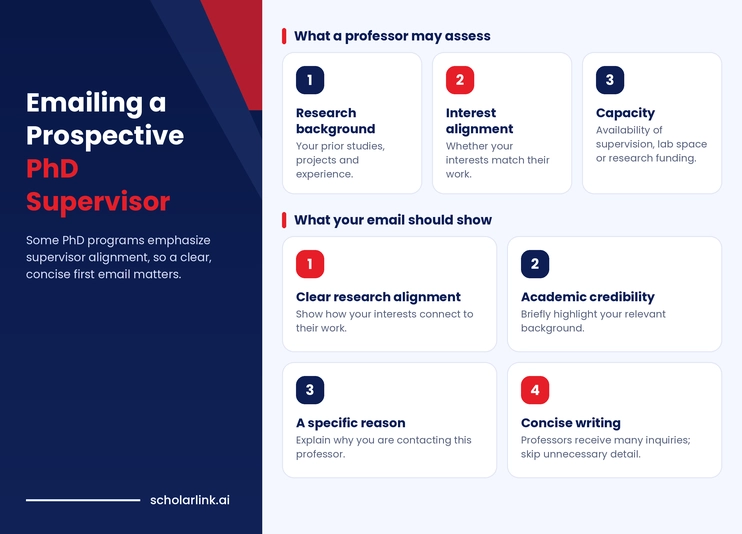
Reaching out to a prospective faculty supervisor can be an important step when seeking admission and funding for a doctoral degree. Unlike undergraduate or master’s admissions, some PhD programs place significant emphasis on supervisor alignment, particularly when students are expected to identify a potential supervisor before or during the application process. A professor may need to assess your research background, determine whether your interests align with their work, and confirm whether supervision, laboratory space, or research funding is available.
Crafting a professional sample email to professor for PhD admission requires a balance between academic substance and concise communication. Faculty members may receive numerous inquiries from prospective students, so your email should demonstrate clear research alignment, academic credibility, and a specific reason for contacting that professor without unnecessary detail. Whether you are preparing a sample email to professor for PhD application, contacting a potential supervisor for the first time, or following up on an existing inquiry, this guide covers the essential structure, strategies, and templates for effective PhD outreach.
Should You Email a Professor Before Applying for a PhD?
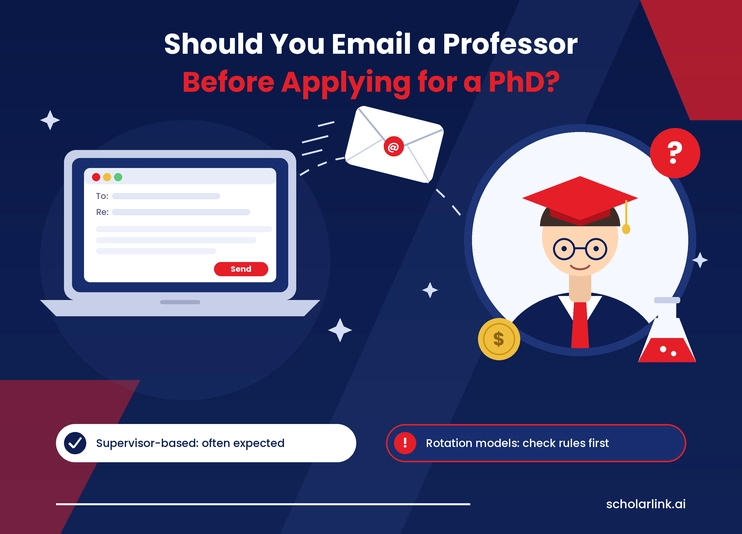
In many thesis-based PhD programs, contacting a potential supervisor before submitting a formal application can be useful for understanding whether a professor is accepting new students, whether your research interests align with their work, and whether funding or project opportunities may be available. In some supervisor-based admission models, prospective students are expected to identify a faculty supervisor before or during the application process.
However, institutional policies vary across countries, universities, disciplines, and PhD program structures. Some universities, particularly programs with centralized admissions or rotation-based models in North America, may discourage students from contacting individual professors before completing the formal application process. In these programs, students may rotate through different laboratories or research groups before selecting a permanent advisor.
For this reason, review the specific admission and departmental guidelines on the university website before contacting a professor. If direct outreach is permitted, a well-written email to professor for PhD sample can help you communicate your academic background, research interests, and supervision goals clearly.
How to Write an Email to a Professor for PhD Admission
When writing an email to a professor for PhD opportunities, structure and clarity are essential. Faculty members often review prospective student inquiries quickly, so each paragraph should have a clear purpose and provide relevant information without unnecessary detail.
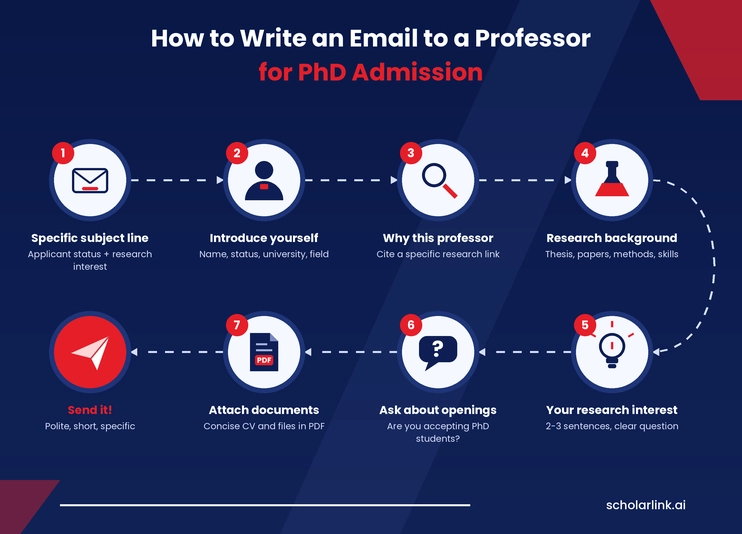
1. Write a Specific Subject Line
The subject line gives the professor an immediate indication of why you are contacting them. Avoid vague phrases such as “PhD Inquiry” or “Hello.” Instead, combine your applicant status with a clear indication of your research interest or purpose. Effective subject line examples include:
- Prospective PhD Student Interested in Your Research
- Inquiry About PhD Supervision Opportunities in [Field]
- PhD Application Inquiry Regarding [Research Topic]
- Prospective PhD Applicant – Research Alignment with Your Work
2. Introduce Yourself Clearly
Open with a brief, professional introduction stating your name, current academic status, university, and field of study. Clearly explain that you are interested in pursuing doctoral study and, where relevant, seeking supervision for an upcoming academic term. For instance:
I am currently completing my Master’s degree in [Field] at [University], and I am interested in pursuing a PhD under your supervision starting in [Term/Year].
3. Explain Why You Chose This Professor
This paragraph is an important part of your message. Show that you have reviewed the professor’s publications, current research projects, laboratory work, or methodological approaches. Avoid generic statements such as “I am very interested in your research.” Instead, highlight a specific connection between their work and your academic background:
Your recent research on [topic], published in [Journal], closely aligns with my previous thesis work on [topic].
4. Present Your Research Background
Highlight the academic and research experience most relevant to your proposed PhD. This may include your Master’s thesis, peer-reviewed publications, conference presentations, research methods, technical skills, or relevant academic projects. Focus on evidence that helps the professor understand your preparation for doctoral research rather than listing general coursework.
5. Explain Your PhD Research Interest
Briefly describe your intended research direction in two or three sentences. You do not need to attach a complete research proposal at this stage unless the program or professor specifically requests one. Instead, demonstrate that you have a clear understanding of the research area and a viable research question that relates to the professor’s work.
6. Ask About PhD Opportunities
Conclude with a direct but polite question about supervision availability. Questions such as “Are you accepting PhD students for [Term/Year]?” or “Would you be open to a brief meeting to discuss potential supervision?” make it clear what information you are seeking.
7. Attach Relevant Documents
An updated academic CV is commonly useful when contacting a potential PhD supervisor. Depending on the university’s requirements and the purpose of your email, you may also attach a short research statement, thesis abstract, or other relevant document. Keep attachments concise, clearly named, and in PDF format unless another format is requested.
Sample Email to Professor for PhD Application
When contacting a faculty member during the PhD application process, your message should focus on your academic preparation, research interests, application timeline, and potential supervision opportunities. If you are applying for a specific funded position or fellowship, you can also briefly explain how your background relates to the relevant project or funding opportunity.
Subject: Inquiry Regarding PhD Application & Supervision Availability – [Your Name]
Dear Professor [Last Name],
I am preparing my application for the PhD program in [Field] at [University] for the upcoming [Term/Year] intake, and I am writing to inquire about potential research supervision opportunities in your group.
I hold a [Bachelor’s/Master’s] degree in [Field] from [University]. My research background focuses on [Area of Focus], with experience in [Skill/Method 1] and [Skill/Method 2]. During my work on [Project/Thesis], I [Key Result or Achievement], which gave me relevant experience in [Subfield or Research Area].
I am particularly interested in your research group because of your current work on [Project/Research Area]. I would be interested in exploring how my background in [Your Skill Area] could contribute to research on [Problem Area]. I plan to submit my application before the [Application Deadline] and would be grateful to know whether you are currently accepting new PhD students.
If you are open to supervising new doctoral researchers for the upcoming cycle, I would welcome the opportunity to share a brief outline of my research interests or schedule a short call at your convenience.
Thank you for your time and consideration.
Best regards,
[Your Name]
[Your Degree & University]
Email Template to Professor for PhD
Below is a simple, customizable email template to professor for PhD inquiries that you can adapt to your academic background, research interests, and target discipline.
Subject: Prospective PhD Student Interested in Your Research
Dear Professor [Last Name],
My name is [Your Name], and I am currently a [Master’s student/researcher] in [Field] at [University].
I am planning to apply for a PhD in [Field] at [University] for [Term/Year], and I am interested in your research on [Specific Topic].
I recently read your work on [Paper/Project], particularly your research on [Specific Research Area]. This work closely relates to my academic background and research interests in [Your Research Area].
During my Master’s studies, I worked on [Thesis/Research Project], where I gained experience in [Methods/Tools/Research Area].
My current research interests focus on [Topic], and I would be interested in exploring how they could connect with your work in [Professor’s Research Area].
I would like to ask whether you are currently accepting PhD students for [Term/Year] and whether there may be an opportunity to discuss potential supervision.
I have attached my CV for your reference and would be grateful for the opportunity to discuss possible PhD research opportunities in your group.
Thank you very much for your time and consideration.
Best regards,
[Name]
[Degree & University]
Sample Letter to Professor for PhD Admission
In some academic and application contexts, a prospective PhD student may use a formal cover letter alongside an email inquiry or application materials. Unlike a short email, a sample letter to professor for PhD admission provides more space to present your academic background, research experience, and reasons for seeking doctoral supervision. Whether a formal letter is appropriate depends on the university, department, and purpose of the application, so always follow the relevant application guidelines.
Email vs. Formal Cover Letter Comparison
- Email Outreach: A concise message focused on introducing yourself, explaining your research interests, and asking about potential supervision.
- Formal Letter: A more structured document that provides additional detail about your academic background and research experience, typically used when a department, professor, or application process requests a formal letter.
[Date]
Professor [Last Name]
Department of [Department Name]
[University Name]
[University Address]Re: Expression of Interest in Doctoral Supervision
Dear Professor [Last Name],
I am writing to express my interest in pursuing doctoral research under your supervision within the Department of [Department Name] at [University Name]. I have completed my Master of Science in [Field] at [Your University], where I developed a research background in [Core Field].
My research interests lie at the intersection of [Topic A] and [Topic B]. During my graduate studies, I completed a Master’s thesis titled “[Thesis Title],” which examined [Key Research Question]. Through this work, I gained experience in [Key Methods/Tools] and investigated [Research Area or Finding]. [If applicable: I also published a paper in [Journal Name] based on this research.]
I am particularly interested in your research on [Professor’s Specialty], especially your work on [Specific Topic or Technique]. I believe there is a strong connection between your research and my background in [Your Research Area], and I would be interested in exploring this connection further through doctoral research.
I have attached my CV, [thesis abstract/research statement/other requested document] for your reference. I would welcome the opportunity to discuss my academic background and potential research directions with you.
Sincerely,
[Your Name]
[Your Degree & University]
Cold Email to Professor for PhD Admission
A sample of cold email to professor for PhD outreach is designed for contacting a faculty member with whom you have no prior institutional connection, mutual acquaintance, or personal introduction. Since the professor may have no prior context about your background, the email should quickly explain who you are, why you are contacting them, and how your research experience relates to their work.
Cold PhD Email Structure
A practical structure for a cold doctoral inquiry is:
Who You Are → Why This Professor → Research Match → Your Experience → PhD Question
Sample Cold Email
The following example shows how an applicant might contact a professor about a potential funded PhD position in an engineering or laboratory-based research group.
Subject: Inquiry Regarding PhD Supervision and Open Funded Positions in [Field]
Dear Professor [Last Name],
My name is [Your Name], and I recently completed my Master’s degree in [Field] at [University]. I am writing to ask whether you currently have any funded PhD opportunities available in your research group for the upcoming academic year.
I recently read your paper on [Paper Title], published in [Journal], and found your research on [Specific Problem] particularly relevant to my background. My research experience is in [Your Subfield], with a focus on [Tool/Method]. During my work at [Lab/University], I developed a computational model that reduced [Issue] by [Percentage/Metric], giving me relevant experience in [Related Research Area].
Given the connection between my research background and your current work on [Project Name], I would be interested in exploring potential PhD opportunities in your group. I have attached my CV, which includes my research experience and public
PhD Admission Email vs Research Email
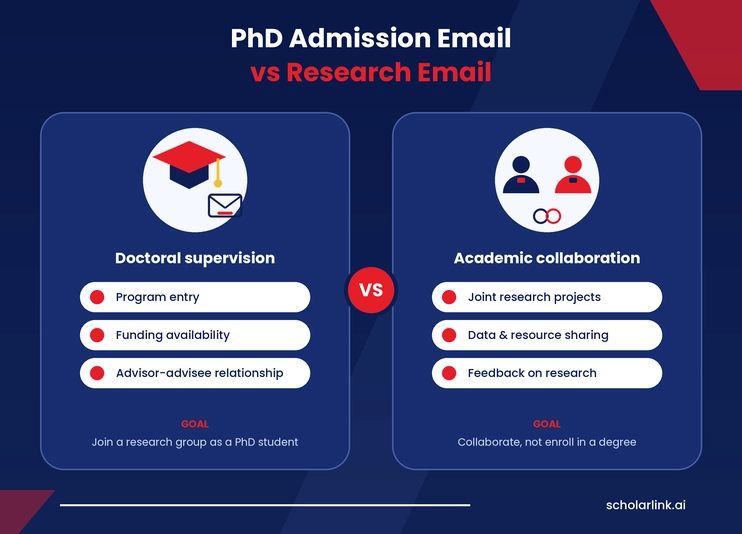
Applicants may confuse a PhD admission email with a general research collaboration email, but the two messages have different purposes. A PhD admission email is primarily about potential doctoral supervision and program entry, while a research email focuses on academic collaboration without necessarily involving degree enrollment.
- PhD Admission Email: Focuses on potential doctoral supervision, program requirements, funding availability, and the possibility of joining a research group as a PhD student. The goal is to explore doctoral study and establish a potential advisor-advisee relationship.
- General Research Email: Focuses on academic collaboration, such as joint research projects, paper submissions, data or resource sharing, or feedback on research. The goal is collaboration rather than admission to a degree program.
What Makes a Strong PhD Email to Professor?
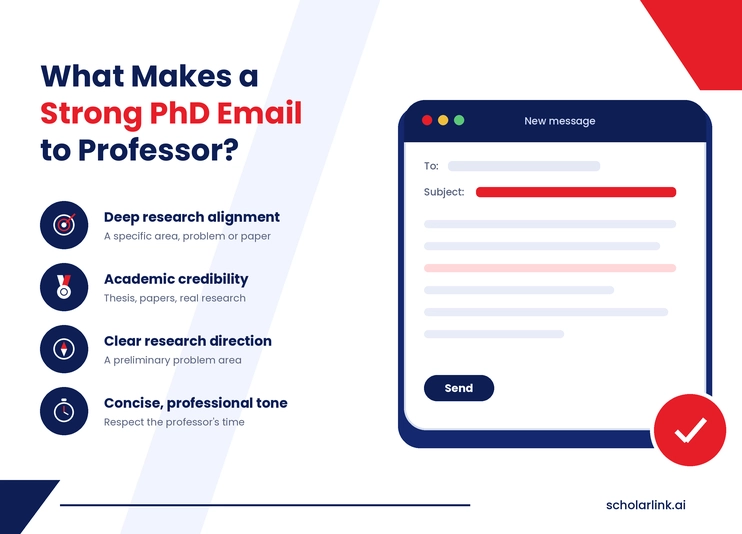
A strong email to a professor should respect the recipient’s time while providing enough information to understand your academic background, research interests, and reason for contacting them. The following elements can help make a PhD inquiry more relevant and effective:
- Deep Research Alignment: Avoid generic statements about an entire discipline, such as “I love artificial intelligence.” Instead, identify a specific research area, problem, methodology, or recent publication that connects your interests with the professor’s work.
- Demonstrated Academic Credibility: Rather than listing general coursework or grades, highlight relevant research experience. A Master’s thesis, published paper, conference presentation, research project, or relevant technical skill can provide useful evidence of your preparation for doctoral research.
- Clear Research Direction: You do not need a fully developed PhD research proposal in an initial email. However, it is helpful to communicate a preliminary research interest or problem area and explain how it relates to the professor’s work.
- Concise Professional Tone: Keep the email focused on the information the professor needs to assess your inquiry. Avoid lengthy personal stories or unrelated biographical details, and use a clear structure that makes your main purpose easy to identify.
Common Mistakes When Emailing Professors for PhD
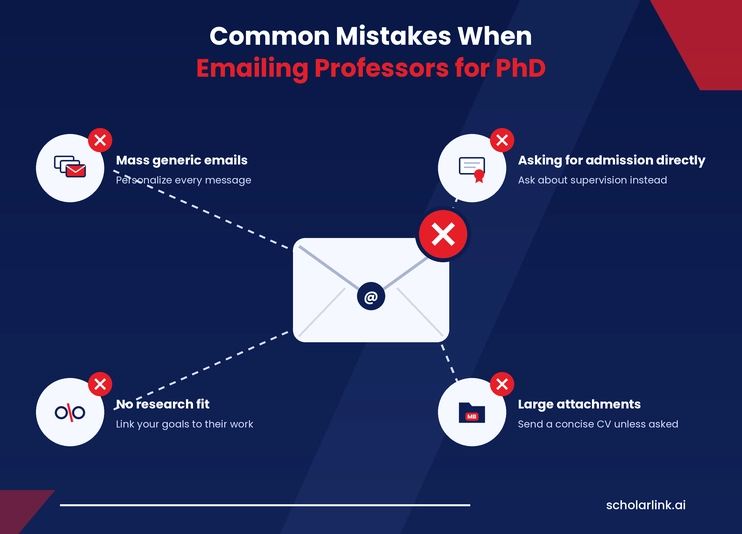
Avoiding common mistakes in your initial email is just as important as including the right information. A well-structured message can make it easier for a professor to understand your background, research interests, and reason for contacting them.
- Sending Mass Generic Emails: Avoid copying the same message to multiple professors without personalization. Generic greetings, broad compliments, and statements that could apply to any professor may make it difficult to demonstrate genuine research alignment. Personalize your message by referring to the professor’s specific research or publications.
- Asking for Admission Directly: Avoid asking a professor to guarantee your admission or immediately “accept” you into a PhD program. In many universities, formal admission is handled through a department or university process, while professors may participate in supervision decisions or recommend prospective students. Instead, ask whether they are accepting new PhD students or open to discussing potential supervision.
- Failing to Mention Research Fit: Explaining your academic goals without connecting them to the professor’s research can make your email less relevant. Briefly explain which aspect of their research interests you and how it relates to your own background or proposed research direction.
- Attaching Unnecessary or Large Files: Avoid sending large collections of documents, full thesis manuscripts, or unrelated portfolios unless requested. Attach relevant materials, such as an academic CV, and follow any instructions provided by the professor, department, or application process.
Follow-Up Email to Professor After No Response
Professors may not be able to respond to every prospective student inquiry, particularly during busy academic periods. If you have not received a response after about one to two weeks, a brief and polite follow-up can be appropriate. If an application deadline is approaching, you may choose to follow up sooner while keeping the message concise and professional.
Subject: Re: Prospective PhD Student Interested in [Research Topic] Supervision
Dear Professor [Last Name],
I am following up on my previous message regarding potential PhD supervision for the [Term/Year] academic intake. I understand that you have a busy schedule, so I wanted to follow up in case my previous email was missed.
I remain very interested in your research group’s work on [Specific Topic] and would appreciate the opportunity to learn whether you are currently accepting new doctoral students for the upcoming intake.
Thank you again for your time and consideration.
Best regards,
[Your Name]
[Your Contact Details]
PhD Email Subject Lines
A clear and specific subject line helps the professor understand the purpose of your email before opening it. Choose a subject that briefly communicates your status, research interest, or reason for contacting them. Examples include:
- Prospective PhD Student Interested in Your Research
- Inquiry About PhD Supervision in [Field]
- PhD Application and Research Interest in [Topic]
- Prospective Doctoral Student – Research Alignment Inquiry
- Question Regarding Available PhD Positions in [Research Group]
Get Your Professor Email Reviewed Before Sending
Before sending your email, a review can help you check its clarity, professional tone, structure, and alignment with the professor’s research. Make sure your message clearly communicates your academic background, research interests, and reason for contacting the professor.
Frequently Asked Questions
How do I email a professor for PhD admission?
To email a professor about PhD admission, write a concise message with a clear subject line, a brief introduction, an explanation of how your research interests relate to the professor’s work, and a summary of your relevant academic or research experience. End with a direct question about potential supervision or whether the professor is accepting new PhD students. Attach your CV if it is relevant or requested.
What should I write in an email to a PhD professor?
Include your current academic status, specific research interests, relevant research experience, and why you are contacting that particular professor. Mention a specific aspect of their research or a relevant publication, and briefly explain how it connects with your background. End with a polite question about potential PhD supervision.
Should I contact professors before applying for PhD?
Contacting professors before applying can be useful in some thesis-based PhD programs, particularly when prospective students are expected to identify a supervisor. However, direct outreach is not required or encouraged in every program. Check the university and department’s admission guidelines before contacting individual professors.
How long should a PhD email to professor be?
A PhD inquiry email should generally be concise and focused on the information the professor needs to understand your background and research interests. There is no universal word limit, so avoid unnecessary detail while providing enough context to explain your purpose clearly.
Should I attach my CV to a PhD email?
An updated academic CV is commonly useful when contacting a potential PhD supervisor, unless the university or professor provides different instructions. Keep it concise, relevant to your research background, and clearly formatted. Other documents, such as a research statement or writing sample, should only be included when relevant or requested.
How do I ask a professor to supervise my PhD?
Ask directly and politely near the end of your email. For example: “Are you currently accepting new PhD students for [Term/Year]?” or “Would you be open to discussing potential doctoral supervision?” This makes your purpose clear without assuming that the professor is available to supervise you.
How many professors should I email for PhD admission?
There is no universal number of professors you should contact. Focus on faculty members whose research genuinely aligns with your interests and who are permitted or available to supervise new students. Personalize each email rather than sending the same message to a large number of professors.
What is the difference between a PhD admission email and research email?
A PhD admission email focuses on potential doctoral supervision and joining a degree program, while a general research email typically concerns academic collaboration, such as a research project, co-authorship, data sharing, or feedback. The purpose of the message should make it clear whether you are seeking PhD supervision or research collaboration.