
A PhD cover letter is a short, targeted letter that accompanies your CV and, where required, your research proposal. Its job is simple: show a selection committee or potential supervisor that your background fits this specific project, this group, and this program. This guide explains what to include, how to structure each paragraph, and how to adapt a PhD cover letter example to your own application.
A quick note before you start: terminology varies. Some universities ask for a “cover letter,” others for a “motivation letter,” “statement of purpose,” or “personal statement.” Always read the application instructions first. If they specify a length, format, or set of questions, those instructions override any general advice here.
What Is a PhD Cover Letter?
A cover letter for a PhD application introduces you and explains why you are applying to a particular position. It sits alongside your academic CV, transcripts, references, and (often) a research proposal. It does not replace any of them. Think of it as the connecting document: it points the reader to the most relevant parts of your record and explains why they matter for this opportunity.
What a PhD Cover Letter Should Achieve
- It does: state the position you are applying for, summarise your most relevant research experience, explain why the project and supervisor interest you, and show that you can work independently.
- It does not: retell your whole CV, promise to solve a field’s biggest problems, or rely on praise for the university’s reputation instead of the research itself.
A strong PhD cover letter connects your experience to the research, not just to the university’s reputation.
PhD Cover Letter vs Motivation Letter vs Personal Statement
These documents overlap, and institutions use the labels differently. The table below shows the usual distinctions, but check what your target program actually asks for.
| Document | Main purpose | Typical content | Avoid duplicating |
| PhD cover letter | Introduce yourself and argue fit for a specific position | Relevant experience, project fit, key skills, brief closing | The full CV, line by line |
| Motivation letter | Explain why you want to do a PhD and why here | Motivation, goals, background, fit with the program | Generic life-story material |
| Personal statement / statement of purpose | Describe your academic path and aims in more depth | Academic journey, interests, goals, sometimes challenges overcome | The research proposal |
| Research proposal | Outline a planned project | Question, background, methods, timeline, significance | The cover letter’s fit argument |
| Academic CV | Record your credentials | Education, research, publications, skills, awards | Narrative explanation |
When Is a Cover Letter Required?
It depends on the country, university, and type of position. Advertised, funded projects (common in the UK and much of Europe) often ask for a cover letter or motivation letter. Programs that admit students through a central application system may use a statement of purpose instead. When the instructions are unclear, ask the admissions office or the project contact rather than guessing.
How to Structure a PhD Cover Letter
A clear structure helps a busy reader find what they need quickly. For most applications, one page is a sensible target unless the instructions say otherwise.
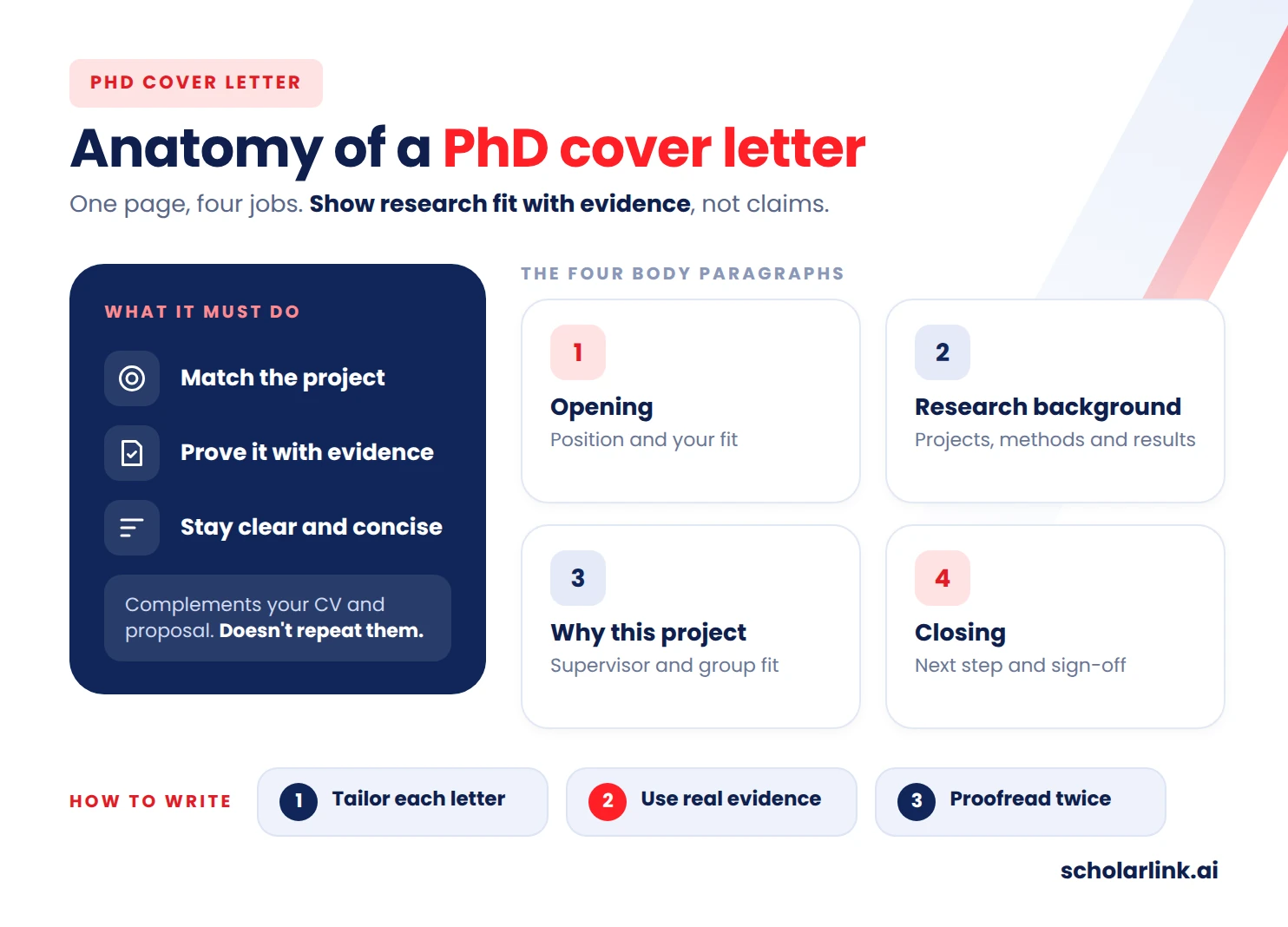
Header, Contact Details, and Salutation
Put your name, email, and phone number at the top, followed by the date and the recipient’s details. Address the letter to a named person whenever you can, such as the project supervisor or the admissions contact. If no name is given, use a neutral, formal greeting such as “Dear Selection Committee.” Check spelling and titles carefully.
Opening Paragraph: State the Position and Your Fit
Say which position you are applying for (include the project title or reference number if there is one) and give one or two sentences that summarise why you are a strong match. Avoid long introductions about your lifelong passion for science. Lead with relevance.
Academic Background and Research Experience
Choose two or three experiences that best match the project: a dissertation, a lab placement, a research assistantship, a relevant methods course. For each one, state what you did, which methods or tools you used, and what came out of it. Specific evidence is far more persuasive than adjectives like “motivated” or “hardworking.”
Why This PhD Project, Supervisor, or Research Group?
This is often the most important paragraph. Show that you have read the group’s recent work or the project description, and explain how your skills and interests connect to it. Mention a specific paper, method, or question, and say what you could contribute. Generic praise can be pasted into any application; specific engagement cannot.
Relevant Skills, Achievements, and Research Potential
Briefly connect your skills (statistical analysis, fieldwork, programming, writing, project management) to tasks the project will involve. Mention scholarships, awards, presentations, or publications if you have them, but keep the focus on what they demonstrate about your readiness for independent research.
Closing Paragraph and Sign-Off
Restate your interest in one or two sentences, mention that your CV and other documents are attached, and say you would welcome the chance to discuss the project further. End with a professional sign-off such as “Yours sincerely” (when you know the recipient’s name) or “Yours faithfully” in British usage, or “Sincerely” in American usage.
Paragraph-by-paragraph guide
| Section | Purpose | What to include | Common mistake |
| Header and salutation | Look professional and reach the right person | Contact details, date, named recipient | Wrong name or title |
| Opening | Name the position and signal fit | Project title, one-line summary of fit | Long, generic introduction |
| Research background | Prove relevant experience | 2–3 projects, methods, outcomes | Listing every activity |
| Project and supervisor fit | Show genuine interest in this opportunity | Specific papers, methods, questions, contribution | Flattery without detail |
| Skills and potential | Link abilities to project tasks | Technical and transferable skills, awards | Unsupported claims |
| Closing | End politely and invite next steps | Thanks, mention of attachments, availability | Repeating the whole letter |
PhD Cover Letter Example and Sample
The sample below is an original, illustrative PhD cover letter example. The names, project, and details are invented. Use it to understand structure and tone, not to copy wording: admissions readers quickly spot recycled language. Follow the target university’s instructions first.
Annotated PhD Cover Letter Example
| Dr. Elena Marković
School of Environmental Sciences Northfield University 12 November 2026 Dear Dr. Marković, I am writing to apply for the funded PhD position “Microplastic Transport in River Systems” (Ref. ENV-2026-14). My MSc research on sediment transport and my experience with field sampling and Python-based data analysis align closely with the aims of this project. During my MSc at Riverside University, I designed and carried out a six-month field study measuring particle movement in two lowland streams. I collected and processed 240 sediment samples, built a data pipeline in Python to clean and analyse the results, and presented my findings at a national student conference. My dissertation, supervised by Dr. A. Rahimi, received a distinction. Earlier, as a research assistant, I helped maintain laboratory protocols for water-quality testing. I am particularly interested in this project because of your group’s recent work on modelling particle settling in variable flow conditions. The question of how flow variability changes transport predictions is one I encountered in my own data, and I would like to study it with the combination of field measurements and numerical modelling that your project proposes. I would bring practical field experience, strong data-handling skills, and a willingness to learn hydrodynamic modelling methods. I have attached my CV, transcripts, and references. Thank you for considering my application. I would welcome the opportunity to discuss the project with you. Yours sincerely, Jordan Ellis |
What Makes This Example Effective?
- Direct opening: it names the position, reference number, and fit in two sentences.
- Evidence over claims: it mentions sample numbers, tools, and outputs rather than describing the applicant as “passionate.”
- Specific project fit: it refers to the group’s research area and connects it to a question from the applicant’s own work.
- Honest about gaps: it acknowledges that hydrodynamic modelling is new and frames it as something to learn.
- Concise: four short paragraphs, easy to scan, no repetition of the CV.
Show the evidence behind your fit; don’t simply claim that you are a perfect candidate.
How to Adapt the Sample to Your Own Application
- Replace every detail with your own experiences, and keep only what is relevant to the position.
- Rewrite the “why this project” paragraph from scratch for each application. This is the part that cannot be generic.
- Match the tone of the institution: slightly more formal for traditional departments, slightly more direct for industry-linked projects.
- Check the page or word limit and cut the weakest sentence in each paragraph if you are over.
How Long Should a PhD Cover Letter Be?
Most PhD cover letters fit on one page, roughly 300 to 500 words, though some programs accept up to two pages or set a strict word limit. Treat these figures as common practice, not a rule. If the university states a length, follow it exactly. Use a readable font at 10 to 12 points, normal margins, short paragraphs, and a professional file name such as “Surname_PhD_Cover_Letter.pdf” if the portal does not specify one.
Tips for Writing a Strong PhD Cover Letter
Tailor the Letter to the Project and Supervisor
Read the project description and the supervisor’s recent publications. Identify the question, method, or dataset that matches your experience, and build the letter around that connection. If you are applying to several programs, write a fresh letter for each one rather than changing only the university name.
Connect Skills to Specific Research Tasks
Instead of writing “I have strong analytical skills,” describe a task you completed and what it required. Compare these two:
- Generic: “I am a hardworking student with excellent research skills.”
- Specific: “I cleaned and analysed 240 sediment samples using Python, which prepared me for the large datasets in this project.”
Show Research Fit Without Repeating Your CV
Your CV lists what you did; your letter explains why it matters for this position. Pick the highlights, interpret them, and leave the rest to the CV.
What to Do if You Have Limited Research Experience
Many strong applicants have no publications. Focus on what you do have and present it honestly: a dissertation or capstone project, research methods coursework, lab or fieldwork placements, data analysis skills, technical writing, and relevant independent study. Explain what you learned from each and how it prepares you for doctoral work. Do not exaggerate your role in a project or imply authorship you do not have.
Common PhD Cover Letter Mistakes to Avoid
- Generic motivation: a letter that could be sent to any university without changes.
- CV repetition: listing every degree and job instead of interpreting the most relevant ones.
- Unsupported claims: calling yourself “exceptional” or “highly skilled” without evidence.
- Excessive praise: spending paragraphs on the institution’s prestige instead of the research.
- Vague fit: saying you are “interested in the field” without naming a topic, method, or question.
- Wrong details: misspelling the supervisor’s name, leaving another university’s name in the text, or missing a stated length limit.
- Careless proofreading: typos and inconsistent formatting suggest a lack of attention to detail.
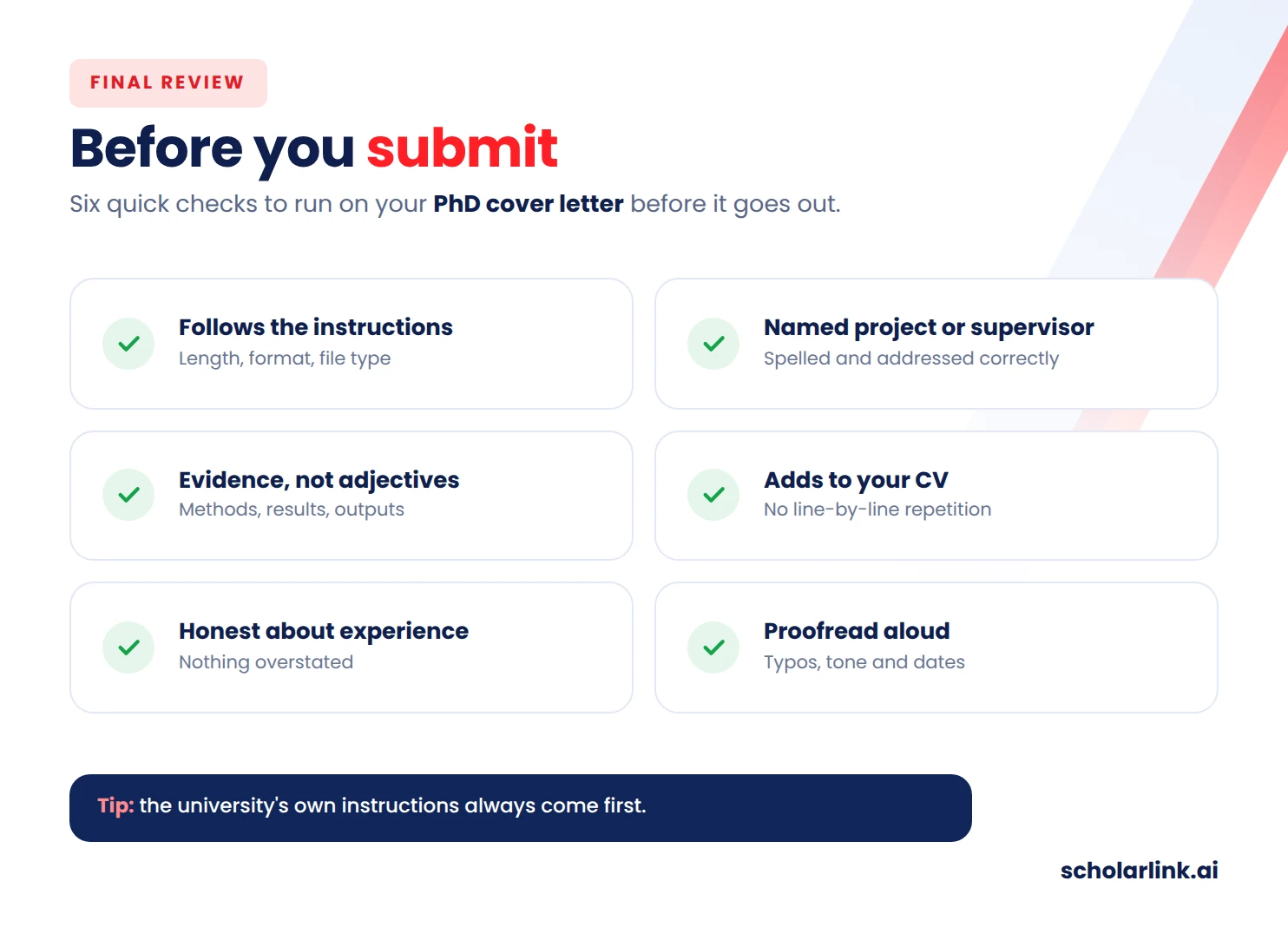
PhD Cover Letter Checklist Before You Submit
- I have followed the university’s instructions on length, format, and file type.
- The letter names the correct position, project, and recipient.
- Every key claim is supported by a specific example.
- The “why this project” paragraph could not be pasted into a different application.
- The letter adds to my CV instead of repeating it.
- Nothing is overstated, and I can discuss every point in an interview.
- I have proofread the letter aloud and asked someone else to read it.
Frequently Asked Questions
How do I start a PhD cover letter?
Begin by naming the position and stating, in one or two sentences, why you are a good fit. Mention the project title or reference number if there is one, and avoid long general introductions.
How many words should a PhD cover letter be?
A common range is about 300 to 500 words, or one page. If the application gives a word or page limit, follow that instead.
Is a PhD cover letter the same as a personal statement?
Not always. A cover letter is usually shorter and focused on fit for a specific position, while a personal statement or statement of purpose is longer and covers your academic path and goals. Some universities use the terms interchangeably, so read the instructions carefully.
Should I address my letter to a potential supervisor?
If the position names a supervisor or contact person, address the letter to them. If the application goes through a general admissions office, use a formal general salutation or the name given in the instructions.
Can I apply for a PhD without publications?
Yes. Many successful applicants have none. Emphasise your research project work, methods training, technical skills, and potential, and be honest about your level of experience.
Should I use the same cover letter for every university?
No. Keep a core structure, but rewrite the sections on project, supervisor, and program fit for each application.
Production Notes (not part of the article)
SEO metadata
- Meta title: PhD Cover Letter: Examples, Format & Writing Tips
- Meta description: Learn how to write a PhD cover letter with a clear structure, practical examples, formatting tips, and a checklist to tailor your application.
- URL slug: /guides/phd-cover-letter/
Images: placement and alt text
| Image | File | Placement | Alt text |
| Image 1 (featured) | phd-cover-letter-featured.png | Right after the introduction paragraph | Preparing a cover letter for a PhD application |
| Image 2 (structure) | phd-cover-letter-structure.png | Start of “How to Structure a PhD Cover Letter,” before the first H3 | PhD cover letter structure with introduction, research experience, fit, and closing |
| Image 3 (checklist) | phd-cover-letter-checklist.png | Under “PhD Cover Letter Checklist Before You Submit,” above the list | Checklist for reviewing a PhD application cover letter before submission |
Internal links to add (use existing site URLs)
- academic CV for PhD applications in “What Is a PhD Cover Letter?” (first paragraph)
- writing a PhD research proposal in the comparison table intro
- statement of purpose for graduate school in the “vs Personal Statement” section
- how to contact a potential PhD supervisor in “Why This PhD Project, Supervisor, or Research Group?”
- finding a PhD position in “When Is a Cover Letter Required?”
- PhD interview preparation in the closing checklist section
- PhD scholarships and funding in the sample section, next to the “funded PhD position” mention
External links (optional)
- FindAPhD, Academic Cover Letters (purpose, structure, tailoring)
- University of Cambridge Careers, CVs and Cover Letters
- University of Kassel, Cover Letter (personalisation and format)
Before publishing
- The sample letter is fictional. The word range (300–500) and one-page guideline are general practice, so verify them against the target audience’s main countries if you want to state them more firmly.
- If you add FAQ schema, check that it meets current search-engine eligibility requirements.