

Identifying a meaningful research gap is an important part of impactful academic research. Strong dissertations, journal articles, and research grant proposals typically begin with a clear understanding of what is already known and what remains unexplored. For doctoral candidates and early-career researchers, navigating the vast body of existing literature to identify these gaps can be challenging. Without a clear framework, researchers may repeat previous studies, pursue questions that have already been sufficiently addressed, or develop projects that make limited contributions to their field.
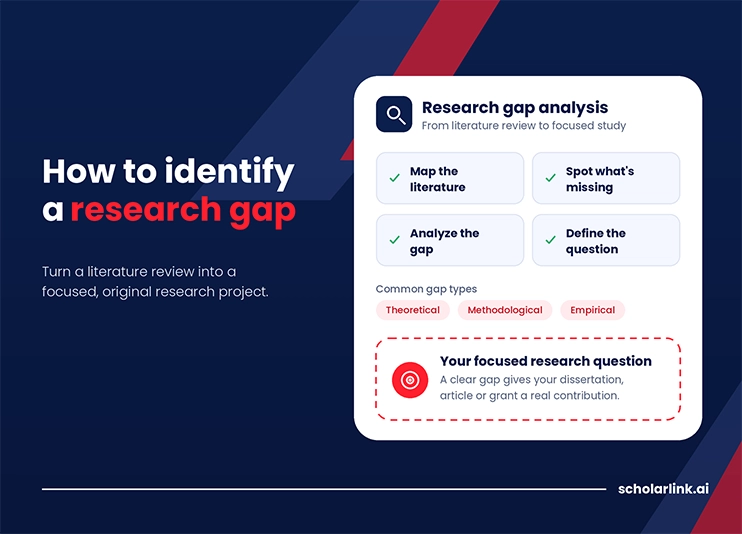
Understanding how to identify research gaps in literature, analyze them, and determine how they can be addressed can turn a routine literature review into a foundation for new academic research. This process helps researchers establish the theoretical significance and practical relevance of their work. This comprehensive guide explains the nature and types of research gaps, introduces practical research gap analysis methods, and provides a step-by-step approach for turning an identified gap into a focused research project.
What Is a Research Gap?
A research gap refers to an area of existing academic knowledge that remains unanswered, underexplored, inconsistent, or insufficiently supported by evidence. Understanding what constitutes a research gap is essential for evaluating existing literature and determining where further research may contribute meaningful knowledge. The following sections explain the definition of a research gap, provide practical examples, and clarify how research gaps differ from research problems and research questions.
Research Gap Definition
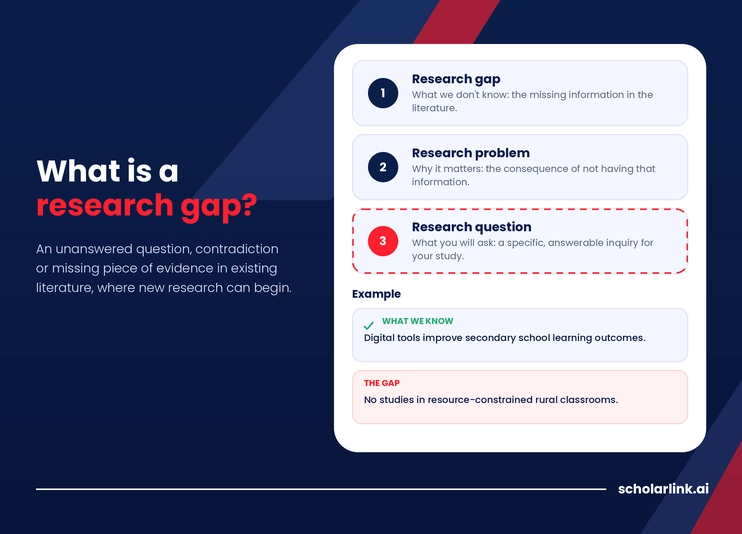
A research gap is an unanswered question, an unresolved issue, a contradiction, or a missing piece of evidence within existing scholarly literature. It represents a boundary where current academic knowledge stops, signaling an opportunity for new empirical, theoretical, or methodological contributions. Identifying a research gap demonstrates that while prior scholars have built a strong foundation, specific conditions, variables, populations, or mechanisms remain unexplored or inadequately explained.
Examples of Research Gaps
In practice, a research gap manifests when existing studies reach a plateau or leave unanswered questions. For instance, extensive literature might demonstrate that digital tools improve secondary school learning outcomes, yet no studies have examined how these same tools perform in resource-constrained rural classrooms. Similarly, clinical trials may confirm the efficacy of a medical intervention in adult populations while completely lacking safety and performance data for elderly patients with chronic comorbidities. In both scenarios, the gap highlights a clear boundary where current knowledge cannot be reliably applied without further investigation.
Research Gap vs. Research Problem
While often used interchangeably, a research gap and a research problem serve distinct functions in academic writing. A research gap is an intellectual omission in the literature—a statement of what the scientific community does not yet know. Conversely, a research problem is the practical or theoretical issue, difficulty, or challenge arising from that lack of knowledge. The gap is the missing information, whereas the problem is the real-world or theoretical consequence of not having that information.
Research Gap vs. Research Question
A research gap serves as the foundation for a research question, but the two are not identical. The research gap describes the broad area of missing knowledge identified during a literature review. The research question translates that missing knowledge into a specific, answerable inquiry that guides data collection, methodology, and analysis. In short, the gap identifies what is missing, while the question defines exactly what your study intends to discover.
Types of Research Gaps
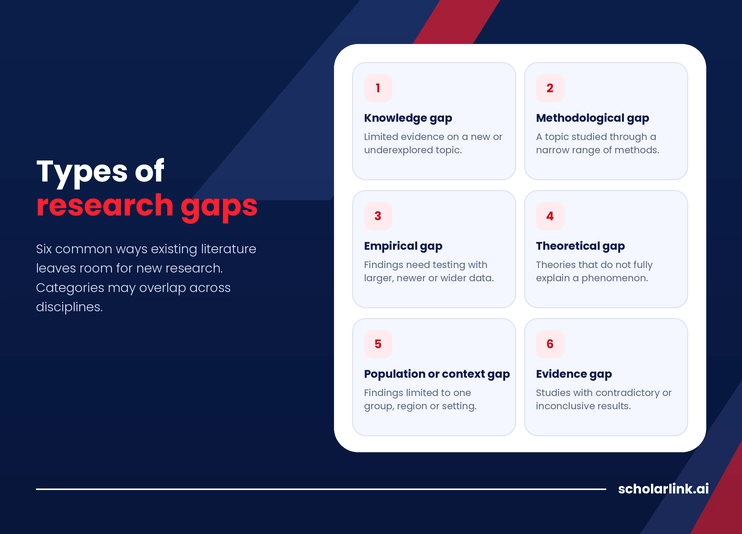
Research gaps can take different forms depending on the research field, existing literature, and the scope of a study. Understanding these categories can help scholars organize their literature reviews, evaluate limitations in existing research, and explain how their work can contribute to the field. The categories below are common examples, although they may overlap or be defined differently across disciplines.
-
Knowledge Gap
A knowledge gap occurs when information or evidence on a specific topic is limited or insufficiently developed in the existing literature. Researchers may encounter a knowledge gap when a relatively new phenomenon emerges, such as a new technology, policy change, or health development, and limited scholarly research is available to explain its characteristics or effects. Addressing a knowledge gap can involve generating new evidence or establishing a stronger understanding of an area that remains underexplored.
-
Methodological Gap
A methodological gap arises when previous studies have examined a topic primarily through a limited range of research designs, measurement tools, or analytical techniques, potentially leaving other aspects of the phenomenon unexplored. For example, if a topic has been studied mainly through quantitative surveys, researchers may identify an opportunity to use qualitative methods to explore participants’ experiences in greater depth. Applying a different methodology can provide perspectives that may not be captured through existing research approaches.
-
Empirical Gap
An empirical gap exists when existing claims or findings require further investigation through additional empirical evidence. This may occur when theoretical propositions have received limited real-world testing, when previous studies use small or narrow samples, or when available datasets are outdated or insufficient to address current research questions. New empirical research can help evaluate whether existing findings hold under different conditions or populations.
-
Theoretical Gap
A theoretical gap appears when existing theories or conceptual frameworks do not fully explain a phenomenon, or when an established theory has received limited testing in a particular context. Researchers may identify a theoretical gap when competing theories provide different explanations for the same outcome or when existing frameworks do not account for important variables or recent developments in a field.
- Population or Context GapA population or context gap occurs when existing research has focused primarily on a particular demographic group, geographic region, organization, or institutional setting, limiting the extent to which findings can be applied to other populations or contexts. For example, organizational behavior research conducted primarily in Western multinational corporations may provide limited insight into small family-owned enterprises in emerging Asian markets. Further research in different populations or settings can help determine whether existing findings are transferable across contexts.
-
Evidence Gap
An evidence gap may emerge when studies produce contradictory, inconsistent, or inconclusive findings on the same research question. For example, one study may find that a training program significantly improves employee performance, while another study reports no significant effect under comparable conditions. Further research can investigate potential explanations for these differences, including variations in study design, sample characteristics, measurement approaches, or moderating and mediating variables.
How to Identify Research Gaps in Literature
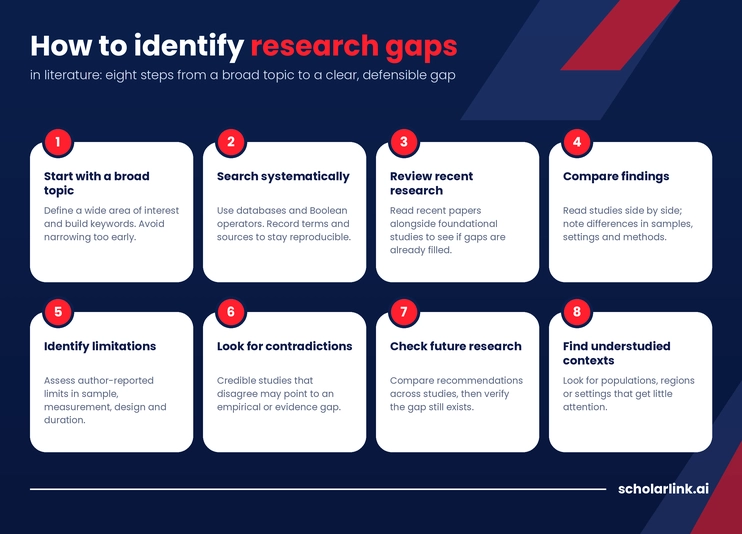
Identifying a research gap requires more than simply reading academic papers. Researchers need to critically evaluate the scope, methods, findings, and limitations of existing studies to determine what remains unexplored or insufficiently understood. The following steps can help structure the process of identifying research gaps in literature.
1. Start With a Broad Research Topic
- Define a broad area of interest within your discipline.
- Choose a topic that aligns with current research trends and your academic interests.
- Use the broad topic to develop initial keywords and search terms.
- Avoid narrowing the topic too early before understanding the existing literature.
2. Conduct a Systematic Literature Search
- Search major academic databases using relevant keywords and Boolean operators.
- Combine related terms and subject headings to identify relevant studies.
- Include foundational papers, highly cited reviews, and recent empirical research.
- Record your search terms and sources to make the literature search more organized and reproducible.
3. Review Recent Research
Review recent publications alongside foundational studies rather than focusing exclusively on the last three to five years. The appropriate time range depends on the discipline and research topic. Recent literature can help determine whether previously identified gaps have already been addressed and whether new questions have emerged.
4. Compare Findings Across Studies
- Read relevant studies comparatively rather than evaluating each paper in isolation.
- Look for differences in sample characteristics, research settings, definitions, and methodologies.
- Identify recurring patterns as well as inconsistent findings.
- Pay particular attention to differences that may help explain why studies reach different conclusions.
5. Identify Limitations in Existing Studies
Review the limitations reported by authors and assess how they affect the findings.
- Examine limitations related to sample size or population.
- Consider measurement limitations and data collection methods.
- Look for limitations related to research design or study duration.
- Evaluate whether the reported limitations create opportunities for further research.
6. Look for Contradictory Findings
Inconsistent findings across studies can indicate that an issue requires further investigation. When credible studies reach different conclusions about the same relationship, examine whether differences in methodology, samples, research settings, or other variables could explain the results. These inconsistencies may point to an empirical or evidence gap.
7. Examine Recommendations for Future Research
Future research recommendations can provide useful starting points for identifying potential gaps.
- Review the research directions suggested by multiple authors.
- Compare recommendations across recent studies.
- Look for recurring questions or areas that researchers identify as requiring further investigation.
- Do not rely on these recommendations alone; evaluate whether the suggested gap still exists in the broader literature.
8. Identify Understudied Populations or Contexts
Consider whether existing research has focused heavily on particular populations, geographic regions, institutions, or cultural settings.
- Identify groups or contexts that receive limited attention in the literature.
- Examine whether established findings have been tested across different populations or settings.
- Consider whether differences in socioeconomic, cultural, institutional, or geographic context could affect existing findings.
- Use this comparison to determine whether a population or context gap warrants further investigation.
Research Gap Analysis Methods
Research gap analysis involves systematically examining existing literature to identify areas that remain underexplored, inconsistent, or insufficiently investigated. Researchers can use different analysis methods depending on the research question, discipline, and type of literature being reviewed. The following methods can help organize evidence and identify potential research gaps.
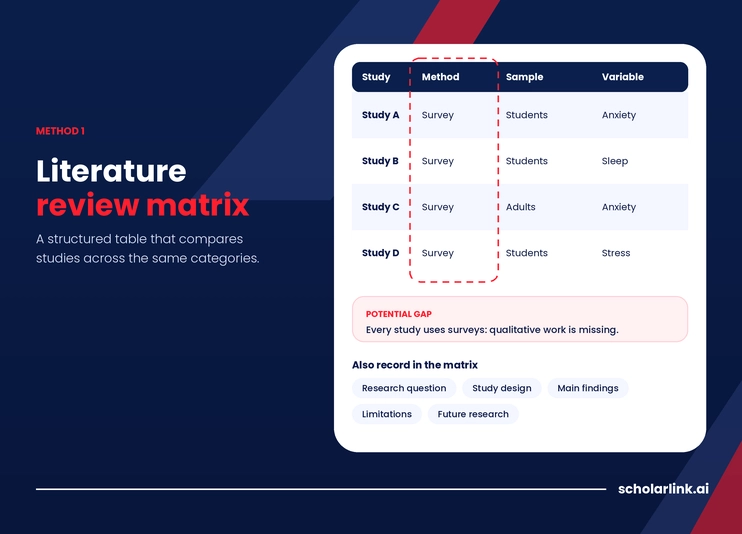
Literature Review Matrix
A literature review matrix is a structured table used to organize information from multiple studies, including authors, research methods, sample characteristics, variables, and key findings. Comparing studies across consistent categories can make patterns, differences, and underexplored areas easier to identify.
A matrix can include:
- Research question or objective
- Research methodology and study design
- Sample or population
- Variables or key concepts
- Main findings
- Reported limitations
- Recommendations for future research
If a particular population, variable, method, or context receives consistently limited attention across relevant studies, it may indicate a potential research gap that requires further investigation.
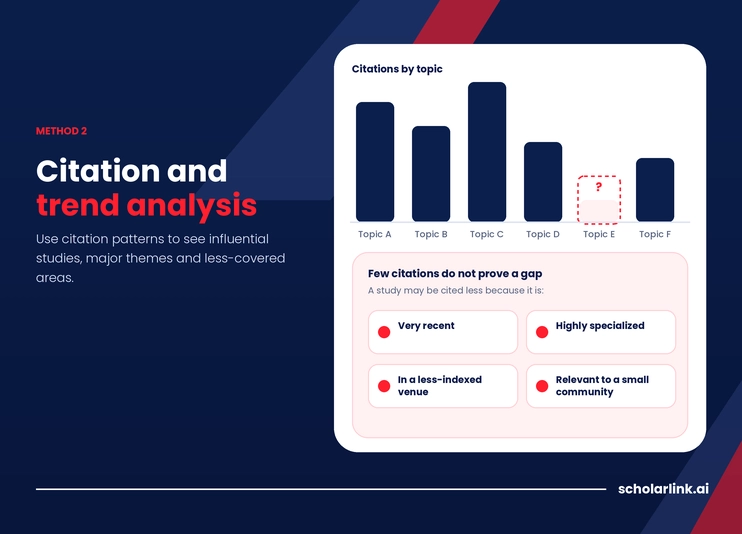
Citation and Trend Analysis
Citation analysis examines how academic studies are connected through citations and how research topics develop over time. Researchers can use citation patterns to identify influential studies, major research themes, and areas that have received comparatively limited attention.
However, citation counts should not be treated as direct evidence of a research gap. A study may have few citations because it is recent, highly specialized, published in a less-indexed venue, or relevant to a small research community.
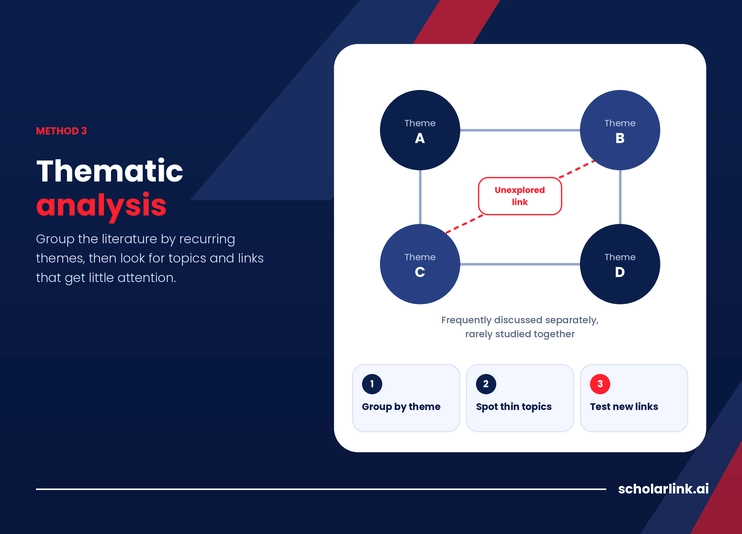
Thematic Analysis
Thematic analysis involves organizing research literature around recurring concepts, topics, or themes. After identifying dominant themes, researchers can examine which related topics receive limited attention or which connections between themes have not been sufficiently explored.
For example, if two research themes are frequently discussed separately but their relationship has received little direct investigation, this may indicate an area for further research.
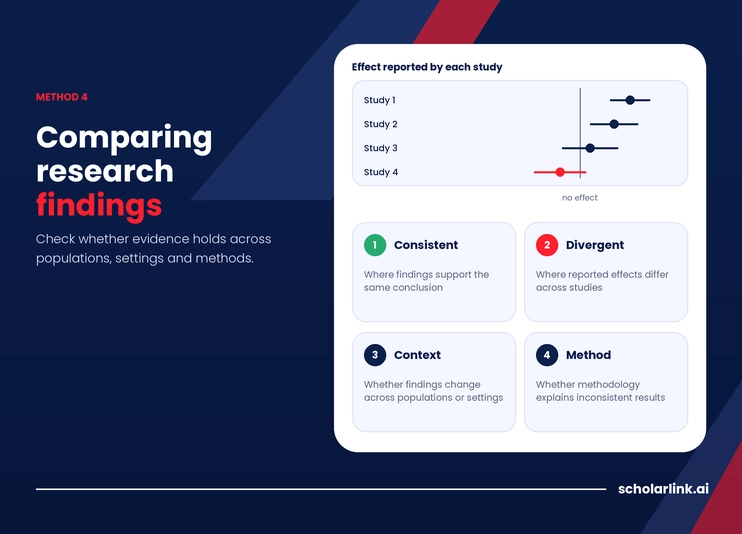
Comparing Research Findings
Comparing findings across studies helps researchers evaluate whether existing evidence is consistent across different populations, settings, and methodologies.
Researchers can examine:
- Where findings consistently support the same conclusion
- Where reported effects differ across studies
- Whether findings change across populations or contexts
- Whether differences in methodology may explain inconsistent results
These comparisons can help identify potential empirical or evidence gaps that require further investigation.
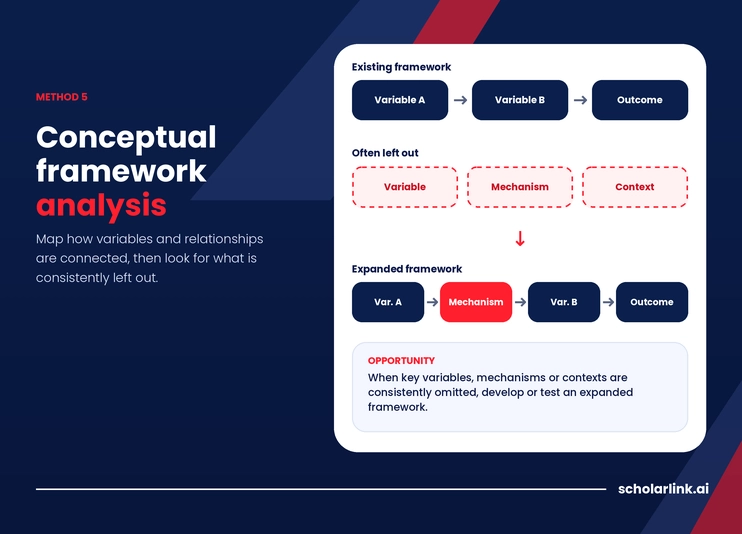
Conceptual Framework Analysis
Analyzing the conceptual frameworks used across a body of literature can help researchers understand how variables, concepts, and proposed relationships have been connected in previous studies. When important variables, mechanisms, or contextual factors are consistently omitted, researchers may identify an opportunity to develop or test an expanded conceptual framework.
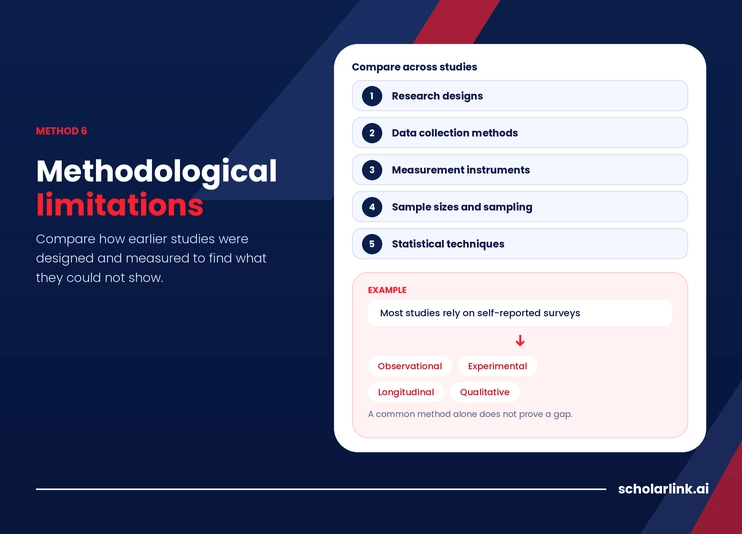
Identifying Methodological Limitations
Examining the methodological choices used in previous studies can reveal limitations that may create opportunities for further research. Researchers can compare:
- Research designs
- Data collection methods
- Measurement instruments
- Sample sizes and sampling strategies
- Statistical or analytical techniques
For example, if a substantial body of research relies primarily on self-reported survey data, researchers may consider whether observational, experimental, longitudinal, or qualitative approaches could provide additional evidence. The presence of a common methodology alone does not establish a research gap, but it can highlight an area worth investigating.
Practical Gap Mapping
Once potential gaps have been identified through literature review and gap analysis, researchers can map observed patterns to possible types of research gaps. The following examples illustrate how common findings in the literature may point to different gap categories:
| Observation in the Literature | Potential Research Gap |
|---|---|
| Very few studies have examined a specific population, geographic region, or context. | Population or Context Gap |
| Existing studies report conflicting, inconsistent, or inconclusive findings. | Empirical or Evidence Gap |
| Most studies rely on the same research design, data source, or methodological approach. | Methodological Gap |
| An established theory has received limited testing in a new population, setting, or environment. | Theoretical or Context Gap |
| A topic is frequently mentioned in the literature but has received limited direct investigation. | Knowledge Gap |
These patterns should be treated as starting points for further analysis rather than automatic proof of a research gap. Researchers should review the broader literature and consider the quality, scope, and relevance of existing studies before defining the final gap.
How to Find a Research Gap in a Literature Review
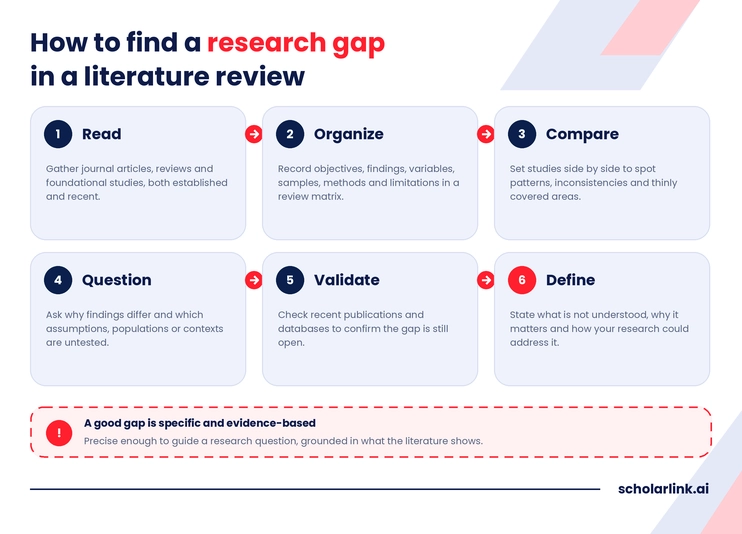
Finding a research gap within a literature review requires a structured workflow that moves from understanding existing studies to defining a specific area for further investigation. A practical process can be summarized as: Read, Organize, Compare, Question, Validate, and Define.
- Read: Begin by gathering relevant journal articles, review papers, and foundational studies within your research area. Include both established literature and recent publications to understand how the field has developed.
- Organize: Record key information such as research objectives, findings, variables, sample characteristics, methodologies, limitations, and research recommendations in a literature review matrix.
- Compare: Examine studies alongside one another to identify recurring patterns, inconsistent findings, differences in methodology, and areas that receive limited attention.
- Question: Ask why certain findings differ, which assumptions remain untested, which populations or contexts are underrepresented, and which aspects of the topic require further investigation.
- Validate: Review recent publications and relevant academic databases to determine whether the potential gap has already been addressed by newer research. This step helps ensure that the proposed gap reflects the current state of the literature.
- Define: Formulate the gap precisely by explaining what remains insufficiently understood, why the gap matters, and how the proposed research could address it.
A well-defined research gap should be specific enough to guide a research question while remaining grounded in the evidence identified through the literature review.
How to Use the Literature Review to Identify a Research Gap
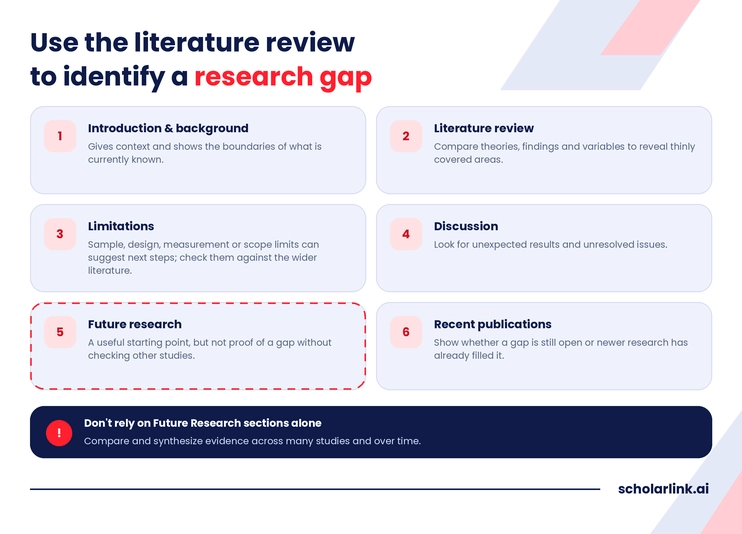
A scholarly literature review is more than a summary of existing books and articles. It synthesizes previous research, compares findings, evaluates limitations, and helps establish why further investigation may be needed. Different sections of academic papers can provide useful evidence when identifying a potential research gap.
- Introduction and Background: These sections provide context, summarize established knowledge, and explain why the topic matters. They can help you understand the boundaries of what is currently known.
- Literature Review: The main body of the review presents theoretical approaches, empirical findings, variables, and relationships examined in previous research. Comparing these studies can reveal areas that have received limited attention.
- Limitations: Authors may identify limitations related to sample characteristics, research design, measurement, data collection, or study scope. These limitations can suggest directions for further investigation, although they should be evaluated alongside the broader literature.
- Discussion: Discussion sections interpret the findings and may identify unexpected results, unresolved issues, or questions that require additional investigation.
- Future Research Recommendations: Authors often suggest topics or questions for future studies. These recommendations can provide useful starting points for identifying potential research gaps, but they should not be treated as definitive evidence of a gap without reviewing other relevant literature.
- Recent Publications: Recent studies help determine whether a previously identified gap remains open or has already been addressed by newer research. Reviewing current literature is therefore an important step in keeping a research gap analysis up to date.
Researchers should not rely solely on the Future Research sections of a small number of articles. A stronger research gap emerges from comparing and synthesizing evidence across multiple studies, evaluating their findings and limitations, and considering how the literature has developed over time.
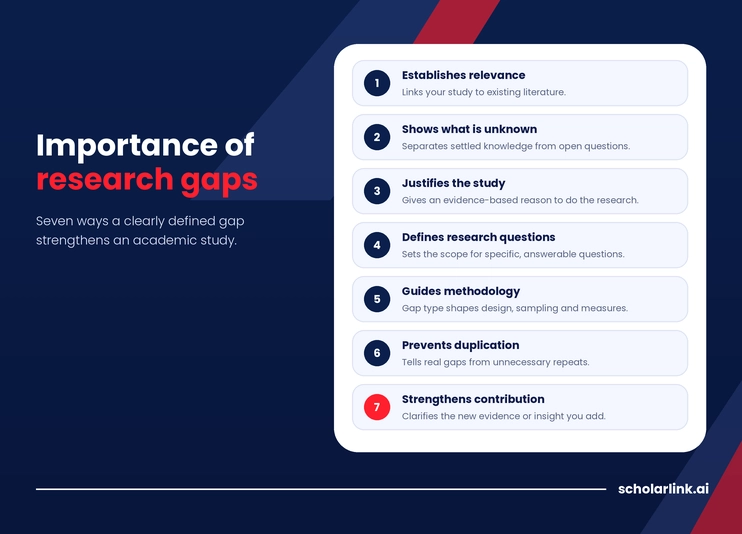
Importance of Research Gaps in Academic Studies
Identifying and clearly defining a research gap helps researchers establish the relevance, purpose, and potential contribution of a study. A well-supported research gap connects a proposed study to existing literature and provides a basis for explaining why further investigation is needed.
Establishes Research Relevance
A well-defined research gap shows how a study relates to existing academic literature and ongoing research in the field. It helps researchers demonstrate their understanding of previous work and explain where their study may contribute additional knowledge.
Shows What Is Still Unknown
Articulating a research gap helps distinguish established knowledge from areas that remain uncertain, underexplored, or insufficiently investigated. This can help researchers avoid unnecessary duplication and focus on questions that have not yet been adequately addressed.
Justifies the Study
A clearly stated gap provides an evidence-based rationale for conducting further research. It helps researchers explain why the study is needed, what issue it addresses, and how its findings could contribute to the existing body of knowledge.
Helps Define Research Questions
A precise research gap can help establish the scope of a study and guide the development of focused research questions. When the gap is clearly defined, researchers can formulate questions that are specific, answerable, and aligned with the study’s objectives.
Guides Methodology
The nature of a research gap can influence the choice of research design and methodology. For example, a methodological gap may support the use of an alternative research design or measurement approach, while a population gap may require sampling participants who have been underrepresented in previous studies.
Prevents Unnecessary Duplication
A thorough review of existing literature helps researchers determine whether a proposed study addresses an unresolved issue or simply repeats research that has already been sufficiently conducted. This can help researchers use their time and resources more effectively while also distinguishing legitimate replication studies from unnecessary duplication.
Strengthens Research Contribution
Connecting a study to a clearly defined research gap helps researchers explain its potential contribution to the field. A well-articulated gap can clarify what new evidence, theoretical insight, methodological perspective, or contextual understanding the study aims to provide.
How to Turn a Research Gap Into a Research Question
Once a research gap has been identified, it can be developed into a focused research project through a logical progression:
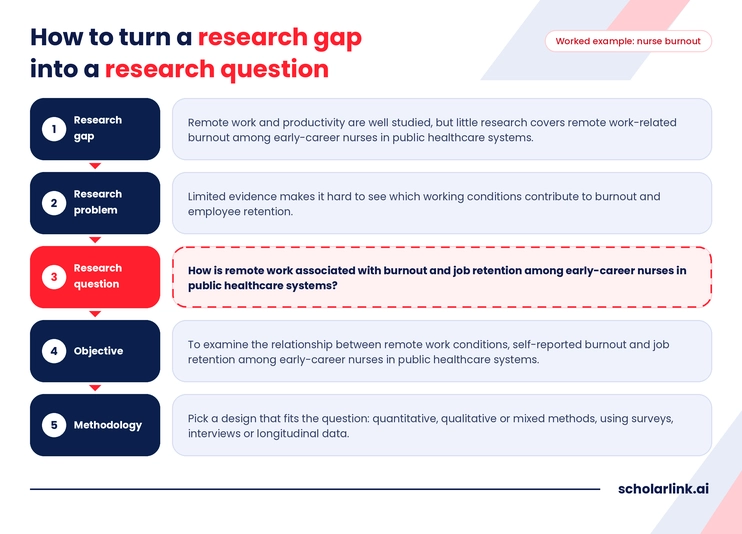
Research Gap → Research Problem → Research Question → Objective → Methodology
The process begins by expressing the identified gap as a clear statement of missing or insufficient knowledge. For example:
Research Gap:
Existing studies have examined the relationship between remote work and employee productivity, but limited research has investigated remote work-related burnout among early-career nurses working in public healthcare systems.
The gap can then be developed into a specific research problem:
Research Problem:
Limited evidence on remote work-related burnout among early-career nurses in public healthcare systems makes it difficult to understand which working conditions may contribute to burnout and employee retention.
From this problem, researchers can formulate a focused and answerable research question:
Research Question:
How is remote work associated with burnout and job retention among early-career nurses in public healthcare systems?
The next step is to define a research objective that directly addresses the question:
Research Objective:
To examine the relationship between remote work conditions, self-reported burnout, and job retention among early-career nurses in public healthcare systems.
Finally, researchers can select a methodology that is appropriate for answering the research question. Depending on the study objectives, this could include a quantitative, qualitative, or mixed-methods design using approaches such as surveys, interviews, or longitudinal data collection.
This progression helps maintain alignment between the identified research gap, research question, objectives, and methodology. It can be particularly useful when developing a PhD research proposal, dissertation, or other academic research project.
How to Fill a Research Gap
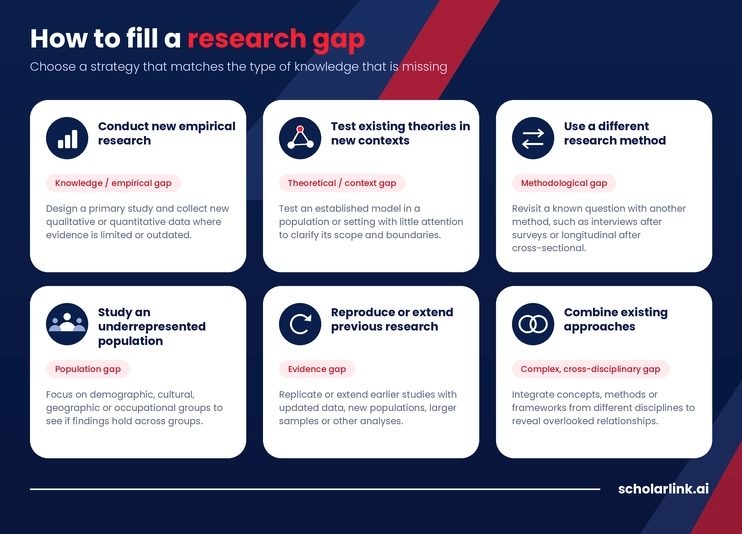
Filling gaps in scientific research requires choosing an investigative strategy that matches the type of knowledge missing from the existing literature. Depending on the nature of the gap, researchers may generate new evidence, test existing theories in different settings, apply alternative methodologies, study underrepresented populations, or extend previous research.
Conduct New Empirical Research
When addressing a knowledge or empirical gap, researchers can design a primary study to collect new qualitative or quantitative data. Original data can provide evidence where existing research is limited, outdated, or insufficient to answer the research question.
Test Existing Theories in New Contexts
Researchers can address a theoretical or contextual gap by testing an established theoretical model in a population, setting, or environment that has received limited attention. Examining whether a theory applies under different conditions can help clarify its scope and boundary conditions.
Use a Different Research Method
A methodological gap may be addressed by examining an established research question using an alternative methodology. For example, qualitative interviews can provide insights into a topic previously studied mainly through quantitative surveys, while longitudinal research can examine changes over time that cross-sectional studies cannot capture.
Study an Underrepresented Population
A population gap can be investigated by focusing on demographic, cultural, geographic, or occupational groups that have received limited attention in previous research. Studying different populations can help determine whether existing findings are consistent across groups or influenced by specific population characteristics.
Reproduce or Extend Previous Research
Researchers can address an evidence gap by replicating or extending previous studies. Replication studies may use updated datasets, different populations, larger samples, or alternative analytical techniques to examine whether previous findings remain consistent under different conditions.
Combine Existing Approaches
Some research gaps may benefit from integrating concepts, methods, or analytical frameworks from different disciplines. Combining established approaches can provide a broader perspective on complex research questions and may reveal relationships or mechanisms that have not been sufficiently examined within a single discipline.
Research Gap Examples
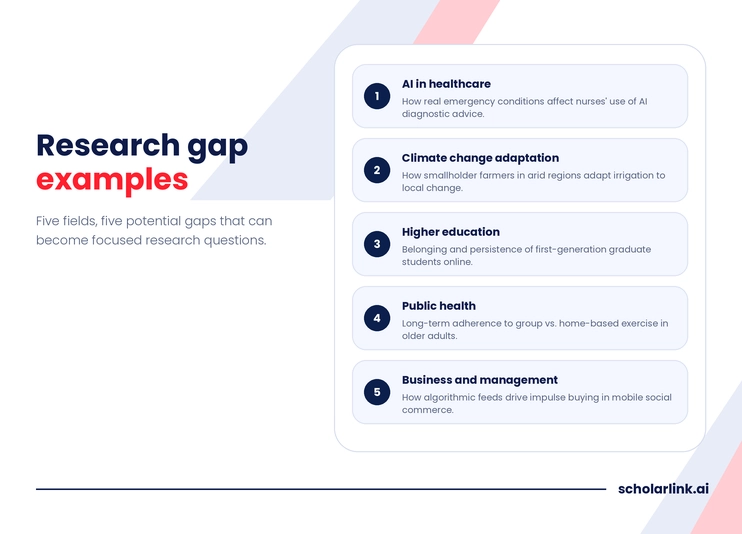
Examining concrete examples can help researchers understand how limitations, inconsistencies, and underexplored areas in existing literature can lead to potential research gaps and focused research questions.
Artificial Intelligence in Healthcare
Existing research has examined AI-based diagnostic tools in simulated or controlled healthcare settings. However, the interaction between frontline nurses and AI-generated diagnostic recommendations in high-pressure emergency care environments may require further investigation.
Potential Research Gap: Limited evidence on how real-world emergency care conditions affect the use of AI-generated diagnostic recommendations.
Research Question: How do high-pressure emergency department conditions influence nurses’ use of AI-generated diagnostic recommendations?
Climate Change Adaptation
Research has extensively examined global temperature projections and broader economic effects of climate change. However, some agricultural communities and local adaptation practices may receive less attention than global or regional trends.
Potential Research Gap: Limited empirical evidence on how smallholder farming communities in arid regions adapt traditional irrigation practices to local climate changes.
Research Question: What socioeconomic factors influence the adoption of low-cost drip irrigation among smallholder farmers in arid regions?
Higher Education
Research has examined online learning systems and digital course delivery across higher education. However, the experiences of specific student populations, including first-generation graduate students, may be less extensively studied in some contexts.
Potential Research Gap: Limited research on how asynchronous digital learning environments affect belonging and academic persistence among first-generation graduate students.
Research Question: How does asynchronous course delivery influence students’ sense of belonging and academic persistence among first-generation doctoral students?
Public Health
Studies have examined different approaches to physical activity and exercise adherence, but findings may vary depending on the intervention, population, and research setting. Comparing community-based group programs with individualized home-based exercise can provide an example of an empirical question that requires further investigation.
Potential Research Gap: Inconsistent evidence regarding long-term adherence to group-based versus home-based exercise programs among older adults.
Research Question: How does participation in group-based exercise compare with home-based exercise in terms of 12-month adherence among adults aged 65 and older?
Business and Management
Research has extensively examined online consumer behavior and purchasing decisions. However, the rapid development of short-form video platforms and algorithmic recommendation systems creates opportunities to investigate how these technologies influence consumer decision-making.
Potential Research Gap: Limited theoretical and empirical understanding of how algorithmic recommendation feeds influence impulse purchasing in mobile social commerce.
Research Question: How do algorithmic recommendation feeds influence impulse purchasing decisions on mobile social commerce platforms?
Common Mistakes When Identifying a Research Gap
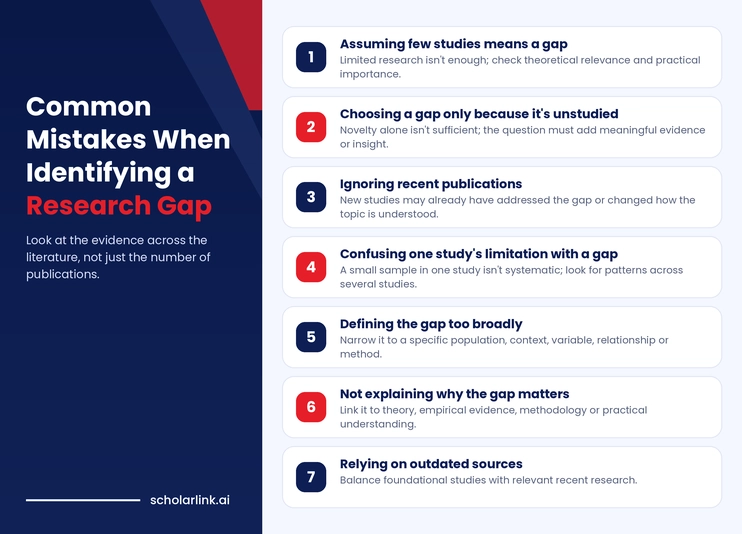
Identifying a research gap requires more than finding an area with limited publications. Researchers should evaluate the evidence across the literature and consider whether a potential gap is relevant, meaningful, and suitable for further investigation. Common mistakes include:
- Assuming that few studies automatically indicate a research gap: A topic with limited research may represent an opportunity, but the lack of studies alone does not establish that a meaningful gap exists. Researchers should consider the topic’s theoretical relevance, practical importance, and relationship to existing knowledge.
- Choosing a gap solely because it has not been studied: Novelty is not sufficient on its own. A potential research gap should address a question or issue that can contribute meaningful evidence, understanding, or methodological insight to the field.
- Ignoring recent publications: New studies may have addressed a previously identified gap or changed the understanding of a research topic. Reviewing recent literature helps researchers determine whether the potential gap remains relevant.
- Confusing an individual limitation with a broader research gap: A limitation reported in one study, such as a small sample size, does not necessarily represent a systematic gap across the literature. Researchers should examine whether similar limitations occur across multiple relevant studies.
- Defining the gap too broadly: A broad or poorly defined gap can lead to an unfocused research project. Narrowing the gap to a specific population, context, variable, relationship, or methodological issue can make it more suitable for investigation.
- Failing to explain why the gap matters: Identifying what is missing is only part of the process. Researchers should also explain why addressing the gap is relevant to existing theory, empirical evidence, methodology, or practical understanding.
- Relying too heavily on outdated sources: Older foundational studies can remain important, but relying primarily on outdated literature may result in overlooking newer evidence. A strong research gap analysis should balance foundational sources with relevant recent research.
Research Gap Checklist
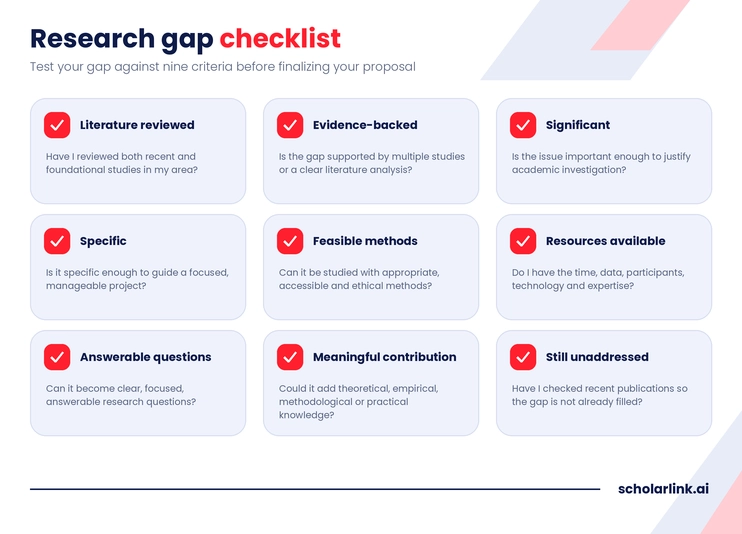
Before finalizing a research proposal, dissertation topic, or research project, evaluate your identified gap against the following criteria:
- Have I reviewed recent and relevant literature alongside foundational studies in my research area?
- Is the identified gap supported by evidence from multiple relevant studies or a clear analysis of the existing literature?
- Is the issue significant enough to justify further academic investigation?
- Is the gap specific enough to guide a focused and manageable research project?
- Can the gap be investigated using appropriate, accessible, and ethically sound research methods?
- Do I have access to the time, resources, data, participants, technology, or expertise required to investigate the gap?
- Can the identified gap be translated into clear, focused, and answerable research questions?
- Could addressing the gap contribute meaningful theoretical, empirical, methodological, or practical knowledge to the field?
- Have I checked recent publications to confirm that the potential gap has not already been sufficiently addressed?
Frequently Asked Questions
What is a research gap?
A research gap is an unanswered question, missing evidence, unresolved issue, or limitation in existing scholarly literature that may require further investigation. A gap can be theoretical, empirical, methodological, contextual, or related to a specific population or body of evidence.
How do you identify a research gap?
You can identify a research gap by systematically reviewing relevant literature, comparing findings across studies, examining limitations, identifying contradictory evidence, and looking for populations, contexts, or methods that have received limited attention.
What are the different types of research gaps?
Common types of research gaps include knowledge gaps, methodological gaps, empirical gaps, theoretical gaps, population or context gaps, and evidence gaps. These categories may overlap and can be defined differently across academic disciplines.
How do you analyze research gaps?
Research gap analysis can involve literature review matrices, citation and trend analysis, thematic analysis, comparison of research findings, conceptual framework analysis, and examination of methodological limitations.
Why is a research gap important?
A research gap helps establish why further investigation may be needed. It can help researchers define the scope of a study, develop focused research questions, select appropriate methods, and explain the potential contribution of their research.
How do you find a research gap in literature?
You can find a research gap by reviewing relevant and recent literature, organizing studies for comparison, evaluating their findings and limitations, examining contradictory results, and assessing recommendations for future research alongside the broader body of evidence.
How do you write a research gap?
To write a research gap, summarize what existing studies have established, identify what remains unknown, inconsistent, or insufficiently investigated, explain why the gap matters, and describe how the proposed study could address it.
Can a research gap become a research question?
Yes. A research gap can provide the foundation for a research question by identifying missing or insufficient knowledge. The gap is then translated into a specific, focused, and answerable question that guides the research objectives and methodology.
How do you fill a research gap?
Researchers can address a research gap by conducting new empirical research, testing existing theories in different contexts, applying alternative methodologies, studying underrepresented populations, replicating or extending previous studies, or combining approaches from different disciplines.

ScholarLink AI
Your Ultimate Admission Co-Pilot
- 🎓 Professors Database: World’s largest supervisor directory
- 📡 Live Positions: Real-time faculty openings & vacancies
- 👥 Students Database: Connect with successful applicants
- 🎯 Smart Matching: AI-driven professor recommendation
- 💰 Funding Analysis: Real-time lab & research funding data
- 📝 Apply Management: Track applications & cold emails