
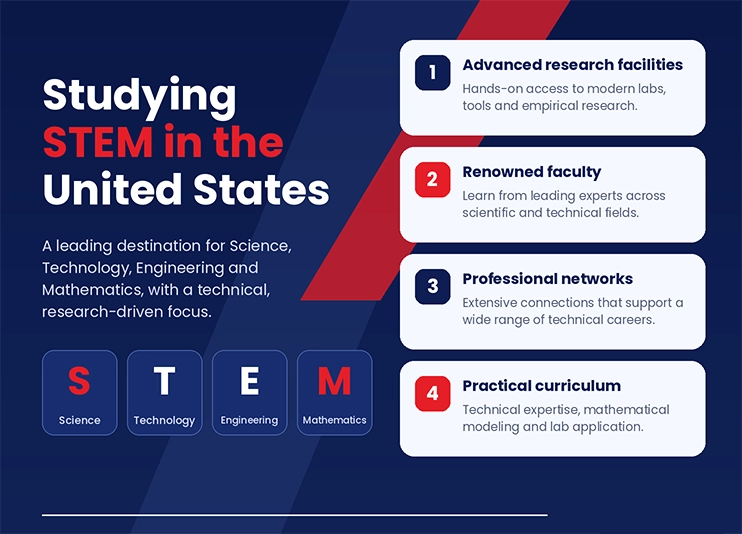
The United States remains a leading destination for higher education in Science, Technology, Engineering, and Mathematics (STEM). Choosing to study STEM in the United States offers international students access to advanced research facilities, renowned faculty, and extensive professional networks. STEM programs encompass a vast spectrum of discipline-specific fields, including natural sciences, physical sciences, quantitative analysis, engineering, and advanced computing technologies. Unlike non-STEM degrees, which often focus on humanities, social sciences, or general business administration, STEM curricula prioritize technical expertise, empirical research methodologies, mathematical modeling, and practical laboratory application. This technical focus can help graduates develop skills relevant to a wide range of technical careers.
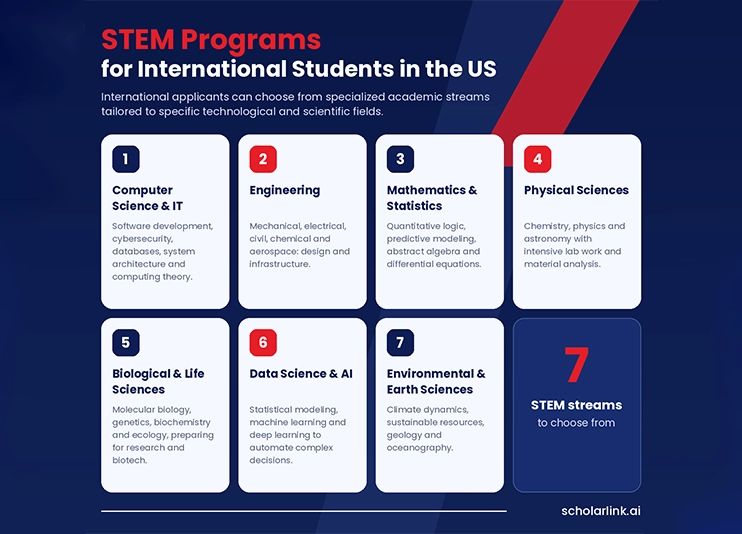
STEM Programs for International Students in the US
International applicants can choose from specialized academic streams tailored to specific technological and scientific fields.
Computer Science and Information Technology
Computer science and IT programs focus on software development, cybersecurity, database administration, system architecture, and theoretical computing principles. Students may gain experience in writing algorithms, building scalable systems, and managing network security.
Engineering
Engineering programs span classical and modern disciplines, including mechanical, electrical, civil, chemical, and aerospace engineering. These curricula emphasize problem-solving, structural design, thermodynamic systems, and real-world infrastructure development.
Mathematics and Statistics
Degrees in mathematics and statistics train students in quantitative logic, predictive modeling, abstract algebra, and differential equations. Graduates apply these analytical frameworks to technical research, finance, and data architecture.
Physical Sciences
Physical sciences explore the foundational laws of the natural world through chemistry, physics, and astronomy. Students engage in intensive laboratory work, fundamental research, and material analysis.
Biological and Life Sciences
Biological and life sciences focus on molecular biology, genetics, biochemistry, and ecological systems. These programs can prepare students for advanced research, biotechnology, and further study in health-related fields.
Data Science and Artificial Intelligence
Data science and AI curricula combine statistical modeling, machine learning, deep learning, and advanced algorithms to process massive datasets and automate complex decision-making systems.
Environmental and Earth Sciences
Environmental and earth sciences examine climate dynamics, sustainable resources, geology, and oceanography to develop solutions for urgent global ecological challenges.
US Universities Offering STEM Degrees
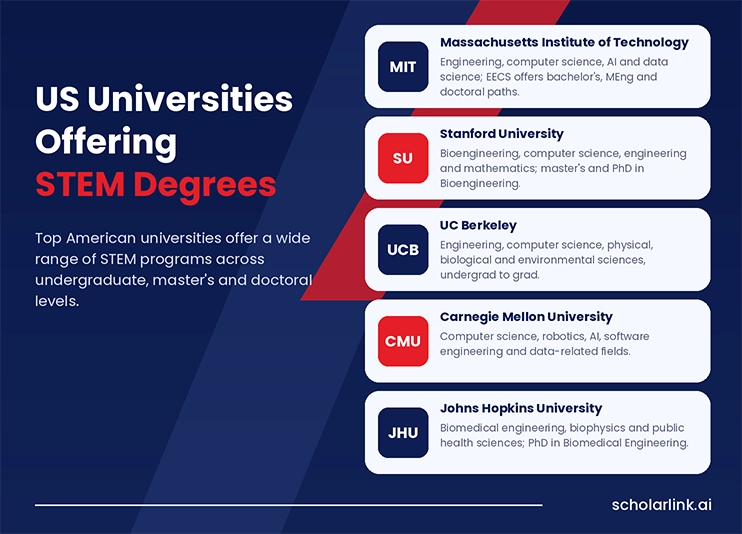
Top American universities offer a wide range of STEM programs across undergraduate, master’s, and doctoral levels.
Massachusetts Institute of Technology (MIT) offers STEM programs across fields such as engineering, computer science, artificial intelligence, and data science. Its Electrical Engineering and Computer Science department offers undergraduate and graduate degree pathways, including bachelor’s, MEng, and doctoral programs.
Stanford University offers STEM programs in areas including bioengineering, computer science, engineering, mathematics, and related scientific disciplines. Its Bioengineering department provides both master’s and PhD programs, with research spanning biology, medicine, engineering, and the physical sciences.
University of California, Berkeley offers STEM programs across engineering, computer science, physical sciences, biological sciences, and environmental fields at undergraduate and graduate levels.
Carnegie Mellon University is known for programs and research in areas such as computer science, robotics, artificial intelligence, software engineering, and data-related fields across undergraduate and graduate study.
Johns Hopkins University offers STEM programs in areas including biomedical engineering, biophysics, public health sciences, and related research fields. Its Biomedical Engineering department offers a PhD program with interdisciplinary research connecting engineering, science, and medicine.
STEM Programs in the US for International Students
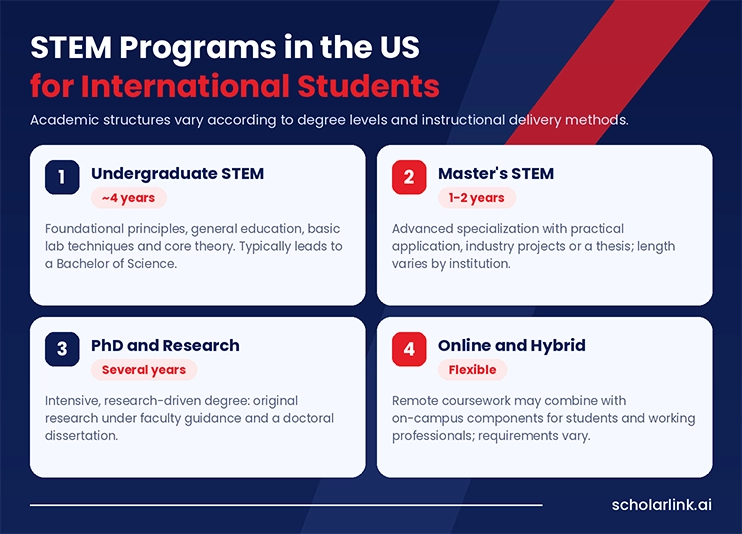
Academic structures vary according to degree levels and instructional delivery methods.
Undergraduate STEM Programs
Undergraduate degrees focus on foundational principles, general education requirements, basic lab techniques, and core theoretical knowledge. Many programs typically lead to a Bachelor of Science degree over approximately four years.
Master’s STEM Programs
Master’s degrees offer advanced specialization, typically over one to two years, although program length varies by institution and field. Students focus on practical application, specialized coursework, industry projects, or a master’s thesis, depending on the program.
PhD and Research Programs
PhD programs are intensive, research-driven degrees that can take several years to complete, depending on the field and institution. Candidates conduct original research under the guidance of faculty members and complete a doctoral dissertation.
Online and Hybrid STEM Programs
Flexible learning options may combine remote coursework with on-campus components, providing specialized technical education for students and working professionals. Program structure and in-person requirements vary by institution.
Admission Requirements for STEM Programs in the US
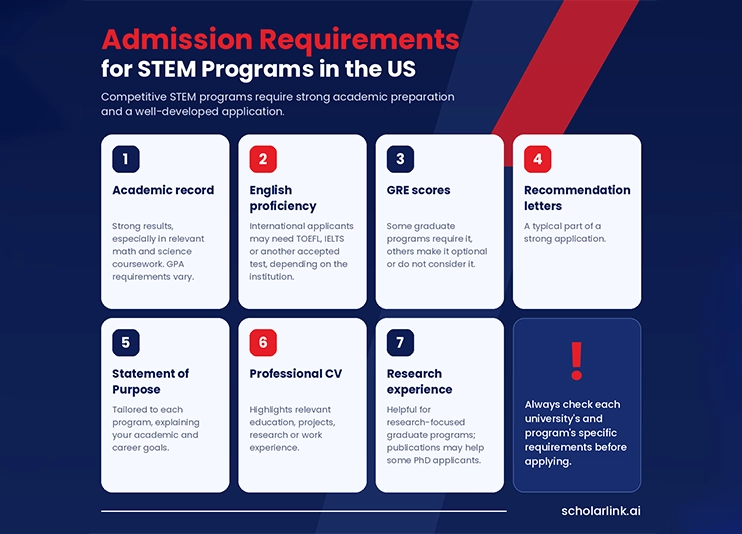
Gaining admission to competitive STEM programs requires strong academic preparation and a well-developed application. Applicants may need to demonstrate a solid academic record, particularly in relevant mathematics and science coursework, although GPA requirements vary by university and program. International applicants may also need to demonstrate English proficiency through an accepted language test, such as TOEFL or IELTS, depending on the institution. GRE requirements also vary, as some graduate programs require the exam while others make it optional or do not consider GRE scores.
A strong application typically includes letters of recommendation, a tailored Statement of Purpose explaining academic and career goals, and a professional CV highlighting relevant education, projects, research, or work experience. For research-focused graduate programs, prior research or laboratory experience can strengthen an application, while publications may be beneficial for some PhD programs but are not universally required. Applicants should review the specific admission requirements of each university and program before applying.
Cost of Studying STEM in the United States
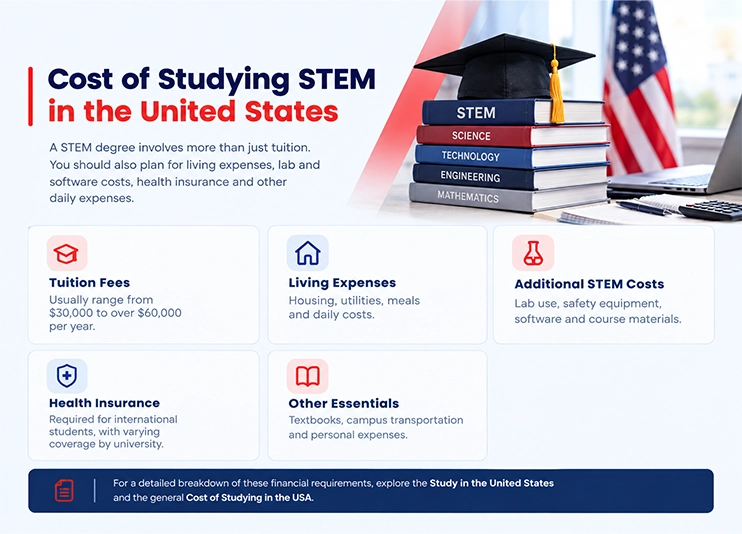
Financing a STEM degree involves planning for multiple expense categories. Tuition rates vary significantly between public and private institutions, often ranging from $30,000 to over $60,000 annually. Beyond tuition, students should budget for living expenses, including housing, utilities, and meals. STEM students may also incur additional costs for specialized laboratory use, safety equipment, software licenses, and course materials. Health insurance is another important expense for international students, with coverage requirements varying by university and location. Students should also account for textbooks, campus transportation, and personal expenses when estimating their total cost of study. Detailed breakdowns of these financial requirements are explored in dedicated resources on Study in the United States and the general Cost of Studying in the USA.
Scholarships and Funding for STEM Students
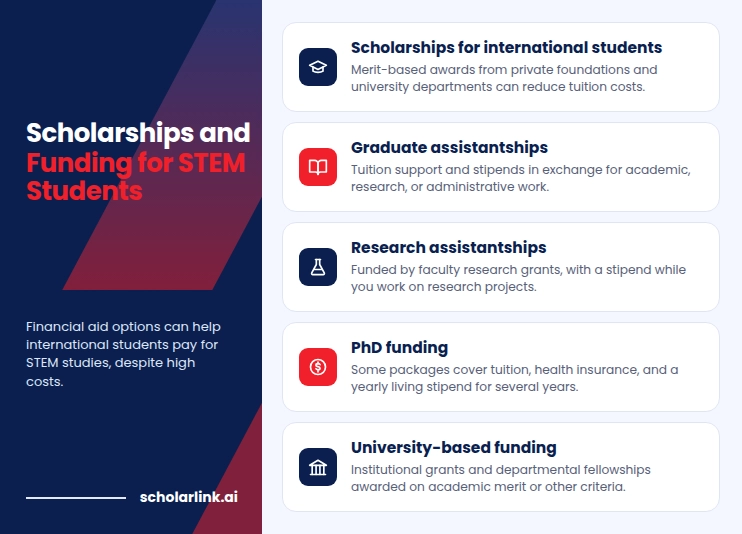
Despite high costs, various financial aid mechanisms can help international students fund STEM studies.
Scholarships for International STEM Students
Merit-based scholarships offered by private foundations and university departments can help reduce tuition costs for qualified international candidates.
Graduate Assistantships
Graduate assistantships may offer tuition support and stipends in exchange for academic, research, or administrative responsibilities, depending on the university and program.
Research Assistantships
Research Assistantships (RAs) may provide funding through faculty research grants, allowing students to contribute to funded research projects while receiving a stipend or other financial support.
PhD Funding
Some PhD programs offer comprehensive funding packages that may cover tuition, health insurance, and an annual living stipend for several years. Funding availability and coverage vary by university, department, and field of study.
University-Based Funding
Institutional grants and departmental fellowships may be awarded based on academic merit or other eligibility criteria. Applicants seeking research funding should learn how to draft an effective Email to Professor for Researc
Opportunities for STEM Students in the United States
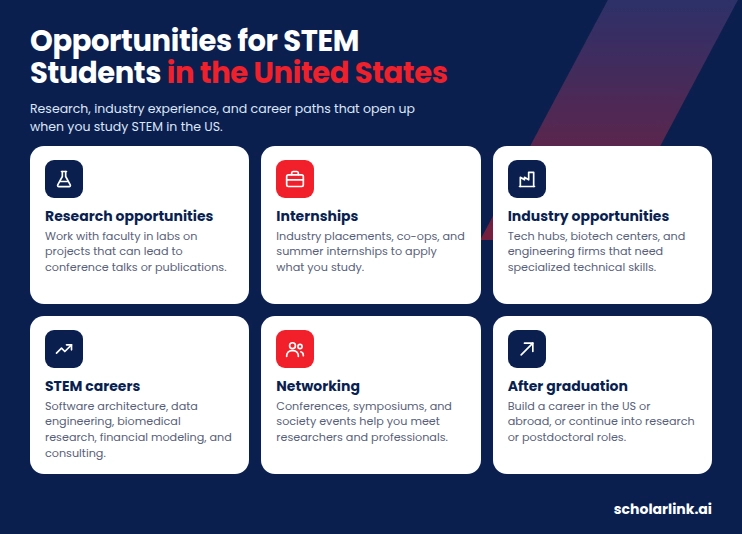
Enrolling in STEM programs in the United States can provide students with access to diverse academic and professional opportunities.
Research Opportunities
Students may work alongside faculty members and researchers in laboratory and research environments, contributing to projects that can lead to conference presentations or publications, depending on their role and contribution.
Internships
Some degree programs provide access to industry placements, co-op experiences, and summer internships that allow students to apply academic knowledge in professional settings.
Industry Opportunities
The STEM students can access opportunities in technology hubs, biotechnology centers, engineering companies, and other industries that require specialized technical skills.
STEM Careers
STEM graduates can pursue technical roles in areas such as software development and architecture, data engineering, biomedical research, financial modeling, and scientific consulting, depending on their qualifications and specialization.
Networking and Academic Opportunities
Attending scientific conferences, symposiums, and professional society events can help students connect with researchers, academics, and professionals in their fields.
Post-Graduation Opportunities
Graduates can pursue careers in the United States or internationally, continue into advanced research or postdoctoral positions, or explore
STEM Designated Degree Programs and OPT
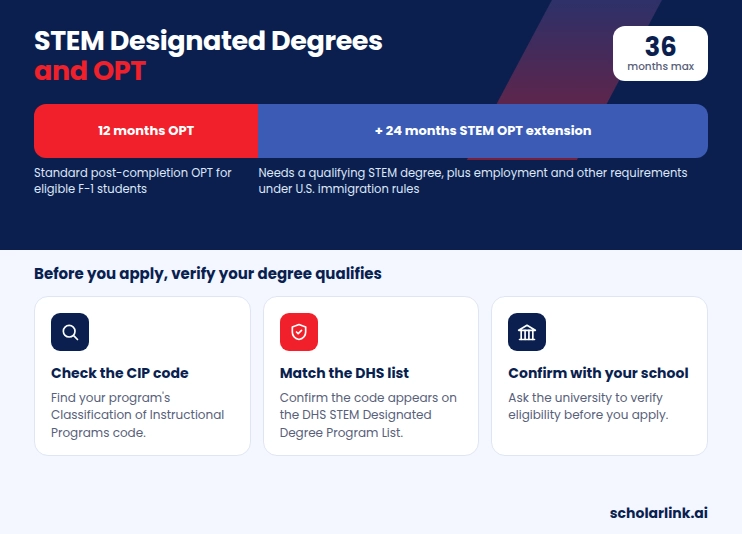
A STEM-designated degree is an academic degree that qualifies as a STEM field under the U.S. Department of Homeland Security (DHS) STEM Designated Degree Program List. Prospective students should verify whether their specific degree qualifies by checking its Classification of Instructional Programs (CIP) code and confirming its eligibility through official university and DHS resources before applying.
Eligible F-1 students may receive up to twelve months of standard post-completion Optional Practical Training (OPT). Students who meet the eligibility requirements for the STEM OPT extension and have a qualifying STEM degree may apply for an additional twenty-four months of STEM OPT, allowing up to thirty-six months of practical training in total. Eligibility depends on factors including the qualifying degree, employment, and other requirements established by U.S. immigration regulations.
Best STEM Fields to Study in the US
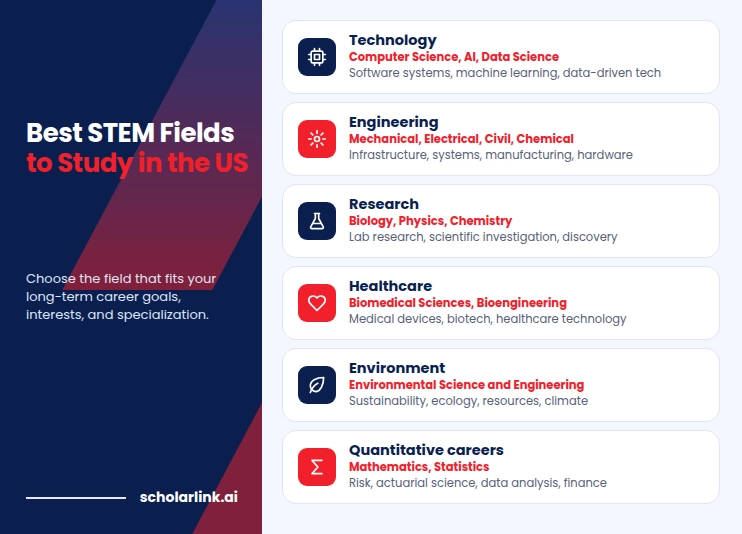
The right STEM field depends on your long-term career goals, academic interests, and preferred area of specialization. The following fields align with different academic and professional interests:
- Technology Goal: Computer Science, Artificial Intelligence, and Data Science can lead to study and career opportunities in software systems, machine learning, and data-driven technologies.
- Engineering Goal: Mechanical, Electrical, Civil, and Chemical Engineering provide training in areas such as infrastructure, engineering systems, manufacturing, and hardware development.
- Research Goal: Biology, Physics, and Chemistry provide a foundation for laboratory research, scientific investigation, and fundamental discovery.
- Healthcare Goal: Biomedical Sciences and Bioengineering connect life science research with areas such as medical devices, biotechnology, and healthcare technologies.
- Environment Goal: Environmental Science and Engineering focus on sustainability, ecology, natural resources, and climate-related challenges.
- Quantitative Careers Goal: Mathematics and Statistics provide analytical foundations for fields such as risk management, actuarial science, data analysis, and quantitative finance.
STEM vs. Non-STEM Degrees in the US
Understanding the key differences between STEM and non-STEM programs can help international students evaluate their academic options.
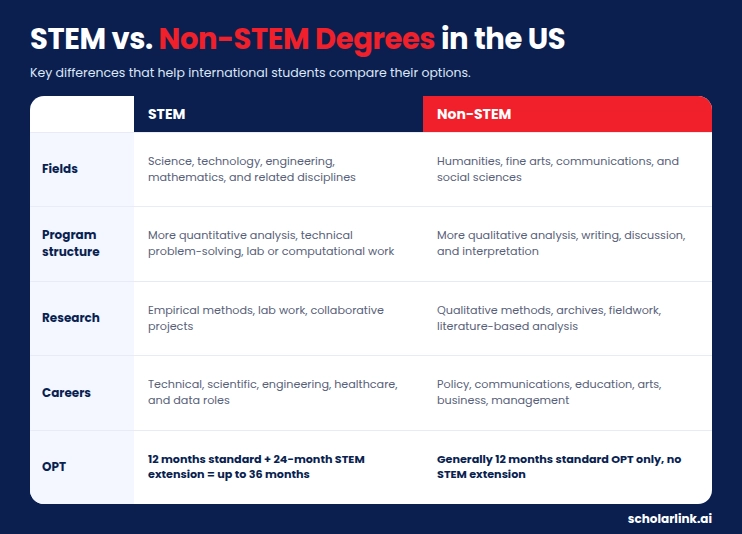
- Academic Fields: STEM includes fields such as science, technology, engineering, mathematics, and related disciplines, while non-STEM programs include areas such as humanities, fine arts, communications, and social sciences.
- Program Structure: STEM programs typically place greater emphasis on quantitative analysis, technical problem-solving, laboratory work, or computational methods, depending on the field. Non-STEM programs may place greater emphasis on qualitative analysis, writing, discussion, interpretation, or other field-specific methods.
- Research Opportunities: STEM research often involves empirical methods, quantitative analysis, laboratory work, or collaborative research projects. Non-STEM research may involve qualitative methods, archival research, fieldwork, or literature-based analysis, depending on the discipline.
- Career Pathways: STEM degrees can prepare students for technical, scientific, engineering, healthcare, and data-related careers, depending on their specialization. Non-STEM degrees can support career paths in areas such as policy, communications, education, arts, business, and management.
- International Considerations: Eligible F-1 students with qualifying STEM degrees may apply for a 24-month STEM OPT extension after completing the standard 12-month post-completion OPT period, allowing up to 36 months of OPT in total. Non-STEM degrees generally do not qualify for the STEM OPT extension and may provide access to the standard 12-month OPT period, subject to eligibility requirements.
How to Choose a STEM Program in the US
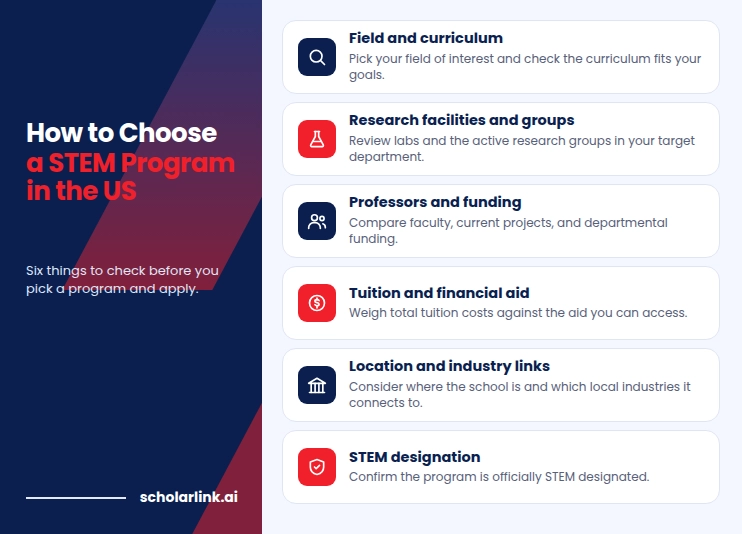
Selecting the right STEM program starts with identifying your field of interest and reviewing program curricula to ensure they align with your academic and career goals. Students should also evaluate university research facilities and examine the active research groups within their target department. For ScholarLink users, comparing professors, their current research projects, and available departmental funding can help identify programs that align with their research interests and financial needs. Other factors to consider include total tuition costs, available financial aid, geographic location, local industry connections, and the program’s official STEM designation status.
Is Studying STEM in the US Worth It for International Students?
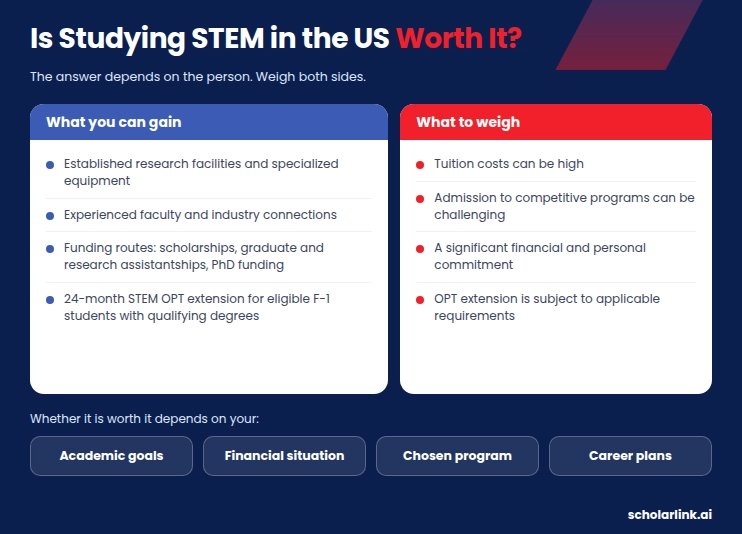
Pursuing a STEM degree in the United States represents a significant financial and personal commitment. US universities offer access to established research facilities, specialized equipment, experienced faculty, and connections with industries across a range of technical fields. While tuition costs can be high and admission to competitive programs may be challenging, international students can explore funding opportunities such as scholarships, graduate assistantships, research assistantships, and PhD funding. Eligible F-1 students with qualifying STEM degrees may also be able to apply for the 24-month STEM OPT extension after completing the standard 12-month OPT period, subject to applicable requirements. The value of studying STEM in the US ultimately depends on factors such as the student’s academic goals, financial situation, chosen program, and long-term career plans.
Frequently Asked Questions
What are the most popular STEM programs in the US?
Common STEM programs include Computer Science, Data Science, Electrical Engineering, Mechanical Engineering, and Biomedical Sciences. Program availability and demand vary by university, field, and labor market.
Can international students study STEM in the United States?
Yes. International students can apply to undergraduate, master’s, and doctoral STEM programs at accredited US universities, subject to the admission requirements of the university and applicable student visa requirements.
Which US universities offer STEM degrees?
Many US universities offer STEM degrees across undergraduate and graduate levels, including institutions such as MIT, Stanford University, UC Berkeley, Carnegie Mellon University, and Johns Hopkins University.
What are the requirements for international STEM students?
Requirements vary by university and program but may include academic transcripts, proof of English language proficiency, letters of recommendation, a Statement of Purpose, a professional CV, and standardized test scores such as the GRE where required.
How much does it cost to study STEM in the US?
Total annual costs can range from approximately $40,000 to $80,000, including tuition, housing, health insurance, and other education and living expenses. Actual costs vary by university, program, and location, while scholarships and other funding options may reduce the amount students need to pay.
Are STEM programs eligible for OPT benefits?
Eligible F-1 students who complete a qualifying STEM degree may apply for a 24-month STEM OPT extension after the standard 12-month post-completion OPT period, allowing up to 36 months of OPT in total, subject to applicable eligibility requirements.
Can international students get scholarships for STEM programs?
Yes. International students may be eligible for merit-based scholarships, graduate assistantships, research assistantships, departmental funding, and, in some cases, fully funded PhD programs or fellowships.
What are the best STEM fields for international students?
Common options include Computer Science, Data Science, Artificial Intellig

ScholarLink AI
Your Ultimate Admission Co-Pilot
- 🎓 Professors Database: World’s largest supervisor directory
- 📡 Live Positions: Real-time faculty openings & vacancies
- 👥 Students Database: Connect with successful applicants
- 🎯 Smart Matching: AI-driven professor recommendation
- 💰 Funding Analysis: Real-time lab & research funding data
- 📝 Apply Management: Track applications & cold emails